


惯性聚合 高效追踪和阅读你感兴趣的博客、新闻、科技资讯
阅读原文 在惯性聚合中打开

推荐订阅源

P
Privacy International News Feed
Hacker News - Newest:
Hacker News - Newest: "LLM"
Application and Cybersecurity Blog
N
News and Events Feed by Topic
Hacker News: Ask HN
Hacker News: Ask HN
V2EX - 技术
V2EX - 技术
L
LINUX DO - 最新话题
Google Online Security Blog
www.infosecurity-magazine.com
Exploit-DB.com RSS Feed
Stack Overflow Blog
Stack Overflow Blog
Recent Commits to openclaw:main
P
Proofpoint News Feed
A
Arctic Wolf
Forbes - Security
Forbes - Security
Spread Privacy
Spread Privacy
Security Latest
Security Latest
C
CXSECURITY Database RSS Feed - CXSecurity.com
C
CERT Recently Published Vulnerability Notes
Latest news
Latest news
AWS News Blog
AWS News Blog
M
MIT News - Artificial intelligence
GbyAI
GbyAI
V
Visual Studio Blog
T
The Blog of Author Tim Ferriss
有赞技术团队
有赞技术团队
Help Net Security
Help Net Security
博客园 - Franky
Cyber Security Advisories - MS-ISAC
S
Schneier on Security
S
SegmentFault 最新的问题
Microsoft Security Blog
Y
Y Combinator Blog
PCI Perspectives
PCI Perspectives
让小产品的独立变现更简单 - ezindie.com
博客园_首页
钛媒体:引领未来商业与生活新知
钛媒体:引领未来商业与生活新知
P
Palo Alto Networks Blog
SecWiki News
SecWiki News
TaoSecurity Blog
TaoSecurity Blog
Threat Intelligence Blog | Flashpoint
K
Kaspersky official blog
G
Google Developers Blog
H
Hacker News: Front Page
T
Tailwind CSS Blog
aimingoo的专栏
aimingoo的专栏
博客园 - 叶小钗
T
Troy Hunt's Blog
F
Full Disclosure
T
Threat Research - Cisco Blogs

CloudCannon Blog

Building with AI: Git-based vs headless vs traditional CMS CloudCannon + Astro: performance meets powerful content management Introducing the Astro Component Starter Introducing Jetstream — built on the Astro Component Starter Why we switched to the system font stack Redesigning CloudCannon’s docs with Diátaxis, Lume, and Pagefind Make content editing more visual: upgraded Editable Regions How Configuration Mode makes building editing interfaces easy Your hosting just got an upgrade (and a price cut) Custom testing domains for professional branding Keep your content consistent with input validation Managing multilingual content in CloudCannon Simplify team publishing with conflict resolution and domain tools Open Beta: Publishing Conflict Resolution Getting started with CloudCannon and Astro: Bookshop, components, and live editing Welcome to the CloudCannon Community! Getting started with CloudCannon and Astro: Snippets and Collections Managing digital assets in CloudCannon: a guide to smart asset storage Understanding CloudCannon's branching workflows and Projects: a complete guide What is a static website? CloudCannon’s 2024 wrapped Getting started with CloudCannon and Astro: WYSIWYG blogging Jamstack vs. WordPress: reasons to make the change The top five static site generators for 2025 (and when to use them!) Free Jekyll themes for 2025: ten great community options Eleventy (11ty) vs. Hugo How to set up WYSIWYG editing with MkDocs Material The rise of static-first websites: why major brands are making the switch Watching your Core Web Vitals on Jamstack Understanding the difference between static, dynamic, and hybrid websites Looking for an alternative to Netlify CMS or Decap CMS? Designing components for your website editors: a CloudCannon case study Does my website look big in this? Six tips to lower your page weight Content is sacred — so own your revision history The eternal balancing act: load time vs. delay time Streamlined Headless Mode, Unified Configuration, and live data editing What is a headless CMS? Looking for a TinaCMS or Tina Cloud alternative? The ultimate guide to Hugo Sections Coming soon: Live config editing and data reloading Faster publishing workflows out now! Why information architecture matters for your website Website UX vs SEO: picking your battles Easily manage your multilingual Astro site in CloudCannon How you can optimize publishing workflows for your content team How you can optimize your CMS for SEO success How you can optimize your Content Editor for long-form articles How you can optimize your Visual Editor for page building Secure, swift, and stable: static sites for the financial sector Enhanced flexibility for teams with Custom Permissions Building static sites that scale The Inaugural 11ty International Symposium on Making Web Sites Real Good How to manage hundreds of connected websites with a Git-based headless CMS How we’re building CloudCannon for accessibility CloudCannon’s new editing improvements are here! Open Beta | New ways to collaborate on editing your websites Top 11 free Eleventy themes for 2024 Top 10 free Astro themes to use in 2024 Why choose a Git-based headless CMS over a monolithic DXP in 2024? Learning web development: a self-guided roadmap Partner Site of the Month: Blüthner Piano Centre, by Winteractive CloudCannon’s 2023 wrapup Let’s create a microblog with visual editing using Bookshop and Eleventy Update and visualize your branches with CloudCannon Projects What is a Git-based CMS and why you should use one CloudCannon secures SOC 2 certification The complete guide to growing your web development agency Automatically optimize your images with Eleventy Image and CloudCannon Share components and syndicate content with Site Mounting Partner Site of the Month: Cru Uncorked, by Ed Meehan New web component for responsive HTML tables Wrapping up HugoConf 2023 Partner Site of the Month: Van Dillen Antieke Bouwmaterialen, by Fulldev How to become a freelance web developer: a comprehensive guide Q3 2023: CloudCannon features and improvements 22 ways to deliver more value to your web development clients Partner Site of the Month: DC Gay Flag Football League, by Ed Cupaioli A new way to configure your CloudCannon sites CloudCannon — the official CMS partner of Eleventy Full CloudCannon support for Nuxt static sites Partner Site of the Month: Stadium Bike, by Insight Creative, Inc. HugoConf 2023, brought to you by CloudCannon DAM Support for Cloudflare R2 and DigitalOcean Spaces Eleventy (11ty) vs. Gatsby in 2023 – which SSG is best for you? How CloudCannon’s live editing works with Astro and Bookshop Partner Site of the Month: Fiducian, by Croissant & Baguette Eleventy (11ty) vs. Astro How to customize CloudCannon’s Client Sharing interface Let anyone, anywhere, edit your CloudCannon sites Top 23 free Astro themes for building out-of-this-world static sites in 2023 How Jampack optimizes our Eleventy website and improves performance Astro vs. Next.js CloudCannon.com is now built with Eleventy! Out-of-this-world support for all Astro users Introducing the CloudCannon Partner Program Full CloudCannon support for Gatsby Top 10 Free SvelteKit Themes for Building Lighting-Fast Static Sites in 2023 Enhanced CloudCannon support for Next.js users Upcoming CloudCannon Interface improvements (Open Beta) Creating sites, the Jamstack way
Omnichannel delivery is just marketing spin from API-based CMS companies
2025-02-25 · via CloudCannon Blog

API-based headless CMS solutions promised to revolutionize content management, but they've only replaced one form of complexity with another, fundamentally flawed one.

For much of the internet's history, content management systems (CMS) have been tightly coupled with the presentation layer — the part of the system that renders and serves websites. While functional, this setup introduced many challenges: increased security risks, difficulties in scaling, and limited portability for both code and content. Why? Because these systems rely on a database to store content, which the CMS and presentation layer both access.

When it’s time to make a change to the site, editors and developers save their changes to the database, and the database makes changes to the website.
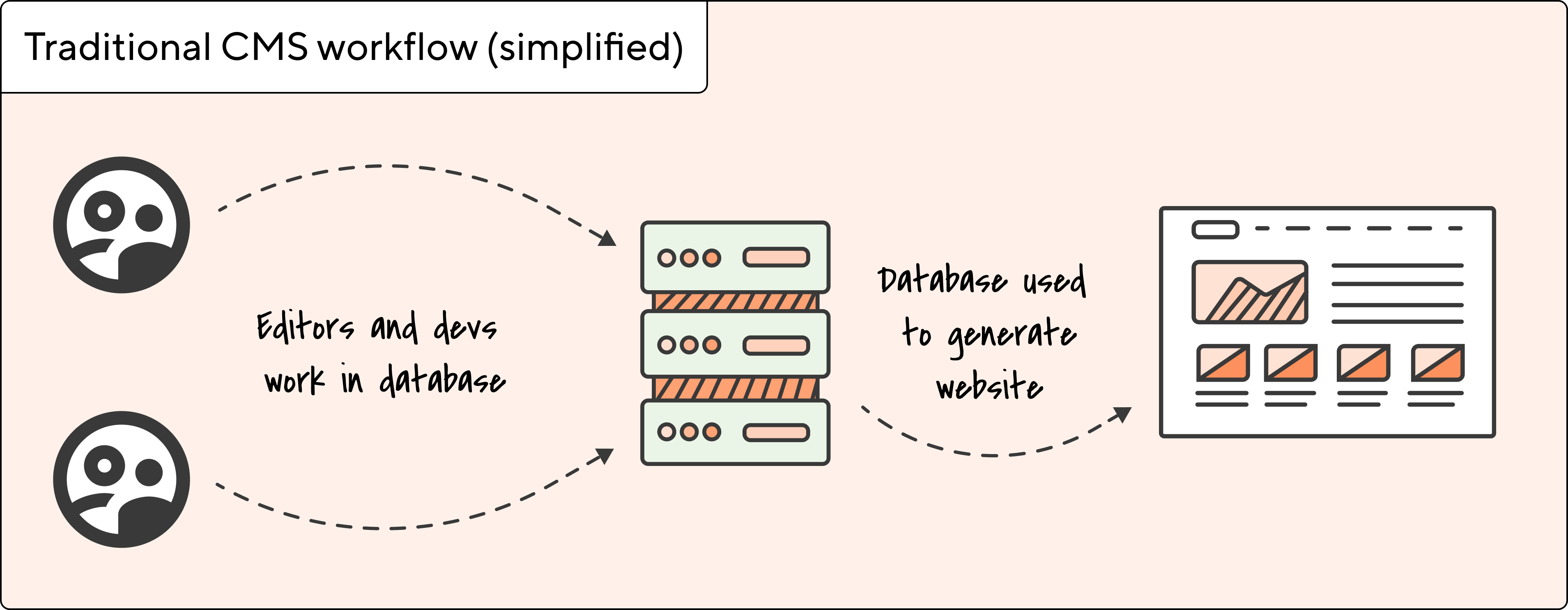
Diagram of a workflow in a traditional CMS

To address some of these challenges, many CMS providers began moving away from traditional coupled architecture, embracing a 'headless' approach.

This architectural shift has proven to be more of an incremental shuffle than a true leap forward.

The API-based approach: a half-step forward Direct link to this section

Most headless CMS providers adopt an API-based model, which partially addresses the issues of traditional systems. Instead of a direct database connection to the presentation layer, the CMS is relocated to a separate system that the website accesses via APIs. This helped solve some of the complications that legacy systems encountered, like security and scaling. But it firmly separated the roles and workflows of developers and content editors.
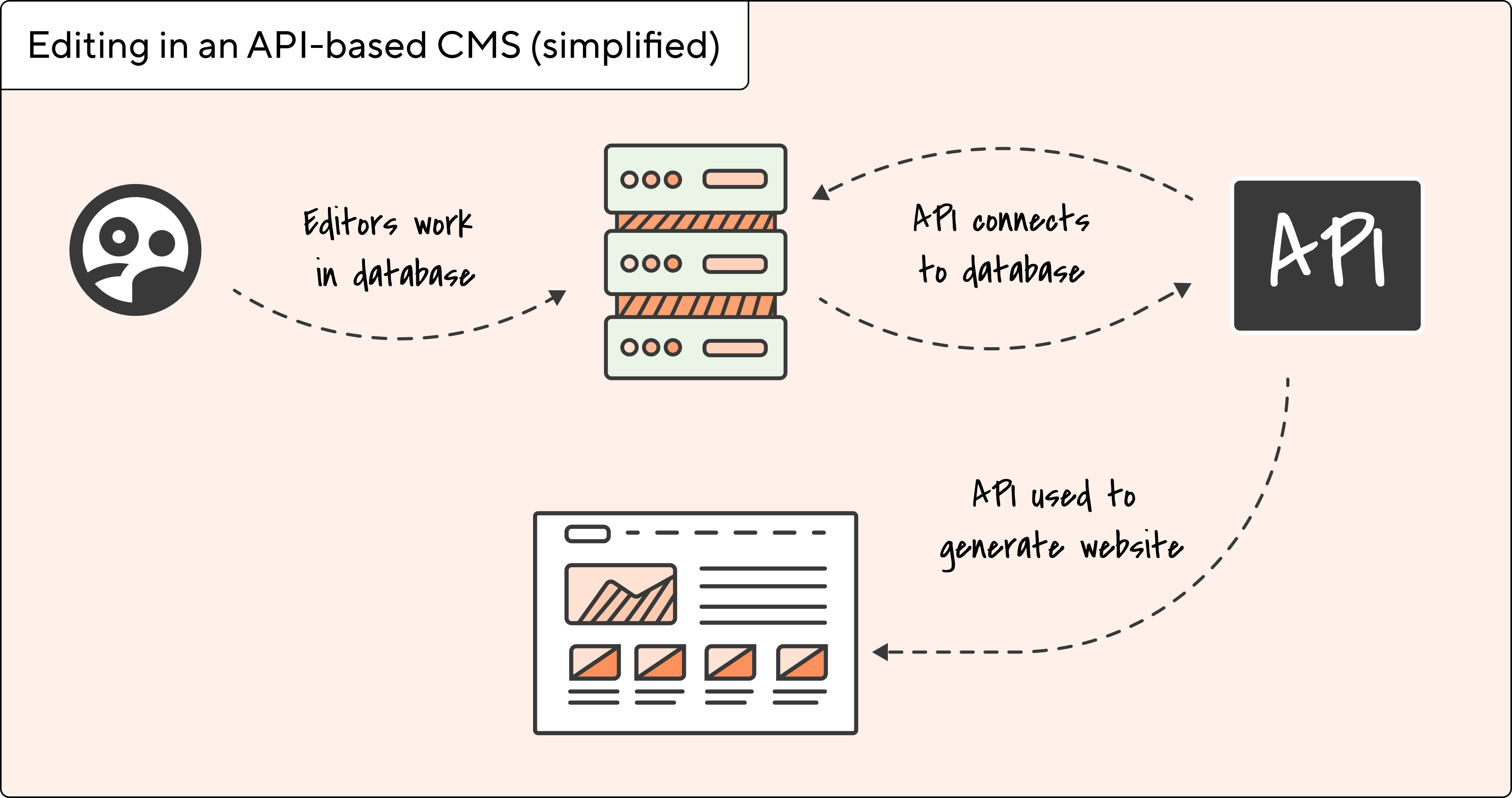
Diagram showing editing in an API-based CMS

API-based CMS providers often tout “omnichannel delivery” as one of their key advantages, promoting the idea that they help serve content across multiple platforms. Realistically, few companies need the exact same text or assets to be displayed on their website and their billboard at the same time. And while the potential to do so might initially sound appealing, it can add unnecessary complexity.

A much more common use case for omnichannel delivery, for example, wanting to replicate shared content like news articles across various locations on a website, is a solved problem, and still doesn’t justify the complexity introduced by API-based systems.

Put simply, any API you choose to use should follow your content, rather than deriving content itself via a database.

Added complexity = added problems Direct link to this section

By separating content management from content delivery through APIs, these CMS providers promised to solve the fundamental problems of traditional CMS platforms. But adding complexity to a problem isn’t always a solution. In fact, decoupling content from code in this way comes with significant drawbacks.

Tracking changes to both code and content would now require two separate version histories, which introduces alignment and coordination problems. Developers using an API-based CMS and Git to track their code changes would not be able to move freely between their code’s multiple branches without considering which version of the content API should be connected to each branch. Meanwhile, the content remains stored in a vendor-locked database, which is itself a new point of potential failure.
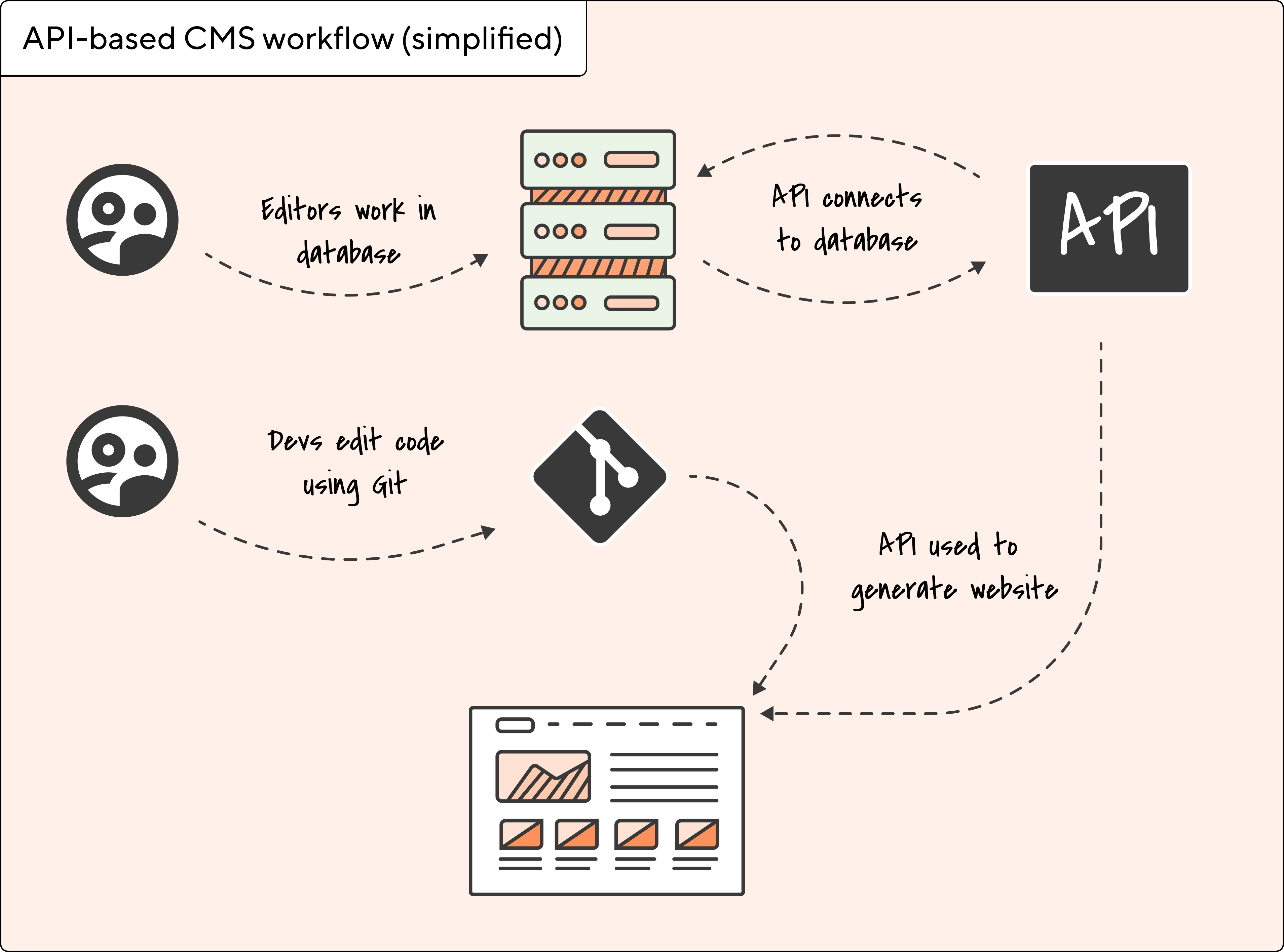
Diagram showing editing and development workflows in an API-based CMS

If your content and code histories are disconnected, you can’t easily track changes or roll back your site to a specific point in time. This creates huge challenges for building and editing multiple environments, auditing content changes, and ensuring consistency across versions of a website.

By contrast, if you give both your content and your code a core home (a single place to store and edit them before they are ‘built’ as a website), you can deal with just one unified version history. Which is where Git comes into its own!

The Git-based CMS: a developer-friendly alternative Direct link to this section

Git has revolutionized how developers share and collaborate on code, both privately and publicly. It’s a system that works — so why not use it for content as well? By storing content alongside code in Git, we can eliminate the need for a separate database and solve many of the problems inherent in both traditional and API-based CMS solutions.

This approach retains the decoupling of content and presentation, meeting the requirements of a headless CMS, but with a crucial advantage: content and code truly coexist in a compatible format. No more struggling to synchronize the two. If omnichannel delivery is truly necessary, existing Git workflows make it straightforward to share code — and content — across projects. (A tool like Flatlake, for example, means that you can still use an API on Git-based content.)
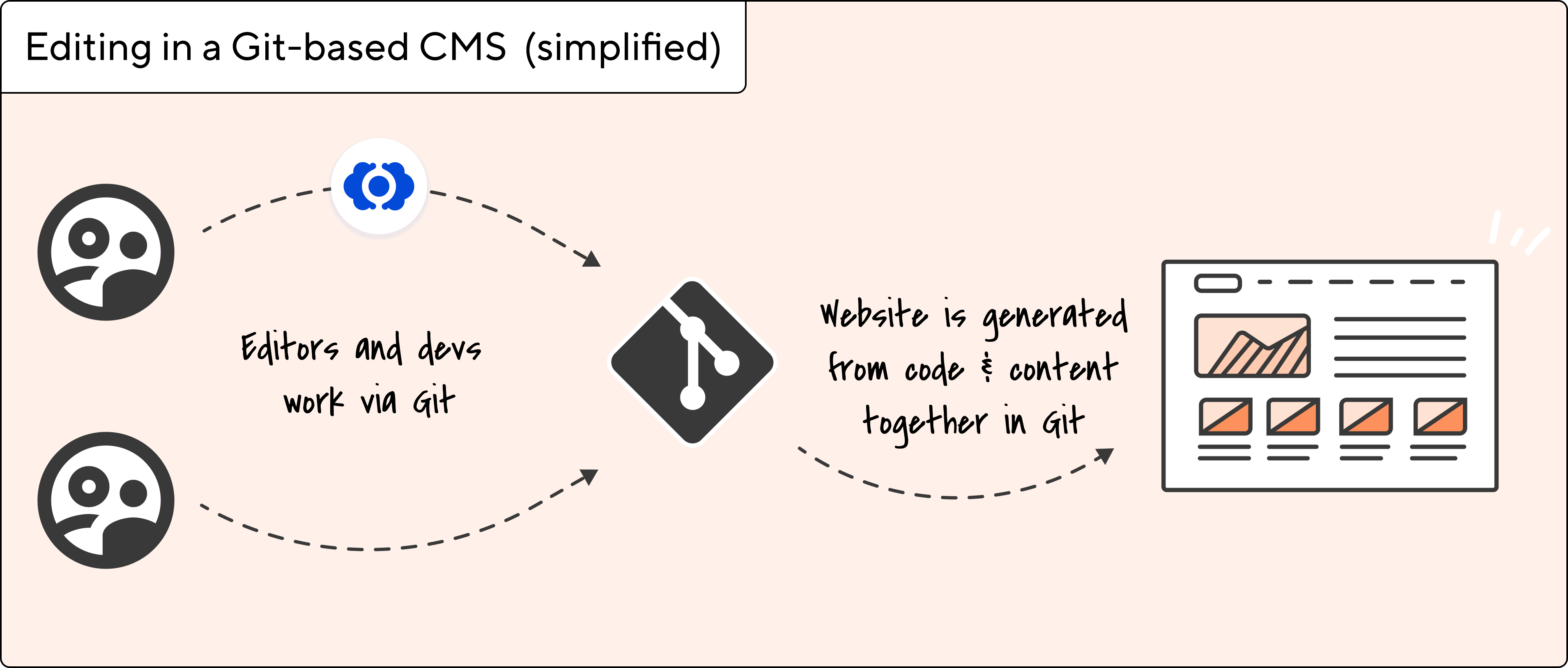
Diagram showing editing and development workflows in a Git-based CMS

Another major benefit is ownership. Unlike API-based CMS providers, who might impose tricky contractual terms on your content, a Git-based approach ensures your content remains entirely yours. You’re free to build custom tooling, create bespoke workflows, and truly own your data.

Empowering non-developers without compromise Direct link to this section

One remaining challenge is accessibility for non-developers. Website teams are often comprised of users with a range of specialities: writers, designers, editors, and developers.

To bridge the gap between developers and everyone else, a Git-based system must provide an intuitive interface where non-technical users can collaborate effectively. This interface should enable user-friendly edits without requiring knowledge of the underlying code. Creating and iterating on the user interface — effectively interpreting the massive power of Git for all users — has been a huge focus for us at CloudCannon, and it’s something we’ll continue to champion for our users.

By combining content and code in Git on CloudCannon, developers can leverage their local workflows to offer live previews, instant updates, and tailored solutions. Non-developers can contribute commits and pull requests through a familiar UI (without having to deeply understand Git concepts), making them part of the collaborative process that has long been a cornerstone of modern software development.

With Git-based content management, we’re not just building a better CMS. We’re creating a system that empowers entire teams to collaborate, innovate, and truly own their digital assets.