


“The aim is not to keep everything exactly as it was before gen AI took off. That would be both impossible and undesirable. The aim is to preserve the parts of philosophical education that are still worth preserving while changing the surrounding infrastructure enough to make that possible.”
That’s David Bourget, a philosophy professor at Western University and executive director of the PhilPapers Foundation, who has created a new tool to help professors—not just philosophy professors, but anyone who teaches by having students write—struggling with the prospect of their students using ChatGPT, Grammarly, and other AI tools to cheat on their assignments.
The tool, currently in beta testing, is called MATCHA (Modern Authoring Tool for Certified Human Authorship). You can try it out here. But before you do, you should read Professor Bourget’s post about it, below, where he describes its purpose, features, and limitations.
MATCHA: A New Tool for Curbing AI Cheating
by David Bourget
Over the past year or so, I’ve been working on a software project whose aim is to make cheating hard again. The result is an app called MATCHA, which stands for Modern Authoring Tool for Certified Human Authorship. In this post, I will explain how MATCHA differs from alternative ways of managing AI plagiarism, how it works, and what it can do beyond preventing AI plagiarism.
Current responses to AI plagiarism seem to fall into three main categories: detecting, scaffolding, and abandoning essay assignments. Detecting worked to some extent for a time, but it now seems both fraught and ineffective. Even analyzing detailed edit histories is largely ineffective on its own, because students can simply hand-transcribe AI-generated essays, giving them plausible deniability. Scaffolding an assignment into multiple steps does not solve the problem either, because ChatGPT can complete the individual steps just as easily as it can produce a finished essay. Abandoning essay assignments does get rid of plagiarism, but at the cost of abandoning a traditional pillar of liberal arts education.
There are two different approaches that MATCHA makes possible. The first is aimed at ordinary home assignments. The second is aimed at supervised writing labs. Both approaches are forms of prevention rather than detection. The goal is not to guess, after the fact, whether a text was produced by AI. The goal is to structure the writing process so that using AI is no longer the path of least resistance.
Start with home assignments, which is the case many of us care most about. MATCHA’s approach here has three key ingredients.
The first ingredient is the production of a detailed record of all work done within MATCHA—not just the editing history, as many Google Docs plug-ins and other tools provide, but a broader proof of work that includes browsing and reading activity, which takes place within MATCHA’s built-in, whitelist-controlled browser (MATCHA only monitors browsing within its own browser). When a student submits a project, the instructor receives a summary of how much of each cited or otherwise relevant work the student has read, along with the more standard editing-history statistics. In cases of doubt, the reading and writing process can be replayed. One available graphical summary of reading looks like this (it’s possible to view stats about specific works by clicking the slices):
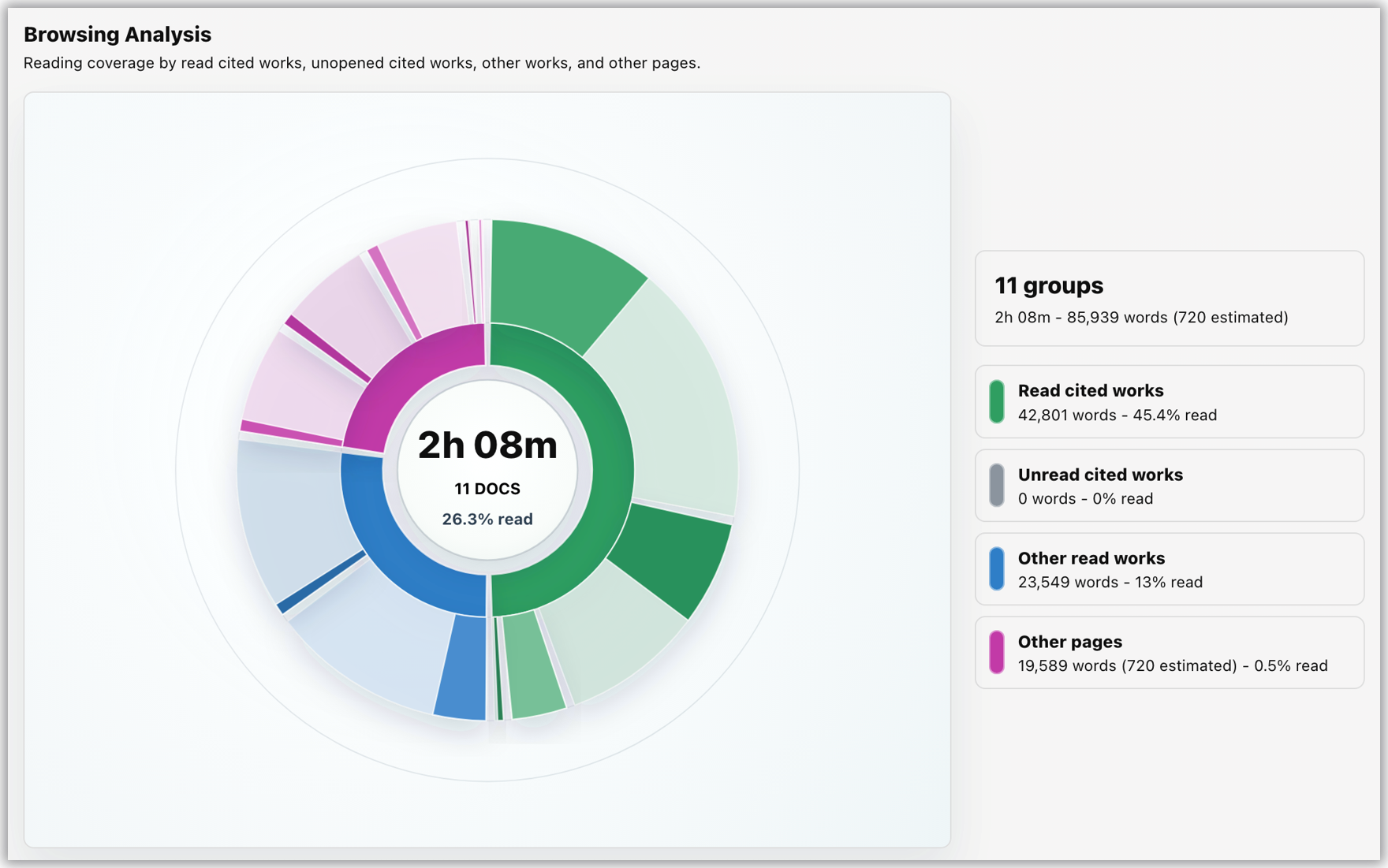
This is not meant to be magic. A proof of work is not a proof of the entire inner process within a student’s mind. Students can think offline. They can read printed books. They can have conversations. Etc. But a plausible record of reading, drafting, revising, and engaging with sources is still evidence of something. And the absence of such a record can also be evidence of something, especially when producing the record was part of the assignment.
The second part is in-person authorship-assessment quizzes. The idea is simple. If a student really wrote the paper, they should usually be able to answer questions about it: why they made certain choices, what a cited author argues, how one part of the paper connects to another, what they would say in response to an obvious objection, and so on. MATCHA can help generate student-specific questions and provide an initial assessment of the answers, so that this does not create an unreasonable amount of extra work for instructors. But the instructor remains in control. The generated questions should be reviewed, and the final judgment should be the instructor’s.
The third ingredient is to make these things matter. Students need to know that they are expected to submit a plausible proof of work and to be able to answer questions about their own papers. This can be done in different ways, but the basic idea is to tie part of the grade to the writing record, the reading record, and the follow-up quiz.
Even when put together, these measures do not make AI cheating impossible. Nothing does. What they do is make successful AI cheating significantly harder. In many cases, it may become about as hard as doing the work properly. That is a large improvement over the current situation.
The second approach made possible by MATCHA is the supervised writing lab. I find this approach especially promising, though it requires more institutional coordination. MATCHA can block AI tools, other apps, and automation on students’ computers. If someone can supervise the writing to prevent other devices from being used, AI plagiarism can be prevented to roughly the same extent as other forms of cheating in a supervised writing environment. This gives us an alternative to the usual forced choice: we do not have to choose between ordinary take-home essays, where AI use may be very hard to control, and in-class essay exams, where students have too little time to do long-form work. A supervised writing lab allows students to write over time, but in a controlled environment. MATCHA supports this with a check-in/check-out system that allows supervisors to enable writing when students are in the space and block it when they leave.
There are obvious logistical challenges. Someone has to provide the space. Someone has to supervise it. At Western, we are fortunate to have some available rooms and TA hours that can be used for this purpose. A key point, though, is that the supervision need not be especially heavy-handed. In many cases, a TA can supervise a lab while doing other work, such as grading. This means that some regular TA hours can contribute to lab supervision.
MATCHA can also be used for other in-person activities. Its Single-App Mode blocks all other apps, not just AI tools, which makes it suitable for writing exams. It can also be used for in-class note-taking. If students take notes in MATCHA, this eliminates the usual laptop distractions without having to ban laptops altogether. Since MATCHA creates a centralized attendance record for each activity, instructors can also use it to assign participation credit.
I should say that MATCHA isn’t about avoiding AI entirely. The app has its own built-in AI assistant, which can help with writing and (soon) research. Crucially, however, instructors control the level of help available (for example, “grammar only”). All the work done by the assistant is tracked and labeled. The assistant also has a pedagogical mode, which makes it turn errors into practice exercises: instead of correcting every error, it highlights passages that need revision and provides hints, giving positive or negative feedback as the student tries to improve the text.
I should be explicit about the status of the project. MATCHA is not just a pedagogical proposal or a research prototype. It is software intended for real use, and it will eventually be a paid product, since operating and maintaining it involves real costs. At the moment, it is still in beta testing. Instructors who are interested in trying it with their students can request access, and beta users will not be charged for their first year of use. The beta period is partly for improving the app and partly for learning how it works in different teaching contexts.
Even if you are not teaching or don’t need something like this for your courses, you might want to check out MATCHA as a word processor. I gave it many features that I wanted in a word processor, such as the ability to insert citations directly from in-app PhilPapers searches, or interoperability with both LaTeX and Word. These and other features (live collaboration, automatic proxy browsing, etc.) can make the lives of academics much easier. All the anti-AI-cheating features can be turned off when MATCHA is used outside educational settings, so they don’t get in the way (but it might soon be valuable for some of us to be able to point at a MATCHA proof of work).
Postscript
When I talk about this project with a large enough group, someone usually raises a version of the following worry: isn’t this just conservatism? Why try to preserve old writing assignments? Why not adapt to AI in the same way that math instruction adapted to calculators?
The calculator analogy is mistaken. First, we do forbid calculators in early education, precisely so that students can develop basic arithmetic skills. If the analogy worked, it would suggest that we should restrict AI while students are still learning to write, argue, interpret texts, and respond to objections. Second, calculators never threatened to do all the relevant work for students. A calculator can carry out computations, but it does not do the whole work we are trying to assess in math courses. AI is different: it can do all the work we might reasonably ask of an undergraduate student.
I’m not opposed to AI in general. There are many good uses of AI, including in teaching, research, and elsewhere (people like to point out that MATCHA’s website has AI-generated illustrations; yes, it does). But there is a real danger in allowing AI to replace the very activities through which students are supposed to develop their abilities. In philosophy, those activities include reading difficult texts, reconstructing arguments, finding objections, revising one’s own claims, and writing with care. These are not incidental to philosophical education. They are a large part of it.
The aim is not to keep everything exactly as it was before gen AI took off. That would be both impossible and undesirable. The aim is to preserve the parts of philosophical education that are still worth preserving while changing the surrounding infrastructure enough to make that possible. I hope MATCHA can help bring long-form essay writing back to the center of the philosophy curriculum—not because the old ways were perfect, but because students still need the kind of training that writing assignments provide.