


There is widespread disagreement over the impact that AI will—or won’t—have on the U.S. economy: some prominent voices warn of a transformative upheaval and large-scale job losses, while others predict modest boosts to productivity at best. But there has been little work attempting to systematically understand expert views on the economic impacts of AI. What do top economists predict will be the economic consequences of AI—and why do they hold those beliefs?
In a new working paper, researchers from the Forecasting Research Institute and coauthors from the Federal Reserve Bank of Chicago, Yale School of Management, Stanford University, and the University of Pennsylvania present results from a large-scale forecasting exercise tracking the views of 69 leading economists, 52 AI industry and policy experts, 38 highly accurate forecasters, and 401 members of the general public. The survey ran from mid-October 2025 to the end of February 2026.
This post summarizes the key findings. For more details, refer to the full working paper.
We also built a tool so you can compare your own forecasts of AI’s economic impact to economists’ forecasts. When you submit your forecasts, you will get a shareable image that compares your predictions to economists’ predictions.
Economists, AI experts, and superforecasters expect that, by 2030, AI will significantly exceed the capabilities of present-day systems; but economists predict that key indicators—including U.S. GDP, total factor productivity, and labor force participation—will remain close to historical trends.
Economists assign a 14% chance to an exceptionally rapid-progress scenario materializing, which they predict could lead to major increases in GDP growth and wealth inequality, along with a large decrease in labor force participation.
Economists support job retraining as a response to AI’s economic impacts, predicting it would increase labor force participation in a rapid AI progress scenario by 1 percentage point (roughly 2.76 million additional people in the labor force), while providing a 0.2 percentage point boost to GDP growth.
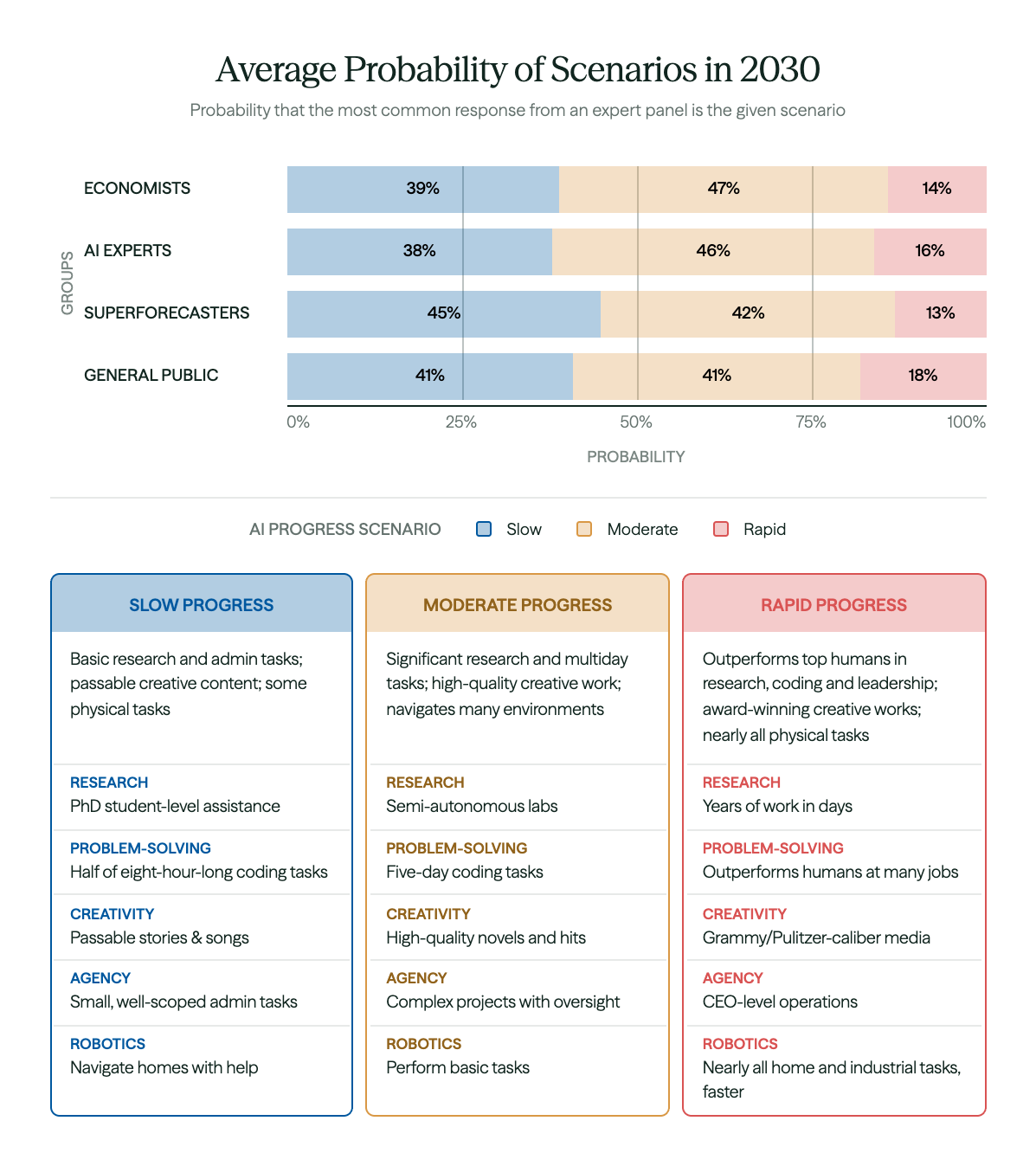
As shown in Figure 1 below, economists gave a 47% probability that a moderate AI progress scenario would most closely match the world in 2030. This describes a world in which AI can run semi-autonomous research laboratories, complete coding tasks that would take a human five days, produce high-quality novels, manage complex business roles, and where robots exist that can navigate homes and perform basic tasks. This is a significant advance from present-day AI capabilities.
On average, economists think there is a 14% chance that in 2030, AI progress will most closely match a rapid scenario where AI outperforms all humans at many tasks, can run businesses at the level of a competent CEO, and where robots exist that can perform nearly all in-home and industrial tasks faster than humans. In total, the average economist assigned a 61% probability to either the moderate or rapid progress scenario. AI experts gave a similar combined probability (62%), while superforecasters (55%) and the general public (59%) were only slightly more pessimistic.
We asked respondents to forecast key economic indicators in 2030 and 2050, assuming their current beliefs about the rate of AI progress. These unconditional forecasts generally clustered around existing trends, although a labor force participation rate of 58% has not been seen since the 1960s, and is well below the Congressional Budget Office's projections for 2050 (see below).
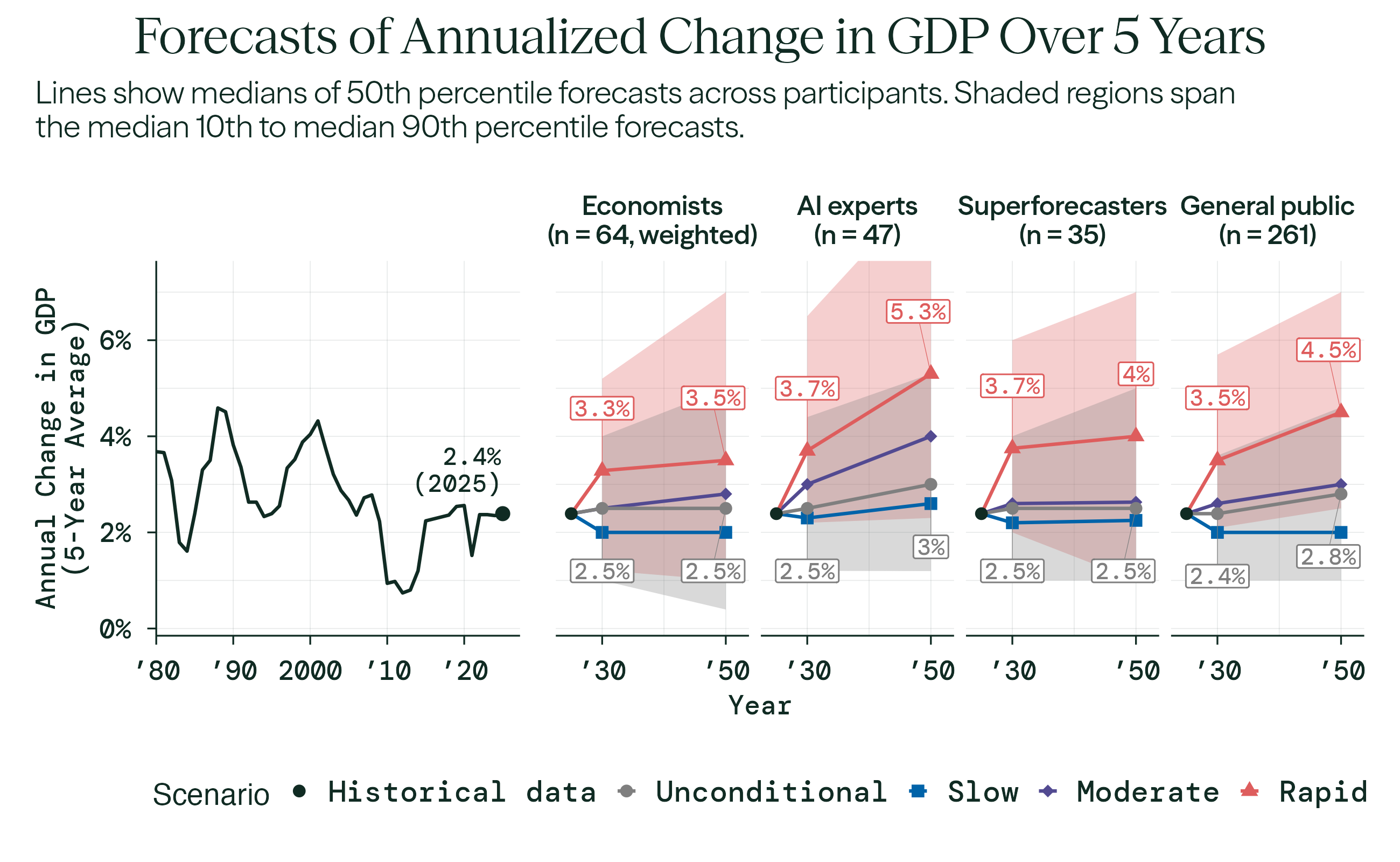
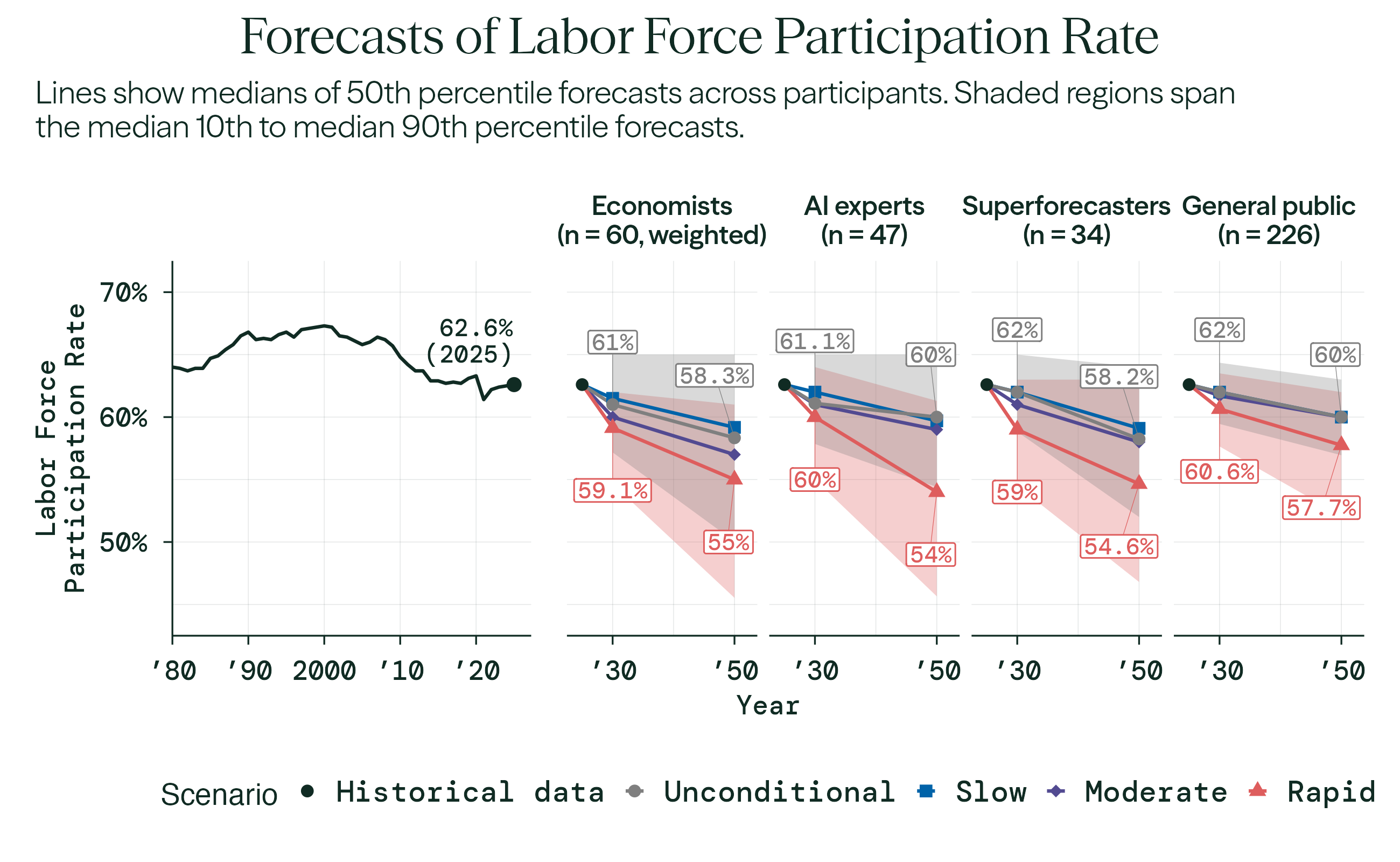
Key insights #1 and #2 seem in tension: Economists expect AI capabilities to improve significantly by 2030, but they do not expect this to translate into dramatically different economic outcomes.
What explains this disconnect between forecasts of AI progress and economic indicators? The following themes appear in the rationales economists wrote to accompany their GDP forecasts.
Uneven and time-lagged diffusion
Some economists argued that AI productivity gains would not be evenly distributed across all sectors, particularly where human labor is a bottleneck. Others pointed out that with other general-purpose technologies (electrification, automobiles, personal computers), there were multi-decade lags between widespread implementation and productivity improvements. Part of this delay is attributed to a shift in capital away from labor and toward compute, data centers, APIs, and so on, which would not manifest as an increase in GDP until productivity improvements set in. Economists agreed that AI boosts to scientific research and development had the most potential to contribute to GDP growth.
Geopolitical, structural, and demographic headwinds
Some economists expected demographic decline and geopolitical instability to offset some of the GDP boost from AI progress. They cited trade wars, global conflicts, climate change, economic competition in a multipolar world, political instability, an aging population, and declining immigration as factors that would limit GDP growth up to 2050. A number of economists were skeptical that double-digit GDP growth could be sustained in a developed economy, pointing out that there is no historical precedent for this.
Bottlenecks on AI infrastructure
Some economists argued that constraints on energy and chip supply, data center build times, and other commodities put a cap on the upper limit of GDP growth. Power plants, data centers, and robotic factory capacity take many years to build, and businesses take time to integrate new tools, which all limit the potential for explosive economic growth.
Possibility of extreme outcomes
Some economists argued that tail risks, particularly in a rapid AI progress scenario, raised the possibility of extreme outcomes that would impact GDP growth. These included existential risks from AI, societal unrest or collapse, and war. Others pointed out that the rapid scenario may lead to large numbers of people leaving the workforce (or even a post-work economy), which would likely negatively impact real GDP.
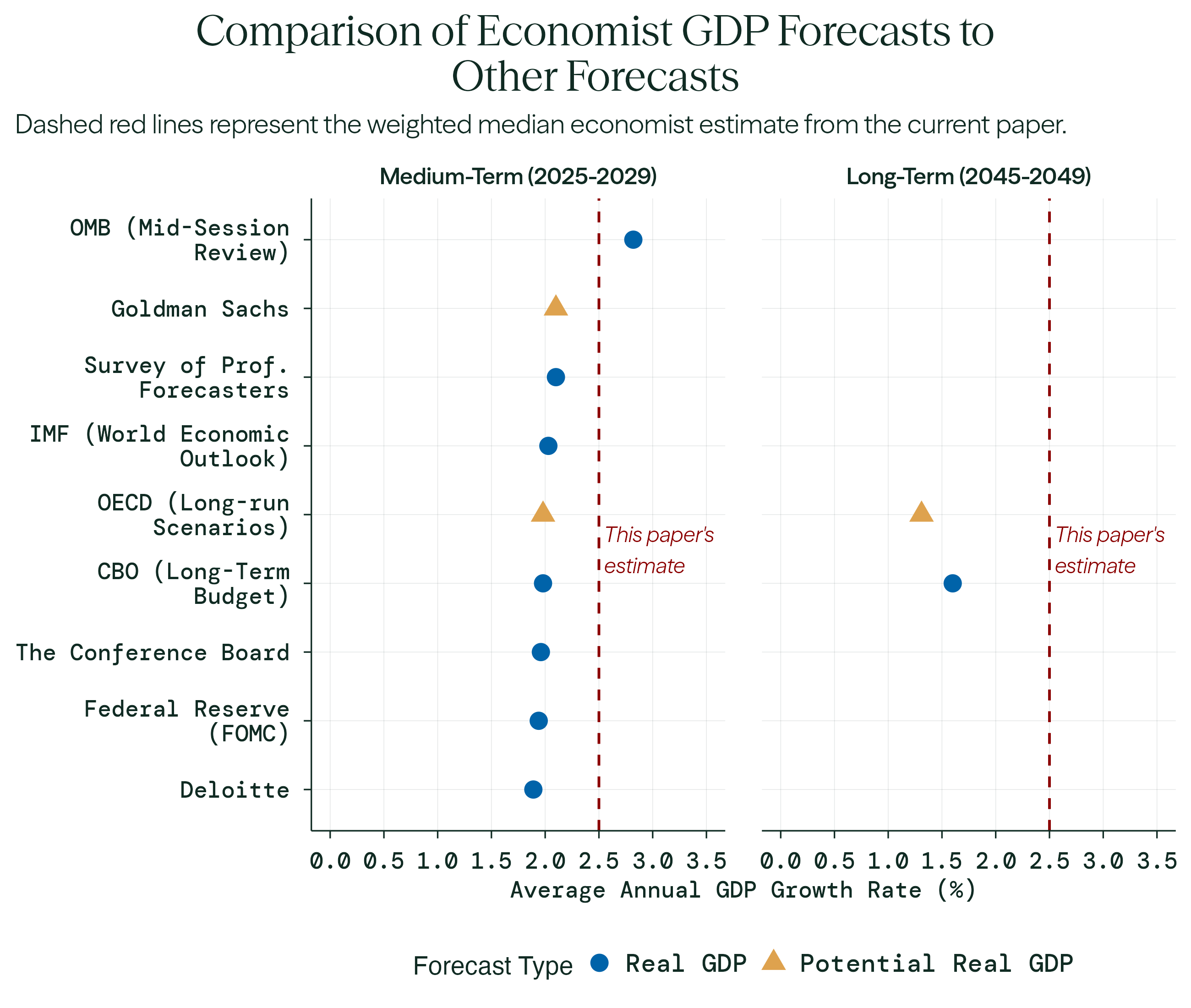
As you can see in Figure 4 below, economists' forecasts for GDP growth in 2030 are higher than most comparable forecasts used by government agencies and the private sector, which tend to be closer to 2%
The rapid progress scenario describes a world in which AI in 2030 is extremely advanced compared to present-day capabilities: autonomously creating game-changing technologies, outperforming all software engineers, producing award-winning songs and novels, acting at the level of highly competent CEOs, and enabling robots that can navigate all homes with ease to perform tasks faster and more reliably than humans and perform all tasks in autonomous factories.
Economists assigned an average 14% probability to this scenario most closely matching the real world in 2030. When asked to forecast economic indicators in 2030 and 2050 in such a world, the median economist predicted substantial changes that parallel some of the most productive periods in recent U.S. history.
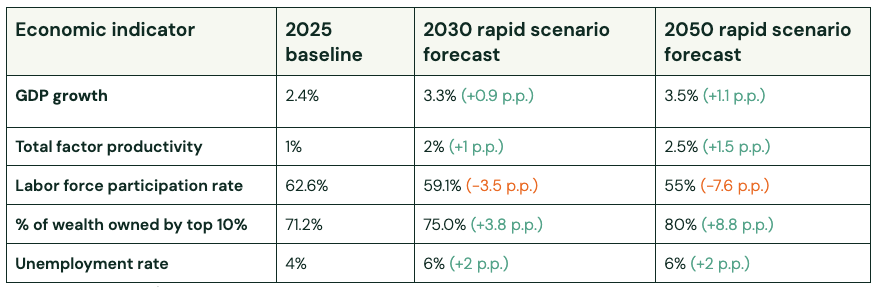
A small increase in annualized GDP growth leads to large differences in the size of the U.S. economy over time. The 3.5% growth rate in the rapid scenario would produce a real GDP of $54.7 trillion in 2050, 25% larger than the $43.7 trillion in the unconditional scenario (2.5% annualized growth). This is roughly equivalent to the difference in GDP (economic output) between 2016 and today.
In a rapid AI progress scenario, economists forecast a drop in labor force participation from its 2025 baseline of 62.6% to 59.1% in 2030 and 55% in 2050, with roughly half of this decline—equivalent to 10 million jobs—attributable to AI. By contrast, the Congressional Budget Office projects the labor force participation rate to be roughly 62.2% in 2050, close to current levels (CBO, 2026).
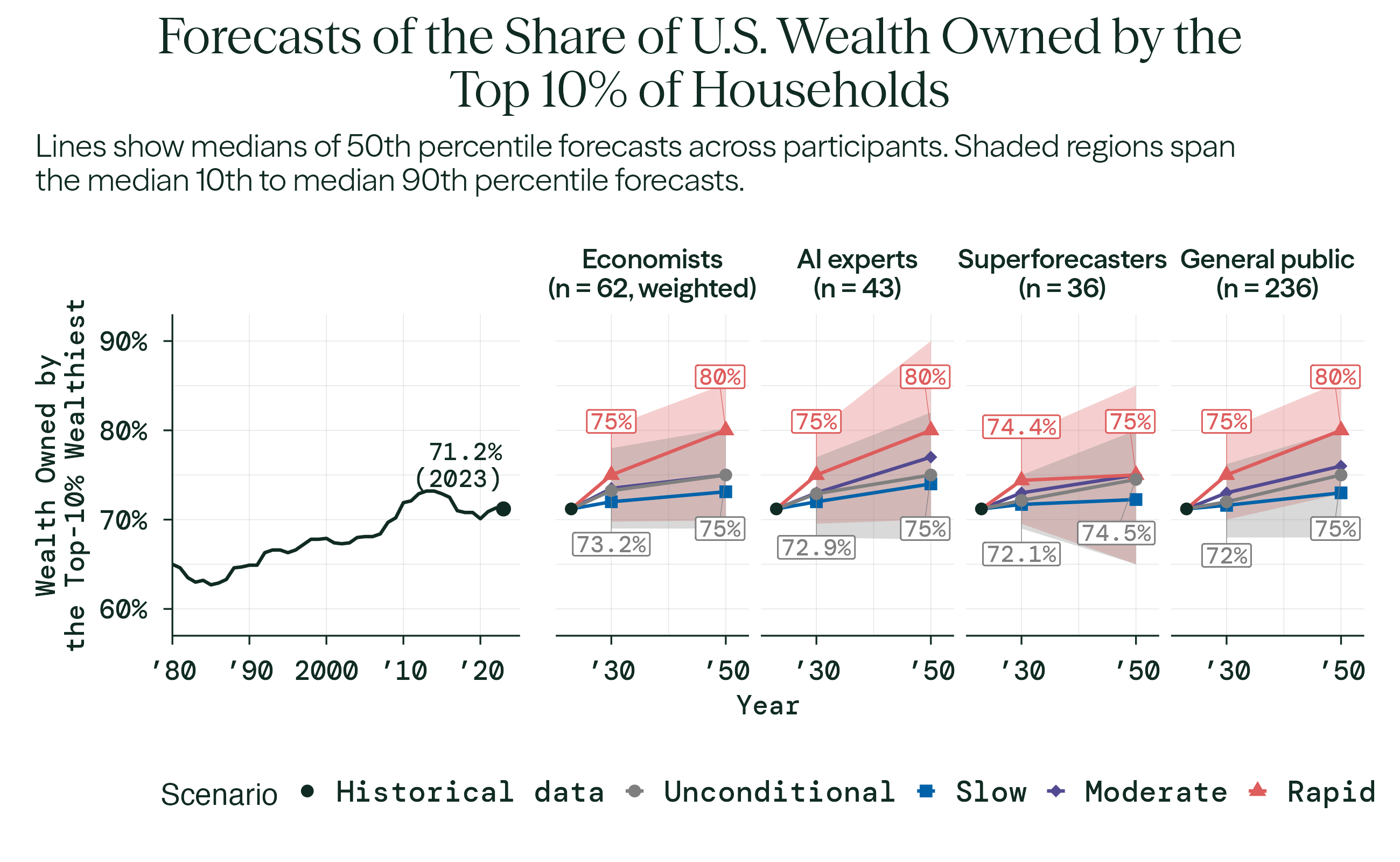
Forecasts for wealth inequality are particularly stark. In the 2030 rapid scenario, the median respondent expects 75% of U.S. national wealth to be held by the richest 10% of the population. In 2050, respondents expect this to hit 80%.
HISTORICAL CONTEXT
The above forecasts describe an economy that is substantially different from the U.S. today.
GDP: The U.S. has not seen a 10-year period with greater than 3.5% growth since 1992-2001 (FRED).
TFP: The U.S. saw average annual total factor productivity growth rates of around 2% in the post-WWII period (Shackleton, 2013, p. 5). The late 1990s “IT boom” was associated with a 0.6 percentage point jump in TFP (Jorgenson and Stiroh, 2000, p. 6).
LFPR: The annual labor force participation rate was last below 60% in the 1960s, when women’s participation in the labor force was much lower than it is today. The Congressional Budget Office projects the labor force participation rate to be roughly 62.2% in 2050, close to current levels (CBO, 2026).
Wealth inequality: The share of U.S. wealth owned by the top 10% wealthiest households last reached 80% in 1939 (World Inequality Database).
Unemployment: The forecasted unemployment rate of 6% is still below the rates of >7% seen in the years following the 2008 financial crisis (FRED).
Economists have substantial uncertainty about economic outcomes in the rapid scenario: their 80% credible intervals for GDP growth in 2050 range from 1.0% annualized GDP growth to 7.0%.1 The equivalent 80% credible interval for the labor force participation rate was between 45.5% and 61%.
We filtered respondents by their unconditional forecasts for GDP growth by 2030. Respondents whose forecasts fell in the top 20% of this distribution tended to focus on the following themes in their rationales:
AI-driven scientific breakthroughs
Some respondents expect rapid progress to lead to major breakthroughs in science, technology, and governance that enable unprecedented levels of productivity before 2030. These respondents expect scientific gains to strongly outweigh any demographic, political, or structural headwinds.
Radically altered economics/geopolitics
Respondents argued that in a radically changed world, U.S. GDP may no longer be a relevant economic indicator. Some pointed out that it is unclear whether economic expansion to outer space would be counted as U.S. GDP, while others predicted that in such a world, the U.S. may no longer exist.
Respondents forecasted the impact of six policy proposals implemented in isolation in both an unconditional and a rapid progress scenario. They were: retraining support, modernized unemployment insurance, universal basic income, a Manhattan Project for AI, a compute tax, and a job guarantee program.
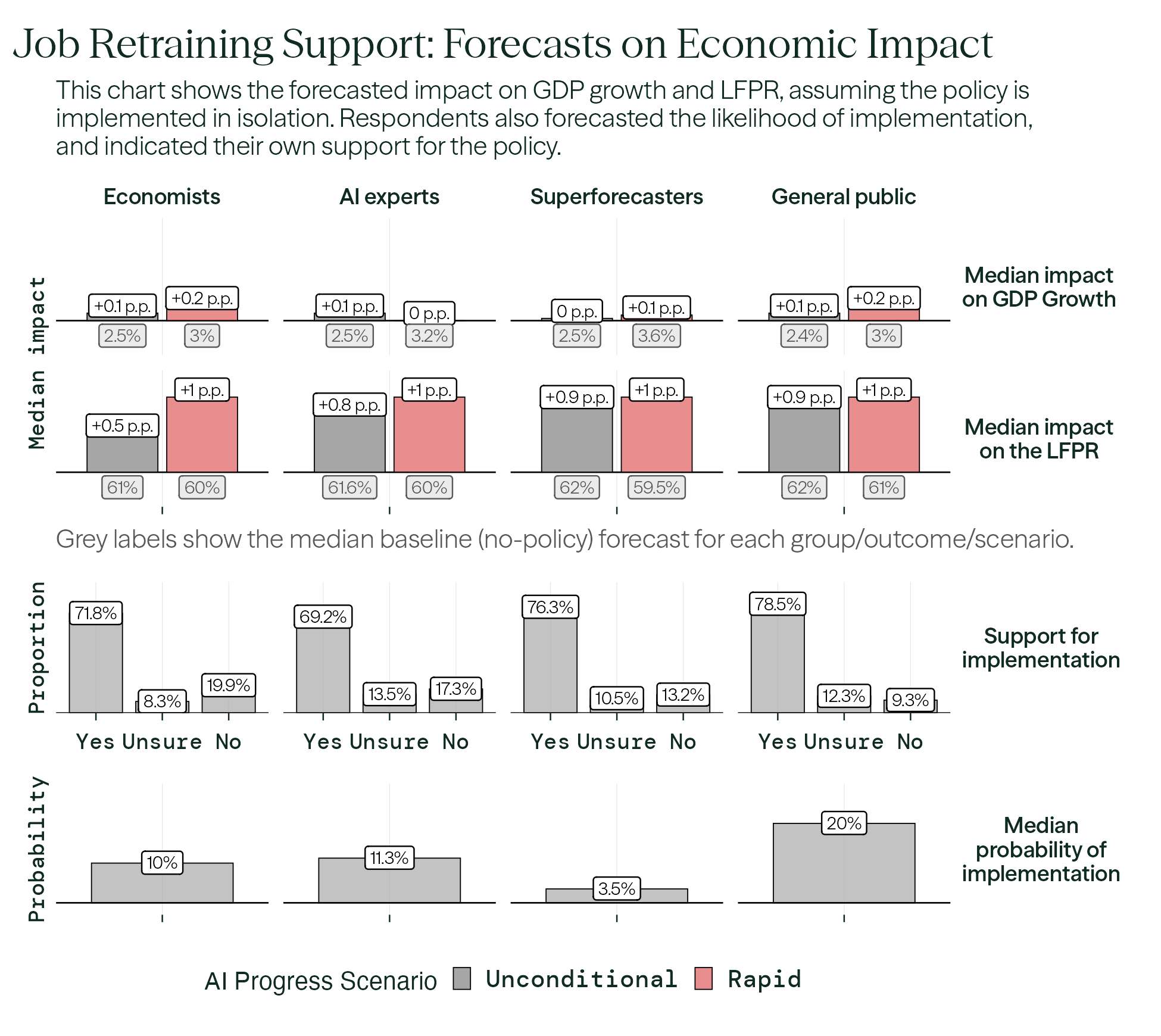
Economists’ support for implementation was highest for a job retraining policy (71.8%), which they predicted would have a modestly positive effect on both GDP (+0.2 p.p.) and LFPR (+1 p.p.) in a rapid progress scenario in 2030. A +1 p.p. increase in LFPR would amount to an additional 2.76 million Americans in the workforce. Economists gave only a 10% chance that this policy would be implemented.
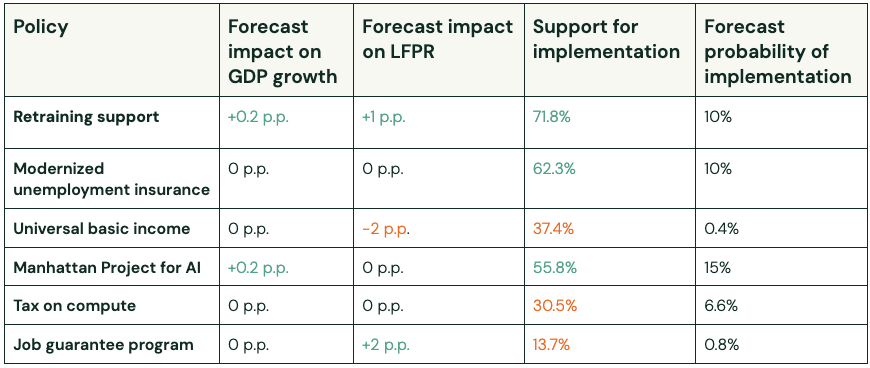
A Manhattan Project for AI, defined as a deployment of roughly $120 billion in annual federal spending to accelerate AI research and infrastructure funded by a 0.7% VAT, and a retraining support program for unemployed people leaving jobs at high risk of automation, had the joint largest forecast impact on GDP growth (+0.2 p.p.) by 2030. The retraining support program received support from 71.8% of economists, with 8.3% unsure and 19.9% opposed to implementation.
Economists viewed universal basic income the most negatively. It was the only policy to be associated with a forecast of a substantial projected LFPR decline (-2.0 p.p.). Over a third of economists (38.2%) opposed it, although the job guarantee program and the tax on compute both garnered even more disapproval, with 56.8% and 45.9% of economists rejecting the policies, respectively.
Economists and the general public disagreed on their support for some policies. 47.9% of the public respondents supported a universal basic income, compared to 37.4% of economists. 57.1% of the public supported a job guarantee program, compared to 13.7% of economists.
In this study, we elicited precise, falsifiable predictions about the future of the U.S. economy from leading economists, AI industry professionals, AI policy experts, top generalist forecasters, and the general public. Over time, we will be able to understand whose predictions about the impact of AI are most accurate. Will people who predicted rapid AI progress in 2030 be closest to the truth? Will AI experts prove more accurate than economists in their predictions for the U.S. economy in 2030?
As AI’s early economic effects become clear, this study can provide a roadmap for whose predictions we should trust more, and which policy responses may be most impactful based on the trajectory we are on.
Economists were sampled from three target populations: economists working on AI-related topics, those working on the impact of technological change, and well-known economists, including Nobel Prize winners and members of the Clark Center U.S. Economic Experts panel. AI experts were sampled from frontier and highly funded AI companies, leading AI institutions, and U.S. think tanks focused on AI policy. Forecasters are designated “superforecasters” if they were either in the top 2% of the accuracy distribution in a given year of the Intelligence Advanced Research Projects Activity (IARPA) Aggregative Contingent Estimation (ACE) tournament or a highly accurate performer on Good Judgment Open. Responses were reweighted to the sample population to correct for non-response bias. The survey ran from mid-October 2025 to the end of February 2026.
For more information, read the full report.