








For years, the bottleneck on internal software was never understanding the problem. The ops lead always knew exactly how stock moved through the warehouse. Finance always knew how an approval should route. The person closing deals always knew the five stages a deal really passes through. What none of them had was a way to turn that knowledge into working software.
So the work sat in a queue. Behind an engineering backlog, a two-quarter wait, or yet another SaaS subscription bent into a shape it was never meant to hold. The people who understood a workflow best were usually the least able to build for it.
That has changed faster than most teams have noticed. AI now lets a domain expert describe a workflow in plain language and get working software back. The person who understands the problem can finally build the solution.
It is the most underrated shift in software right now. Everyone is showing off consumer apps and landing pages. Meanwhile, operators are quietly building the tools that actually run their companies.
The same patterns show up over and over:
None of these will trend. None of them are flashy. Every one of them is software somebody needs working on Monday.
There is a difference between a weekend prototype and software that runs a business. A tool that organizes your week can be thrown away and rebuilt whenever. A tool that routes every purchase approval, holds your customer records, or tells the warehouse what to ship cannot.
Here is the part the build-it-with-AI demos rarely mention. The moment the person who generated that tool changes roles or leaves, an unsupported script becomes the thing nobody else understands and nobody dares to touch. The build problem gets solved, and a maintenance problem takes its place.
For a growing company, that is not a smaller problem. It is the same shadow IT and the same bus factor that custom internal software has always carried. Only now it gets created faster, by more people, in more corners of the business.
Software that keeps running after its author moves on tends to share a few traits. None of them are glamorous, which is exactly why a quickly generated script tends to skip them.
A clever script can handle the happy path. The unglamorous parts above are what turn it into software you will still trust in two years, and what let a second person pick it up when the first one is gone.
dForge is built for that durable layer.
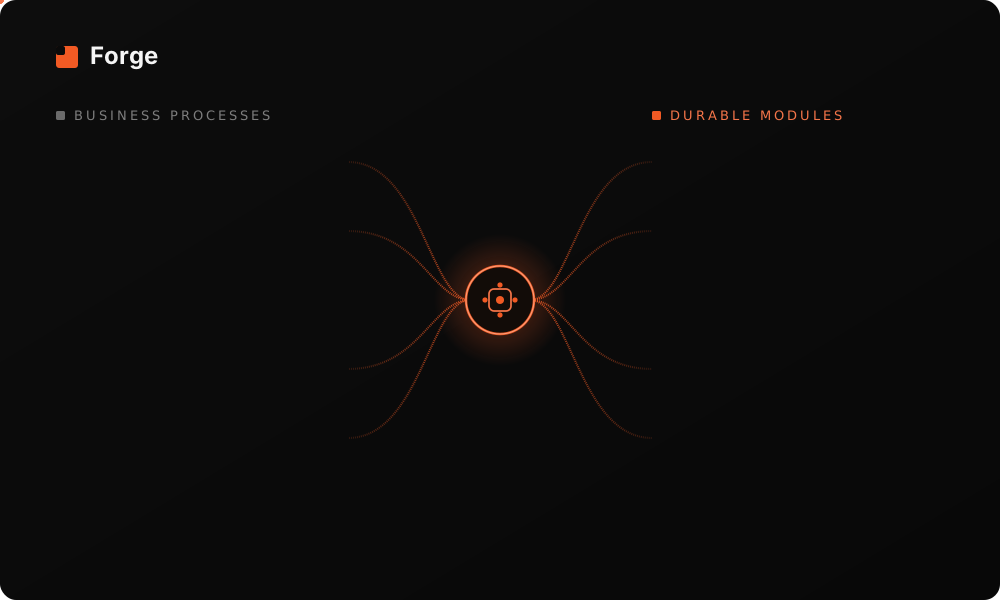
Instead of generating isolated scripts, your team builds business modules on a platform that already handles roles, lifecycle states, history, and reporting from the start. You are not bolting structure on afterwards. It is there underneath everything you build.
You can start from existing modules like CRM, HR, or warehouse and adapt them to how your business actually works, or describe a new module in plain language and build it with AI through the dForge MCP server. Either way it lands on the same foundation, with the same structure underneath.
Every deployment is single-tenant. Your operational data lives in its own database, and you can self-host it. And because a module is described declaratively as part of the platform rather than buried in code only its author understands, the tool your operator builds today can survive the handoff to whoever maintains it next.
The constraint on internal software was never who understood the problem. It was who could build it. That constraint is gone. The operator who lives inside a workflow can finally build the workflow.
The real question is what happens after. Whether the thing they built will still be running the business in two years, or whether it becomes the next fragile system nobody wants to own. That is the part dForge is built for.
If you are modernizing a legacy custom system or outgrowing a packaged SaaS tool, that gap is exactly the one dForge is meant to close. See how it works at dForge.
此内容由惯性聚合(RSS阅读器)自动聚合整理,仅供阅读参考。 原文来自 — 版权归原作者所有。