



惯性聚合 高效追踪和阅读你感兴趣的博客、新闻、科技资讯
阅读原文 在惯性聚合中打开

推荐订阅源

T
The Blog of Author Tim Ferriss
Last Week in AI
Last Week in AI
IT之家
IT之家
Exploit-DB.com RSS Feed
P
Proofpoint News Feed
C
Cyber Attacks, Cyber Crime and Cyber Security
A
Arctic Wolf
P
Privacy & Cybersecurity Law Blog
Threat Intelligence Blog | Flashpoint
K
Kaspersky official blog
Spread Privacy
Spread Privacy
S
Securelist
C
CERT Recently Published Vulnerability Notes
The Hacker News
The Hacker News
P
Palo Alto Networks Blog
C
Cybersecurity and Infrastructure Security Agency CISA
C
Cisco Blogs
S
Schneier on Security
B
Blog RSS Feed
博客园_首页
O
OpenAI News
M
MIT News - Artificial intelligence
Y
Y Combinator Blog
Stack Overflow Blog
Stack Overflow Blog
H
Hacker News: Front Page
AWS News Blog
AWS News Blog
W
WeLiveSecurity
Vercel News
Vercel News
博客园 - 叶小钗
U
Unit 42
Hacker News: Ask HN
Hacker News: Ask HN
奇客Solidot–传递最新科技情报
奇客Solidot–传递最新科技情报
Google DeepMind News
Cloudbric
Cloudbric
酷 壳 – CoolShell
酷 壳 – CoolShell
The Cloudflare Blog
Schneier on Security
The Last Watchdog
The Last Watchdog
T
Threatpost
GbyAI
GbyAI
freeCodeCamp Programming Tutorials: Python, JavaScript, Git & More
TaoSecurity Blog
TaoSecurity Blog
D
DataBreaches.Net
V
Vulnerabilities – Threatpost
Recent Announcements
博客园 - 三生石上(FineUI控件)
www.infosecurity-magazine.com
cs.AI updates on arXiv.org
The GitHub Blog
The GitHub Blog
量子位

Hacker News - Newest: "AI"

AI can't read an investor deck AI as an attorney? Student uses ChatGPT, Gemini to sue UW over alleged racial discrimination Hacking MCP Servers in AI Systems – The Rug Pull: Tool Changes After Approval GitHub - MeepCastana/KubeezCut: Free Web based video editor GitHub - GenAI-Gurus/awesome-eu-ai-act: Curated tools, official sources, OSS, templates, and guides for EU AI Act compliance. Can AI judge journalism? A Thiel-backed startup says yes, even if it risks chilling whistleblowers Coming soon: 10 Things That Matter in AI Right Now DARPA built an AI to fact-check enemy weapons claims What explains heterogeneity in AI adoption? When AI Meets Muscle: Context-Aware Electrical Stimulation Promises a New Way to Guide Human Movements - Department of Computer Science AI Changed How We Build. It Did Not Change What Matters. Linux rules on using AI-generated code - Copilot is OK, but humans must take 'full responsibility for the… Meta spins up AI version of Mark Zuckerberg to engage with employees Code Mode: Let Your AI Write Programs, Not Just Call Tools | TanStack Blog GitHub - Delavalom/graft: Go framework for building AI agents. Type-safe tools, multi-provider (OpenAI, Anthropic, Gemini, Bedrock), zero vendor SDKs. India's TCS tops estimates, says new AI models did not dent services demand Gen Z's fading AI hype Strong feeling: we are in a folded AI reality GitHub - machinarii/total-recall-catalog: A reference catalog of latest knowledge retrieval, memory & RAG systems GitHub - mensfeld/code-on-incus: Give each AI agent its own isolated machine with root, Docker, and systemd. Active defense detects and stops threats automatically.. Quantization, LoRA, and the 8% Problem: Benchmarking Local LLMs for Production AI Iran war: We spoke to the man making Lego-style AI videos that experts say are powerful propaganda Powell, Bessent discussed Anthropic's Mythos AI cyber threat with major U.S. banks GitHub - immartian/bellamem: Persistent belief-graph memory for AI agents. Retrieves decisive context by importance — not recency, not RAG, not /compact. recursive-mode: The Repo-Native Operating System for AI Engineering After the attack on Sam Altman's home, will AI CEO's go on the offensive? The biggest advance in AI since the LLM Opus 4.6 vs GPT 5.4 One Prompt Unity World Generation Test “AI polls” are fake polls Client Challenge Can AI be a 'child of God'? Inside Anthropic's meeting with Christian leaders How to Switch AI Chatbots and Why You Might Want To GitHub - MattMessinger1/agentic_refund_guardrail: Safe refund policy layer for AI agents — Python + TypeScript. Same behavior, shared tests. Adam/papers/emergent_values_whitepaper.md at master · strangeadvancedmarketing/Adam Ask HN: How do you stop playing 20 questions with your AI coding tools How far can automation and AI support psychotherapy? - @theU GitHub - stagas/rtdiff: realtime git diff gui and AI-assisted commits A Mac Studio for Local AI — 6 Months Later A History of the Early Years of AI at the University of Edinburgh Why AI Coding Tools Still Feel Stuck on Localhost MSN AI Datacenters Are Becoming Strategic Targets twitter.com Penn Researchers Use AI to Surface Unreported GLP-1 Side Effects in Reddit Posts Show HN: MoodSense AI (ML and FastAPI and Gradio, Deployed on Hugging Face) Moodsense Ai - a Hugging Face Space by aman179102 AI models are terrible at betting on soccer—especially xAI Grok GitHub - xialeistudio/echoic GitHub - HimashaHerath/github-dev-wrapped: AI-powered weekly GitHub activity reports deployed to GitHub Pages GitHub - alejandrobalderas/claude-code-from-source: Architecture, patterns & internals of Anthropic's AI coding agent — reverse-engineered from source maps AI and Tech brief: Ireland ascendant GitHub - Titovilal/context0: Context0 - Never Surrender Training for a Marathon with an AI Coach: What Worked and What Didn't Cyber Pulse: Agentic Intel - Apps on Google Play I Built an AI PR Reviewer That Catches Bugs by Not Looking for Bugs Gen Z workers are so fearful AI will take their job they’re intentionally sabotaging their company’s AI rollout | Fortune How AI Is Reimagining the Game of Golf–For Both Players and Courses GitHub - nattergabriel/reseed: A CLI tool for managing and distributing agent skills across projects Is SVG the final frontier? My AI workflow evolved from prompts to a near-autonomous workflow MLSharp Help - 3DGS Viewer & Generator I put my cognitive field based AI's runtime on GitHub Is Numble the first AI-proof game? A3: Kubernetes for autonomous AI agent fleets | Emergent Principles Deepali Vyas ("The Elite Recruiter") GitHub - msmarkgu/RelayFreeLLM: A restful API designed to route user prompts to various AI model providers. Unionized ProPublica staff are on strike over AI, layoffs, and wages Unleashing the Advantage of Quantum AI We're heading for an AI-fueled 'dementia crisis,' brain scientist warns The AI-Assisted Breach of Mexico's Government Infrastructure [pdf] GitHub - stef41/lmscan: 🔍 Detect AI-generated text and fingerprint which LLM wrote it. Open-source GPTZero alternative. Zero dependencies, works offline. MSN GitHub - visionscaper/collabmem: Enabling long-term collaboration with Agentic AI - building up episodic and world model memory over time with in-context awareness We gave an AI a 3 year retail lease in SF and asked it to make a profit | Andon Labs AI Code is Hollowing Out Open Source, and Maintainers are Looking the Other Way What leaked "SteamGPT" files could mean for the PC gaming platform's use of AI AI is the boss at this retail store. What could go wrong? GitHub - Wuzu11517/agentic-proxy: Local proxy meant to help reduce With Drones, Geophysics and ArtificiaI Intelligence, Researchers Prepare to Do Battle Against Land Mines A Single Operator, Two AI Platforms, Nine Government Agencies: The Full Technical Report 在 Steam 上购买 FriedrichAI: Offline AI 立省 10% GitHub - inevolin/resume-cli: Hit Claude usage limits? Resume any AI coding session elsewhere. Switch tools at zero friction. GitHub - atripati/ark: AI Runtime Kernel — a context operating system for AI agents. Eliminates tool bloat, loads only what’s needed, and gives LLMs their reasoning space back. How to Build a Secure AI PR Reviewer with Claude, GitHub Actions, and JavaScript This Startup Wants You to Pay Up to Talk With AI Versions of Human Experts Intel Arc Pro B70 Brings 32GB VRAM to Local AI for $949 WordPress 7.0: The Good, the AI, and the Still Missing AI on the couch: Anthropic gives Claude 20 hours of psychiatry IatroBench: Pre-Registered Evidence of Iatrogenic Harm from AI Safety Measures AI Agents Know About Supabase. They Don't Always Use It Right. The history and future of AI at Google, with Sundar Pichai Inside an AI‑enabled device code phishing campaign How Meta Used AI to Map Tribal Knowledge in Large-Scale Data Pipelines AI for Systems: Using LLMs to Optimize Database Query Execution Forecasting the Economic Effects of AI Introducing Tinker: Play with AI, bring your ideas to life AI sheds light on an ancient gaming mystery People really hate AI but not as much as Iran—or Democrats | Fortune What is an AI Product Engineer? Phoebe Gates wants her $185 million AI startup to succeed with 'no ties to my privilege or my last name': 'I have a chip on my shoulder' | Fortune
Ed Zitron Just Disproved the Core Claim Behind His AI Bubble Case
Garrison Lovely · 2026-06-18 · via Hacker News - Newest: "AI"

I spent months digging into the case for and against the AI bubble for my forthcoming book Obsolete: The AI Industry’s Trillion-Dollar Race to Replace Us—and How to Stop It (Nation Books, preorders ship in August, wide release is September 15).

Preorder

Today’s piece focuses on the most common mistake in the bubble case, which we just got some welcome clarity on.

AI’s most dedicated hater, Ed Zitron, recently intoned that something big was coming:

One of my sources has come forward and brought me a story that will possibly burst the AI bubble …

If you’re wondering what the story is, know that it’s the information I’ve wanted for years, delivered as I have always wanted it, and I will treat it with the reverence it deserves. Imagine what the worst possible thing for me to get would be and you’re probably close. …

I can guarantee you it’ll be worth it, and you’ll be stunned by what I report.

On Monday, Zitron came through, sharing OpenAI financial data that was leaked to him. He regularly publishes 15,000 word posts, but this time he kept it short and sweet, explaining that “Due to the seriousness of this story, I am not going to do very much editorializing, as the numbers speak for themselves.” While OpenAI’s losses are, as we’ll soon see, significant, the uncharacteristic lack of analysis may better reflect the fact that the numbers don’t actually comport with the story Zitron has been selling.

The blogger and public relations consultant has emerged as the loudest and brashest proponent of the idea that generative AI is a bubble, destined to pop… any day now. Zitron makes a lot of arguments to support his position. But the most load-bearing one of all is this: the generative AI companies driving the entire industry are losing money, even on their paying customers. Here’s him writing in September:

Generative AI companies — OpenAI and Anthropic included — lose millions or billions of dollars, and so do the companies building on top of them, in part because the costs associated with delivering models continue to increase. Integrating Large Language Models into your product already loses you money, at a price where the Large Language Model provider (EG: OpenAI and Anthropic) is losing money.

I believe that generative AI is, at its core, unprofitable, and that no company building their core services on top of models from Anthropic or OpenAI has a path to profitability outside of massive, unrealistic price increases.

The only realistic path forward for generative AI firms is to start charging their users the direct costs for running their services, and I do not believe users will be enthusiastic to do so, because the amount of compute that the average user costs vastly exceeds the amount of money that the company generates from a user each month (emphasis mine).

And here’s him on a podcast in November talking about OpenAI specifically:

We’re talking a company that just the cost of doing business is two or three times what they are making in revenue. And that’s just the inference. That’s before training.

Indeed, these companies are famously unprofitable (well, before Anthropic’s unprecedented revenue tear in recent months), so why does it matter so much how they’re losing money? Well, if each additional paying customer costs more to serve than they pay you, then faster growth just brings you to bankruptcy faster. But if you profit from each new paying customer, then enough growth will bring you to overall profitability, even if you have high fixed costs (in this case, mostly from training future generations of AI models).

Put simply, if AI companies need to grow like crazy and fix their cost structure to ever become profitable, then yes, this does all look like a bubble. But if instead they profit from each unit sold, then they just need to grow like crazy to recoup training costs.

Public reporting and independent estimates have indicated that companies like OpenAI and Anthropic are profitable on serving their models, with healthy gross margins in the 30-60 percent range.
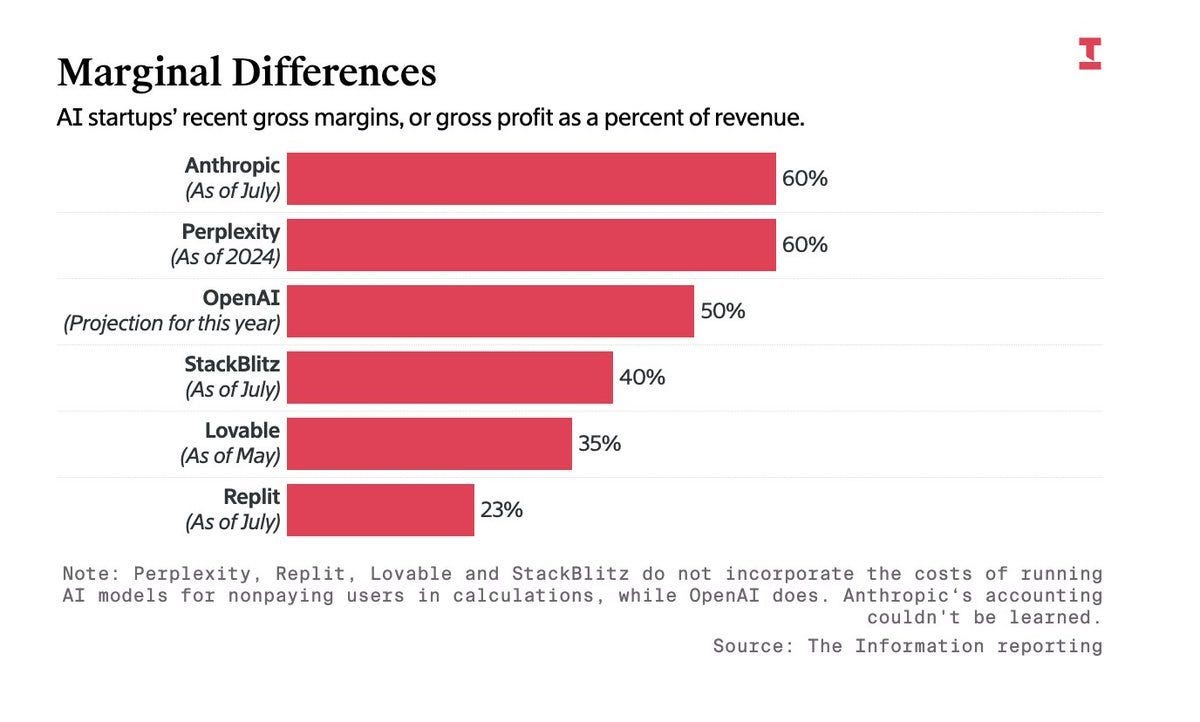
But these companies are still private, so we can’t inspect their books directly. Fortunately, someone leaked OpenAI’s audited financial statements to Zitron, who shared them with the Financial Times to validate their authenticity.

And wouldn’t you know it, OpenAI’s gross margins are positive and improving. In 2024, OpenAI’s cost of serving customers was $2.65 billion and its revenue was $3.7 billion (28 percent gross margins). Last year, cost of revenue reached $7.5 billion, but revenue more than tripled to reach $13.07 billion (43 percent gross margins).

Of course, this misses most of the costs OpenAI bore, which overwhelmingly came from R&D (i.e. training new models). And in October, OpenAI completed its restructuring as a for-profit, with the controlling nonprofit foundation taking an equity stake worth about $130 billion at the time, roughly 26 percent of the company. Here are the full numbers from Zitron:

2024:

  • Revenue: $3.7 billion

  • Cost of Revenue: $2.65 billion

  • Research and Development: $7.81 billion

  • Sales and Marketing: $1.11 billion

  • General and Administrative: $907 Million

  • Total Costs and Expenses: $12.48 billion

  • Loss from Operations: $8.78 billion

2025:

  • Revenue: $13.07 billion

  • Cost of Revenue: $7.5 billion

  • Research and Development: $19.18 billion

  • Sales and Marketing: $5.73 billion

  • General and Administrative: $1.57 Billion

  • Total Costs and Expenses: $34 billion

  • Loss from Operations: $20.92 billion

The ChatGPT creator has a tough financial road ahead of it, and the amount of money it expects to lose before becoming profitable overall ($115 billion) is nearly four-times higher than the most money a company ever burned before reaching profitability (Uber’s $31.5 billion).

It might not get there.

But all that distracts from the fact that Zitron pulled out the linchpin in his own case that the whole industry is a bubble. His data shows definitively that OpenAI makes far more from ChatGPT than it costs to serve, even while serving it to hundreds of millions of free users. And the vast majority of its users pay nothing: with 900 million weekly active users and just 50 million paying subscribers as of February.

Through a flurry of circular compute deals worth around $1.4 trillion struck last fall, the company tied its financial fate to some of the largest firms in the world. Now, if OpenAI goes down, it really could take the global economy with it. And in the meantime, it gives the company outsized power with regulators and lawmakers.

But Zitron’s bubble case long-preceded those deals and has consistently featured the claim that generative AI has negative gross margins. In October 2024, he wrote:

OpenAI’s API services — which lets people integrate its various models into external products — is currently priced at a loss, and increasing prices will likely make this product unsustainable for many businesses currently relying on these discounted rates.

And his mistaken claims about the economics aren’t some sideshow to otherwise astute observations about the technology or its future. For instance, in July 2024, he wrote that:

Generative AI, as I said back in March, is peaking, if it hasn’t already peaked. It cannot do much more than it is currently doing, other than doing more of it faster with some new inputs.

Wherever Zitron’s takes pop up, the reaction is effusive: finally, someone who knows what they’re talking about, who’s willing to call out the obvious madness! But while presenting as a courageous dissenter in a sea of charlatans and fools, he’s really just telling people what they want to hear.

And people really, really don’t want AI to be real. The inverse of Zitron’s case — the technology will actually deliver on sky high investments and expectations — implies labor displacement, further wealth and power concentration, environmental harms, and risks far graver than an economic crash.

The uncomfortable reality is that we can’t count on the bursting of a bubble to save us — there’s far too much at stake. The less appealing message is that AI companies are trying to render us obsolete, and the only surefire way they won’t succeed is if we stop them. And that’s going to involve a lot of hard work.

But I’ll take that over waiting around for the supposedly inevitable.

P.S. Ed, if you’re reading this, I know Richard Hames from Novara Media invited you to debate me. I just want to say for the record that I’m game — any time, anywhere.

If you enjoyed this, please share it with a friend.

Share

Discussion about this post

Ready for more?