



惯性聚合 高效追踪和阅读你感兴趣的博客、新闻、科技资讯
阅读原文 在惯性聚合中打开

推荐订阅源

Simon Willison's Weblog
Engineering at Meta
Engineering at Meta
宝玉的分享
宝玉的分享
有赞技术团队
有赞技术团队
Last Week in AI
Last Week in AI
博客园 - Franky
云风的 BLOG
云风的 BLOG
D
Docker
The Register - Security
V
V2EX
The GitHub Blog
The GitHub Blog
B
Blog
N
Netflix TechBlog - Medium
WordPress大学
WordPress大学
T
The Blog of Author Tim Ferriss
Microsoft Security Blog
奇客Solidot–传递最新科技情报
奇客Solidot–传递最新科技情报
博客园 - 叶小钗
人人都是产品经理
人人都是产品经理
J
Java Code Geeks
钛媒体:引领未来商业与生活新知
钛媒体:引领未来商业与生活新知
博客园 - 司徒正美
Google Online Security Blog
U
Unit 42
K
Kaspersky official blog
MongoDB | Blog
MongoDB | Blog
Cisco Talos Blog
Cisco Talos Blog
C
Cyber Attacks, Cyber Crime and Cyber Security
T
Tor Project blog
B
Blog RSS Feed
Security Latest
Security Latest
Threat Intelligence Blog | Flashpoint
H
Hackread – Cybersecurity News, Data Breaches, AI and More
Blog — PlanetScale
Blog — PlanetScale
T
Threat Research - Cisco Blogs
Recent Announcements
小众软件
小众软件
Stack Overflow Blog
Stack Overflow Blog
I
Intezer
C
CXSECURITY Database RSS Feed - CXSecurity.com
博客园 - 【当耐特】
Recorded Future
Recorded Future
Scott Helme
Scott Helme
D
Darknet – Hacking Tools, Hacker News & Cyber Security
The Cloudflare Blog
AI
AI
G
GRAHAM CLULEY
L
LangChain Blog
Google DeepMind News
L
LINUX DO - 最新话题

Hacker News - Newest: "AI"

AI can't read an investor deck AI as an attorney? Student uses ChatGPT, Gemini to sue UW over alleged racial discrimination Hacking MCP Servers in AI Systems – The Rug Pull: Tool Changes After Approval GitHub - MeepCastana/KubeezCut: Free Web based video editor GitHub - GenAI-Gurus/awesome-eu-ai-act: Curated tools, official sources, OSS, templates, and guides for EU AI Act compliance. Can AI judge journalism? A Thiel-backed startup says yes, even if it risks chilling whistleblowers Coming soon: 10 Things That Matter in AI Right Now DARPA built an AI to fact-check enemy weapons claims What explains heterogeneity in AI adoption? When AI Meets Muscle: Context-Aware Electrical Stimulation Promises a New Way to Guide Human Movements - Department of Computer Science AI Changed How We Build. It Did Not Change What Matters. Linux rules on using AI-generated code - Copilot is OK, but humans must take 'full responsibility for the… Meta spins up AI version of Mark Zuckerberg to engage with employees Code Mode: Let Your AI Write Programs, Not Just Call Tools | TanStack Blog GitHub - Delavalom/graft: Go framework for building AI agents. Type-safe tools, multi-provider (OpenAI, Anthropic, Gemini, Bedrock), zero vendor SDKs. India's TCS tops estimates, says new AI models did not dent services demand Gen Z's fading AI hype Strong feeling: we are in a folded AI reality GitHub - machinarii/total-recall-catalog: A reference catalog of latest knowledge retrieval, memory & RAG systems GitHub - mensfeld/code-on-incus: Give each AI agent its own isolated machine with root, Docker, and systemd. Active defense detects and stops threats automatically.. Quantization, LoRA, and the 8% Problem: Benchmarking Local LLMs for Production AI Iran war: We spoke to the man making Lego-style AI videos that experts say are powerful propaganda Powell, Bessent discussed Anthropic's Mythos AI cyber threat with major U.S. banks GitHub - immartian/bellamem: Persistent belief-graph memory for AI agents. Retrieves decisive context by importance — not recency, not RAG, not /compact. recursive-mode: The Repo-Native Operating System for AI Engineering After the attack on Sam Altman's home, will AI CEO's go on the offensive? The biggest advance in AI since the LLM Opus 4.6 vs GPT 5.4 One Prompt Unity World Generation Test “AI polls” are fake polls Client Challenge Can AI be a 'child of God'? Inside Anthropic's meeting with Christian leaders How to Switch AI Chatbots and Why You Might Want To GitHub - MattMessinger1/agentic_refund_guardrail: Safe refund policy layer for AI agents — Python + TypeScript. Same behavior, shared tests. Adam/papers/emergent_values_whitepaper.md at master · strangeadvancedmarketing/Adam Ask HN: How do you stop playing 20 questions with your AI coding tools How far can automation and AI support psychotherapy? - @theU GitHub - stagas/rtdiff: realtime git diff gui and AI-assisted commits A Mac Studio for Local AI — 6 Months Later A History of the Early Years of AI at the University of Edinburgh Why AI Coding Tools Still Feel Stuck on Localhost MSN AI Datacenters Are Becoming Strategic Targets twitter.com Penn Researchers Use AI to Surface Unreported GLP-1 Side Effects in Reddit Posts Show HN: MoodSense AI (ML and FastAPI and Gradio, Deployed on Hugging Face) Moodsense Ai - a Hugging Face Space by aman179102 AI models are terrible at betting on soccer—especially xAI Grok GitHub - xialeistudio/echoic GitHub - HimashaHerath/github-dev-wrapped: AI-powered weekly GitHub activity reports deployed to GitHub Pages GitHub - alejandrobalderas/claude-code-from-source: Architecture, patterns & internals of Anthropic's AI coding agent — reverse-engineered from source maps AI and Tech brief: Ireland ascendant GitHub - Titovilal/context0: Context0 - Never Surrender Training for a Marathon with an AI Coach: What Worked and What Didn't Cyber Pulse: Agentic Intel - Apps on Google Play I Built an AI PR Reviewer That Catches Bugs by Not Looking for Bugs Gen Z workers are so fearful AI will take their job they’re intentionally sabotaging their company’s AI rollout | Fortune How AI Is Reimagining the Game of Golf–For Both Players and Courses GitHub - nattergabriel/reseed: A CLI tool for managing and distributing agent skills across projects Is SVG the final frontier? My AI workflow evolved from prompts to a near-autonomous workflow MLSharp Help - 3DGS Viewer & Generator I put my cognitive field based AI's runtime on GitHub Is Numble the first AI-proof game? A3: Kubernetes for autonomous AI agent fleets | Emergent Principles Deepali Vyas ("The Elite Recruiter") GitHub - msmarkgu/RelayFreeLLM: A restful API designed to route user prompts to various AI model providers. Unionized ProPublica staff are on strike over AI, layoffs, and wages Unleashing the Advantage of Quantum AI We're heading for an AI-fueled 'dementia crisis,' brain scientist warns The AI-Assisted Breach of Mexico's Government Infrastructure [pdf] GitHub - stef41/lmscan: 🔍 Detect AI-generated text and fingerprint which LLM wrote it. Open-source GPTZero alternative. Zero dependencies, works offline. MSN GitHub - visionscaper/collabmem: Enabling long-term collaboration with Agentic AI - building up episodic and world model memory over time with in-context awareness We gave an AI a 3 year retail lease in SF and asked it to make a profit | Andon Labs AI Code is Hollowing Out Open Source, and Maintainers are Looking the Other Way What leaked "SteamGPT" files could mean for the PC gaming platform's use of AI AI is the boss at this retail store. What could go wrong? GitHub - Wuzu11517/agentic-proxy: Local proxy meant to help reduce With Drones, Geophysics and ArtificiaI Intelligence, Researchers Prepare to Do Battle Against Land Mines A Single Operator, Two AI Platforms, Nine Government Agencies: The Full Technical Report 在 Steam 上购买 FriedrichAI: Offline AI 立省 10% GitHub - inevolin/resume-cli: Hit Claude usage limits? Resume any AI coding session elsewhere. Switch tools at zero friction. GitHub - atripati/ark: AI Runtime Kernel — a context operating system for AI agents. Eliminates tool bloat, loads only what’s needed, and gives LLMs their reasoning space back. How to Build a Secure AI PR Reviewer with Claude, GitHub Actions, and JavaScript This Startup Wants You to Pay Up to Talk With AI Versions of Human Experts Intel Arc Pro B70 Brings 32GB VRAM to Local AI for $949 WordPress 7.0: The Good, the AI, and the Still Missing AI on the couch: Anthropic gives Claude 20 hours of psychiatry IatroBench: Pre-Registered Evidence of Iatrogenic Harm from AI Safety Measures AI Agents Know About Supabase. They Don't Always Use It Right. The history and future of AI at Google, with Sundar Pichai Inside an AI‑enabled device code phishing campaign How Meta Used AI to Map Tribal Knowledge in Large-Scale Data Pipelines AI for Systems: Using LLMs to Optimize Database Query Execution Forecasting the Economic Effects of AI Introducing Tinker: Play with AI, bring your ideas to life AI sheds light on an ancient gaming mystery People really hate AI but not as much as Iran—or Democrats | Fortune What is an AI Product Engineer? Phoebe Gates wants her $185 million AI startup to succeed with 'no ties to my privilege or my last name': 'I have a chip on my shoulder' | Fortune
A Disordered Protein Won't Hold Still for Its Portrait
Kamil Tamiola · 2026-06-16 · via Hacker News - Newest: "AI"

I take a lot of photographs. Somewhere between playing my C. Bechstein B-212 grand piano, and golf, high-fidelity photography is one of the hobbies I keep returning to, and over the years, I have developed a deep respect for two very different machines.

On one side, there is the Hasselblad. A medium-format Hasselblad produces images of almost absurd fidelity — enormous sensors, exquisite glass, resolution, and tonal depth that an entire genre of professional photographers will never give up. When you want to capture a single, still subject in all its glory — a face, a landscape, a product on a table — nothing touches it. It is the gold standard for a perfect frame.
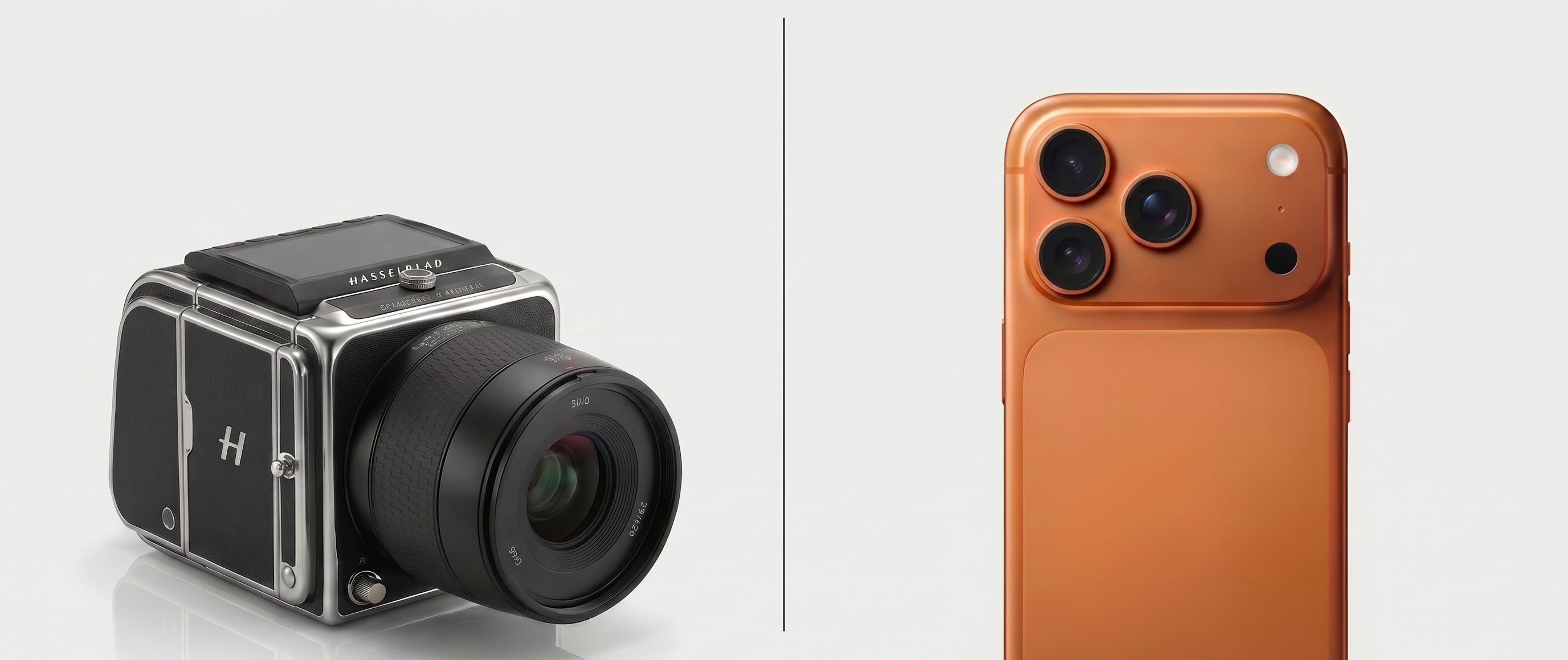
Hasselblad 907X: 100MP medium-format stills and 4K video, vs iPhone 17 Pro Max: 4K Dolby Vision at 24/25/30/60/100/120 fps, Cinematic mode up to 4K/30, Action mode up to 2.8K/60, and 1080p slow motion up to 240 fps — ultimate detail versus all-in-one speed and flexibility.

On the other side, there is the phone in my pocket. By any classical measure, an iPhone sensor is tiny, and its lens is humble. And yet it has quietly become the most consequential camera on Earth. Not because it out-resolves a Hasselblad — it does not — but because it does something a Hasselblad was never designed to do. It fuses dozens of frames in real time, it shoots video, it captures the laugh, the jump, the wave, the moment. It trades a little resolution for an honest record of what moves.
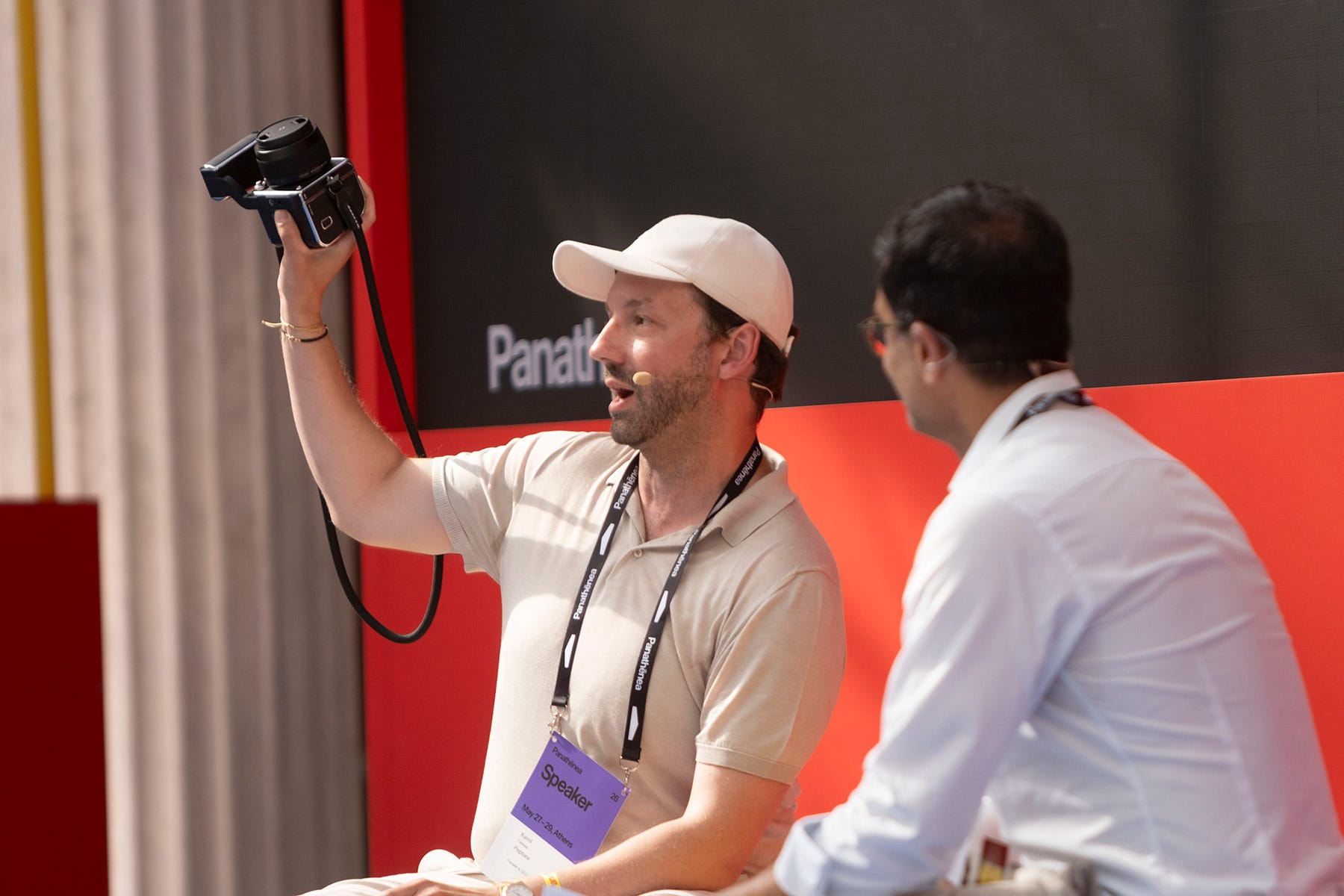
Yours truly, during the Panathaena festival of Arts, Science, and Tech in Greece (2026), with Hussein Kanji of Hoxton, giving a talk to a tech audience about disordered proteins and building a company to tackle them.

I keep coming back to this contrast, because it is the cleanest way I know to explain what my field has gotten wrong about proteins — and what a paper we just published is trying to fix.

For most of the modern history of structural biology, our ambition was Hasselblad ambition. We wanted the perfect still.

We crystallized a protein, hit it with X-rays, and reconstructed a single, gorgeous, atom-by-atom structure. We learned a tidy story along with it: sequence folds into structure, and structure dictates function.
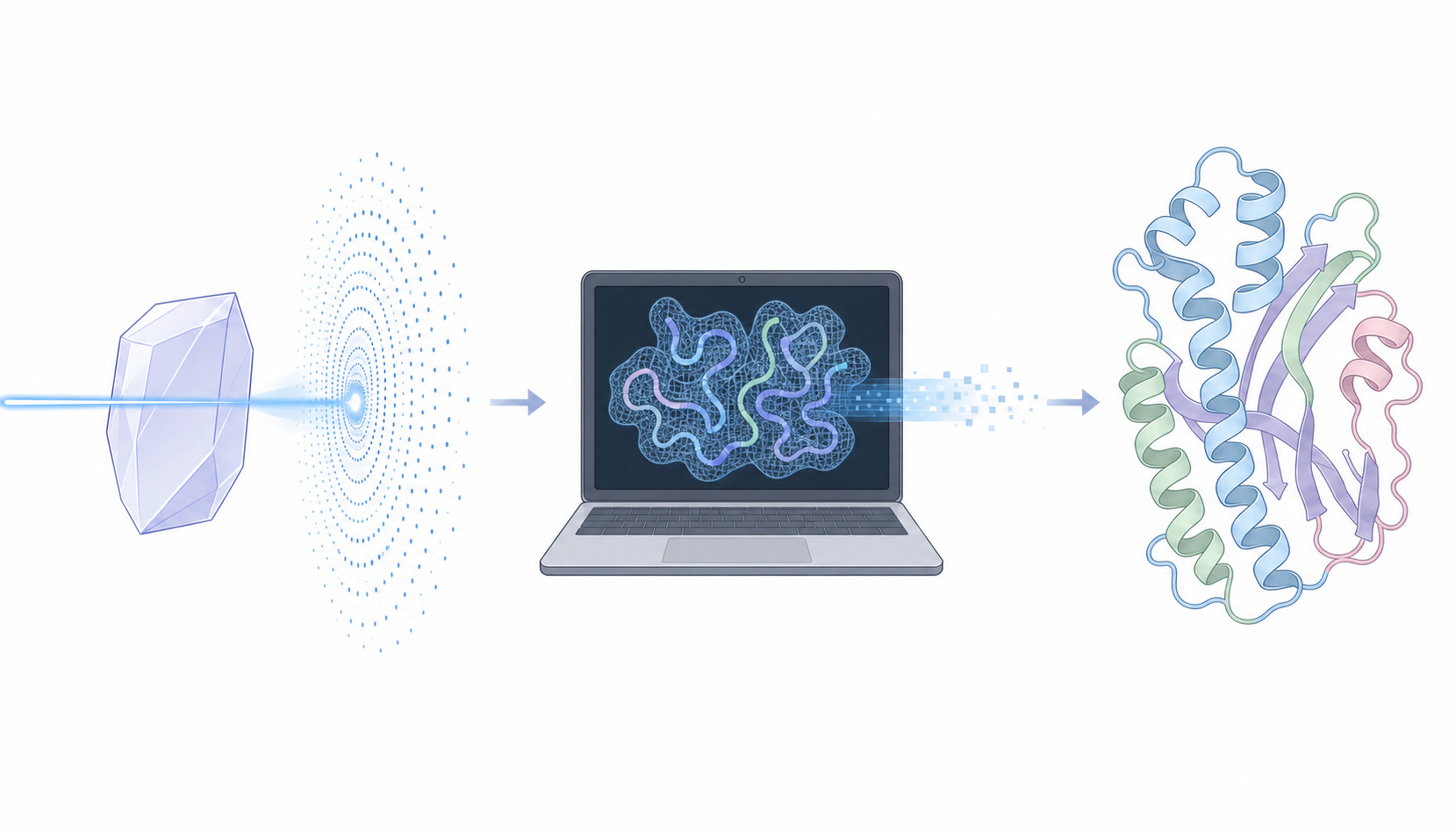
BioRender-style illustration showing X-ray diffraction computed into electron density to generate a protein structure.
Workflow illustrating the structural biology pipeline, where X-ray diffraction patterns from a protein crystal are computationally processed into 3D electron density to reconstruct the final atomic model.

Find the one true shape, find the pocket, design the drug. The whole edifice of classical, structure-based drug discovery is, in a sense, a Hasselblad pointed at biology — an instrument optimized to capture one immaculate, motionless frame at the highest possible resolution.
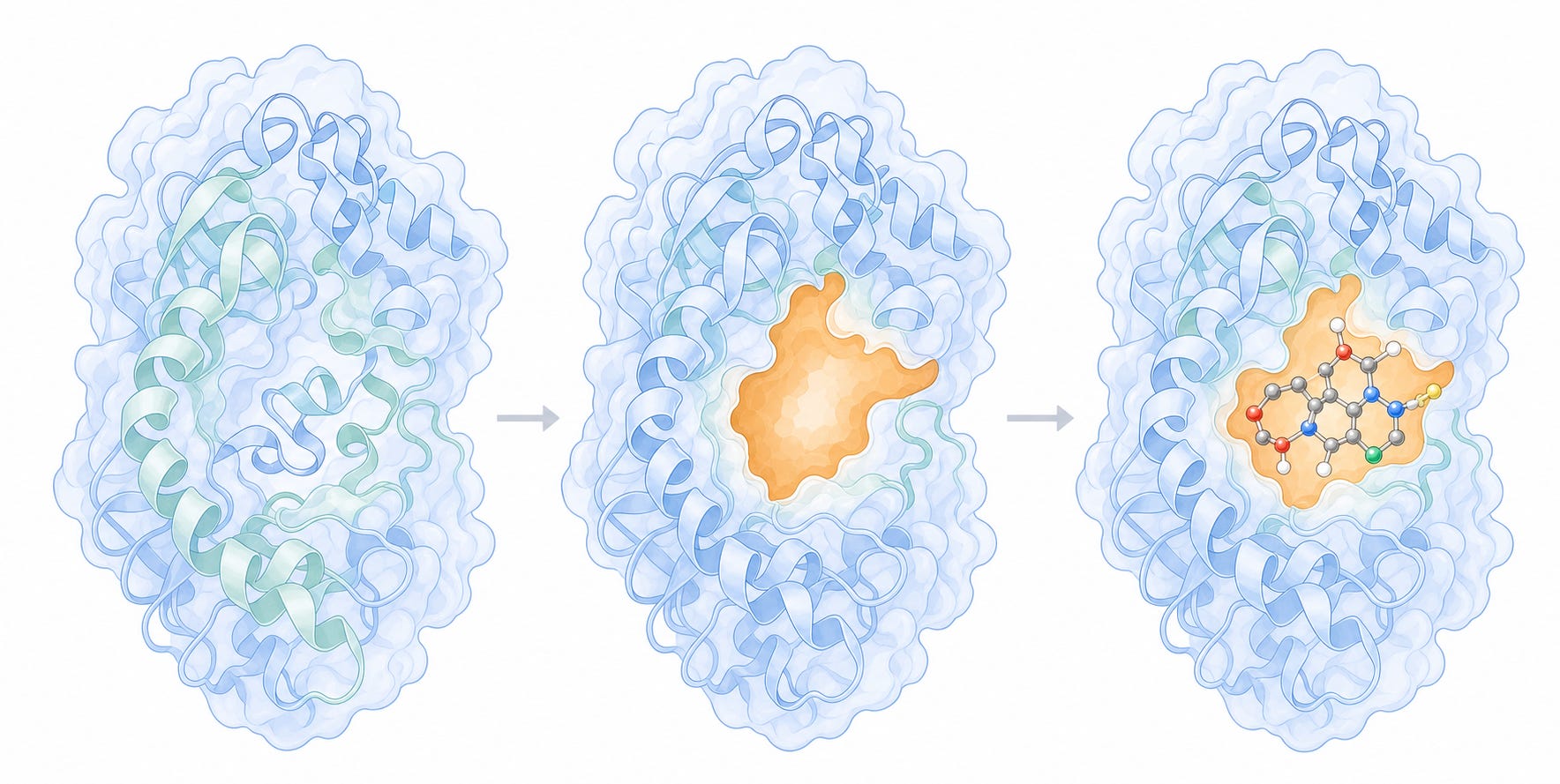
BioRender-style illustration of a protein structure, highlighted binding pocket, and a drug molecule docking.
An exemplary and oversimplified process of looking for a stable pocket in a well-folded protein that is the cornerstone of computer-aided drug discovery (CADD).

And for proteins that actually hold still, it is glorious. A well-folded enzyme sitting in its crystal is the perfect Hasselblad subject: posed, static, cooperative. Click. You get a masterpiece.

And we did not just take these portraits one at a time. We built an archive.

The Protein Data Bank is the great gallery of structural biology — a single, public repository where, for more than fifty years, every beautiful still we captured has been hung on the wall for everyone to study. Today it holds over 255,000 structures, the overwhelming majority of them solved by exactly the kind of Hasselblad instruments I have been describing: around four out of five by X-ray crystallography, with most of the rest from cryo-EM and NMR (RCSB Protein Data Bank). It is one of the most extraordinary collective achievements in all of science — a quarter of a million frozen frames of life’s machinery, each one painstakingly earned.
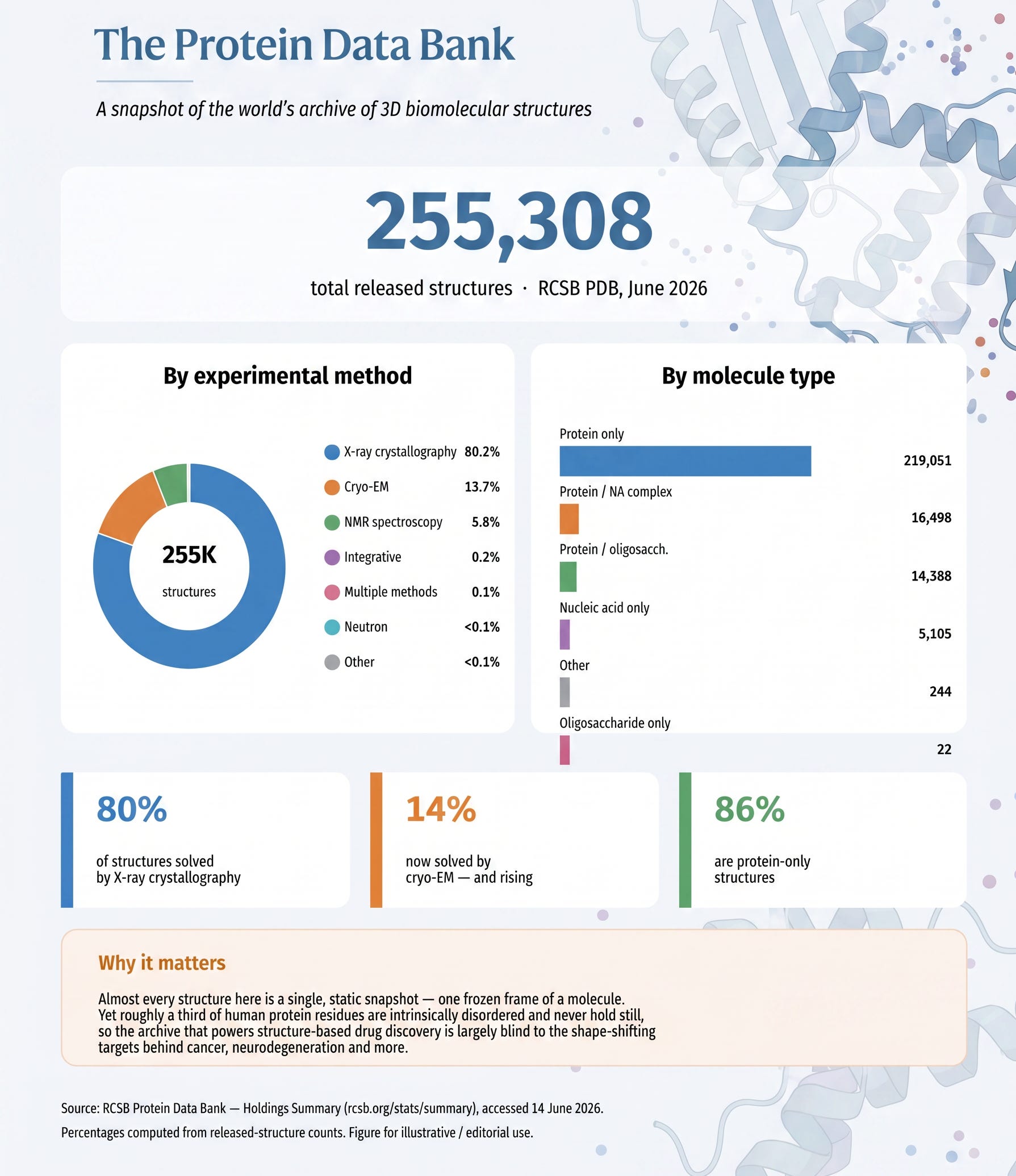
And here is where the story takes its most thrilling turn. Because once you have a gallery that large, you can do something new with it: you can teach a machine to paint.

That is, in essence, what AlphaFold did. DeepMind’s AlphaFold2, and now AlphaFold3, learned to predict a protein’s three-dimensional structure straight from its sequence — and they learned it by studying the Protein Data Bank. AlphaFold3 is explicitly built to predict “nearly all molecular types present in the Protein Data Bank,” trained on the very structures deposited there over decades (Abramson et al., Nature, 2024).
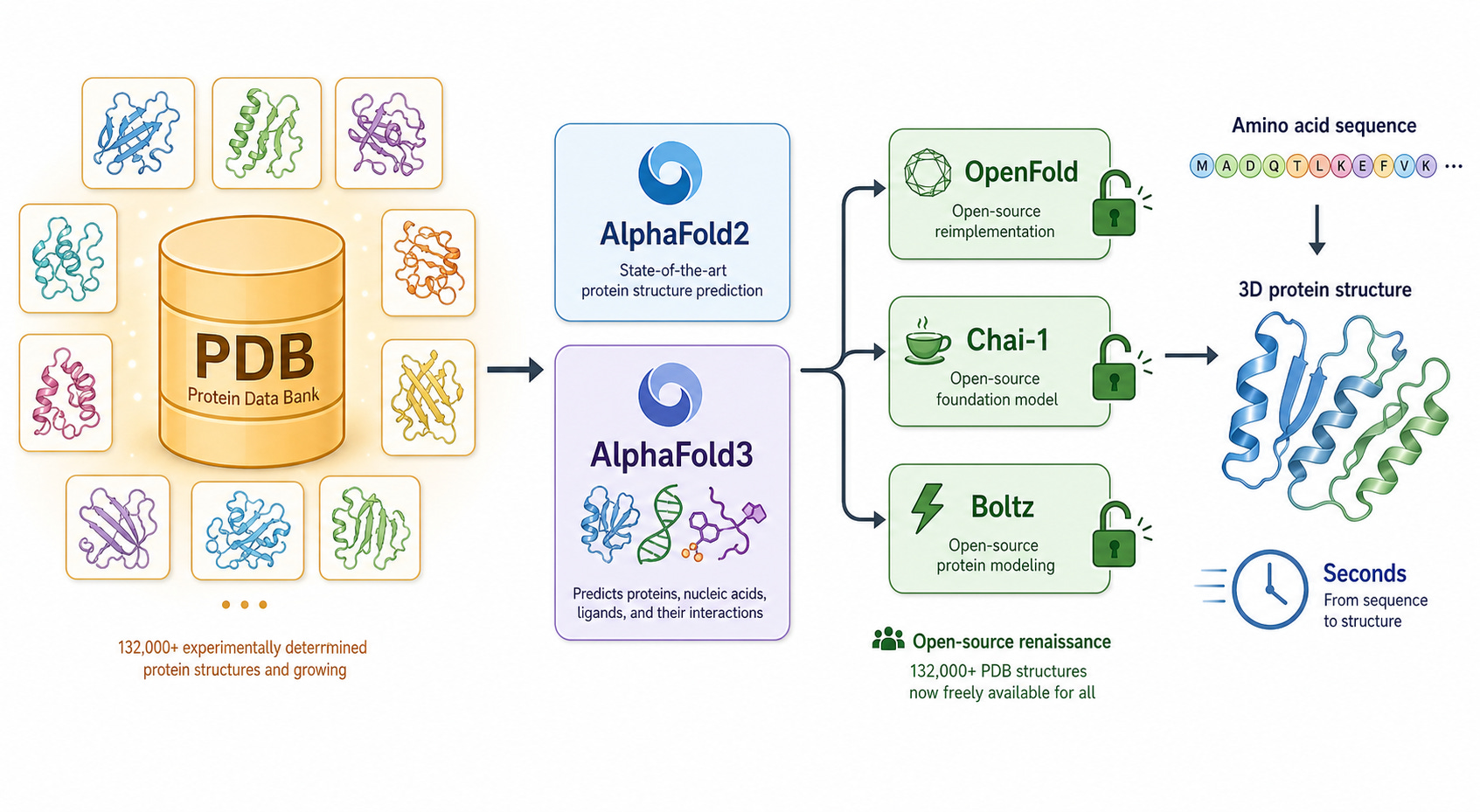
BioRender-style figure showing AlphaFold2, AlphaFold3, OpenFold, Chai-1, and Boltz trained on the PDB, predicting structures in seconds.
The Protein Data Bank (PDB) — built over decades of X-ray crystallography experiments — served as the training foundation for a lineage of structure prediction models: DeepMind's AlphaFold2 and AlphaFold3, followed by the open-source models OpenFold, Chai-1, and Boltz, each of which releases model weights publicly. Together, these models can conjure a plausible 3D structure from a bare amino acid sequence in seconds.

It was a staggering achievement, and it kicked off an open-source renaissance: OpenFold faithfully retrained the AlphaFold2 architecture from scratch on roughly 132,000 experimental PDB structures (Ahdritz et al., Nature Methods, 2024), while Chai-1 and Boltz reproduced AlphaFold3-level accuracy and released their weights to everyone — each of them, again, trained on the full PDB (Boltz-1, MIT Jameel Clinic). In just a few years, we went from one frozen frame at a time to models that conjure a plausible frame for almost any sequence we hand them, in seconds.

But notice what every one of these remarkable machines inherited from its teacher. They learned from a gallery of stills. They are, all of them, the most sophisticated Hasselblads ever built — trained on perfect portraits to produce another perfect portrait. Ask AlphaFold for a structure, and it will hand you one gorgeous, confident, motionless frame, because that is the only kind of picture its entire education ever contained.
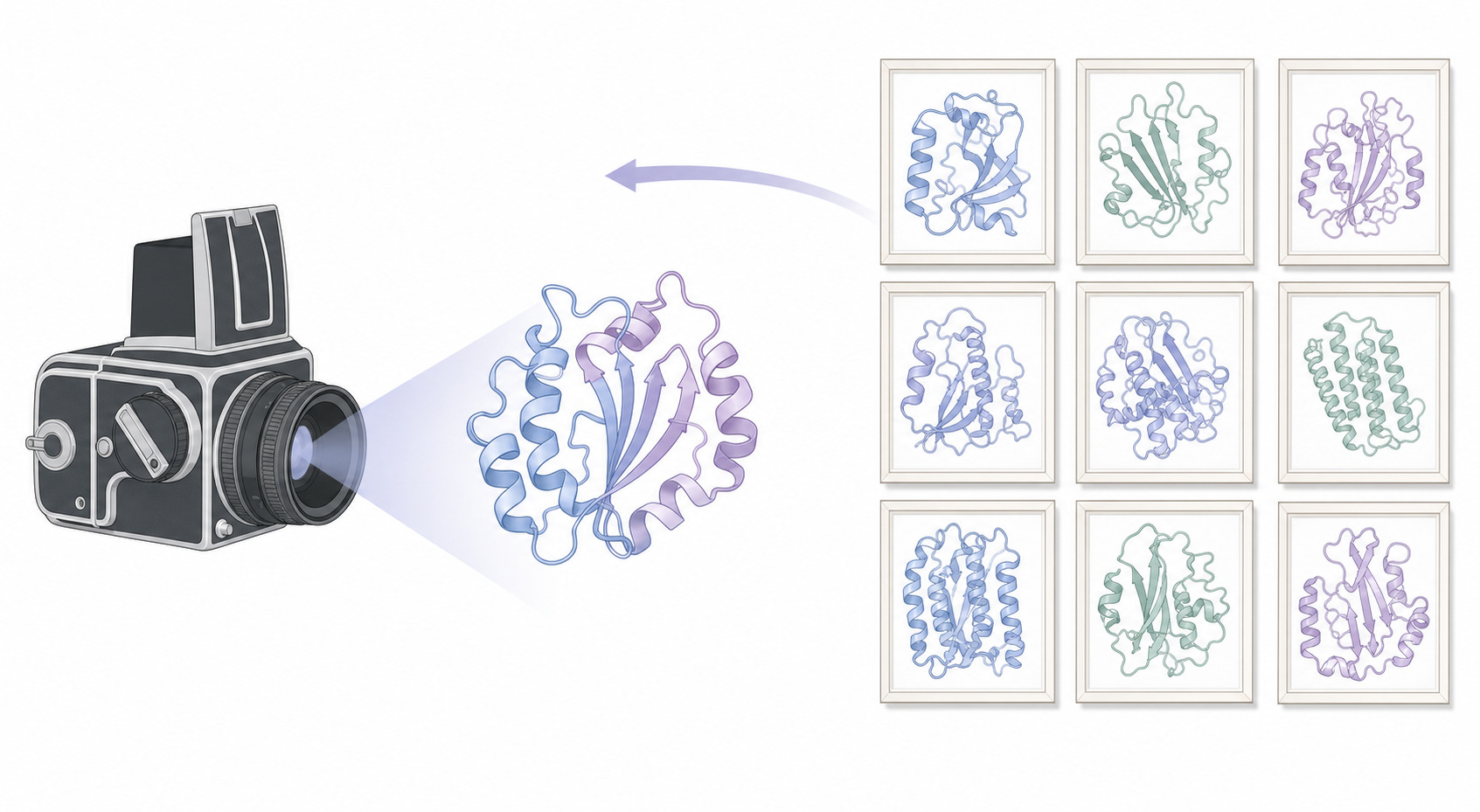
BioRender-style illustration of AI protein models as cameras trained on a gallery of frozen structural portraits.

For a protein that holds still, this is pure magic. For one that doesn’t, for example, human Androgen Receptor (AR), the key driver of prostate cancer, the machine simply paints you the most convincing still it can of a subject that never sits still in the first place — and hands it over with a confidence that hides the very thing you needed to know. Just see the image below, the ‘spaghetti’ parts of the protein are all red and, from a structural biochemistry and drug discovery perspective, unusable.
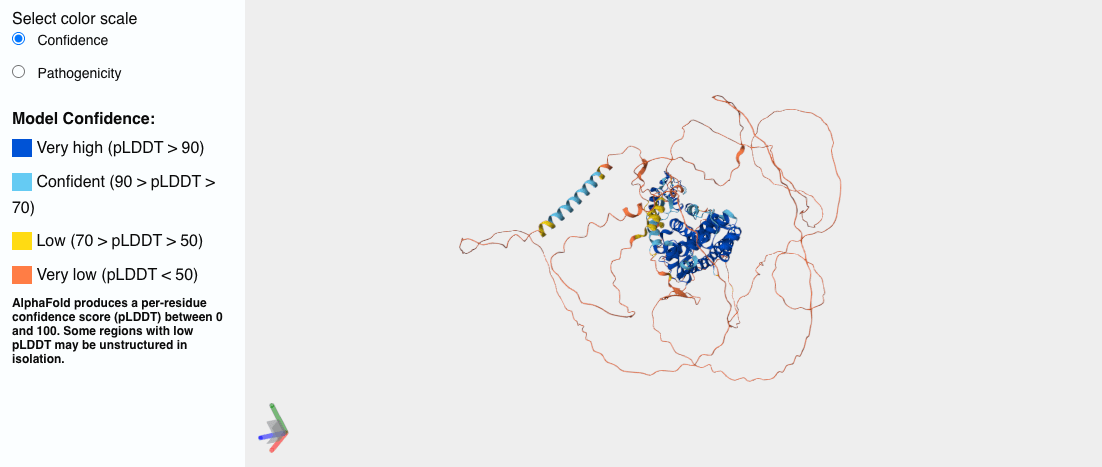
AlphaFold3 structural model of the full-length human androgen receptor (AR) coloured by per-residue confidence (pLDDT). The globular ligand‑binding domain and portions of the DNA‑binding domain are predicted with high confidence (dark and light blue; pLDDT > 70), whereas the extended N‑terminal transactivation region and other flexible segments appear as highly disordered chains with very low confidence scores (orange to red; pLDDT < 50), consistent with these regions being intrinsically disordered.

Asking a Hasselblad to photograph an intrinsically disordered protein is like asking it to photograph a hummingbird in flight. You will get one technically flawless frame of a blur — and you will learn almost nothing about how the bird actually flies.
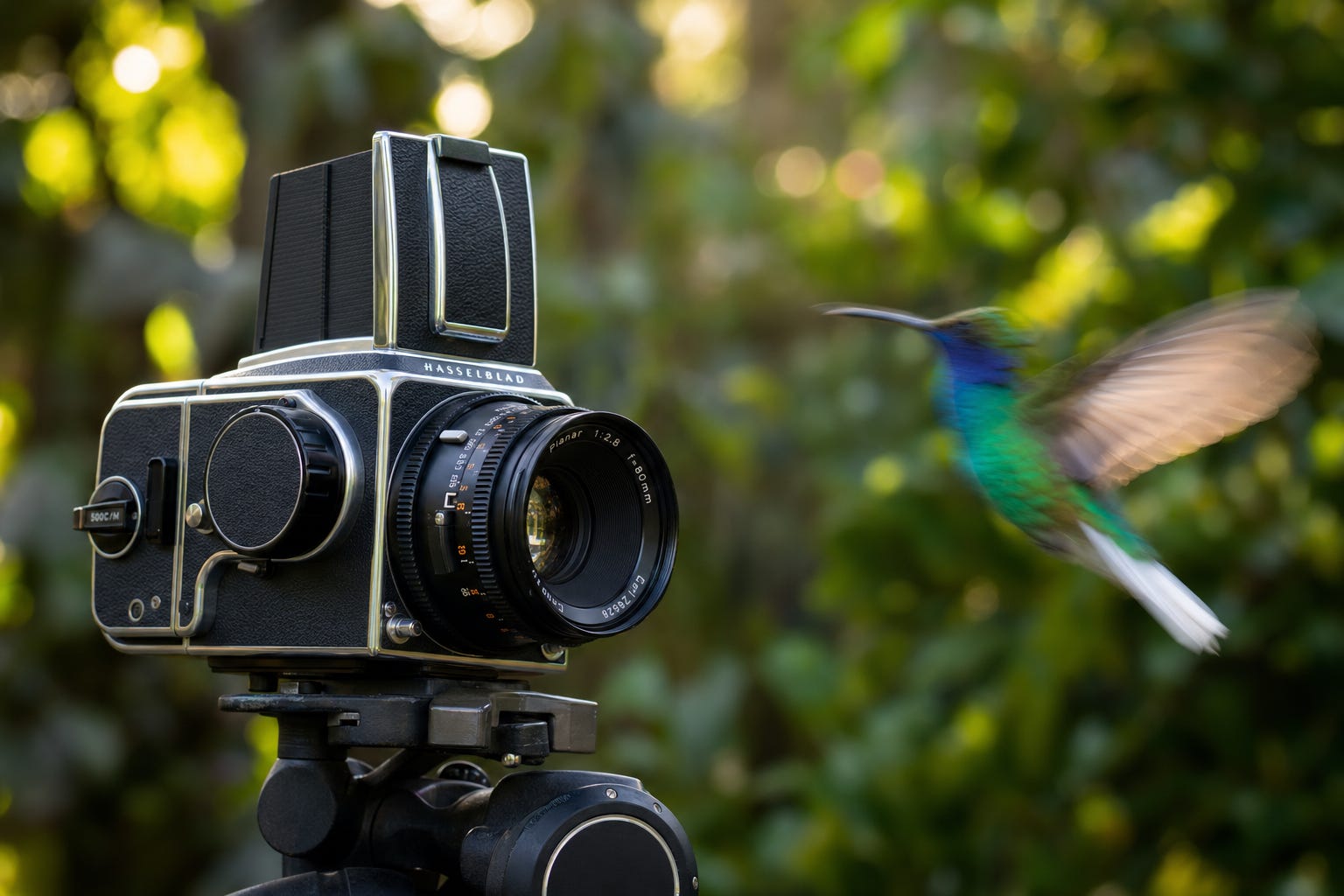
Hasselblad camera trying to photograph a blurred hummingbird to represent intrinsically disordered proteins

This is the part that took me years to fully internalize, so let me say it plainly.

For a disordered protein, a single high-resolution structure is not just insufficient — it can be actively misleading. It implies a permanence that does not exist. It is a photograph of a thing pretending to be something it is not. You walk away with a stunning image and a false belief: that the molecule looks like that.

It does not look like that. It looks like that, and that, and that — a shifting ensemble of interconverting shapes, most of them fleeting, visited and abandoned over and over. The function lives in the motion, not in any one frame, just like in the attached example of the ACTR protein.
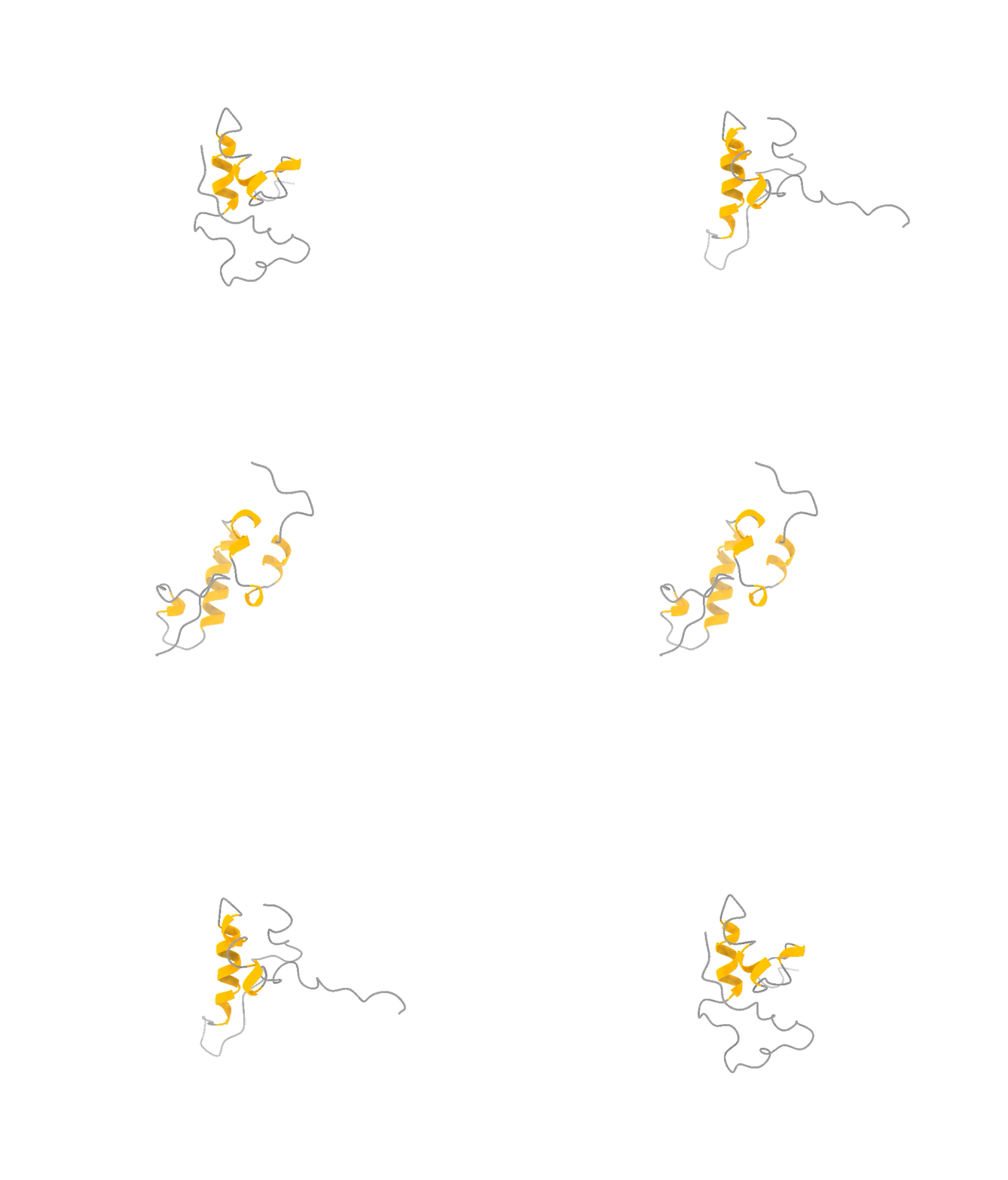
ACTR (Activator for Thyroid Hormone and Retinoid Receptors) is a 71-residue human intrinsically disordered protein (IDP) that functions as a transcriptional coactivator. In isolation, ACTR populates a broad, heterogeneous conformational ensemble and lacks a stable tertiary structure; however, upon binding to the nuclear coactivator binding domain (NCBD) of CREB-binding protein (CBP), it folds cooperatively into three amphipathic α-helices (h1, h2, h3) that form a stable complex.

So you face a genuine trade-off, and it is exactly the photographer’s trade-off. You can have one frame at the highest possible resolution and lose all the motion. Or you can accept slightly lower per-frame resolution and, in exchange, capture the thing that actually matters: the dynamics, the rare moments, the fleeting shapes the molecule briefly assumes when it is doing its job. For a hummingbird — and for a disordered protein — the second option is not a compromise. It is the only honest picture.

A Hasselblad gives you a singular state at high resolution. An iPhone gives you dynamics at sensible fidelity. For proteins that refuse to hold still, the iPhone wins — not despite the trade-off, but because of it.

Here is the detail I love most, because it maps so cleanly onto our work.

The iPhone does not beat physics. Its sensor really is small. What makes it extraordinary is computation — it captures many frames, understands how they relate in time, and fuses them into something richer than any single exposure could ever be. The intelligence is not in the glass. It is in how the frames are sampled and combined.

iPhone computationally fusing multiple frames of a timelapse sunset skyline

That is almost exactly what we set out to do with disordered proteins, except our “camera” is a physics simulation.

In our new paper in Nature Communications, my colleagues applied an enhanced-sampling method called On-the-fly Probability Enhanced Sampling — OPES — in a multithermal ensemble.
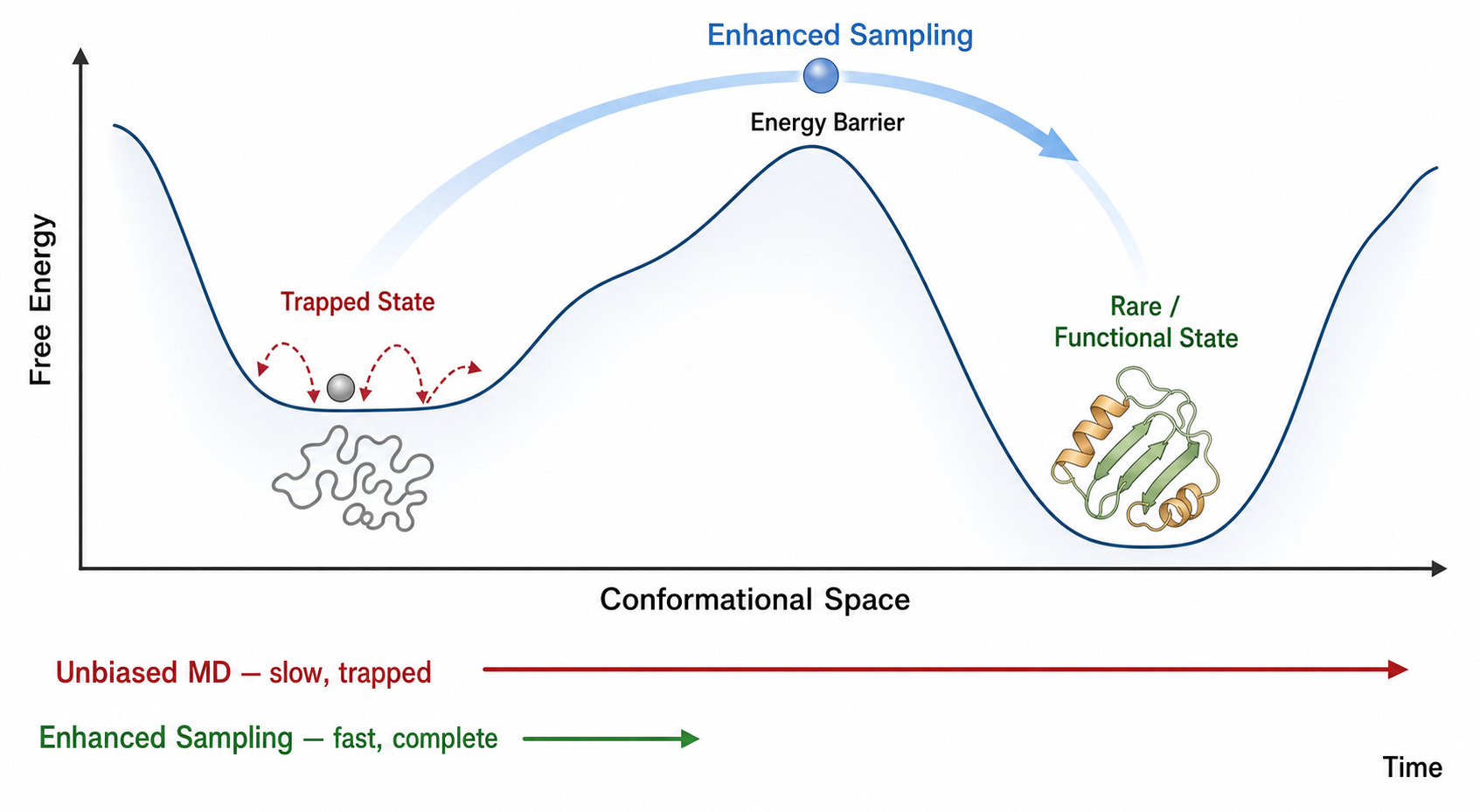
BioRender-style illustration of enhanced sampling in MD: overcoming energy barriers to access rare functional conformational states.
Enhanced sampling methods in molecular dynamics (MD) simulations are designed to overcome the fundamental timescale problem: standard unbiased MD trajectories become trapped in low-energy local minima, unable to surmount high free-energy barriers within tractable simulation times. By applying a bias potential that progressively flattens the free-energy landscape across conformational space, enhanced sampling methods enable a single simulation to escape local traps and reversibly visit rare, low-population states — including biologically functional conformations — that would otherwise remain inaccessible.

The technical achievement is that a single simulation replica diffuses across a wide temperature range and is reweighted back to physiological conditions, instead of running the brittle, parameter-heavy replica-exchange machinery these simulations normally demand (Streit et al., 2026). Think of it as one clever, computationally fused exposure rather than a cumbersome rig of cameras all firing at once.
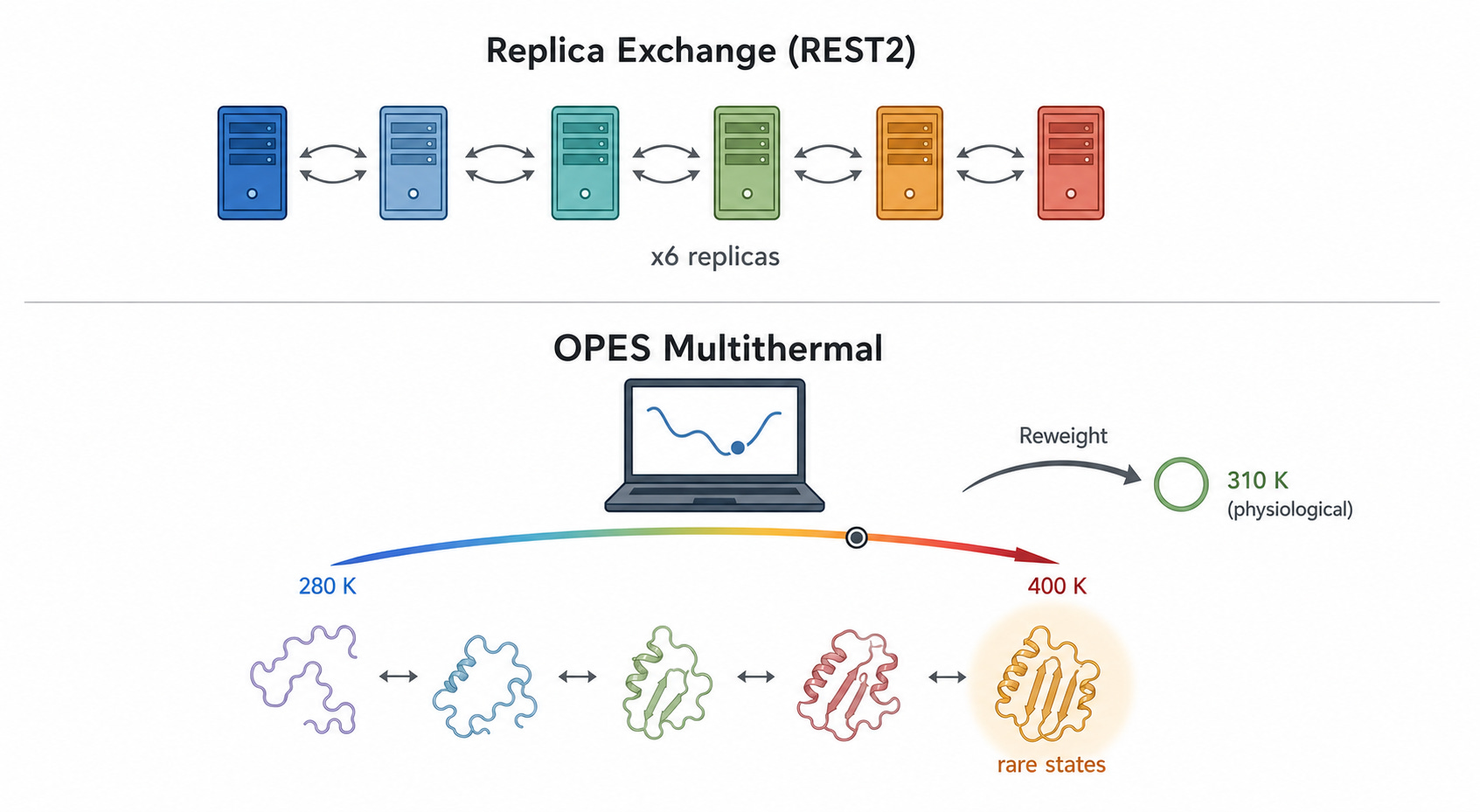
Reworked BioRender-style figure contrasting REST2 replica-exchange with OPES single-replica multithermal sampling and physiological reweighting.
Comparison of replica-exchange (REST2) and OPES multithermal enhanced sampling strategies for intrinsically disordered proteins. In REST2, multiple parallel simulation replicas — each held at a distinct temperature — must continuously exchange configurations, imposing significant computational overhead and parameter tuning. In OPES multithermal sampling, a single simulation replica diffuses autonomously across the full temperature range via a converged bias potential and is subsequently reweighted to physiological conditions (310 K), eliminating the need for replica exchange. Critically, OPES accesses rare, low-population folded conformational states not sampled by REST2 or unbiased MD, as demonstrated for the intrinsically disordered protein ACTR (Streit et al., Nature Communications, 2026).

And the OPES “footage” holds up against reality. Compared to the older REST2 approach and to plain simulations, it produces consistent ensemble averages, converges faster, and — crucially — explores broader conformational space, catching low-population states the other methods miss (Streit et al., 2026). Lower drama, more honest motion.

We pointed this iPhone-style camera at ACTR, a 71-residue disordered transcriptional coactivator that only folds when it meets its partner. In its free state, ACTR looks like exactly what the textbooks promise: a floppy, structureless chain. Photograph it with a Hasselblad and you would conclude there is nothing there to see.

But the motion told a different story. Our simulations revealed a rare, low-population set of transiently structured states — populated only a few percent of the time — in which multiple α-helices fold cooperatively and form genuine tertiary contacts, a fleeting, binding-competent shape the protein visits and then lets go (Streit et al., 2026). This is the laugh in the candid photo. The wave. The moment a posed portrait would never have caught.
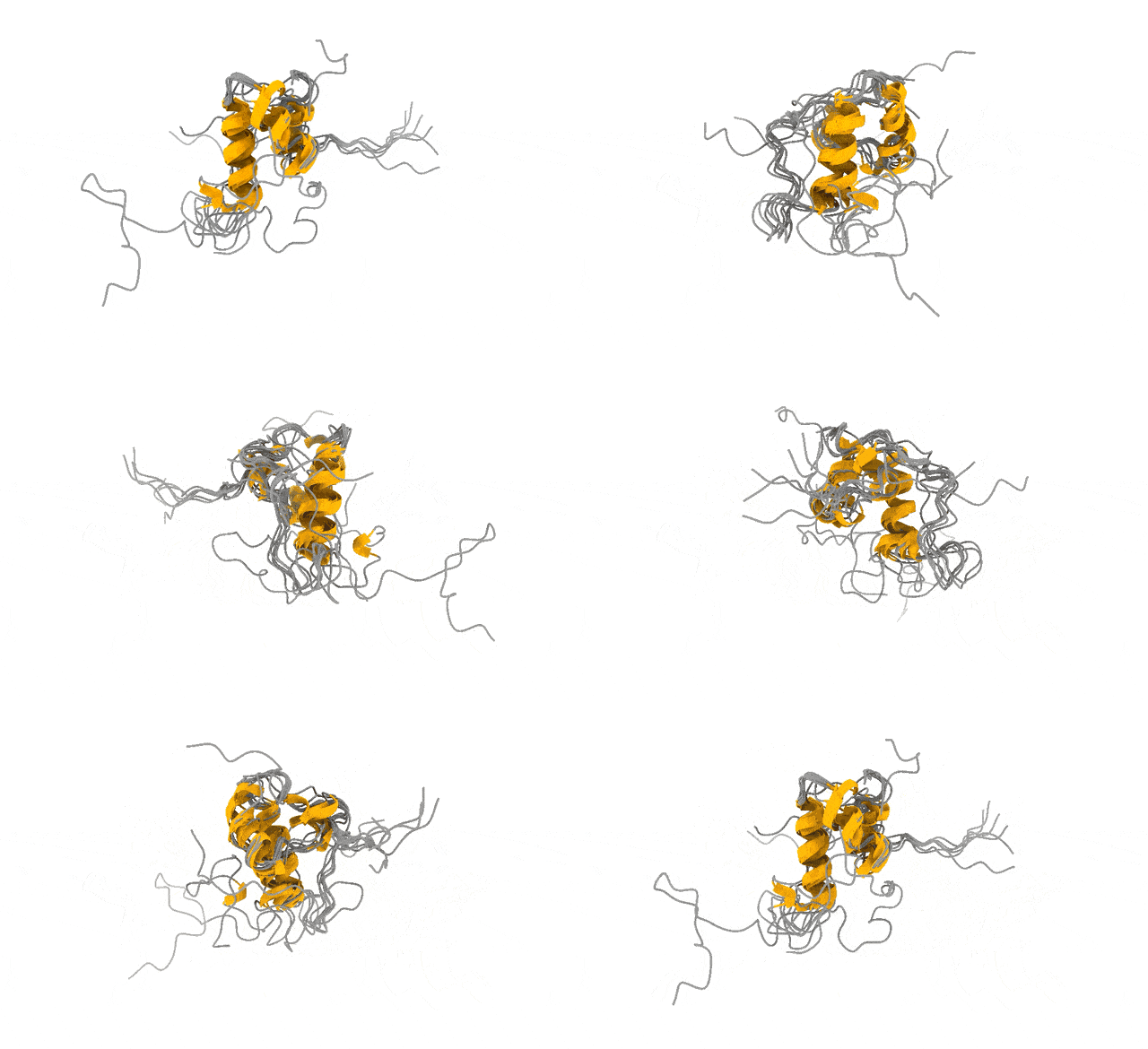
And these are not numerical ghosts. The states are reversibly sampled, separated from the disordered ground state by only a modest free-energy barrier, and — the part that matters most to me — consistent with extensive NMR and SAXS data we used to validate the ensemble (Streit et al., 2026). The physics and the experiments agree on what the candid shot shows.

Why should anyone outside a biophysics lab care?

Because those fleeting, partially folded conformations may harbor exactly the kind of binding pockets that make an “undruggable” disordered protein suddenly addressable.

You cannot design a drug against a pocket you have never seen. And you will never see this one with a Hasselblad.

None of this means the Hasselblad is obsolete. For a folded enzyme with a deep, stable pocket, the perfect high-resolution still is still the right tool, and I would reach for it every time. The mistake was never owning a Hasselblad. The mistake was believing it was the only camera worth owning — and pointing it at subjects it was never built to capture.

The lesson photography taught me, and the lesson this paper makes concrete, is the same one:

Resolution is not the same as understanding.

A slightly lower-resolution picture that captures motion can tell you infinitely more than a flawless picture of a single frozen instant — when the truth of your subject is the motion.
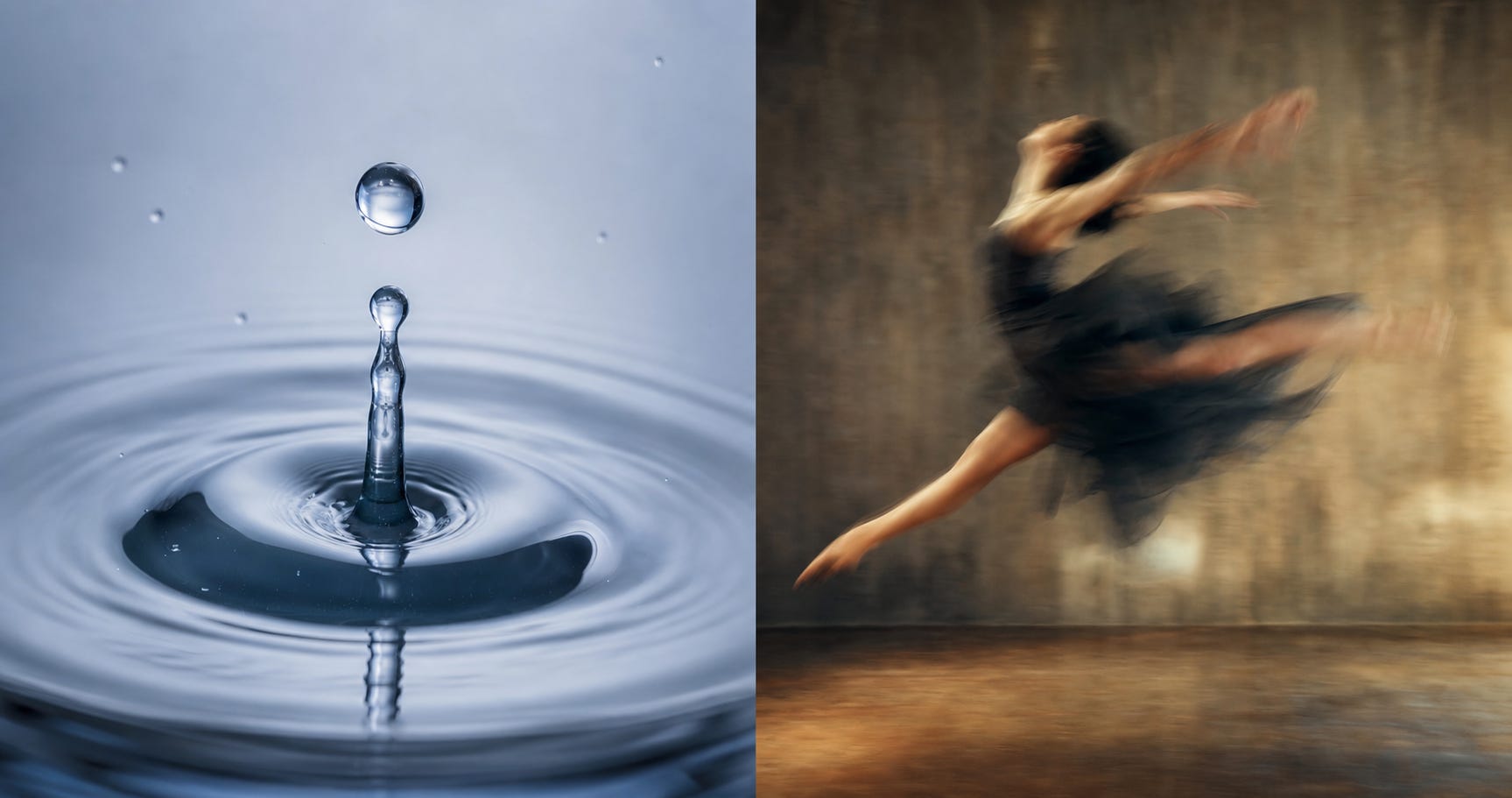
Motion blur conveying more understanding than a frozen instant
Resolution is not understanding. The droplet is frozen in flawless detail — yet tells you nothing about the rain. The dancer is a blur — yet you can feel the leap.

For a third of the proteins in your body, the truth is the motion. Just like the human body, the proteins we care about are always in motion. So we stopped trying to take the perfect photograph and started shooting the honest, computationally fused, slightly lower-resolution footage instead. It is the least glamorous-sounding upgrade in the world. Trade a little resolution, catch the moment.

  • Big thanks to Kareem Reeda for reading, reviewing, and providing critical suggestions.

  • I want to cordially thank our Scientific Advisory Board member, Prof. Kresten Lindorff-Larsen of the University of Copenhagen, for his continued scientific support and for spearheading our efforts to advance understanding of disordered proteins.

  • I want to express my sincere gratitude to Dr. Julian Streit, who conducted this project jointly with our Peptone team: Dr. Michele Invernizi and Dr. Sandro Bottaro.

Discussion about this post

Ready for more?