




Recent PhD graduate Nikhita Joshi has won the Governor General’s Gold Medal, one of Canada’s highest academic honours.
To be considered for the University-wide competition, doctoral students must first be selected as the recipient of their faculty’s top doctoral prize. After winning first place in the Faculty of Mathematics’ Doctoral Prize competition, Nikhita was named the faculty’s nominee for the Governor General’s Gold Medal. She is one of three students receiving this honour at Spring Convocation.
“I’m incredibly honoured to have received the Governor General’s Gold Medal, and I’m thrilled that my work has been recognized in such a profound way,” says Nikhita. “I owe immense gratitude to my advisor, Daniel Vogel, for his support and encouragement. I’ve thoroughly enjoyed being a student at the University of Waterloo, and I’ll look back fondly on this time for years to come.”
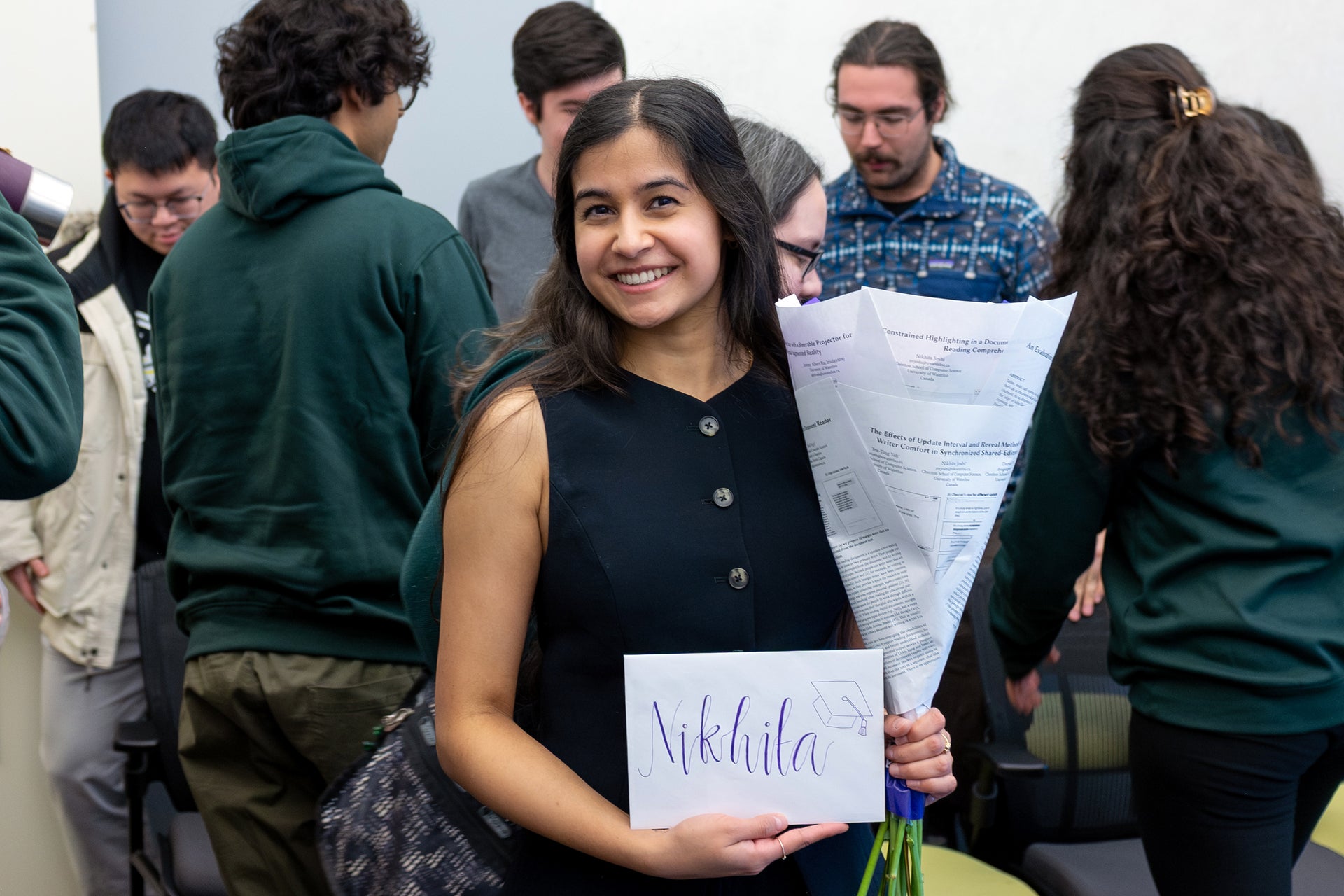
Nikhita Joshi celebrates with members of the HCI Lab after her PhD defence in November 2025. To mark the occasion, her lab created a bouquet composed of research papers she published during her doctoral studies.
For over 150 years, the Governor General’s Gold Medal recognizes graduate students who demonstrate exceptional scholastic achievement, innovative research, and outstanding academic performance. Past recipients of the Governor General Academic Medal include former Prime Ministers Pierre Elliot Trudeau and Kim Campbell, renowned physicist Sylvia Fedoruk, and celebrated author Gabrielle Roy. Nikhita is also the first person from the Cheriton School of Computer Science to win this award in ten years.
Nikhita’s doctoral research has been praised widely by the human–computer interaction (HCI) community for revealing insights into digital reading, writing interfaces, and human–AI collaboration, with implications for the design of future technologies.
Traditionally, constraints in user interface design have been used to make tasks easier, faster and less error-prone. Drawing on theories from psychology, Nikhita explored whether such constraints could instead help unlock users’ potential, particularly in reading, writing, and critical thinking tasks.
“In today’s research climate, it’s actually quite brave to centre an HCI dissertation on conventional graphical user interfaces,” says her supervisor Professor Daniel Vogel. “Basic interactions like scrolling, highlighting, and text entry seem so well studied that there’s nothing left to do. But Nikhita challenges that assumption by making them harder, slower, or even impossible to uncover new human-centred benefits.”
Rather than focusing on traditional user interface efficiency, Nikhita examined the impact of constraints on “when” and “where” users can interact with tasks — for example, when users can submit a prompt or where they can view a document. To support this research, she designed a suite of software tools and conducted studies involving nearly 1,000 participants.
In one study, Nikhita found that limiting the number of words users could highlight significantly improved reading comprehension, providing empirical support for the drawbacks of excessive highlighting on learning. The restriction encourages participants to think more critically about the text by focusing on key concepts and words. This groundbreaking work won a Best Paper Award at CHI 2024, the Conference on Human Factors in Computing Systems, the leading international HCI conference. The findings were also covered by major outlets, including Phys.org.
Over the past decade, HCI researchers have increasingly explored how AI can improve task efficiency without undermining human capabilities. Nikhita addressed this challenge by exploring AI-powered margin note systems, similar to the commenting feature in Google Docs. This part of her dissertation focused on constraining “where” people can write or prompt a comment and “when” it can be finalized.
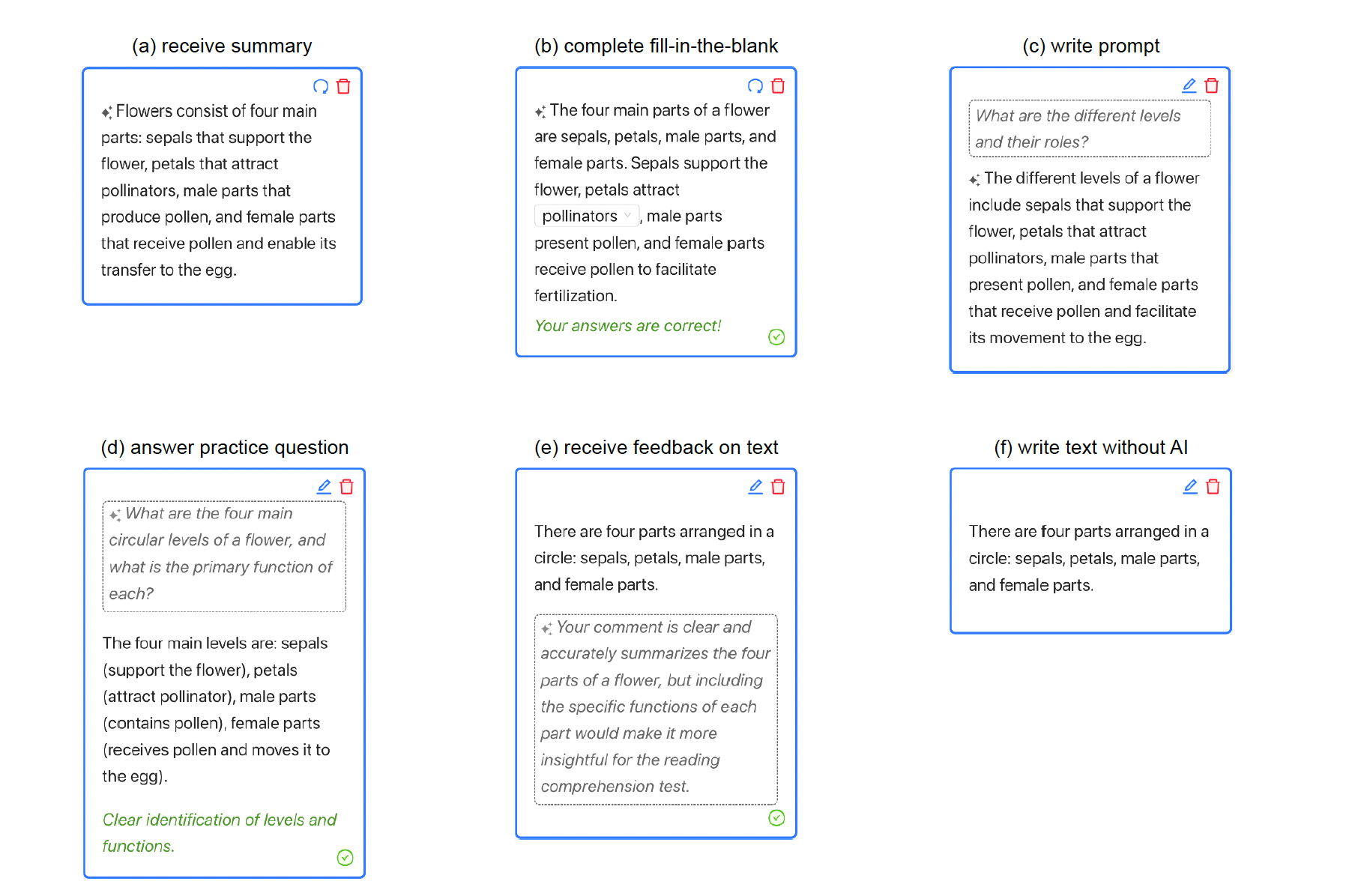
Nikhita created six AI-powered margin notes with varying degrees of human and AI involvement. Instead of using ChatGPT in a different tab, we can study with AI all at once!
She developed six margin note features with varying degrees of human and AI involvement, ranging from note-taking without AI assistance to AI-assisted feedback on user comments to fully AI-generated summaries with interactive components such as fill-in-the-blank sections and practice tests. Notably, tasks with more human involvement led to higher psychological ownership but did not significantly affect reading comprehension. This finding was unexpected, as many researchers hypothesize that AI-heavy assistance can impede reading comprehension by lowering user engagement. Likewise, most participants preferred the AI-heavy methods because they were faster and less demanding.
Nikhita also discovered that AI-assisted writing increased feelings of ownership when users wrote longer prompts, as it encouraged participants to add personalized elements to their AI-generated content. She then designed user interface features that incorporated time delays, such as holding the submission button for 20 to 60 seconds or moving a slider before the deadline. Ultimately, these constraints successfully increased prompt length as well as feelings of ownership. Parts of this work led to a recently published paper that has already been cited 35 times, demonstrating its strong impact.
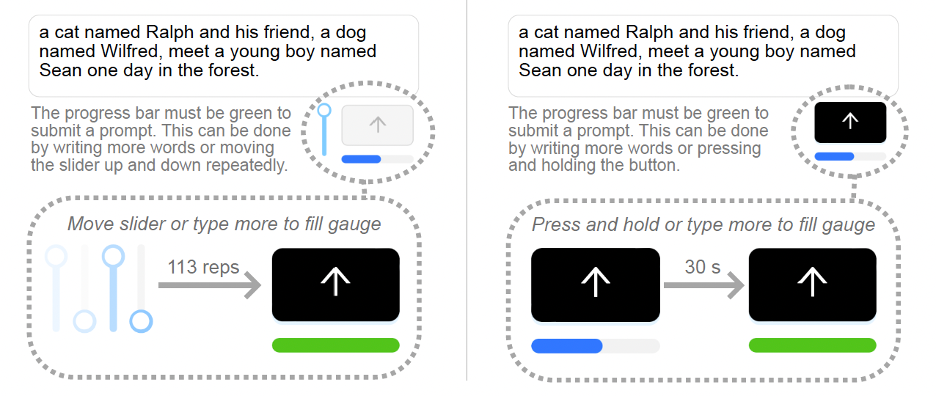
Don't want to wait? Just write more! Nikhita discovered that time-delay features successfully boosted prompt length and feelings of ownership.
Overall, Nikhita’s research has the potential to transform everyday tasks, from studying to writing. These insights offer valuable guidance for user experience designers, engineers and software developers, especially in today’s rapidly evolving human–AI landscape.
The Governor General’s Gold Medal adds to her impressive list of awards and achievements. In 2024, Nikhita was named a Rising Star in Computer Science at MIT and was selected as a Heidelberg Laureate Forum Young Researcher, prestigious international programs for exceptional early-career researchers. She has published extensively on topics including augmented reality, gestural input, and software learning. Four of her papers have received awards, including a Best Paper Award at SUI 2022, the ACM Spatial User Interaction Symposium, for innovative research on an instrumented office chair to support work tasks and productivity.
“Huge congratulations to Nikhita! This award underscores an outstanding trajectory, reflected in leadership roles within the HCI community and an enviable record of prestigious academic honours and top-tier publications,” says Professor Vogel.
Currently, Nikhita is an NSERC Postdoctoral Fellow at Université Paris-Saclay, working in one of the world’s leading HCI research groups and continuing to advance technological boundaries to better support human learning.
此内容由惯性聚合(RSS阅读器)自动聚合整理,仅供阅读参考。 原文来自 — 版权归原作者所有。