



惯性聚合 高效追踪和阅读你感兴趣的博客、新闻、科技资讯
阅读原文 在惯性聚合中打开

推荐订阅源

Security Archives - TechRepublic
Project Zero
Project Zero
K
Kaspersky official blog
G
Google Developers Blog
T
Threat Research - Cisco Blogs
T
The Blog of Author Tim Ferriss
Cyberwarzone
Cyberwarzone
Y
Y Combinator Blog
Recorded Future
Recorded Future
Blog — PlanetScale
Blog — PlanetScale
Threat Intelligence Blog | Flashpoint
Cisco Talos Blog
Cisco Talos Blog
Latest news
Latest news
Microsoft Security Blog
H
Help Net Security
S
Schneier on Security
P
Palo Alto Networks Blog
H
Hacker News: Front Page
N
News and Events Feed by Topic
N
Netflix TechBlog - Medium
博客园 - Franky
OSCHINA 社区最新新闻
OSCHINA 社区最新新闻
SecWiki News
SecWiki News
Cloudbric
Cloudbric
TaoSecurity Blog
TaoSecurity Blog
CTFtime.org: upcoming CTF events
The Hacker News
The Hacker News
C
Check Point Blog
L
LangChain Blog
腾讯CDC
小众软件
小众软件
T
Tenable Blog
Google DeepMind News
GbyAI
GbyAI
L
LINUX DO - 最新话题
A
About on SuperTechFans
Google Online Security Blog
C
Cisco Blogs
Recent Announcements
Hacker News: Ask HN
Hacker News: Ask HN
freeCodeCamp Programming Tutorials: Python, JavaScript, Git & More
Vercel News
Vercel News
雷峰网
雷峰网
美团技术团队
D
DataBreaches.Net
Martin Fowler
Martin Fowler
Help Net Security
Help Net Security
钛媒体:引领未来商业与生活新知
钛媒体:引领未来商业与生活新知
F
Full Disclosure
博客园_首页

Cheriton School of Computer Science

Computer science students receive Ontario Graduate Scholarships | Cheriton School of Computer Science | University of Waterloo Q&A with Professor Dan Brown: Exploring societal, ethical and legal questions surrounding generative AI | Cheriton School of Computer Science | University of Waterloo Waterloo computer scientists receive more than $1.3M in federal funding | Cheriton School of Computer Science | University of Waterloo Ahmed Alquraan wins 2026 Cheriton Distinguished Dissertation Award | Cheriton School of Computer Science | University of Waterloo Technovation Girls Waterloo celebrates two milestones | Cheriton School of Computer Science | University of Waterloo Dave Tompkins receives 2026 Faculty of Mathematics Award for Distinction in Teaching | Cheriton School of Computer Science | University of Waterloo Victor Zhong, Jimmy Lin awarded $1.64M NSERC Alliance grant to develop deep research agents for natural science research and development | Cheriton School of Computer Science | University of Waterloo Computer scientists develop zero-shot algorithm for de novo sequencing of post-translationally modified peptides | Cheriton School of Computer Science | University of Waterloo Yaoliang Yu wins 2026 Faculty of Mathematics Golden Jubilee Research Excellence Award | Cheriton School of Computer Science | University of Waterloo Cheriton School of Computer Science faculty members receive 2025 Outstanding Performance Awards | Cheriton School of Computer Science | University of Waterloo Nikhita Joshi awarded prestigious Governor General’s Gold Medal | Cheriton School of Computer Science | University of Waterloo Systems and networking researchers win NOMS 2026 Best Paper Award | Cheriton School of Computer Science | University of Waterloo Gautam Kamath and collaborators awarded 2026 Gödel Prize | Cheriton School of Computer Science | University of Waterloo Computer science students win prestigious Faculty of Mathematics Doctoral Prizes | Cheriton School of Computer Science | University of Waterloo Jian Zhao receives 2025 Early Career Research Award from CS Can | Info Can | Cheriton School of Computer Science | University of Waterloo Technovation Waterloo presents girl-powered-apps | Cheriton School of Computer Science | University of Waterloo Computer Science PhD alumna Claudia Maria Bauzer Medeiros receives 2026 ACM Presidential Award | Cheriton School of Computer Science | University of Waterloo Ryusuke Sugimoto receives multiple prestigious dissertation awards | Cheriton School of Computer Science | University of Waterloo Mars Xiang and Max Jiang jointly win 2026 Germain-Erdős Undergraduate Award in Mathematical Research | Cheriton School of Computer Science | University of Waterloo Raouf Boutaba appointed Canada Research Chair in Network Intelligence | Cheriton School of Computer Science | University of Waterloo Marina Meila appointed Canada Research Chair in Reliable Structure Discovery | Cheriton School of Computer Science | University of Waterloo Coding Art into Masterpieces | Cheriton School of Computer Science | University of Waterloo Software engineering researchers win ACM SIGSOFT Distinguished Paper Award at FORGE 2026 | Cheriton School of Computer Science | University of Waterloo
A wide web of words | Cheriton School of Computer Science | University of Waterloo
Joe Petrik · 2026-07-15 · via Cheriton School of Computer Science

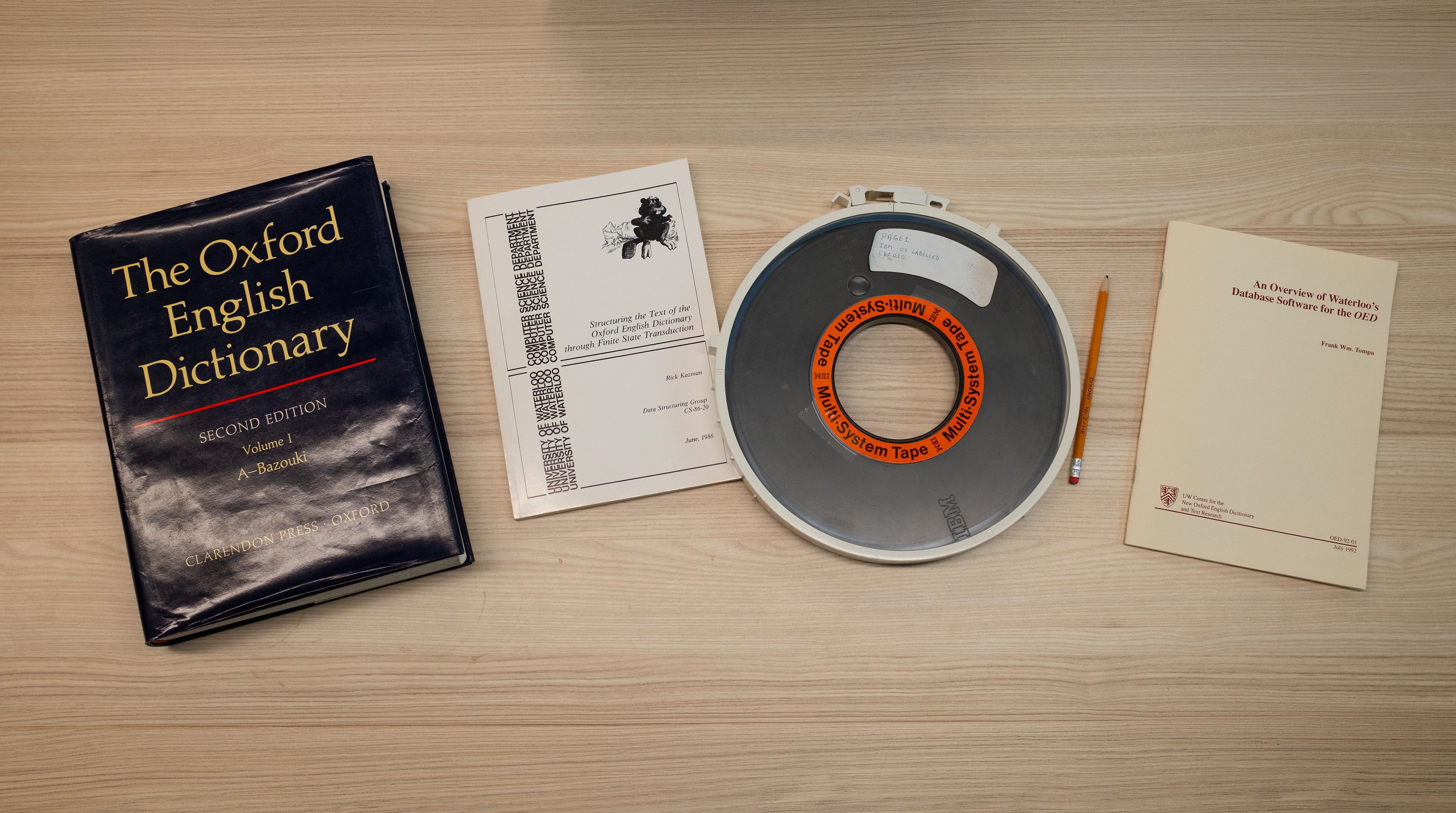
photos of an Oxford English Dictionary, two reports and magnetic computer tape

In an age of search engines, online databases, and AI assistants, it is easy to forget that for most of modern history research was done using books, paper, and pencils. If you have ever looked up a definition or searched the etymology of a word online instead of driving to the library, you have the Waterloo innovators behind the New Oxford English Dictionary Project to thank.

When the original Oxford English Dictionary — the largest and most comprehensive history of the English language ever created — was published in 1928, it was the result of more than 70 years of collective effort. Researchers had begun collecting historical examples of word use in 1857. In the decades that followed, more than 800 volunteers collected millions of quotations, which they wrote out by hand on slips of paper.

Between 1884 and 1928, Oxford University Press (OUP) published 125 small books containing definitions as they finished them, which they then collected into a 12-volume set containing more than 400,000 definitions. There was just one problem: the dictionary had taken so long to assemble that it was already out of date! By 1933, OUP published the first of four eventual supplements containing new words: users would have to look up a word in the original dictionary, then check the supplement separately if they couldn’t find it.

In the 1980s, the publishers at OUP decided it was time to create a second, complete edition of the Oxford English Dictionary — ideally in less than seventy years. That’s where the cutting-edge Department of Computer Science at the University of Waterloo came in.

Read the full article on Waterloo News.