背景
最近刷到一篇博客,吐槽torchtext不能做多标签任务,特来为torchtext鸣不平,看好,我要用torchtext做多标签任务了。
简要
- 解读
- torchtext库,做多标签任务
- 实践
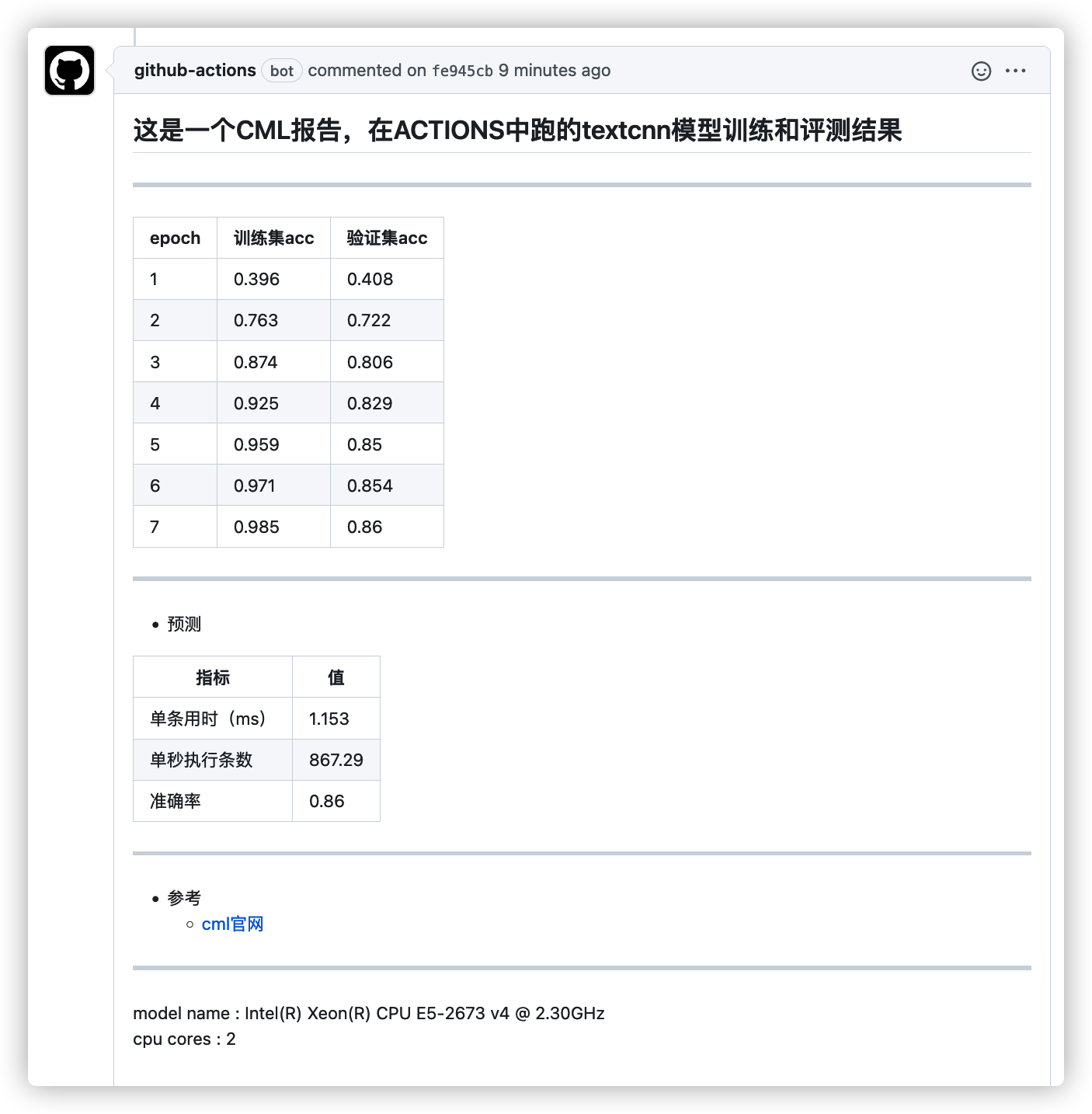
- textcnn模型,跑百度事件多标签比赛,验证集准确率accuracy达到
86%
- textcnn模型,跑百度事件多标签比赛,验证集准确率accuracy达到
- 运行
github的action中,完成全程训练、批测,结果报告通过cml工具发送至commit评论
解读
- 如何用torchtext库,做多标签任务
读取数据
顾名思义,多标签任务像是不定项选择题,是一条样本对应一个或多个标签,也可以没有对应标签,所以标注字段不能再用sequential=False参数,要对标注列进行切分,源码中的注释说明:
sequential: Whether the datatype represents sequential data. If False, no tokenization is applied. Default: True.
写入标签数据
<pad>表示占位符没有任何意义
echo -e "label\n汽车&&银行\n汽车&&天气\n天气\n<pad>\n咖啡" > label.tsv字段设置
以&&切分标注标签,那么可以这样写:
label = torchtext.data.Field(
    tokenize=lambda x: x.split("&&"), unk_token=None
    )
读取Dataset
dataset = torchtext.data.TabularDataset(
            path="label.tsv",
            format="tsv",
            skip_header=True,
            fields=[("label", label)],
        )
print(dataset.examples[0].__dict__)
print(dataset.examples[1].__dict__)
print(dataset.examples[2].__dict__)
print(dataset.examples[3].__dict__)
print(dataset.examples[4].__dict__)
{‘label’: [‘汽车’, ‘银行’]}
{‘label’: [‘汽车’, ‘天气’]}
{‘label’: [‘天气’]}
{‘label’: [“<pad>“]}
{‘label’: [“咖啡”]}
建立标签id映射表
label.build_vocab(dataset)
with open("label_dict.json", "w") as f:
    json.dump(
        dict(label.vocab.stoi),
        f,
        indent=4,
        ensure_ascii=False
    )
print(label.vocab.stoi)
{‘
<pad>‘: 0, ‘天气’: 1, ‘汽车’: 2, ‘咖啡’: 3, ‘银行’: 4}
读取Iterator
train_iter = torchtext.data.BucketIterator(
        dataset,
        device="cpu",
        repeat=False,
        batch_size=2,
        sort=False,
        shuffle=True,
    )
for batch in train_iter:
    print(batch.label)
# 注意这里每一列是一个样本
tensor([[2],
[4]]) # 汽车、银行;
tensor([[2, 1],
[1, 0]]) # 汽车、天气;天气、<pad>
tensor([[3, 0]]) # 咖啡;<pad>损失函数
- 多分类任务相当于
单选题,每个标签是互斥的,预测整个logits在这个标签体系上做softmax,然后计算交叉熵损失函数; - 多标签任务相当于
不定项选择题,每个标签是独立的,每个标签位置的logit做sigmoid,然后单独计算交叉熵损失函数,然后再求和; - pytorch已经包装好多标签任务的损失函数BCEWithLogitsLoss
torch.nn.BCEWithLogitsLoss标注标签转onehot格式
- 当前从生成器BucketIterator出来的batch数据,是标签id,需要把它映射成
onehot格式便于计算Loss
def multi_label_metrics_transfer(self, y, label_num):
    """
    输入 torchtext 的多分类标签体系,0表示占位符没有意义
    tensor([[1, 1, 1, 2, 1, 1, 1, 1, 1],
            [2, 3, 2, 1, 0, 2, 2, 0, 2],
            [0, 0, 3, 0, 0, 0, 0, 0, 0]])
    输出 onehot多标签矩阵
    tensor([[1., 1., 0.],
            [1., 0., 1.],
            [1., 1., 1.],
            [1., 1., 0.],
            [1., 0., 0.],
            [1., 1., 0.],
            [1., 1., 0.],
            [1., 0., 0.],
            [1., 1., 0.]])
    """
    return torch.zeros(
        y.shape[1],
        label_num,
        dtype=torch.float,
        device=self.config.device,
    ).scatter_(
        1,
        y.T,
        torch.ones(
            y.shape[1],
            label_num,
            dtype=torch.float,
            device=self.config.device,
        ),
    )[
        :, 1:
    ]
实践
统计
| 数据项目 | 统计值 |
|---|---|
| 训练集单条jieba分词个数均值 | 31.63 |
| 训练集单条jieba分词个数98%分位 | 101 |
| 训练集条数 | 11958 |
| 验证集条数 | 1498 |
| jieba分词去重个数 | 40113 |
| 标签个数 | 65 |
因此模型最大长度设置100
词向量sgns_百度.pt是来自词向量sgns.merge.word中,训练集出现过的词汇、以及原词向量中词频最高的前10000个词
运行