





Learn how PhysioNet utilizes the trust markers found in ORCID records to streamline qualification of applicants seeking access to sensitive data
PhysioNet is an ORCID-enabled repository of medical research data managed by the Massachusetts Institute of Technology (MIT) Laboratory for Computational Physiology. MIT became an ORCID member in 2014 and joined the ORCID US Community consortium in 2019. This blog post explores how trust markers found in ORCID records helps to streamline the process PhysioNet uses to qualify users and grant them access to sensitive clinical data. We want to thank Tom Pollard and Brian Gow, research scientists at MIT, for their ORCID US Community Showcase Webinar #7 presentation on February 2, 2022, on which this blog post is based.
The PhysioNet platform was established in 1999 through grant funding from the National Institutes of Health (NIH), and includes clinical data and software that is used globally for research, education, and industry with over 49,000 individual user accounts (as of May. 2022). In 2019, the platform was re-designed to support FAIR data principles, making the data and software in the PhysioNet platform more Findable, Accessible, Interoperable, and Reusable.
As open as possible, as closed as necessary
“As open as possible, as closed as necessary” is a phrase that is often used to describe the practical nuances of implementing the “Accessible” principle in FAIR. It also perfectly captures the challenge that PhysioNet faces of balancing the benefits of open data sharing with privacy rights as well as ethical and regulatory requirements.
While PhysioNet resources are available at no cost to everyone and some of its datasets are open access, much of the data is considered sensitive, and would-be users of that data must be “credentialed” before they can access it. To qualify, applicants must complete a free online course on ethical use of human research data and submit their training report when applying to access and use the sensitive data in the PhysioNet platform. PhysioNet staff typically review about 350 applications per week in an effort to establish the identity and research background of the users before granting access to sensitive datasets.
To help streamline this process, the ORCID API was integrated with PhysioNet so that applicants can link their ORCID iD with their PhysioNet user profile/application, allowing information from their ORCID record to be used during the credentialing process. The integration work took roughly two months, guided by ORCID’s technical documentation and ORCID US Community support staff. To encourage researcher engagement, PhysioNet released an announcement about the ORCID integration and saw immediate results. Applicants quickly began linking their ORCID iDs making it much quicker and easier for PhysioNet staff to verify applicant identity and research background.
Walking through PhysioNet’s application workflow
With the new ORCID-enabled PhysioNet sensitive data application workflow, users are immediately advised that linking their ORCID iD to their PhysioNet user account can help to expedite their access:

They are then prompted to link their ORCID iD to their PhysioNet profile by simply clicking an ORCID-branded button that launches the user into the ORCID authentication process:
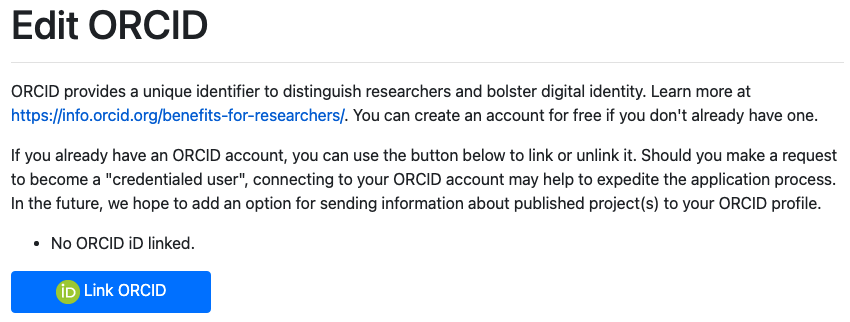
Once the ORCID authentication process is complete, the user’s ORCID iD is displayed as a confirmation that they have successfully linked their ORCID iD to their PhysioNet profile:
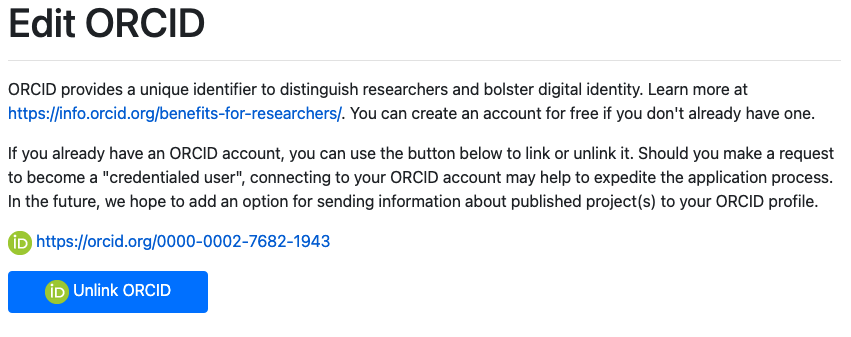
As part of the credentialing process, applicants are often asked to provide references who can speak to their research background and current work, so reference providers are also able to link their ORCID iDs with PhysioNet for credential review purposes. Having an authenticated ORCID iD for both the applicant and their reference helps the process to go faster.
Trust markers in ORCID records increase efficiency and confidence levels of credentialing process
As part of the credentialing process, PhysioNet staff not only check the information on each ORCID record but also the provenance of that information. Reliable, trustworthy data sources that are connected via authenticated workflows to an ORCID record—with the record holder’s permission—assert data into an ORCID record and transparently disclose the provenance of each and every assertion present in a record. This provides a mechanism—what we call “trust markers”—by which users of ORCID data can judge the veracity of information in ORCID records for themselves and determine which records are trustworthy for their particular use case.
Data added by the record holder themselves is perfectly acceptable, but data added to ORCID by trusted organizations via authenticated, third-party workflows—such as affiliation or education data added by universities, or publications added by publishers—allows for quicker verification of data and lends even more confidence to the credentialed access process. The sample application below shows the information collected and the ORCID status for both the applicant and their reference; since ORCID enables a collection of research activities in one place, reviews are much more efficient for applicants who have linked their ORCID iD:
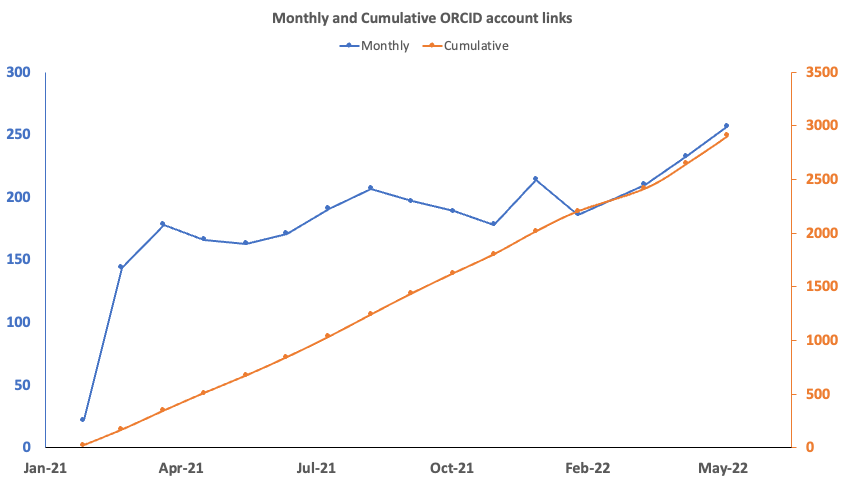
Over the past 16 months, since ORCID was integrated with PhysioNet, they have seen roughly 190 user-ORCID iD connections per month (represented by the blue line below), and over 2,900 linked ORCID iDs (represented by the orange line below):
Up next: PhysioNet plans to add Works to ORCID records
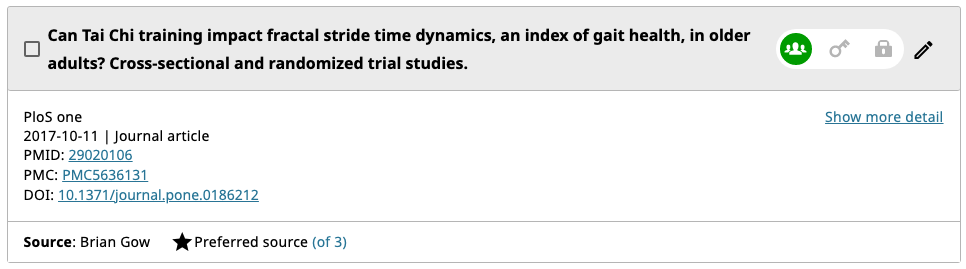
The PhysioNet team has future plans to also write work citations to ORCID records for data and software within the PhysioNet platform to more broadly include data and software in research output representations, with the goal of bolstering dataset and software publications to be recognized similarly to research paper publications. So, in the future, the ORCID work entry pictured below will have the source of “PhysioNet” rather than the researcher’s name:
Resources for credentialing workflows
Do you need to build a credentialing workflow? The code for the PhysioNet platform, including the ORCID API integration, is fully open source and available for anyone to reuse, and the PhysioNet team is happy to collaborate with anyone. For example, most recently the University of Toronto has started using the PhysioNet software and built-in ORCID API integration for a grant-funded project for artificial intelligence in medicine.
Researchers are encouraged to connect their ORCID iDs to their PhysioNet accounts. Additionally, if you’d like to collaborate with the PhysioNet team or for any questions about their work, please send an email to [email protected].
To learn more about trust markers and how they can streamline your workflow and contribute to the entire research ecosystem, register for the 15 June webinar ORCID Trust Program: Principles & Practices.
-

Brian works full-time for the Laboratory for Computational Physiology (LCP) at the MIT Institute for Medical Engineering & Science (IMES). He studied electrical engineering at Rensselaer Polytechnic Institute in Troy, NY. He transitioned into research from corporate engineering as part of a study that used a Kelvin (capacitive-coupling) probe. He developed expertise in using complexity-based techniques for non-linear physiological signal analysis. His current role involves incorporating new modules of data into MIMIC, along with supporting the PhysioNet platform and community.
-

Tom earned his PhD in biomedical engineering at University College London and University College London Hospitals (UCLH) where he obtained focused experience in the intensive care environment and computational modeling of patient physiology. He is currently a full time Research Scientist at MIT and Technical Director of PhysioNet. He is expert in the development, support, and analysis of critical care databases, including MIMIC and the recently released eICU Collaborative Research Database. He conducts retrospective studies in collaboration with clinical specialists, develops and supports critical care databases that are widely used around the world in research and education, and he has created software used by hundreds of researchers and students internationally. Tom has a broad interest in how we can improve the way that critical care data is managed, shared, and analyzed for the benefit of patients. He is a Fellow of the Software Sustainability Institute and a Member of the MIT Task Force on Open Access.