







In Canada, it takes tens of thousands of dollars and months of training for a certified guide dog to be able to help blind and low-vision people navigate public spaces, and applicants can expect to wait for years before being able to welcome one in their life.
To address this, we are introducing Milo, the first fully autonomous robot guide dog to help people navigate both indoor and outdoor spaces safely. For under 2000$, this AI-powered and open-source robotic companion can be mass-produced to help thousands of people while they wait for a real, possibly cuter counterpart.
Using our custom machine learning algorithms, Milo can navigate complex, unfamiliar sidewalks and indoor areas while dynamically avoiding pedestrians and obstacles. We have trained it to be fully autonomous by design, so it does not rely on any external computer: the robot can navigate anywhere, anytime. Our locally-run AI model also allows it to operate completely on-device without relying on an internet connection or external servers.
The onboard navigation software has been trained entirely via reinforcement learning within a custom, GPU-accelerated simulator that randomizes paths, walls, obstacles, and pedestrians. The training relies on an abstract bird's-eye view (BEV) representation, constructed using powerful segmentation models such as SAM. By representing floors, walls, and obstacles consistently regardless of appearance or lighting, the robot learns to navigate efficiently across diverse real-world environments.
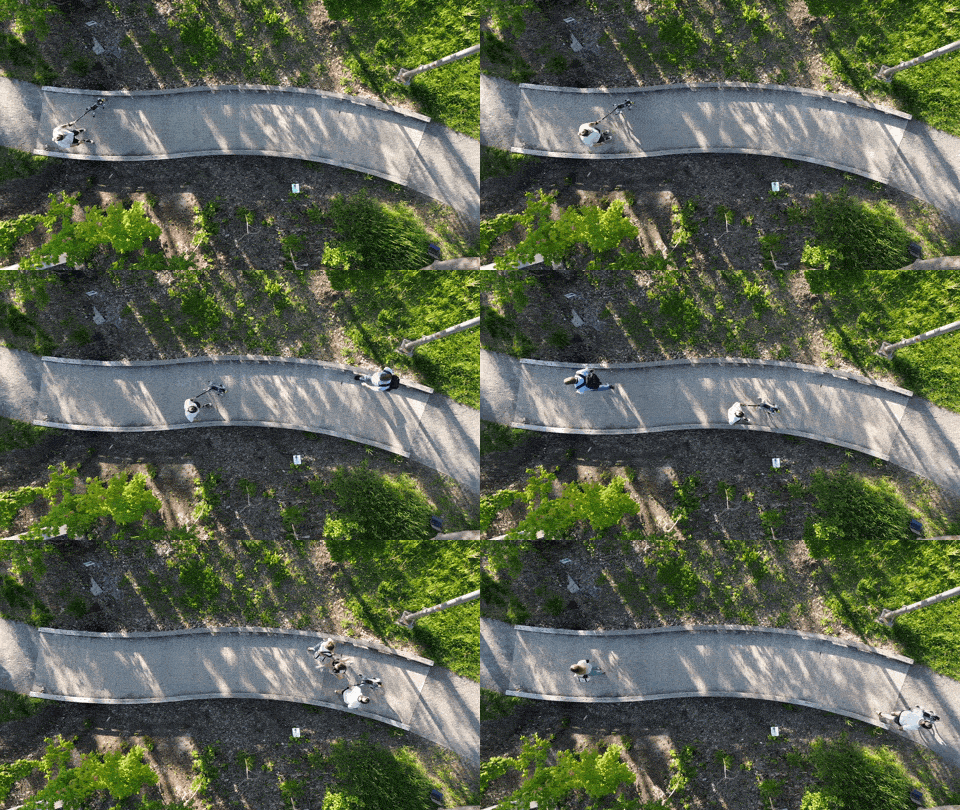
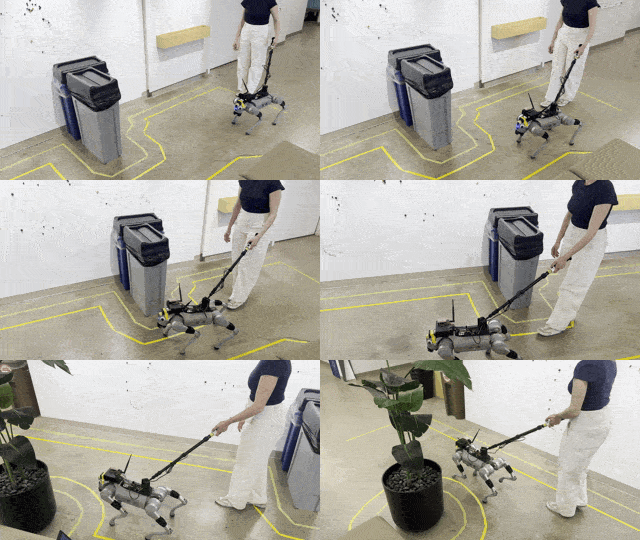
Unlike existing robotics systems that require a complete 3D scan of an environment before it ventures out into the world, Milo can operate immediately in completely unknown environments. The performance of the robot was evaluated using metrics including error counts, navigation speed, and obstacle clearance distances on real-world indoor and outdoor obstacle courses.
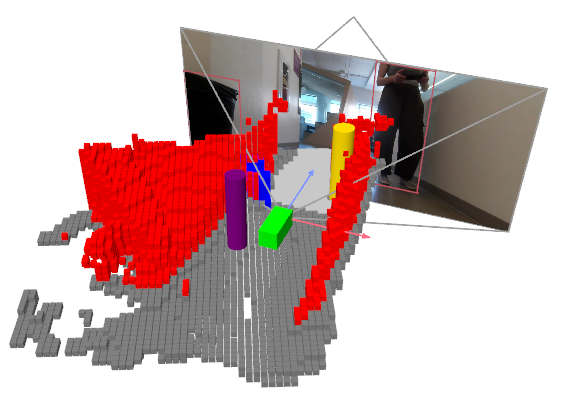
As it navigates the world, Milo builds up an understanding of the environment and keeps a memory of what the user has encountered before while maintaining a consistent map of its surroundings, even for things that have left its immediate field of view. Just like a real dog, it won't immediately forget an obstacle the second it walks past it.
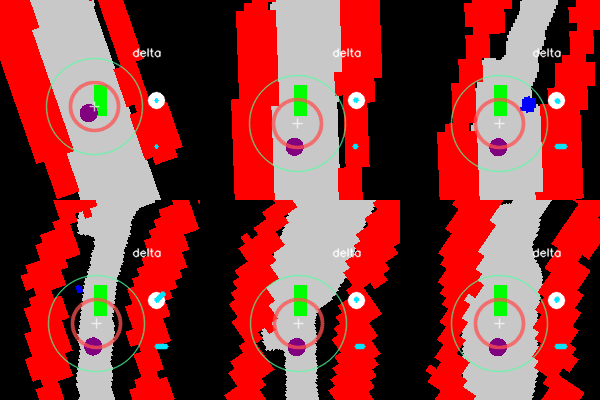
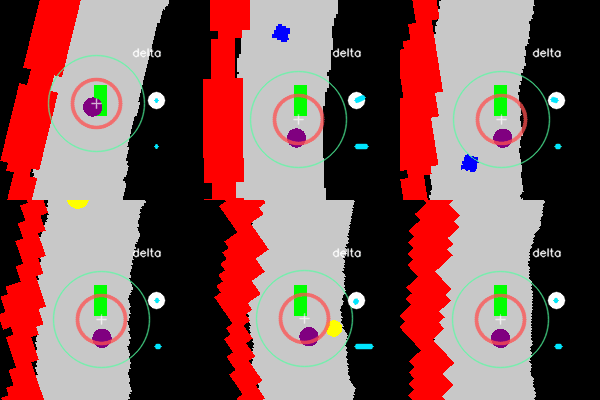
Milo monitors the human handler's position in real time using a telescopic handle equipped with sensors to account for the person’s position in space when deciding where to go and keep the human safe at all times. We have also included a directional pad to adjust walking speeds and let the robot know in which direction to turn at intersections.
With a few hardware and software tweaks, Milo can be built at scale by almost anyone. Along with our paper Milo, a Fully Autonomous Indoor/Outdoor Robotic Guide Dog, we are releasing all hardware design documents, simulator code, and pretrained policies to foster open science.
此内容由惯性聚合(RSS阅读器)自动聚合整理,仅供阅读参考。 原文来自 — 版权归原作者所有。