










Galaxy clusters can contain thousands of individual galaxies, and are the largest gravitationally-bound structures that we know of in the Universe. They're so massive they can be used as gravitational lenses.
One of these ancient clusters is called XLSSC 122, and it's in a lucky alignment with more distant single galaxies. This makes the cluster a gravitational lens, and it's warping and amplifying the light from the distant galaxies. Astronomers used the JWST to study the cluster, and the warping of the background galaxy let them measure XLSSC 122's mass more accurately.
Ten billion years ago, most galaxy clusters were just beginning to take shape. But these observations show that XLSSC 122 is different from other galaxy clusters in the Universe at the same time. Instead, it is more massive, concentrated, and organized, resembing modern clusters.
Three new papers in The Astrophysical Journal present the findings, which were also presented at the 248th meeting of the American Astronomical Society. Kyle Finner, a staff scientist at the Infrared Processing and Analysis Center (IPAC), is the lead author of one of the papers.
"When we got those first images back from JWST, we said, ‘wow, look at this, there's strong lensing coming from this cluster!’" Finner said in a press release. "XLSSC 122 has now set the record for the most distant galaxy cluster displaying strong lensing, which is a valuable tool for astronomers."
XLSSC 122 was first discovered more than a decade ago in 2014, when the ESA's XMM Newton x-ray observatory detected the massive amount of heated gas in the cluster. Hubble observations followed, showing that the cluster was 10.4 billion light years away. Those observations also showed that the cluster was unusually mature compared to other clusters at the same age.
Now, astronomers have observed the cluster with the JWST, and discovered that it's a strong gravitational lens. The telltale arcs of warped light were absent in the Hubble images, but were clear in the JWST's images. “Before JWST, we couldn’t do this level of science in the early, distant universe,” said Finner.
While clusters like XLSSC 122 contain enormous amounts of stars and gas, they contain even more dark matter. It's the dark matter that creates the strong gravitational lensing effect. Dark matter is also like the scaffolding on which galaxies and clusters form. The large-scale structure of the Universe is made of dark matter filaments, upon with galaxies and clusters form. The JWST's observations of XLSSC 122 provide an opportunity to learn more about dark matter and its distribution.
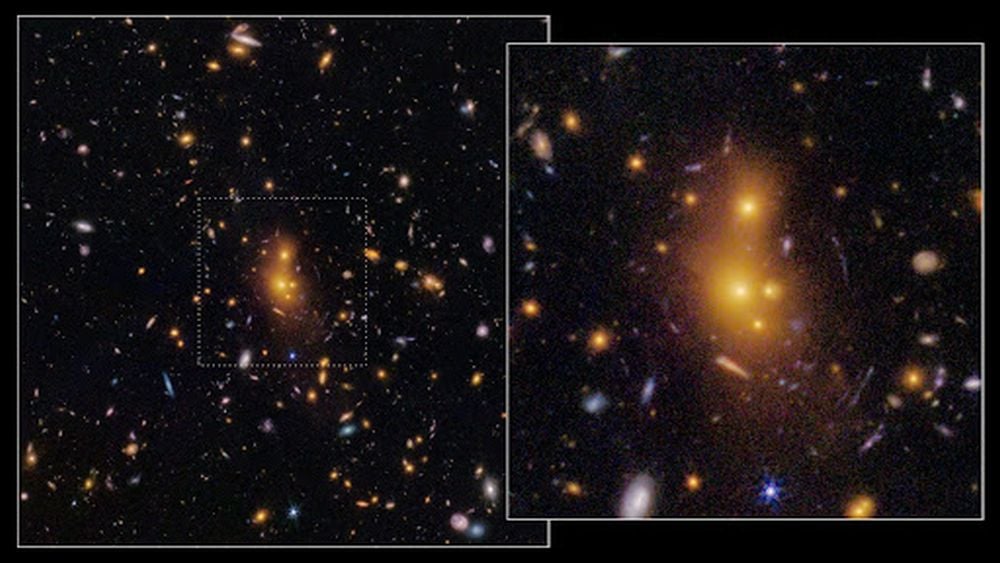 This JWST image shows the fuzzy orange clumps that are the central galaxies of the XLSSC 122 cluster. The JWST found the tell-tale arcs of light indicating that XLSSC 122 is acting as a strong gravitational lens of background galaxies. Image Credit: NASA, ESA, CSA; Kyle Finner (Caltech/IPAC) Image processing: Robert Hurt (Caltech/IPAC-SELab)
“Strong lensing is a way to measure the dark matter without actually seeing the dark matter,” said Finner. “It gives us a sensitive probe of our cosmological models.”
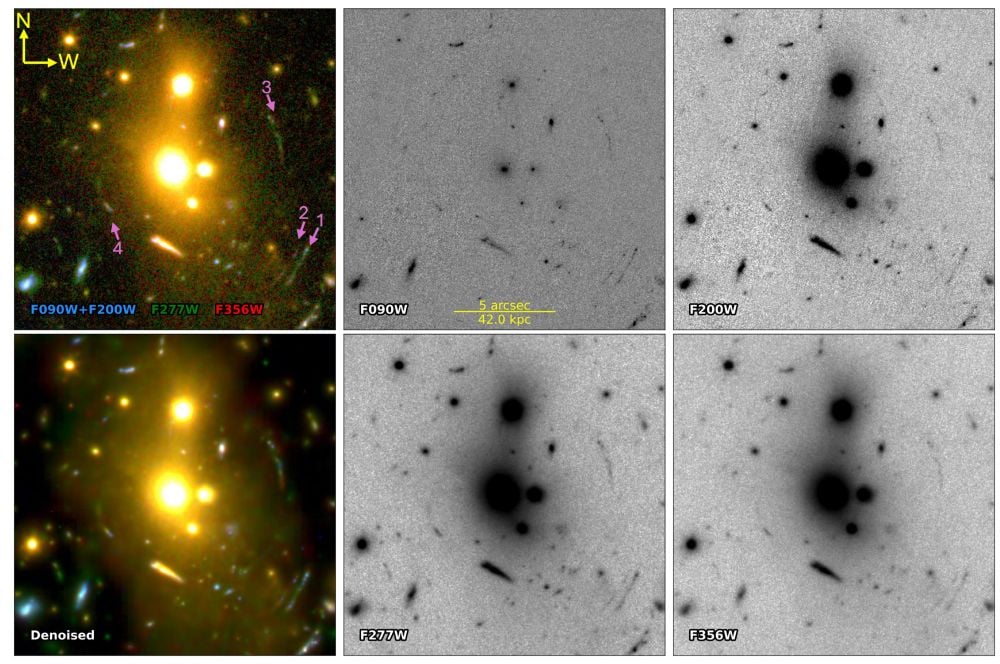 *These are composite color and individual filter images of XLSSC 122 from the JWST. The purple arrows in the upper left image show the candidate strongly lensed galaxy arcs. Image Credit: Kyle Finner et al 2025 ApJL 994 L35*
The cluster also acts as a weak gravitational lens. Weak gravitational lensing doesn't affect individual galaxies the way strong lensing does. It only distorts background galaxies a tiny bit, and relies on large samples to recover a mass signature. Strong lensing let the researchers measure the mass of the cluster's center, and weak lensing let them measure mass all across the cluster, including its peripheral galaxies.
“Weak gravitational lensing can constrain mass much further out, so you can get a better picture of the surrounding cluster area,” said Finner.
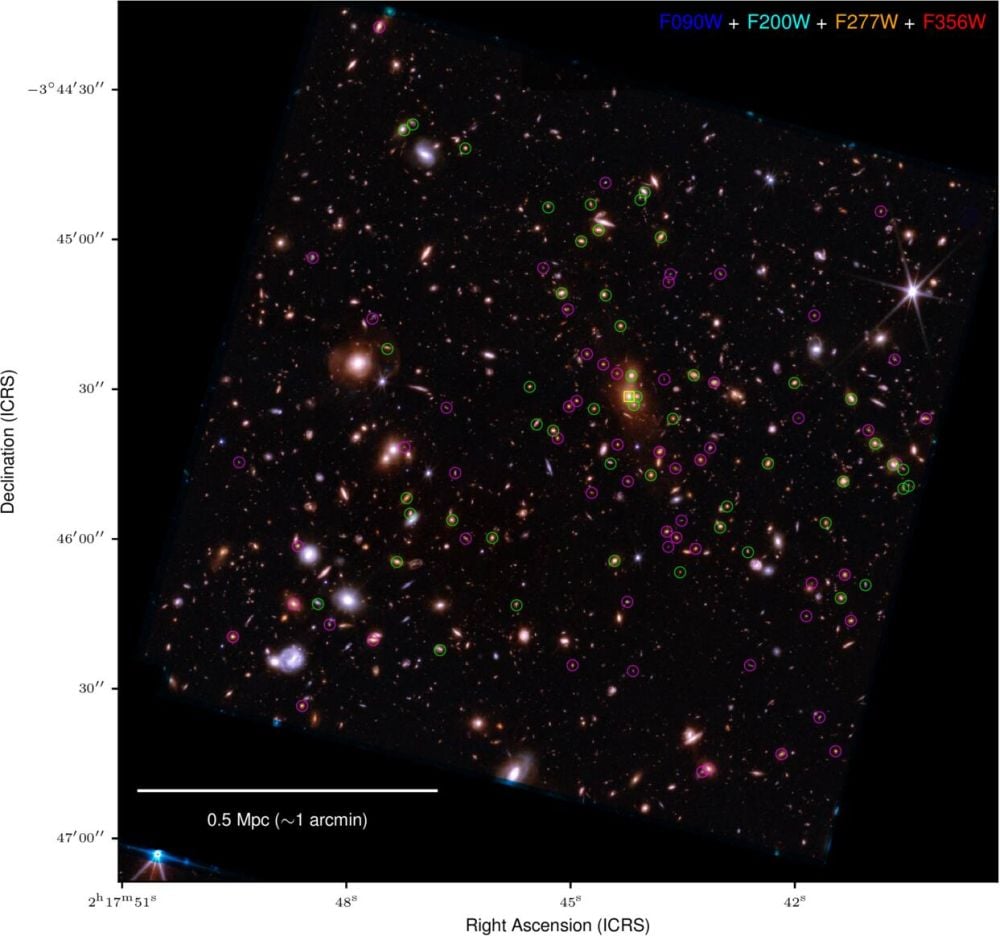 *This JWST image shows the wider field of the cluster XLSSC 122. The brightest cluster galaxy (BCG) is shown by the yellow square in the center. Candidate members of the cluster identified with spectroscopy are shown in green circles, and ones found photometrically are shown in magenta circles. Image Credit: Zachary P. Scofield et al 2026 ApJL 999 L1*
Astronomers have used other telescopes to observe the cluster across the electromagnetic spectrum. X-ray and radio observations show that XLSSC 122 is still undergoing a merger process as its galaxies move closer together. In one of the new paper, the authors used data from Chandra, MeerKat, ALMA, and the JWST to "... identify consistent NE–SW elongation across datasets and a pronounced offset along the same axis between the SZ and mass/X-ray peaks, pointing to significant merger activity."
The JWST also observed the intracluster light (ICL) in XLSSC 122, and those results are in the third paper. ICL comes not from the galaxies in the cluster, but from individual stars that have been tidally stripped away from their galaxies. ICL is extremely faint, but it can tell astronomers a lot about a cluster's merger history. XLSSC 122's ICL shows that these unattached stars are still scattered and haven't yet congregated in the cluster's gravitationally dominant core. That indicates that the merger is ongoing.
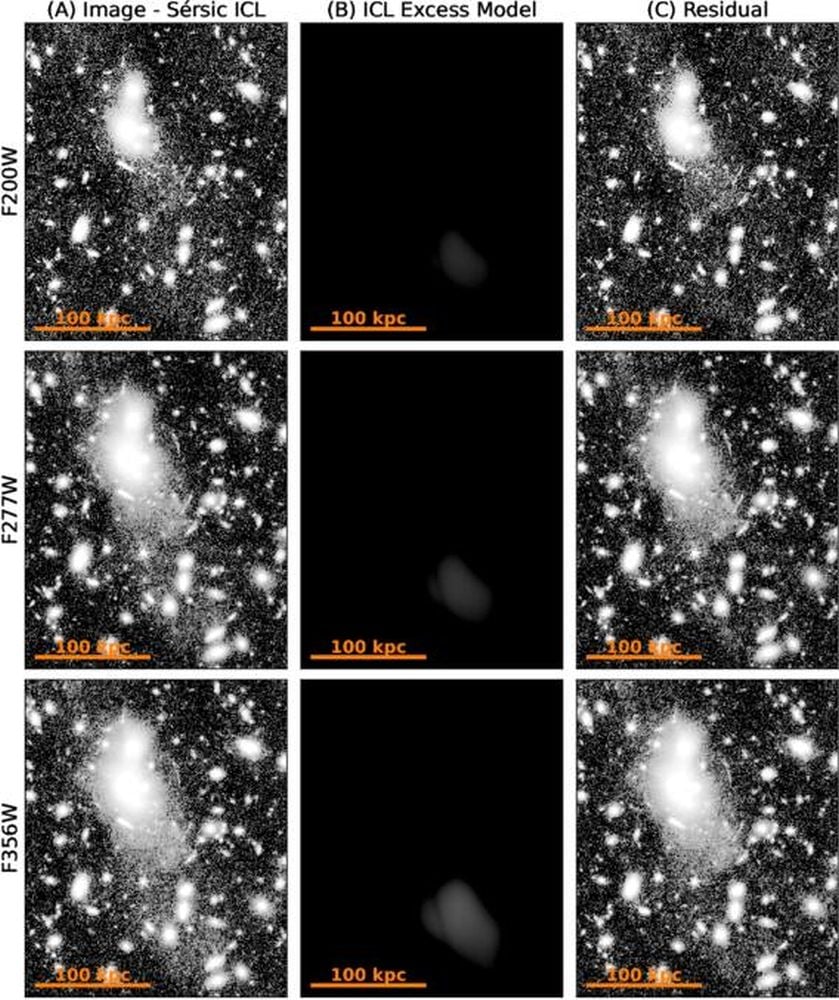 *These processed images of XLSSC 122 uncover the very faint ICL in the cluster, shown with all else subtracted in the middle column, where its visible as a grey shape in the lower right. Image Credit: Hyungjin Joo et al 2026 ApJL 1002 L17*
"This southern feature represents a significant excess of diffuse emission extending approximately 100 kpc from the BCG," the third paper states. "Its spatial alignment with the overdensity of member galaxies and independent multiwavelength asymmetries (X-ray, radio, and SZ) strongly suggests an origin in tidally stripped stars resulting from ongoing or recent dynamical interactions within the cluster."
The ICL footprint also lines up with the concentration of dark matter uncovered with strong gravitational lensing. “In this cluster, the intracluster light essentially traces the dark matter,” said Finner. “That light tells us that the cluster is in a merging state.”
This is another example of the JWST showing us the early Universe in a way we've never seen before. By finding an ancient cluster that seems more evolved than it should be, it's forcing scientists to refine their models of cosmology and how the Universe evolved. The next step is to find more clusters like XLSSC 122, if they're out there.
“It's still early in the JWST era,” said Finner, “and if we can start to get data on tens or hundreds of these types of objects at this stage in the universe, then we can really start putting our cosmological models to the test.”
Papers: 1. JWST Discovery of Strong Lensing from a Galaxy Cluster at Cosmic Noon: Giant Arcs and a Highly Concentrated Core of XLSSC 122 2. An Active Galaxy Cluster Merger at Cosmic Noon Revealed by JWST Weak Lensing and Multiwavelength Probes 3. Mature but Still Growing: JWST Detection of the Earliest Intracluster Light at z ∼ 2
此内容由惯性聚合(RSS阅读器)自动聚合整理,仅供阅读参考。 原文来自 — 版权归原作者所有。