







Life exists because elements combine to form complex organic molecules. Astrochemistry studies this process, trying to understand how Nature creates carbon-based molecules critical for life. One source for these types of molecules is the outflows emitted by protostars.
Protostars grow by accreting gas, and while they do so, they also emit energy. Protostars haven't begun fusing hydrogen yet, so their energy comes from shocks on its surface generated by in-falling gas. They can also emit high speed streams of gas as astrophysical jets. These jets carry away excess angular momentum, allowing the protostars to keep growing. These jets also create illuminated shocks in the interstellar medium (ISM).
Shock fronts like these are where energy and matter are concentrated, and that's where Nature does its thing. They're like a chaotic speed-dating event for chemicals. The heat and pressure splits some molecules apart and binds others together and it all happens quickly.
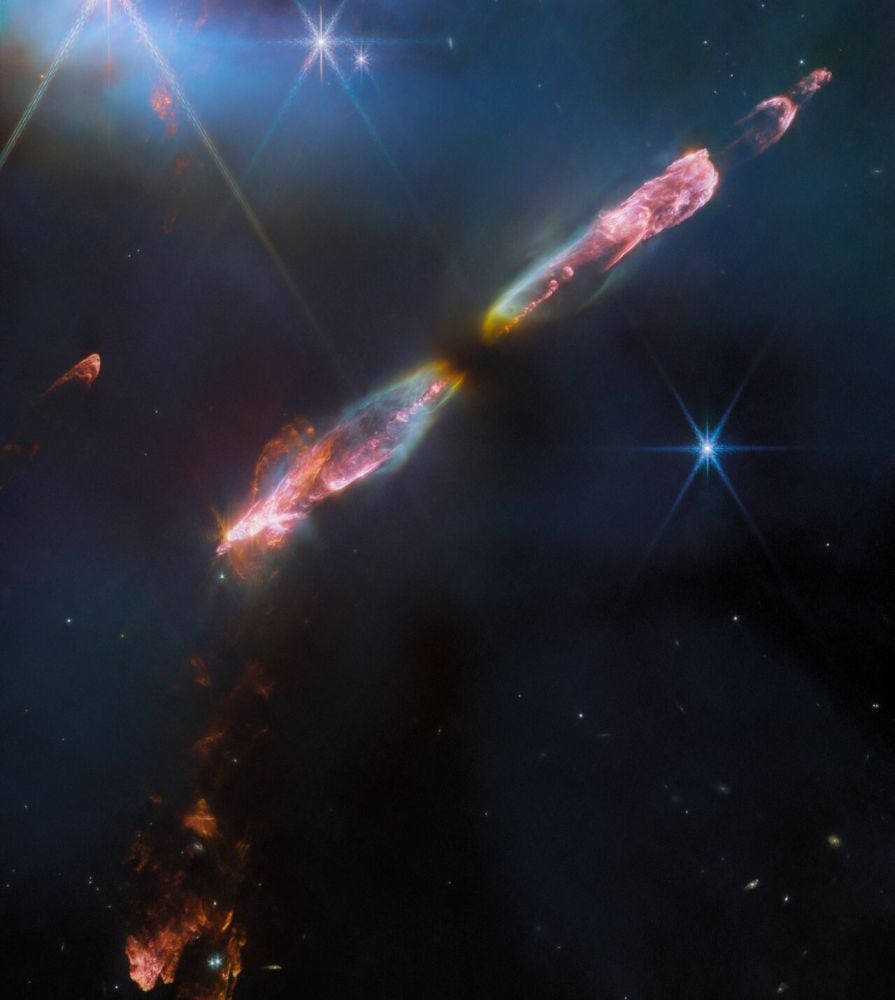 The JWST hasn't imaged the protostellar jets in this research, but it has imaged other ones (Herbig-Haro 211). This JWST image shows jets from a different protostar as they slam into the interstellar matter, creating shock fronts where complex organic molecules form. Image Credit: ESA/Webb, NASA, CSA, T. Ray (Dublin Institute for Advanced Studies)
These shocks are where some complex molecules are created, and recent research in Astronomy and Astrophysics presents a detailed look at the chemistry in protostellar jets. The research article is "PRODIGE – Envelope to disk with NOEMA VII. (Complex) organic molecules in the NGC1333 IRAS 4B1 outflow: A new laboratory for shock chemistry." The lead author is Laura Busch, a postdoctoral researcher at the Center for Astrochemical Studies at the Max Planck Institute for Extraterrestrial Physics.
PRODIGE is the PROtostars & Disks: Global Evolution. PRODIGE used the Northern Extended Millimeter Array, a powerful radio telescope in the French Alps, to survey 32 protostars in the Perseus Molecular Cloud and 8 protostars in the Taurus Molecular Cloud. It studies the "... angular momentum, density, temperature, turbulence, and chemical compositions of protostars and pre-main-sequence stars during the evolutionary eras where planet formation begins," the website states. The PRODIGE survey finished in late 2025.
"Shock chemistry is an excellent tool for shedding light on the formation and destruction mechanisms of complex organic molecules (COMs)," the authors write. Even though PRODIGE is a survey, these protostar shockwave environments haven't been extensively studied across a large sample.
In this work, the authors examined the outflows from the Class 0 protostar IRAS 4B1, a binary star in the star-forming region NGC 1333. They focused on the shocked regions that both generate and destroy COMS.
"One of the key questions in astrochemistry is understanding the growth of molecular complexity during the process of star formation, including the formation and destruction processes of complex organic molecules (COMs; ≥6 atoms and carbon-bearing)," the authors explain. "Shock waves passing through a quiescent medium greatly affect the local chemical composition."
“While working on a separate PRODIGE project mapping methyl cyanide (CH₃CN) toward IRAS 4B1, I noticed emission that appeared to trace the outflow rather than the hot surroundings of the forming star,” said lead author Busch in a press release. “This made me search the data for more complex molecules – and I found them.”
The researchers report the first detection of 3 COMS: CH3CN (acetonitrile), CH3CHO (acetaldehyde), and CH2DOH (deuterated methanol).
Acetonitrile is significant because it's a nitrogen-bearing molecule, which are relatively rare. It's an important molecule in what's called the nitrogen chemistry network.
Acetaldehyde is significant because it's oxygen-bearing, and is one of the simplest oxygen-bearing COMs. It sits in a junction in carbon-oxygen chemistry, and its formation pathway is still unclear. But it's presence is strong proof that protostellar environments can synthesize prebiotic chemistry.
The presence of deuterated methanol in the outflows is also significant, but for reasons other than prebiotic chemistry. It should be destroyed in the heated environment in the outflows, so its presence is fossil-like. It must have formed in gas in the pre-stellar phase, then locked into ice mantles. It was freed from these icy mantles by the shocks, but stayed intact.
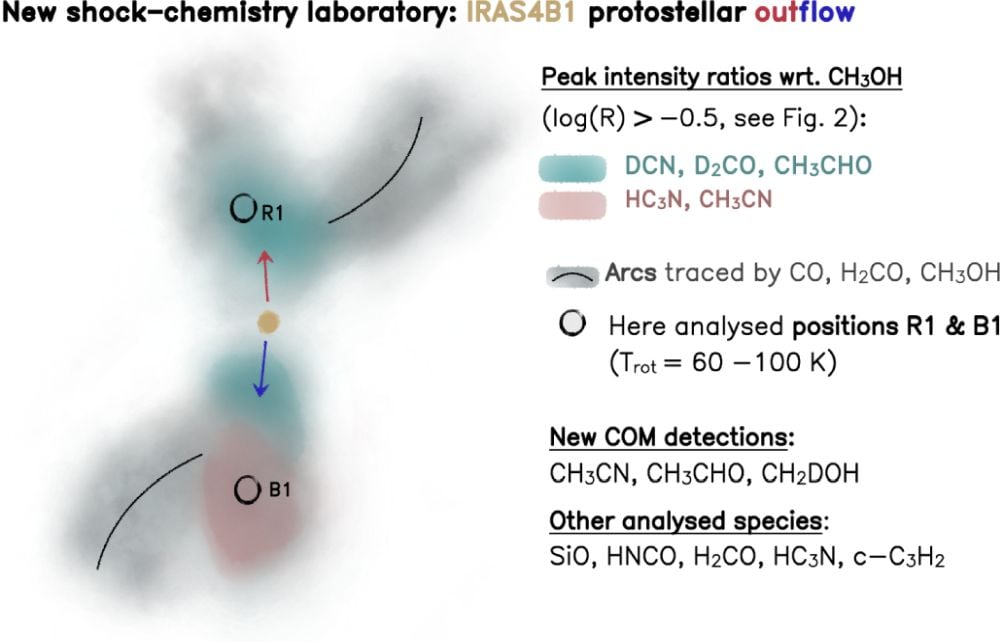 *This figure highlights the main molecular features of the IRAS4B1 outflow. Along with the three newly detected COMs, other molecules like silicon dioxide and carbon monoxide were also found, which are typical tracers in these outflows. Image Credit: Busch et al. 2026. A&A*
All molecules have different emissions, and that let the researchers map their presence throughout the outflows, revealing regions with different temperatures and densities. Some molecules are present where temperatures are highest, some where they're lowest. This shows that different molecules follow different creation pathways. But there's much more to learn, and much more detail yet to be revealed.
"For the first time, we securely detected the COMs CH3CN, CH3CHO, and CH2DOH in the IRAS 4B1 outflow," the authors write. "Targeted observations will enable the discovery of new COMs and a more detailed analysis of their emission."
Only one other protostellar outflow has been observed in detail. It's named L1157-B1 and is considered to be a prototype for these chemically-rich outflows. It's the subject of more sensitive observations, and the authors of this work say that similarly sensitive observations of IRAS4B1 will let them "... detect less abundant COMs and build a comprehensive chemical inventory of the IRAS4B1 outflow."
"Together with modelling efforts, this will deliver crucial information on COM formation and destruction processes as well as outflow structure and kinematics," the authors conclude.
此内容由惯性聚合(RSS阅读器)自动聚合整理,仅供阅读参考。 原文来自 — 版权归原作者所有。