





The majority of star systems in the Milky Way are binary, and the relationships between these stars can last for billions of years. They form in the same molecular cloud and can be bound together until death. New research presented at the 248th meeting of the American Astronomical Society highlights the relationship between a binary pair of stars that both exploded as supernovae.
The Jellyfish Nebula, also called IC 443, is a well-known and well-studied supernova remnant (SNR) about 5,000 light years away. It was created by a supernova explosion 8,000 or 9,000 years ago. It's about 70 light years across, and is one of the best examples of a SNR interacting with a nearby molecular cloud.
The Jellyfish Nebula is known for being very bright in gamma-rays, which are created when high-speed particles called cosmic rays slam into interstellar gas. NASA's Fermi Gamma-ray observatory detected gamma-rays from the Jellyfish Nebula back in 2013 when particles from the nebula interacted with the nearby cloud, called Sharpless 249.
But the Jellyfish Nebula is also bright in x-rays and has been observed in detail by observatories like Chandra. Another x-ray observatory, the German-led ROSAT (Roentgen Satellite) mission, also surveyed the region in 1994. e-ROSITA also observed the region, and those observations found another, fainter SNR that neighbours the Jellyfish Nebula, named G189.6+3.3.
"For many years, x-ray observations hinted at a second shell-like structure nearby," said Miltiadis Michailidis from the Kavli Institute for Particle Astrophysics and Cosmology, and, lead author of a paper that will be published in Nature Communications. "The e-ROSITA observations now confirm that this eastern extension is in fact a second, separate and overlapping supernova remnant," Michailidis said at a 248 ASS press conference. These observations set the stage for the researchers' deeper examination of the region.
The researchers' observations revealed an unusual feature in the region. The SNR overlap each other and are connected by a bright filament of gas. Those observations show that the shock wave from G189.6+3.3 generated this bright filament when it slammed into the same cloud that the Jellyfish Nebula is interacting with.
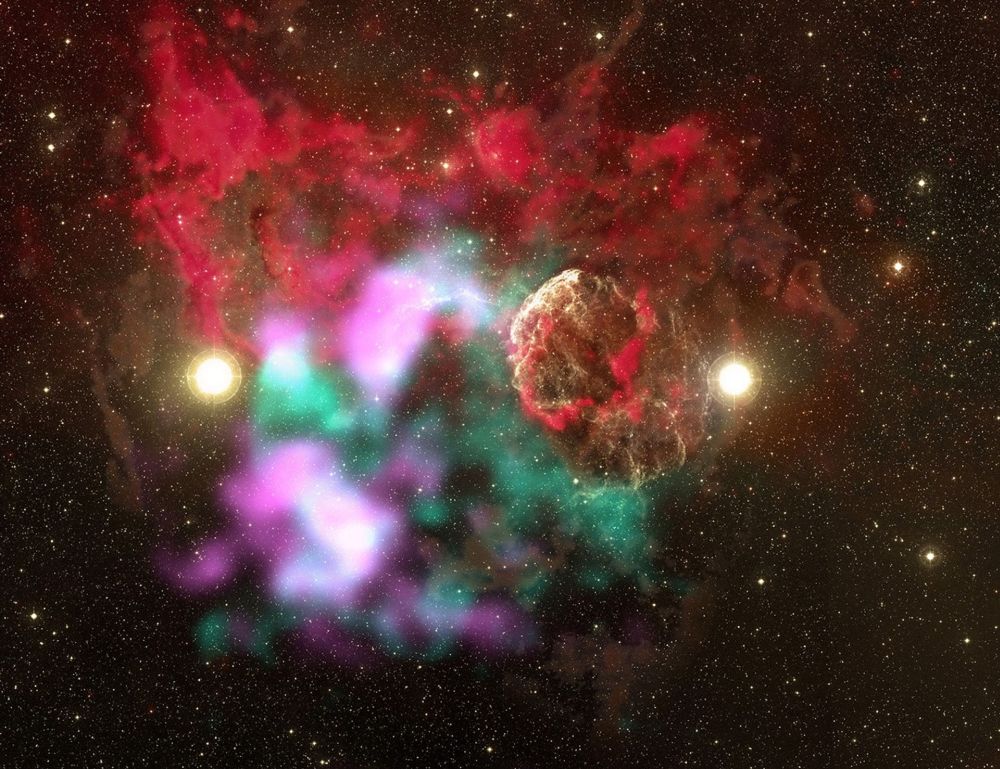 *This false-color image shows the prominent Jellyfish Nebula on the right. It's older and fainter neighbor, G189.6+3.3, is shown in blue, green, and magenta. The violet arc in the center is the filament of glowing gas that connects the two. Red, orange, and brown show infrared and radio data in the cloud, while yellow shows visible light. Blue-green shows X-rays from the fainter remnant, while magenta shows gamma rays with energies greater than 10 billion electron volts. To make the image clearer, high-energy light from the Jellyfish Nebula has been removed. The gamma-rays near the filament are from protons accelerated in the supernova explosion that have slammed into the cloud. Image Credit: NASA Goddard Space Flight Center and M. Michailidis et al. 2026; radio, MWISP and ESA/Planck; infrared: NASA/WISE/JPL-Caltech/UCLA; optical: DSS; ultraviolet: NASA/Swift; X-ray: SRG/eROSITA; gamma ray: NASA/DOE/Fermi LAT Collaboration*
This suggests a strong link between the pair of nebula.
“The overlapping remnants, a connecting gas filament, and the availability of data from Fermi and other facilities motivated us to delve into this complex but little-studied region,” said study co-author Marianne Lemoine-Goumard. She's an astrophysicist at the French National Centre for Scientific Research (CNRS) based at the University of Bordeaux. “With Fermi’s LAT instrument, we found gamma-ray emission associated with accelerated protons in the northern part of the fainter remnant. If both remnants are interacting with the same structure, then they must share a common distance from us.”
The researchers think that when the Jellyfish Nebula's progenitor star exploded as a supernova, it kicked its binary partner out. Since its partner was also a massive star—both were about 20 times more massive than the Sun—it continued to evolve and eventually exploded as a supernova between 20,000 to 110,000 years later. This second SNR was hidden in the glare of IC 443, but not any longer. Now, the explosion centers are separated by about 40 light years.
“We’re looking at the final chapter of a relationship that began millions of years ago,” said lead author Michailidis. “It is a binary star story with two massive stars that were bound together by gravity before they both exploded, and we can see the remnants.”
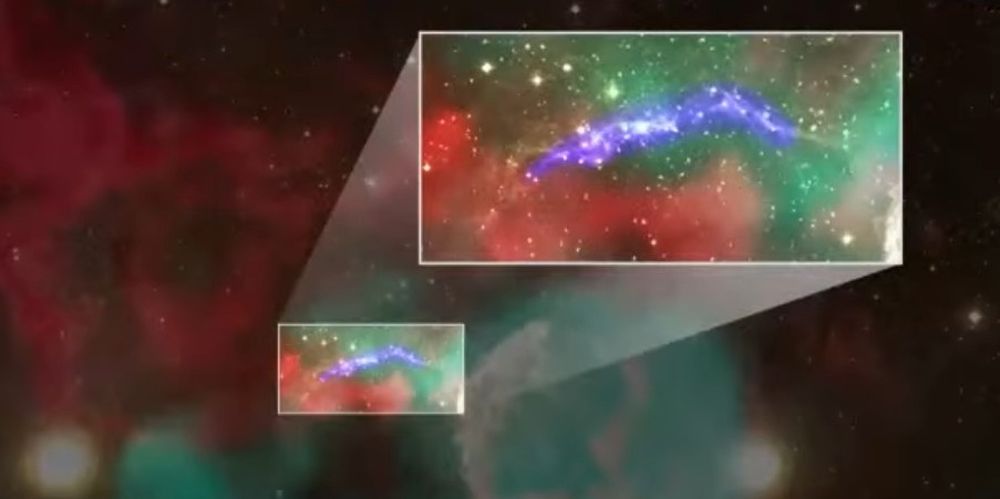 *This image highlights the gaseous filament that connects the pair of supernova remnants. Image Credit: M. Michailidis et al. 2026*
To help confirm their observations, the researchers used simulations to model one million massive binary systems. Those simulations showed that when the stars orbit close enough to exchange matter they can recreate what happened with IC 443 and G189.6+3.3. The researchers also determined that the probability that the two are only aligned by chance and not a binary SNR pair is less than 1%, which strongly supports the idea that they were a binary pair.
“The evidence we’ve compiled — including observations across the spectrum, the chemical and physical properties of the remnants, simulations, and more — paints a compelling picture of a dual supernova event,” said Michailidis.
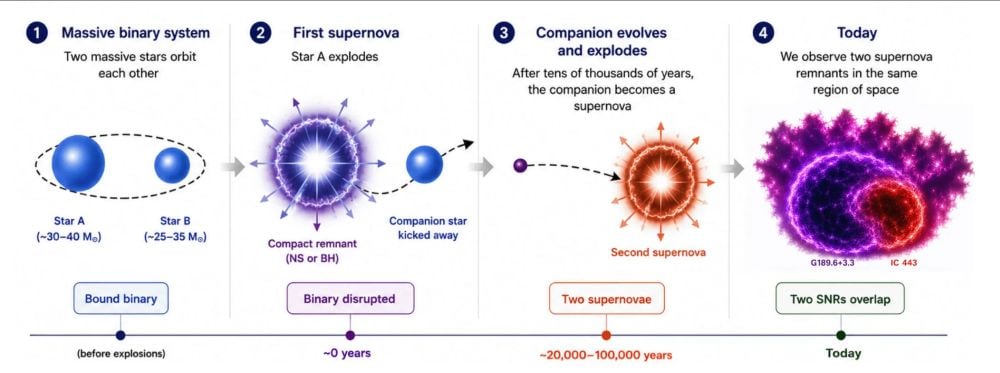 *This graphic illustrates what happened with the pair of stars that both exploded and became supernova remnants. Today, the two remnants are expanding and merging. Image Credit: M. Michailidis et al. 2026*
The Jellyfish Nebula is also known for generating cosmic ray protons with extremely high energy levels. It may be what's called a PeVatron, an object capable of creating protons so energetic they can escape the galaxy. When interacting with gas, these protons can create gamma rays that are trillions of times more energetic than visible light. If G189.6+3.3 is also a PeVatron, this makes the dynamic region even more interesting scientifically and could provide clues to how SNR become PeVatrons.
“Fermi’s gamma-ray observations of supernova remnants continue to reveal the dynamic lives of stars,” said Elizabeth Hays, the Fermi project scientist at NASA’s Goddard Space Flight Center in Greenbelt, Maryland. “We can now connect the glowing remains of two massive stars to a powerful pair that evolved together over thousands of years.”
此内容由惯性聚合(RSS阅读器)自动聚合整理,仅供阅读参考。 原文来自 — 版权归原作者所有。