







When a massive, ten-kilometer asteroid slammed into Earth about 66 million years ago, it created a massive crater. The impact triggered a megatsunami and a global firestorm. It also created an impact winter, stifling photosynthesis. This all led to the extinction of the non-avian dinosaurs. In total, the impact and its aftermath extinguished about 75% of all species on Earth.
But in recent years, some researchers have focused on its underground effect. The impact likely generated a vast hydrothermal system of shattered rock through which superheated water flowed, interacting with the rock. Nobody knows for sure, but this type of hydrothermal system could be where life gets its start, if the system lasts long enough.
New research in Nature Communications Earth and Environment says that the hydrothermal system created by the Chicxulub could've lasted longer than previously thought. It's titled "A long-lived impact-generated hydrothermal system at the Chicxulub impact structure," and the lead author is Annemarie E. Pickersgill. Pickersgill is from the School of Geographical & Earth Sciences at the University of Glasgow.
"Hydrothermal systems likely played an essential role in the origin of life, both on Earth and potentially on other planets," the authors write. "They form anywhere that heat and aqueous fluids interact, including within cooling hypervelocity impact craters."
The longer these systems last, the more opportunities there are for prebiotic chemical reactions to take place. And if simple life does arise there, then the longer the systems last, the more opportunity there is for them to propagate and thrive, and even spread to other niches.
Hydrothermal systems under impacts are not rare. Of the approximatey 200 known impact structures on Earth, about 70 of them have evidence of hydrothermal systems. These systems seem like ideal environments for habitability. They're porous and permeable, have rich chemistry, and easily available nutrients. However, evidence of microbial colonisation in the systems is slim. Only 8 of the 200 on Earth show clear evidence of microbial colonisation. "We cannot say with certainty that these early impact environments were inhabited because so little of the rock record from Early Earth still exists, and therefore, the physical properties of the early Earth’s crust are poorly constrained," the authors write.
But they can consider the nature of these systems, and calculate how long they last. "We can, however, examine whether impact craters may have provided the right temperature and fluid flux conditions, for sufficiently long durations, for life to emerge," the researchers explain.
Time is critical, because it creates more opportunities for the right chemistry to occur. In this work, they examine how long the Chicxulub hydrothermal system may have lasted, and use it as an analogue for other large basins. The results not only apply to Earth, but to other planets as well, especially Mars, which was once warm, wet, and most likely habitable.
"Here, we present radioisotopic age constraints and numerical simulations for the duration of post-impact hydrothermal activity in and around the peak ring of the ~200 km diameter 66 Ma Chicxulub impact structure," the researchers write.
Scientists have known about the hydrothermal system for decades because of seismic investigation and drilling. Multiple drilling efforts found minerals altered by hydrothermal activity.
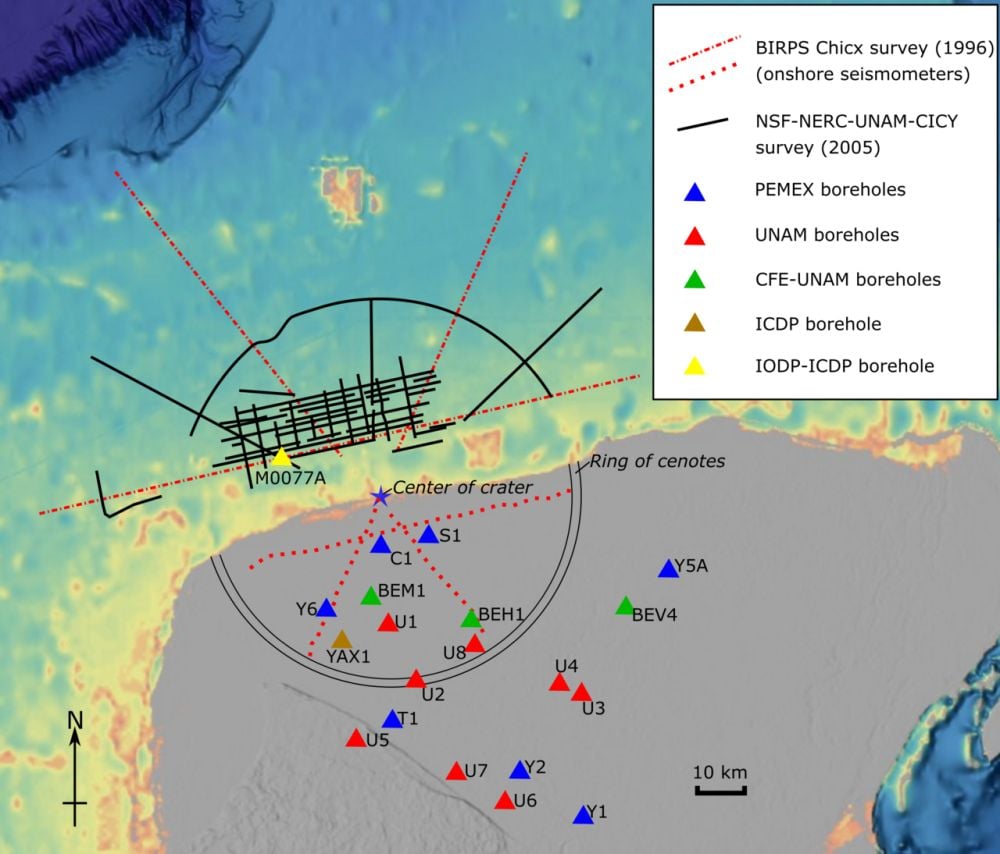 *This image shows some of the drilling and seismic surveys of the Chicxulub region. Image Credit: By Mikenorton - Own work, CC BY-SA 4.0, https://commons.wikimedia.org/w/index.php?curid=116431783*
Research from 2004 suggested the system lasted a minimum of 300,000 years. "Our initial conclusion is that hydrothermal processes were active in the Chicxulub basin for at least 300 ka, and could have been operative for significantly longer," those researchers wrote.
Other research followed, and in 2007 researchers estimated that the system took 2.3 million years before it cooled to below 90 Celsius. Those same researchers thought their number was a conservative estimate.
“Wherever on Earth you find flowing warm water, you find life, and we’ve known for a while that asteroid impacts create hydrothermal systems," lead author Pickersgill said in a press release. "Previous research undertaken in the early 2000s suggested that the system created by the Chicxulub impact lasted for about two million years. Those findings were based on computer models which were, even at the time, regarded as conservative estimates, but we were still surprised by the outcomes of our research.”
Other researchers arrived at different estimates, and in 2020 one group said that the "system maintained temperatures of ≥250 °C for between 150 and 500 kyr."
But this work shows that those numbers may very well have been conservative.
"We find that hydrothermal activity persisted for at least 8 million years (Myr), which is approximately four times longer than previously estimated by numerical simulations, palaeomagnetic records, and petrographic interpretations at Chicxulub, making it the longest-lived impact generated hydrothermal system documented on Earth," the authors write.
Much of what this new result is based on comes from the International Ocean Discovery Programme and the International Continental Scientific Drilling Programme, and their expedition 364. That expedition took place in 2016 and drilled deep into Chicxulub's peak ring. Those drill samples contained a type of feldspar that's rich in potassium and formed as a result of the flow of hot fluids. Lead author Pickersgill was part of that science team, and used argon-argon dating to find the age of those samples. The feldspar's age ranged from 66 million years ago, the time of the impact, to about 58 million years ago, an 8 million year long window.
To add to those results, the researchers turned to simulations. In those simulations, they modelled different types of geological conditions, to see which ones could create the same type of long lived system. The team's modelling showed that high-permeability in the rock, impact heating, and natural geothermal systems enabled hydrothermal system to last for so long.
“Advancements in computational methods enable researchers to simulate complex natural systems with unprecedented realism, bringing us even closer to unveiling the mysteries of the chaotic physical processes that shape Earth and other planetary bodies through geological timescales," said co-author Dr Evangelos Christou, a former PhD student at the University of Glasgow’s College of Science & Engineering. "We used those advances to explore in unprecedented detail the complex interactions between heat, rock composition and water flow the Chicxulub impact induced, allowing us to explore the ways that the hydrothermal systems changed over time and determine how long they stayed active below the crater.”
These results can extend to other rocky planets, which have suffered their own massive impacts over the course of the Solar System's history. Mars has dozens of massive impact craters, the largest one being more than 3,000 km in diameter, and it's only natural to wonder if these impacts created similar hydrothermal systems. If they did, then they could be where simple life got its start on that planet, if it ever did.
“We know that planets like Mars, which don’t have the protection of a thick atmosphere like Earth does, have experienced many, many impacts during their history," said lead author Pickersgill. "That includes periods when water may have been much more abundant, and big enough impacts could have spurred the formation of long-lived hydrothermal systems which could have supported life."
“The porous, fractured rocks created by impacts create microenvironments where micro-organisms can be protected from radiation and extreme temperatures," added Pickersgill. "Those conditions give life the chance to take hold and flourish, and that is likely what happened here on Earth billions of years ago. As we look to the future of space exploration, these findings could help future missions to other planets determine which impact craters might have been most likely to sustain life.”
此内容由惯性聚合(RSS阅读器)自动聚合整理,仅供阅读参考。 原文来自 — 版权归原作者所有。