






There is something almost dramatic about a star that tries to hurl a billion tonnes of magnetised plasma into space and simply cannot pull it off. It builds, it strains, it rises and then it stops as if it never happened. a bit like me trying to do press-ups! Scientists call these events failed eruptions, and while they have been observed before, nobody has fully understood why they occur. A new study from the Center for Astrophysics at Harvard & Smithsonian has now provided the most detailed answer yet.
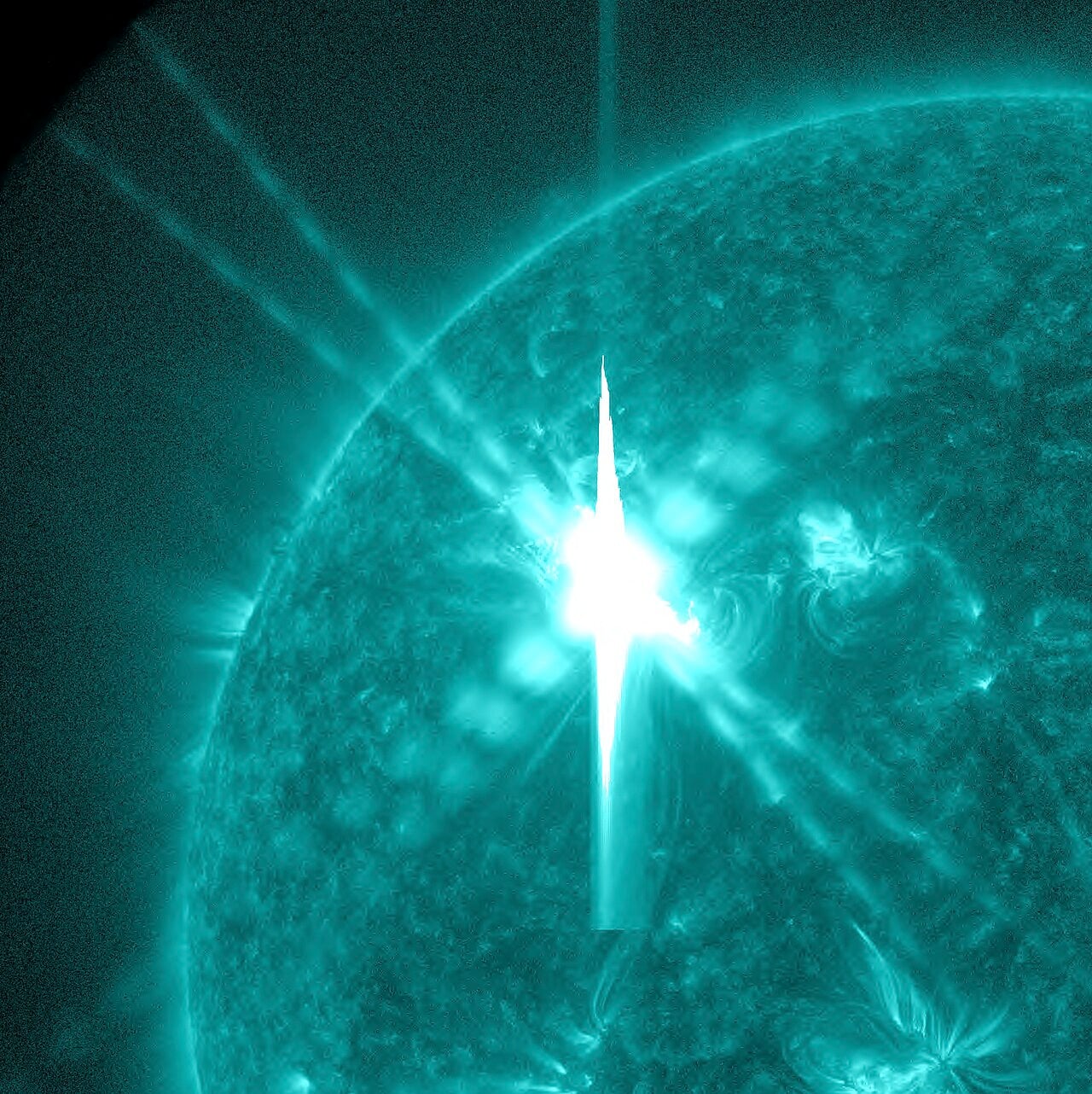 Image artefacts (diffraction spikes and vertical streaks) appearing in a CCD image of a major solar flare due to the excess incident radiation (Credit : NASA Goddard Space Flight Centre)
In March 2024, the Sun produced an intense solar flare from a large and magnetically complex active region. A prominence, a vast cloud of relatively cool, dense gas that began to rise above the solar surface, carried upward by the Sun's twisting magnetic fields, building into what should have been a coronal mass ejection, or CME. These are the Solar System's most powerful eruptions, capable of sending charged particles screaming towards Earth at millions of kilometres per hour, disrupting satellites, power grids, and communications systems. This one should have been significant but instead, it stalled. Then collapsed. It fell back toward the Sun's surface as though it had changed its mind.
"This strong flare should have produced a big eruption but instead, we saw that the eruption stalled and collapsed shortly after its initiation” - Tingyu Gou lead author from the Smithsonian Astrophysical Observatory.
To find out why, the team used multiple spacecraft watching the same event simultaneously from different angles and across many wavelengths of light. NASA's Solar Dynamics Observatory and the Hinode satellite observed from near Earth, while ESA's Solar Orbiter viewed the same eruption from the side. Ground-based telescopes and NASA's IRIS mission added radio and ultraviolet data. Together they built what amounts to a three dimensional portrait of a solar eruption in the act of dying.
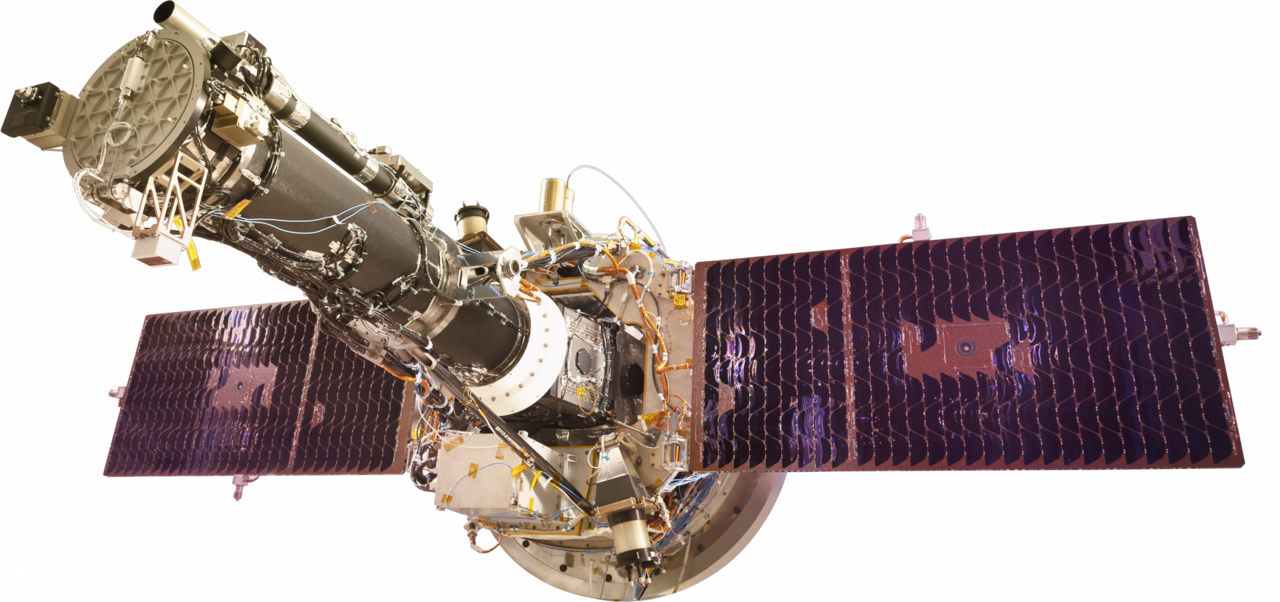 Illustration of the IRIS spacecraft (Credit : NASA)
What they found was a double process working against the eruption simultaneously. Below the rising magnetic structure was magnetic reconnection, the breaking and rejoining of field lines that was pushing it upward, as it normally does in solar flares. But above it, a second reconnection process was doing the opposite, cutting into the top of the rising structure and weakening it from above. At the same time, a strong overlying magnetic field was acting like a lid, confining the material and preventing it from breaking free.
The findings, published in Nature Astronomy help us to understand what makes some eruptions fail, helps us predict which ones will succeed, and which ones pose a genuine threat to Earth. But there is a deeper consequence too. Astronomers have long been puzzled by an apparent gap between what they observe on our Sun and on distant Sun like stars. There are plenty of stellar flares detected, but far fewer stellar CMEs and it may be that, if complex magnetic fields routinely cause eruptions to fail across the Galaxy, many stellar CMEs may simply be dying close to their host stars, invisible to our telescopes. Thankfully, our local star the Sun may have just given us the answer.
此内容由惯性聚合(RSS阅读器)自动聚合整理,仅供阅读参考。 原文来自 — 版权归原作者所有。