







For decades, astronomers and policymakers have been working on plans to protect our planet from killer asteroids. But now there’s a new realm to protect: the thousands of satellites we’re putting in orbit.
And that’s just the start: Future off-world infrastructure, ranging from orbital fuel depots to moon bases, could be hit by asteroids, meteor storms or other threats from above.
A new proposal to identify such threats — and do something about them — has earned two researchers from the University of Edinburgh this year’s Schweickart Prize, which is named in honor of Apollo 9 astronaut (and planetary defense advocate) Rusty Schweickart.
“As human activity and vital interests rapidly expand into regions beyond the protective shield of our atmosphere, the number of passing objects capable of causing serious damage to both life and critical infrastructure increases dramatically,” Schweickart said today in a news release. “Our Schweickart Prize winners this year have called for a comprehensive and systematic examination of this emerging reality.”
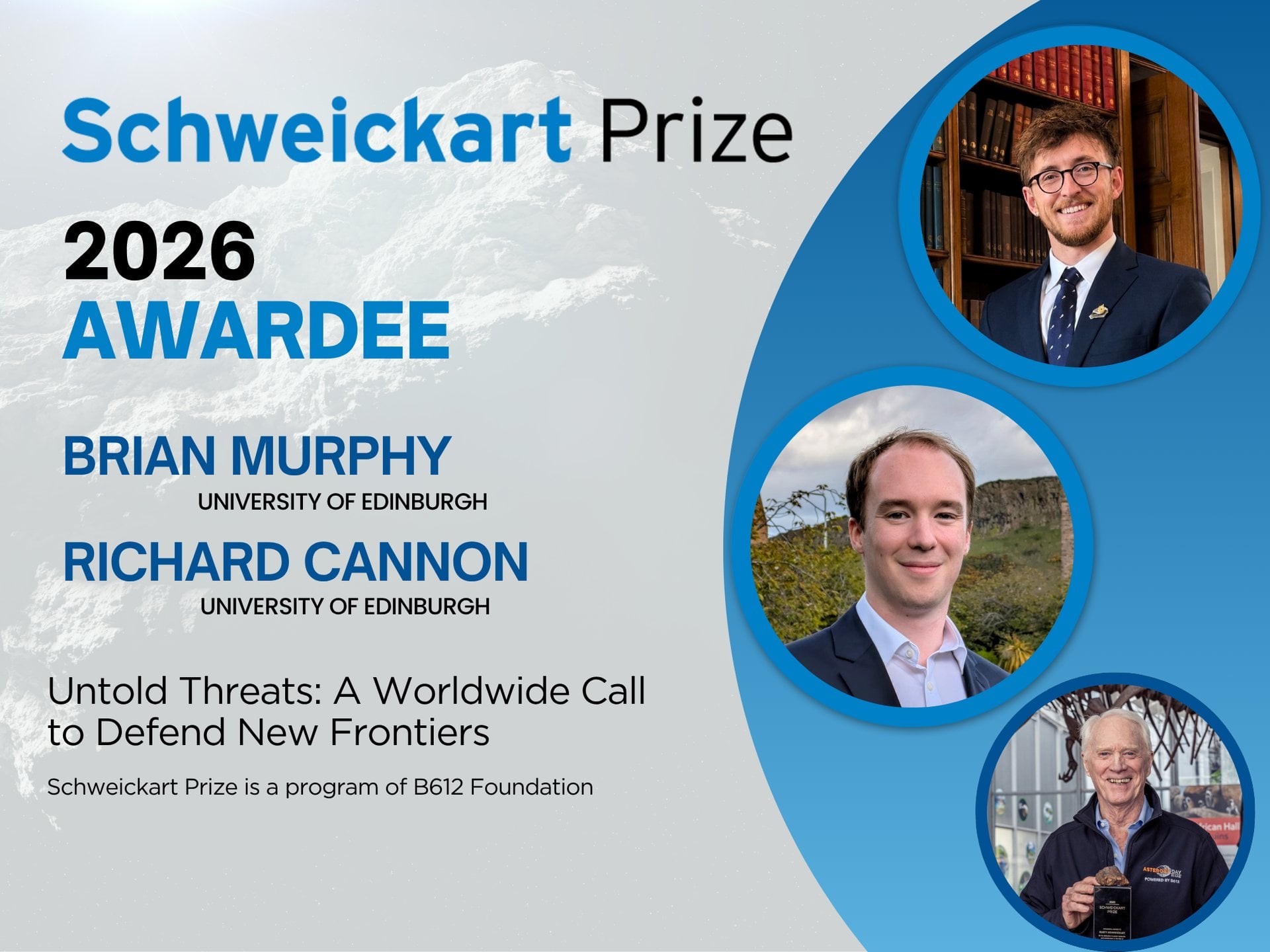 University of Edinburgh researchers Brian Murphy and Richard Cannon are the winners of this year's Schweickart Prize, which is named after Apollo 9 astronaut Rusty Schweickart.
The winners — Brian Murphy and Richard Cannon — are due to receive the prize at Lowell Observatory in Arizona on June 27. The Schweickart Prize is a B612 Foundation program that encourages graduate students to come up with fresh ideas aimed at defending our planet from near-Earth objects, or NEOs. Winners receive a $10,000 cash award as well as a museum-quality trophy with a meteorite on top.
Past prize-winners have proposed methods for spotting asteroids coming at us from a difficult-to-monitor zone between Earth and the sun, or for managing future risks associated with asteroid mining. This year’s winning proposal focuses on potential threats posed by streams of space grit, or by space rocks that are far smaller than your typical asteroid. As Schweickart noted, those cosmic bits would burn up in our atmosphere, but they can do a lot of damage in the vacuum of space.
Murphy and Cannon propose setting up an international commission to assess the threats to space infrastructure, in Earth orbit and beyond. That would lead to the creation of a coordinating body that would build on the work currently being done to anticipate asteroid threats. The researchers call their proposed coordinating body “WARDEN,” which stands for Warning Network for Asset Resilience From Dusts, Ejecta and NEOs.
Murphy, whose research focuses on planetary defense missions and the composition of comets, said the idea for the new initiatives came to him in a dream.
“I had a very vivid dream that there was this meteoroid storm impacting Earth, and I woke up in the morning and said, ‘I need to check that out. Is this related to the Schweickart Prize? Could I submit this?'” he recalled. It didn’t take long for him to run the calculations and team up with Cannon, a fellow postgraduate researcher.
Satellite operators have long known that meteor storms can ruin their spacecraft. They typically reduce the risk through the use of shielding and special maneuvers aimed at minimizing a satellite’s exposure during a predicted storm. But protective measures don’t always work. In 1993, meteoroids from the Perseid meteor shower are thought to have led to the demise of the European Space Agency’s Olympus 1 satellite. And scientists suspect that a Perseid meteoroid dealt a blow to the NASA/USGS Landsat 5 satellite in 2009.
Since 2009, the number of satellites in orbit has mushroomed from less than 1,000 to more than 17,000 — mostly due to the expansion of SpaceX’s Starlink constellation. Murphy and Cannon estimate that the exposure to meteoroids has increased by a factor of 10 to 100, and that the risk will increase exponentially as more commercial ventures build out their satellite mega-constellations.
“Even when we had a hundredth of the assets in space, there was still damage that was in the $1.2 billion range,” Murphy said. “You can do the numbers for yourself there and say, all right, if we have 100 times that now, and potentially 1,000 times that in the next decade … this is going to be a big problem, and we need to start addressing that question now.”
In their proposal, Murphy and Cannon even lay out deadlines for doing something: “There are meteoroid storms coming back in 2028, 2033 and 2034 that historically have been damaging to spacecraft in the 1990s, as well as some of the biggest meteoroid storms ever recorded in the 1960s,” Murphy said. The 2028 event is predicted during the Perseids that August, while the potential storms in 2033 and 2034 are associated with November’s Leonid meteor shower.
Is the meteoroid threat on the radar screen for satellite ventures? The short answer appears to be yes, thanks in part to the fact that protective measures are already being taken to address the impact of satellite collisions in orbit. SpaceX, for example, equips its Starlink satellites with extra shielding — and it has a procedure for reducing a satellite’s exposure to impacts by flattening its solar panels.
The engineers at Starcloud, a Seattle-area space venture that eventually plans to launch tens of thousands of data center satellites, are also aware of the issue. “Right now we are very focused on the engineering for the first and second satellite, but it’s something we will put more time into as we build out the constellation,” Starcloud co-founder and CEO Philip Johnston said in an email.
Looking beyond Earth orbit, the WARDEN system that Murphy and Cannon propose would monitor potential threats to space infrastructure extending as far out as the moon. Last year, NASA reported that a building-sized asteroid known as 2024 YR4 had a small chance of hitting the moon in 2032. Ed Lu, executive director of the B612 Foundation’s Asteroid Institute, said an impact by an asteroid that large would result in a “pretty big explosion” and create a 2-kilometer-wide (1.2-mile-wide) crater.
NASA eventually ruled out an impact, but the episode served to illustrate the cosmic risks that future moon bases would have to contend with, perhaps starting in the 2030s. The risks could come not only from passing asteroids, but also from cometary fragments or the debris that’s blasted into space by future asteroid mining operations.
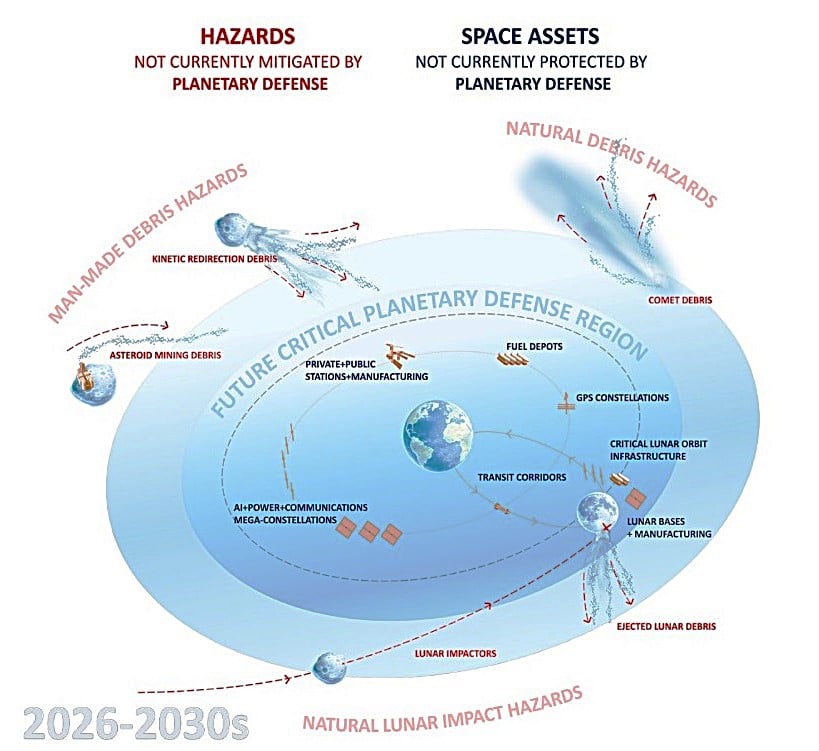 A chart from the prize-winning report points up hazards and space assets that would be covered by a new planetary defense initiative. (Credit: B. Murphy and R. Cannon via SchweickartPrize.org and B612 Foundation)
Murphy and Cannon argue that the international bodies currently tasked with monitoring potential asteroid threats to Earth — the International Asteroid Warning Network and the Space Mission Planning and Advisory Group — aren’t well-positioned to focus on off-Earth threats. Murphy said adding WARDEN to the mix would “create a trifecta of planetary defense.”
“They all are checks and balances to each other, rather than two systems that could be at odds with planetary defense,” he said.
So, where does the proposal go from here? “The next step is, first of all, engaging with the expertise that is present,” Murphy said. “The primary way that we’ll go about that is through Richard Cannon, my co-author, as well as my network within the small-body community.”
Murphy and Cannon plan to use their $10,000 award to fund meetings that will result in the creation of the International Commission on Space Infrastructure Resilience. or ICSIR.
“Our first ICSIR meeting would be at the University of Edinburgh in Scotland,” Murphy said. “We want to have potential meetings of ICSIR roughly every six months following the first meeting, and really keep that momentum going, and also have an online presence for ICSIR.”
The way Murphy sees it, winning the prize is just the start of something far bigger. “We’re about to expand into the final frontier, further than we’ve ever gone before, and bring with us the critical infrastructure for our civilization,” he said. “So we simply must evolve planetary defense to protect that as well.”
Murphy and Cannon will discuss their proposal at 9 a.m. PT today during a live online event that’s open to the press and the public. Registration is available via SchweickartPrize.org.
The June 27 presentation of the trophy and the $10,000 award at Lowell Observatory is timed to coincide with an Asteroid Day celebration featuring Rusty Schweickart and fellow NASA astronauts. Check out the Asteroid Day Arizona website for the full program.
Three other Schweickart Prize proposals earned honorable mentions:
Heritage Auctions is conducting a sale featuring Apollo memorabilia from Rusty Schweickart, consigned by the B612 Foundation. B612 has also launched a separate auction of Schweickart memorabilia. Proceeds from both auctions will support the Schweickart Prize.
Founding sponsors of the Schweickart Prize program include Anousheh Ansari, Barringer Crater Company, Future Ventures, Geoffrey Notkin, Jurvetson Family Foundation, Meteor Crater Enterprises, Randy Schweickart and Michelle Heng, and Rusty B. Schweickart and Joanne Keys.
International Asteroid Day is observed annually on June 30 as a U.N.-sanctioned occasion aimed at raising public awareness about the risks of asteroid impacts. It commemorates the Tunguska explosion, a cosmic impact that destroyed millions of acres of Siberian forest land on June 30, 1908.
此内容由惯性聚合(RSS阅读器)自动聚合整理,仅供阅读参考。 原文来自 — 版权归原作者所有。