







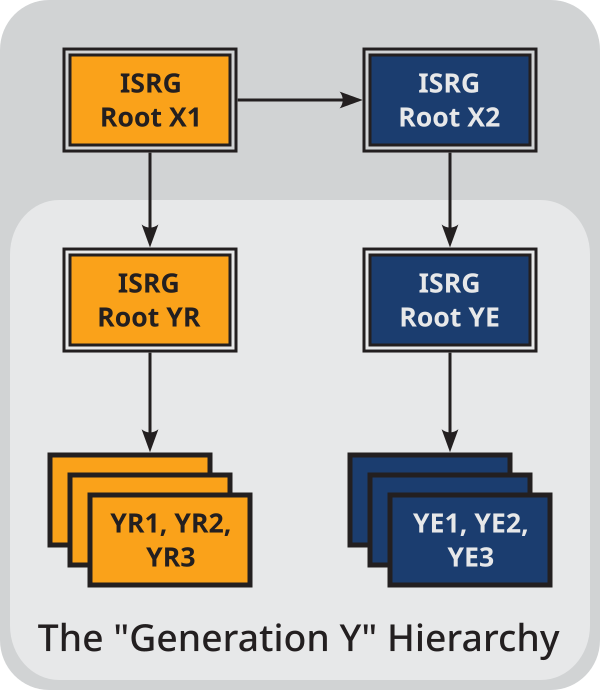
Recently, Let’s Encrypt officially announced its all-new Gen Y Root Certificate Hierarchy (Generation Y Hierarchy). This update introduces two new root certificates (ISRG Root YR and ISRG Root YE) as well as a series of new intermediate certificates.
Without a deeper look, this might seem like just a routine key rotation. But in reality, this architectural adjustment profoundly reflects the dramatic changes occurring in the Web PKI (Public Key Infrastructure) industry. By analyzing this update, we can summarize five core trends for the future of HTTPS and certificate management.
Trend: The era of “one root certificate for everything” is over. Public CAs will no longer be involved in private identity authentication.
Interpretation: This is the biggest industry rule change behind this update. According to the Google Chrome Root Program and Mozilla Root Store Policy (7.5 Dedicated Root Certificates), future root certificates must strictly follow the “Single Purpose” principle. That is: roots used for website encryption (Server Auth) and roots used for client identity authentication (Client Auth) or email signing (S/MIME) must be completely isolated in the physical trust chain.
Direct impact on developers:
Affected by this standard, Let’s Encrypt has explicitly removed the TLS Web Client Authentication Extended Key Usage (EKU) from intermediate certificates in the Gen Y architecture. This means:
clientAuth property in 2026.Trend: The hierarchy of certificate chains is deepening. The classic “Root -> Intermediate -> Leaf” three-level structure is transitioning to a “Old Root -> New Root -> Intermediate -> Leaf” four-level structure.
Interpretation: In the early stages of the Gen Y architecture, the new root certificates (ISRG Root YR/YE) will be cross-signed by existing old root certificates (ISRG Root X1/X2) to ensure compatibility with older devices globally.
This means that the certificate chain seen by clients is often 4 layers deep. With the shortening of root certificate rotation cycles (for security) and the retention of compatibility requirements (for coverage), this “four-level chain” will become the norm when configuring servers for a long time to come. Developers must ensure that the server side (such as Nginx/Apache) is configured with the complete Fullchain file, otherwise handshake failures and untrusted certificate issues are very likely to occur.
Trend: Intermediate certificates will no longer be fixed, but dynamically changing. Any form of intermediate certificate pinning will directly lead to service interruption.
Interpretation: Let’s Encrypt introduced multiple serial number intermediate certificates like YR1, YR2, YR3… in the Gen Y architecture, and will randomly select one for signing during issuance. This means the certificate you issue today might be signed by YR1, and the next renewal might be signed by YR3. If your App or IoT device has hardcoded the fingerprint of a certain intermediate certificate (a common mistake in the past), this upgrade will directly cause connection failures.
Industry Best Practices:
ISRG Root X1 and the future ISRG Root YR/YE).Trend: The industry is no longer just “discussing” shortening validity periods; a clear timeline has been released. With the passing of CA/B Forum Ballot SC-081, Web PKI will officially enter the era of 47-day validity, and Automated Certificate Lifecycle Management (CLM) will change from a “best practice” to a “mandatory requirement”.
Interpretation: The once undecided “90-day proposal” has now settled and been replaced by a more aggressive roadmap. According to the latest industry standards (Ballot SC-081), the validity period of public trust TLS certificates will be forcibly reduced according to the following schedule:
What does this mean for operations? A 47-day validity period means that to leave a safety buffer, certificates must be renewed once a month.
Trend: PKI architecture design is beginning to emphasize “Agility” to prepare for a smooth transition to Post-Quantum Cryptography (PQC).
Interpretation: The naming convention of Gen Y (YR1, YR2…) and the comprehensive support for ECDSA P-384 demonstrate extremely strong scalability.
Summary:
Let’s Encrypt’s Gen Y architecture is not just an upgrade, but an “industry manifesto”. It tells us: Future Web security will be built on shorter cycles, stricter isolation, deeper automation, and more agile architectures.
此内容由惯性聚合(RSS阅读器)自动聚合整理,仅供阅读参考。 原文来自 — 版权归原作者所有。