



The foundation of trust on the internet is quietly evolving. You may have noticed that the little padlock in your browser’s address bar is becoming more common, indicating that a website uses HTTPS encryption—something that relies on SSL certificates. Today, a significant industry development may have a profound impact on all website operators: the CA/Browser Forum (CABF) has passed a proposal called SC-081, which plans to gradually reduce the maximum validity of publicly trusted SSL certificates to just 47 days! What does this change mean, and how will it affect us? Let’s dive in.
Before we discuss the shortening of certificate validity, let’s briefly review the importance of SSL certificates. Think of them as a website’s “digital ID card,” serving two main purposes:
Websites with SSL certificates use the HTTPS protocol, and the padlock in the address bar has become a key indicator of a site’s trustworthiness.
This isn’t the first time certificate validity periods have been shortened. Looking back, it’s been a continuous process:
Now, with the CABF’s SC-081 proposal, the validity period will be drastically shortened again.
SC-081 stands for “Introduce Schedule of Reducing Validity and Data Reuse Periods.” The proposal covers not only certificate validity but also limits on domain validation data reuse.
Key Points:
Certificate maximum validity will be gradually reduced to 47 days:
This will happen in stages:
Domain validation data reuse periods will also be shortened:
| Date | Non-SAN Validation Data Reuse | SAN Validation Data Reuse | Max Certificate Validity |
|---|---|---|---|
| Before 2026/03/15 | 825 days | 398 days | 398 days |
| 2026/03/15 ~ 2027/03/15 | 398 days | 200 days | 200 days |
| 2027/03/15 ~ 2029/03/15 | 398 days | 100 days | 100 days |
| After 2029/03/15 | 398 days | 10 days | 47 days |
A quick explanation of Non-SAN and SAN validation data reuse:
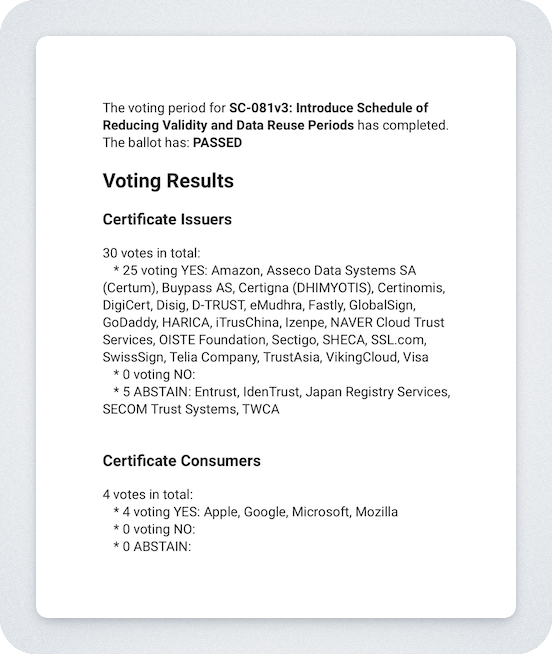
The Proposal Has Passed:
Notably, this proposal has received broad support from CABF members and has been approved. Major browser vendors like Google, Apple, and Microsoft, as well as CAs like Sectigo and DigiCert, voted in favor.
Shortening certificate validity isn’t arbitrary; it’s driven by multiple security and industry trends:
Enhanced Security: The shorter the validity, the less damage a stolen or misissued certificate can cause.
In 2011, hackers breached DigiNotar and misissued hundreds of fake certificates, including for high-value domains like Google. Because these certificates had long validity periods, attackers could use them for man-in-the-middle attacks for some time before they were discovered and revoked. Shorter validity would have greatly reduced the window of exploitation and the number of affected users.
Last year, Entrust misissued over 26,000 EV SSL certificates and failed to revoke them promptly. Longer validity would have increased the risk of abuse. The eventual distrust of this CA by browsers highlights the risks of long-lived certificates.
Improved Reliability: Ensures that domain ownership and organization info in certificates are up-to-date.
SSL certificates often contain information about domain owners and, for OV/EV, organization details. Over long validity periods, domain ownership or organization info may change, making certificates inaccurate and less trustworthy.
For example, if a domain is maliciously acquired but still holds a long-valid OV/EV certificate, attackers could impersonate the previous legitimate organization for phishing or fraud. Shorter validity and more frequent validation reduce this risk.
Better Validation Practices: More frequent validation reduces the risk of misissuance and encourages stricter CA processes.
CAs must verify applicant identity and domain control before issuing certificates. With long validity, only one check is needed for the entire period. Shorter validity means more frequent checks, pushing CAs to improve their validation processes and reduce misissuance. In 2018, the Trustico/Symantec revocation incident exposed risks in the certificate management chain. More frequent updates and validation could help catch such issues earlier.
Promotes Automation: Extremely short validity makes manual certificate management nearly impossible, pushing website owners to adopt automated certificate lifecycle management (CLM) tools like ACME.
With 47-day validity, manually tracking and renewing certificates becomes tedious and error-prone for organizations with many certificates. Automation tools (like ACME) can handle issuance, deployment, and renewal, improving efficiency and reducing outages from expired certificates. Even large organizations like Equifax, Azure, Google Voice, Microsoft Teams, and Apple have suffered outages due to expired certificates. Mature automation could have prevented these incidents.
Security Even Without Revocation: Short validity limits the window for abuse even if a certificate isn’t revoked in time.
Existing revocation mechanisms (CRL, OCSP) aren’t perfect and can be delayed or incomplete. If a stolen or misissued certificate isn’t revoked promptly, it can still be abused during its validity.
Short validity acts as a built-in safety net: even if revocation fails, malicious certificates will soon expire, limiting the window for abuse.
Promotes Cryptographic Agility: Easier to roll out new, more secure algorithms.
Cryptography evolves, with new, more secure algorithms replacing old, vulnerable ones. With long-lived certificates, it takes longer for the industry to adopt new algorithms.
Shorter validity means certificates are replaced more often, providing opportunities to upgrade to stronger algorithms and improving overall Web PKI security.
Reducing certificate validity to 47 days will have a direct impact on website owners and organizations:
Automation is Key: Manual renewal will become extremely difficult or impossible. You’ll need to deploy automation tools for certificate issuance and renewal.
More Frequent Renewals: Certificates will need to be updated more often to keep sites running smoothly.
Potential Cost Increase: While automation boosts efficiency, some solutions or increased certificate operations may add costs.
Timely Renewal is Critical: If a certificate expires, your site will be inaccessible via HTTPS, severely impacting user experience and reputation.
More Frequent Domain Validation: Shorter SAN validation reuse means you’ll need to validate domain control more often for multi-domain certificates.
With these changes coming, website owners should prepare proactively. Here are some tips:
Embrace Automation Now: If you’re not already using automated certificate management, start researching and deploying it. The ACME protocol is a widely adopted open standard for automated renewal.
Choose the Right Management Solution: Depending on your site’s scale and architecture, pick a suitable certificate management solution—whether a cloud provider’s integrated service or a third-party CLM platform.
Focus on DNS Validation: DNS validation is a common automated method. Ensure your DNS setup is correct for smooth automation.
Work with Your CA: Choose a CA that offers good automation support and services.
Plan and Test Ahead: Before new validity limits take effect, thoroughly test your automation workflows to ensure everything runs smoothly.
Stay Informed: Keep up with CABF developments and requirements to adjust your processes as needed.
Reducing certificate validity to 47 days is a major milestone in web security, reflecting the industry’s ongoing pursuit of security and agility. While it may pose short-term challenges for website operations, in the long run it will help build a safer, more reliable internet. Automation will be key to adapting—sites that fail to automate may face significant operational pressure. Let’s embrace the change and work together for a safer web!
此内容由惯性聚合(RSS阅读器)自动聚合整理,仅供阅读参考。 原文来自 — 版权归原作者所有。