


惯性聚合 高效追踪和阅读你感兴趣的博客、新闻、科技资讯
阅读原文 在惯性聚合中打开

推荐订阅源

Google DeepMind News
人人都是产品经理
人人都是产品经理
S
Securelist
P
Proofpoint News Feed
H
Help Net Security
S
Schneier on Security
T
Tenable Blog
C
Cisco Blogs
S
Security @ Cisco Blogs
博客园 - 司徒正美
博客园 - 叶小钗
Cisco Talos Blog
Cisco Talos Blog
Google DeepMind News
C
Cybersecurity and Infrastructure Security Agency CISA
Google Online Security Blog
Exploit-DB.com RSS Feed
Hacker News: Ask HN
Hacker News: Ask HN
NISL@THU
NISL@THU
云风的 BLOG
云风的 BLOG
V
Vulnerabilities – Threatpost
T
The Blog of Author Tim Ferriss
aimingoo的专栏
aimingoo的专栏
W
WeLiveSecurity
www.infosecurity-magazine.com
Jina AI
Jina AI
腾讯CDC
WordPress大学
WordPress大学
Simon Willison's Weblog
Vercel News
Vercel News
小众软件
小众软件
N
Netflix TechBlog - Medium
有赞技术团队
有赞技术团队
AWS News Blog
AWS News Blog
雷峰网
雷峰网
Forbes - Security
Forbes - Security
The Hacker News
The Hacker News
博客园 - 聂微东
F
Full Disclosure
量子位
Scott Helme
Scott Helme
宝玉的分享
宝玉的分享
A
About on SuperTechFans
钛媒体:引领未来商业与生活新知
钛媒体:引领未来商业与生活新知
Schneier on Security
让小产品的独立变现更简单 - ezindie.com
K
Kaspersky official blog
AI
AI
SecWiki News
SecWiki News
Webroot Blog
Webroot Blog
Martin Fowler
Martin Fowler

Dropbox Tech Blog

How our universal content processing platform Riviera evolved for AI and beyond How we used DSPy to turn AI evaluations into better responses in Dash chat How Dropbox uses MCP and Dash to close the design-to-code security gap Beyond code generation: rethinking engineering productivity in the age of AI agents Introducing Nova, our internal platform for coding agents Improving storage efficiency in Magic Pocket, our immutable blob store Reducing our monorepo size to improve developer velocity How we optimized Dash's relevance judge with DSPy Using LLMs to amplify human labeling and improve Dash search relevance How low-bit inference enables efficient AI Insights from our executive roundtable on AI and engineering productivity Engineering VP Josh Clemm on how we use knowledge graphs, MCP, and DSPy in Dash Inside the feature store powering real-time AI in Dropbox Dash Building the future: highlights from Dropbox’s 2025 summer intern class Fighting the forces of clock skew when syncing password payloads Introducing Focus, a new open source Gradle plugin Making camera uploads for Android faster and more reliable How Dropbox Replay keeps everyone in sync Why we built a custom Rust library for Capture Detecting memory leaks in Android applications How we sped up Dropbox Android app startup by 30% Revamping the Android testing pipeline at Dropbox Our counterintuitive fix for Android path normalization JQuery to React: How we rewrote the HelloSign Editor How we ensure credible analytics on Dropbox mobile apps Engineering Dropbox Transfer: Making simple even simpler Speeding up a Git monorepo at Dropbox with <200 lines of code Building for reliability at HelloSign Store grand re-opening: loading Android data with coroutines Modernizing our Android build system: Part I, the planning Modernizing our Android build system: Part II, the execution Our journey to type checking 4 million lines of Python The (not so) hidden cost of sharing code between iOS and Android Redux with Code-Splitting and Type Checking The Programmer Mindset: Main Debug Loop On working with designers Incrementally migrating over one million lines of code from Python 2 to Python 3 Crash reporting in desktop Python applications What we learned at our first JS Guild Summit How we rolled out one of the largest Python 3 migrations ever Dropbox Paper: Emojis and Exformation Creating a culture of accessibility Adding IPv6 connectivity support to the Dropbox desktop client Accelerating Iteration Velocity on Dropbox’s Desktop Client, Part 2 Accelerating Iteration Velocity on Dropbox’s Desktop Client, Part 1 DropboxMacUpdate: Making automatic updates on macOS safer and more reliable Annotations on Document Previews Open Sourcing Pytest Tools Open Sourcing Zulip – a Dropbox Hack Week Project Building Carousel, Part III: Drawing Images on Screen The Tech Behind Dropbox’s New User Experience on Mobile (Part 2) Building Dropbox’s New User Experience for Mobile, Part 1 Building Carousel, Part II: Speeding Up the Data Model Building Carousel, Part I: How we made our networked mobile app feel fast and local Scaling MongoDB at Mailbox Welcome Guido! Dropbox dives into CoffeeScript Some love for JavaScript applications Plop: Low-overhead profiling for Python Using the Dropbox API from Haskell A Python Optimization Anecdote Translating Dropbox
Why we chose Apache Superset as our data exploration platform
Bogdan Kyryliuk · 2021-01-19 · via Dropbox Tech Blog

Today the Apache Software Foundation announced Apache Superset as one of its official top-level projects. Apache Superset is a modern, open source data exploration and visualization platform already in use at Airbnb, American Express, Lyft, Nielsen, Rakuten Viki, Twitter, and Udemy among others.

I worked on Apache Superset at Airbnb in its early days. When I came to Dropbox in late 2018, I got to continue working on it as a side project. Eventually, the company decided it was important enough to our internal needs to put our full attention to incorporating Apache Superset as our data exploration platform. We’ve been using it in production since early 2020, expanding its use until it became our main data exploration tool.

Our choice of Apache Superset wasn’t cut and dry, though. I’ll explain what alternatives we looked at, and why we chose Superset. Of course I think it’s great, but for your own purposes it’s important to choose the tool that solves the most important real problems you have.

Problems we started with

As many companies of our size have done, we had built a number of internal tools to help engineers, analysts, and business stakeholders with their analytics needs. At one point we had more than 10 different data visualization solutions in order to:

  • Monitoring and ensuring uptime
  • Performing migrations as needed
  • Piping data between systems
  • Ensuring correct access controls
  • Data governance
  • Onboarding users into these systems
  • Providing on-demand user support

In late 2019, we decided to consolidate our data exploration tooling and introduce a single solution. For our needs, it would need to be able to:

  • Transform SQL queries into charts with minimal friction
  • Enable quick data exploration for ad-hoc analysis, without needing to design a dataset first
  • Allow users to create charts and dashboards that could be shared with others
  • Encourage re-use of queries through customizable macros
  • Consume data from our centralized data store (Hive and Presto clusters on top of S3 data)

Evaluating data exploration tools

Most of our dashboarding and data visualization needs could be classified into three buckets:

  1. Business analytics: exploration and investigation of past business performance to gain insights, identify trends, evaluate ideas and experiments, and size up opportunities.
  2. Operational analytics: investigation of our operational systems, especially software ones (software reliability, trends, debugging, etc).
  3. Automation of repetitive tasks: as a data-driven company, there was a lot of demand for report automation—monitoring system health, reviewing team metrics, measuring OKRs, etc.

To arrive at the right tool, we prioritized the following capabilities in descending order of importance:

  • Security: Data visualization tools have access to sensitive data. We need first and foremost to ensure that data access can be governed and audited, and that we are following the best practices of the Dropbox security team.
  • User friendliness: A shallow learning curve, good documentation, and good support were our top priority after security, so that insights from data can be generated quickly. A steep learning curve has historically been one of the major adoption blockers of any data visualization or dashboarding tool we’ve deployed.
  • Maintainability: Minimize the maintenance cost of the system, which breaks down to two key factors:
    • End users should have minimal overhead to maintain their charts and dashboards.
    • The Data Platform team should be able to ensure continuous support of the tool and its development.
  • Flexibility and extensibility: Seamless integration into the ecosystem of data infrastructure tools and adaptability to future needs is a plus, but not as important as user friendliness and maintainability for us.

While data processing and data visualization are critical to our business, they are neither our core competency, nor are they a competitive advantage themselves. Building best-in-class tools requires a lot of long-term investment and has proven to be a challenging task.

Our general philosophy is to buy a solution that satisfies our need whenever possible, or leverage an open source initiative. We will build a tool in-house only if neither of the first two options are possible. 

With all this in mind, we created a list of properties we were looking for in a data exploration tool:

  1. Preference to buy a solution or leverage open source rather than build
  2. Minimize the number of solutions needed to cover our internal use cases
  3. Optimize for ease of iteration and dashboard creation
  4. Encourage the right behavior and ETL best practices in data quality
    • Maintain a clear delineation between visualization and data processing
  5. Stay as close as possible to the source of truth
    • Delegate computation to the database engine
    • Minimize the number of intermediate layers or configurations needed to build a chart 

Why we chose Superset

As our table below shows, no one option is the best at everything. They all have unique strengths. Periscope (recently renamed to Sisense) allows drag-and-drop interfaces and works with any git server. Mode’s implementation of topics and cross-topic searches is impressive. Redash has alerts today which Superset has only begun to develop, plus a user activity log not found in some other solutions. Metabase is also worth considering, but we ruled it out for Dropbox because it is written in Clojure, which is neither adopted internally within Dropbox engineering, nor supported by our current infrastructure.

For us, Superset offered abilities that mattered to our internal users, who want to get answers without writing SQL and for whom time and effort creating visualizations needs to be minimal. The ability to create reusable virtual table columns and metrics that are shared across teams is a big plus for them. Access control list granularity helped us meet the high security expectations we have at Dropbox, streamline data access and cross-team sharing, and minimize support and administration work. Superset’s API for creating charts powers a couple of internal tools and has saved engineering time when building custom visualizations. And in daily use for busy people, a progress bar is more helpful than you might realize.

In short, we chose Apache Superset because it was the best match to our specific internal needs. We were ready to invest engineering effort to close the gaps wherever needed. 

We also enjoyed contributing the following features back to the Superset project:

As part of our decision-making process, we created this table which lists the key properties of the leading contenders. We’re happy to share it to help you make your own decisions.
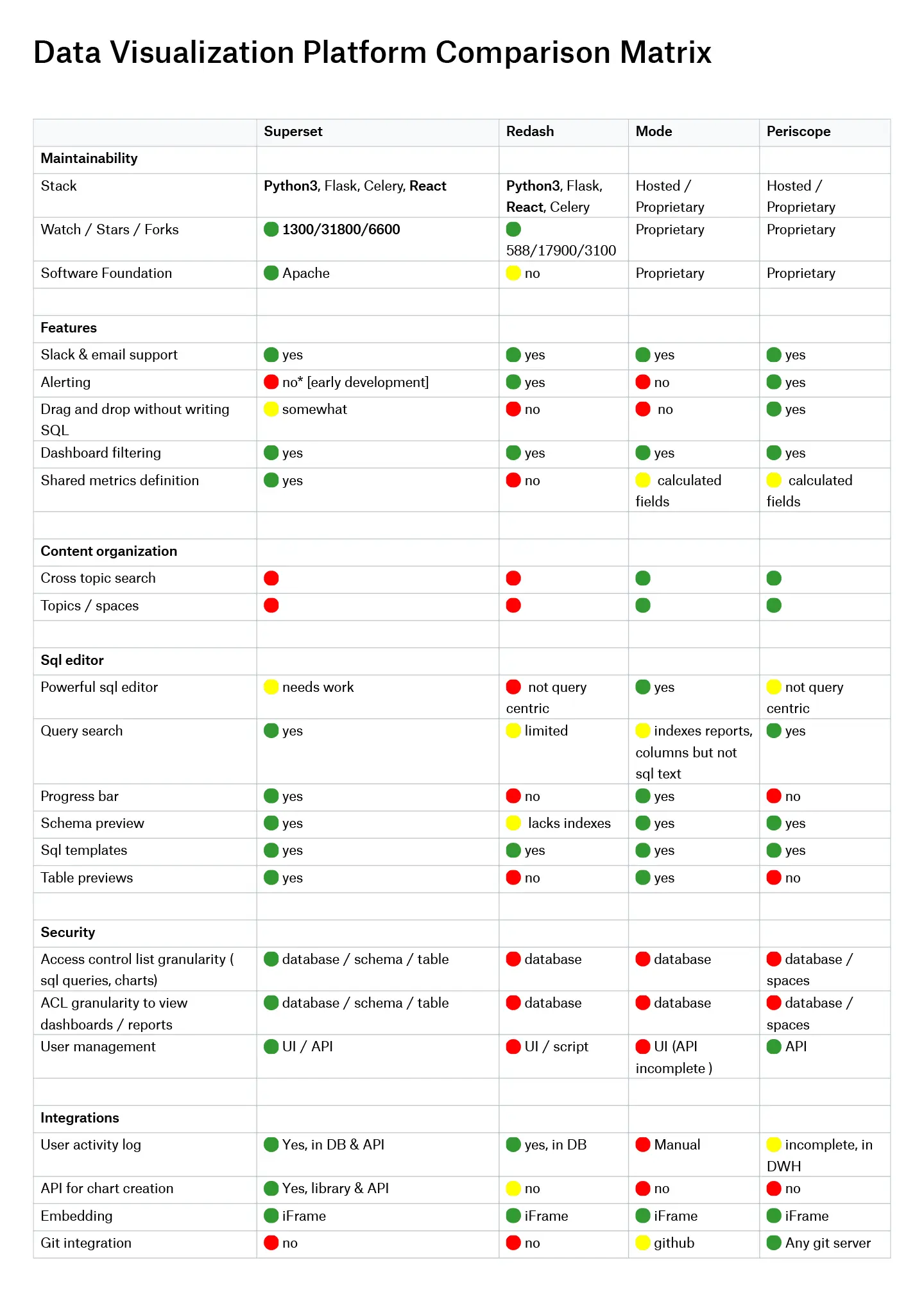
View or download the full-size comparison matrix here.

Results

Six months after we bet on Superset, it’s clearly been a big success at Dropbox. Superset had quick and strong adoption across the organization, and is now the main data exploration tool for our data warehouse. It has helped a number of teams to improve their workflows—so much so that they agreed to be quoted:

It's been a game changer for us. It is much less friction than the previous flow, and it makes it easy to add new metrics. We'll be able to get much more visibility into how the various aspects of the sync engine are working, which will help us detect issues earlier and minimize their impact on our customers. —Core Sync Team

Superset is great, the speed of queries is astounding! It has been a big upgrade for the team over our legacy tools and the dashboards are much easier to build.  —Product Analytics

Their praise is quantified by a chart of Superset’s Weekly Average Users at Dropbox following rollout:
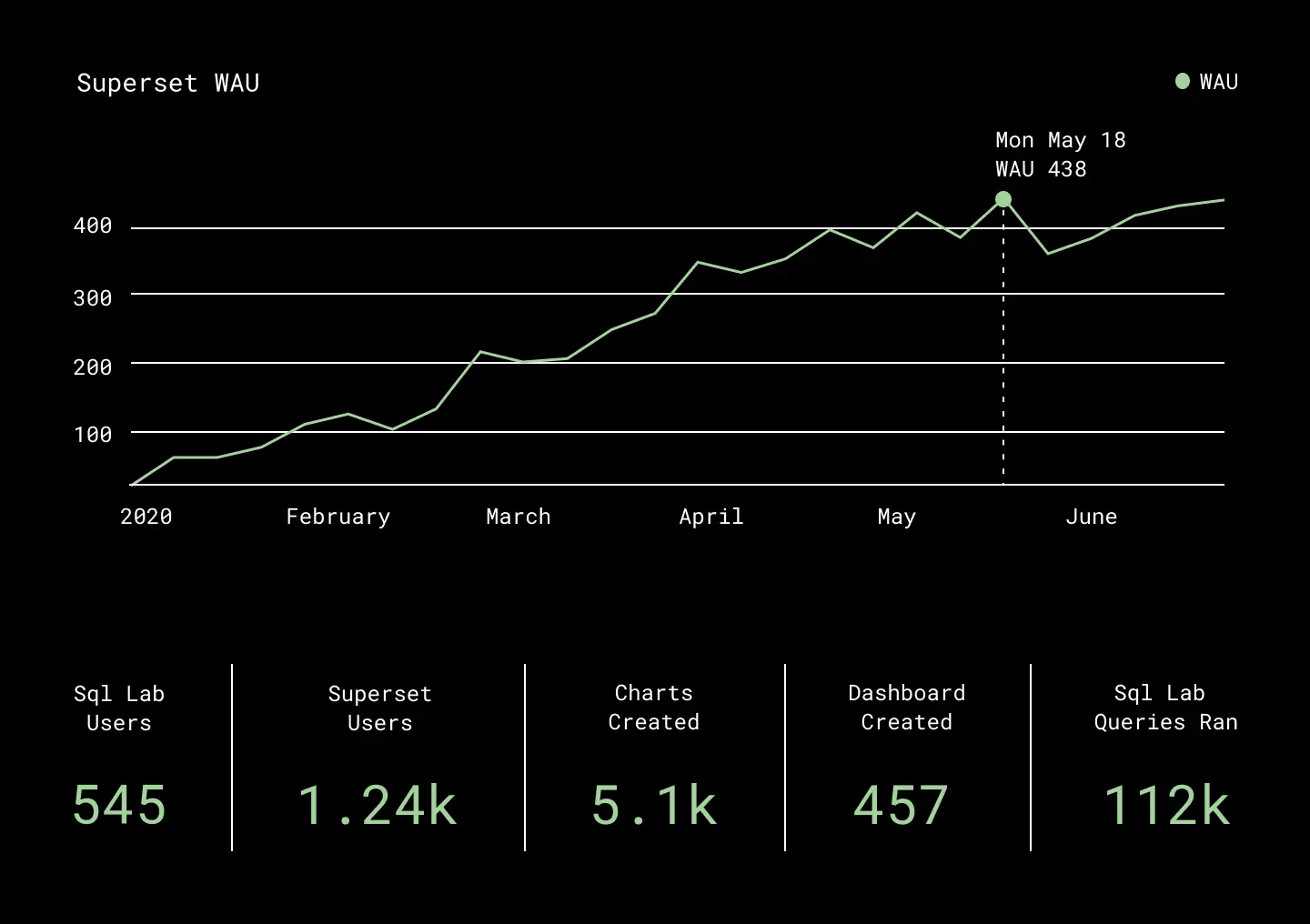
superset adoption data graphics

Superset Weekly Average Users trend following initial rollout (top), overall users and content created (bottom)

Choose the best solution for your own biggest problems

I’m proud of what we’ve built with Superset, but you should research and decide what your own priorities are before committing to a platform. In our case, user-friendliness was more important than flexibility and extensibility. Apache Superset stood out to us in ease of user adoption, yet was flexible enough to meet our needs. 

We’re lucky to be living in a time where there are a number of great solutions on the market that can provide powerful data exploration capabilities to your organization. We hope this post helps you make your own best decision.