


惯性聚合 高效追踪和阅读你感兴趣的博客、新闻、科技资讯
阅读原文 在惯性聚合中打开

推荐订阅源

Threat Intelligence Blog | Flashpoint
B
Blog RSS Feed
GbyAI
GbyAI
Google DeepMind News
B
Blog
博客园 - 司徒正美
Vercel News
Vercel News
A
About on SuperTechFans
Martin Fowler
Martin Fowler
WordPress大学
WordPress大学
Recent Announcements
S
SegmentFault 最新的问题
博客园_首页
Apple Machine Learning Research
Stack Overflow Blog
Stack Overflow Blog
L
LINUX DO - 热门话题
Y
Y Combinator Blog
F
Full Disclosure
月光博客
月光博客
C
Cyber Attacks, Cyber Crime and Cyber Security
MongoDB | Blog
MongoDB | Blog
The Cloudflare Blog
The Hacker News
The Hacker News
CTFtime.org: upcoming CTF events
A
Arctic Wolf
Scott Helme
Scott Helme
V
Visual Studio Blog
C
Cybersecurity and Infrastructure Security Agency CISA
T
Tor Project blog
P
Privacy International News Feed
Spread Privacy
Spread Privacy
G
GRAHAM CLULEY
Microsoft Security Blog
N
News and Events Feed by Topic
Exploit-DB.com RSS Feed
PCI Perspectives
PCI Perspectives
小众软件
小众软件
博客园 - 【当耐特】
Cloudbric
Cloudbric
S
Secure Thoughts
L
LINUX DO - 最新话题
Google Online Security Blog
T
Troy Hunt's Blog
Cyber Security Advisories - MS-ISAC
W
WeLiveSecurity
V
Vulnerabilities – Threatpost
人人都是产品经理
人人都是产品经理
酷 壳 – CoolShell
酷 壳 – CoolShell
钛媒体:引领未来商业与生活新知
钛媒体:引领未来商业与生活新知
量子位

Dropbox Tech Blog

How our universal content processing platform Riviera evolved for AI and beyond How we used DSPy to turn AI evaluations into better responses in Dash chat How Dropbox uses MCP and Dash to close the design-to-code security gap Beyond code generation: rethinking engineering productivity in the age of AI agents Introducing Nova, our internal platform for coding agents Improving storage efficiency in Magic Pocket, our immutable blob store Reducing our monorepo size to improve developer velocity How we optimized Dash's relevance judge with DSPy Using LLMs to amplify human labeling and improve Dash search relevance How low-bit inference enables efficient AI Engineering VP Josh Clemm on how we use knowledge graphs, MCP, and DSPy in Dash Inside the feature store powering real-time AI in Dropbox Dash Building the future: highlights from Dropbox’s 2025 summer intern class Fighting the forces of clock skew when syncing password payloads Introducing Focus, a new open source Gradle plugin Making camera uploads for Android faster and more reliable How Dropbox Replay keeps everyone in sync Why we built a custom Rust library for Capture Detecting memory leaks in Android applications How we sped up Dropbox Android app startup by 30% Why we chose Apache Superset as our data exploration platform Revamping the Android testing pipeline at Dropbox Our counterintuitive fix for Android path normalization JQuery to React: How we rewrote the HelloSign Editor How we ensure credible analytics on Dropbox mobile apps Engineering Dropbox Transfer: Making simple even simpler Speeding up a Git monorepo at Dropbox with <200 lines of code Building for reliability at HelloSign Store grand re-opening: loading Android data with coroutines Modernizing our Android build system: Part I, the planning Modernizing our Android build system: Part II, the execution Our journey to type checking 4 million lines of Python The (not so) hidden cost of sharing code between iOS and Android Redux with Code-Splitting and Type Checking The Programmer Mindset: Main Debug Loop On working with designers Incrementally migrating over one million lines of code from Python 2 to Python 3 Crash reporting in desktop Python applications What we learned at our first JS Guild Summit How we rolled out one of the largest Python 3 migrations ever Dropbox Paper: Emojis and Exformation Creating a culture of accessibility Adding IPv6 connectivity support to the Dropbox desktop client Accelerating Iteration Velocity on Dropbox’s Desktop Client, Part 2 Accelerating Iteration Velocity on Dropbox’s Desktop Client, Part 1 DropboxMacUpdate: Making automatic updates on macOS safer and more reliable Annotations on Document Previews Open Sourcing Pytest Tools Open Sourcing Zulip – a Dropbox Hack Week Project Building Carousel, Part III: Drawing Images on Screen The Tech Behind Dropbox’s New User Experience on Mobile (Part 2) Building Dropbox’s New User Experience for Mobile, Part 1 Building Carousel, Part II: Speeding Up the Data Model Building Carousel, Part I: How we made our networked mobile app feel fast and local Scaling MongoDB at Mailbox Welcome Guido! Dropbox dives into CoffeeScript Some love for JavaScript applications Plop: Low-overhead profiling for Python Using the Dropbox API from Haskell A Python Optimization Anecdote Translating Dropbox
Insights from our executive roundtable on AI and engineering productivity
Craig Wilhite · 2026-02-12 · via Dropbox Tech Blog

Improving engineering productivity is crucial to the work we do at Dropbox. The more quickly we can deliver high-quality features to our customers, the more value they can get from our products. This rapid iteration has been key to developing tools like Dropbox Dash, context-aware AI that connects to all your work apps, so you can search, ask questions about, and organize all your content.

In the process of building Dash, we’ve become big adopters of AI tools in our own work, from Claude Code to Cursor. The early results have been promising, but there are still a lot of open questions about how to work with these tools most effectively and where they can have the most impact. To push this conversation forward, Dropbox CTO Ali Dasdan hosted an executive roundtable on December 11, 2025, at our San Francisco studio. We brought together a small group of technology leaders from top companies for an afternoon of open discussion, idea-sharing, and a deep dive into the evolving world of engineering productivity and AI. Here’s how it went.

How Dropbox is accelerating progress with AI

Adopting AI tooling for the sake of AI is meaningless; it must be tied to tangible business results. As we navigate this shift, we’ve had to ask ourselves: Which approach is the right one? What existing processes need to be upgraded in light of AI workflows? To kick off the event—and show attendees how we’ve been thinking through these questions at Dropbox—Uma Namasivayam, Senior Director of Engineering Productivity, took a closer look at our own experimentation, adoption, and enablement cycle to accelerate engineering productivity with AI.

We started by working with Dropbox leadership to gain buy-in and establish the importance of AI tooling, and together made AI adoption a company-level priority. This turned AI from a grassroots experiment into an urgent organizational priority, and helped everyone get aligned. Teams were now empowered to experiment with tooling, and we reduced the overhead associated with getting contracts approved to pilot new tooling at Dropbox. 

In our experimentation, Dropbox saw impact across the entire software development life cycle, from code review and documentation to debugging and testing. Like other large organizations, Dropbox has our unique challenges. Off-the-shelf AI tools don’t always fit our scale constraints—we have a very large, multi-language monorepo—so we’ve had to be deliberate about where to adopt, where to extend, and where to build our own capabilities. For example, Dropbox built our own AI tooling that listens for failed builds on pull requests and uses our AI platform to propose fixes to them.

As a result of our efforts, most Dropbox developers are now using at least one AI tool in their workflows. We track pull request (PR) throughput per month, per engineer as a core metric. You can see how users who are engaging more with AI coding tools have an outsized impact on the code shipped, measured by PR throughput per month.
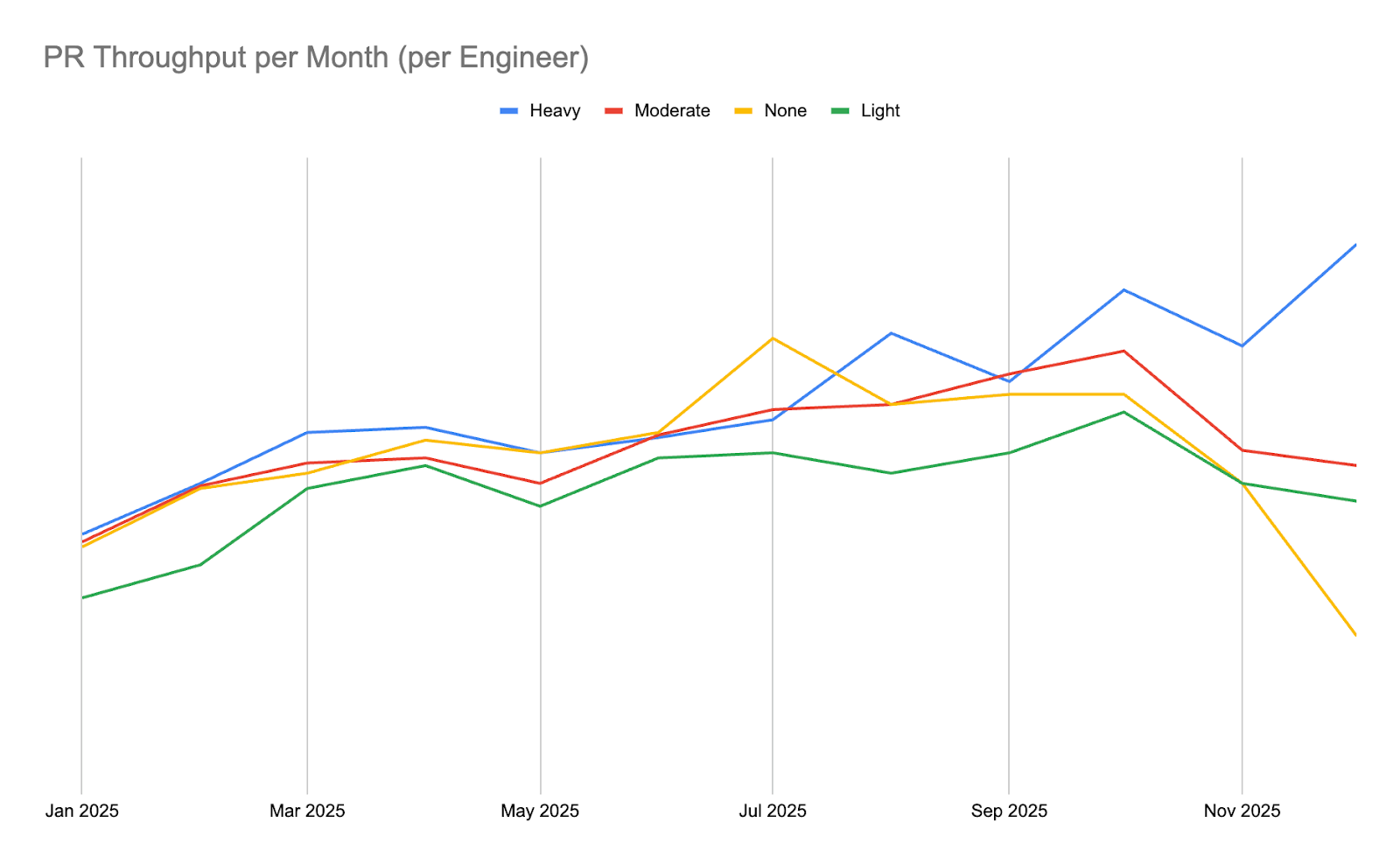
A graph showing pull request throughput per month, per engineer.

We also closely monitor the sentiment of engineers internally regarding AI tooling. As strong positive sentiment increases, we’re seeing the share of negative sentiment go down.
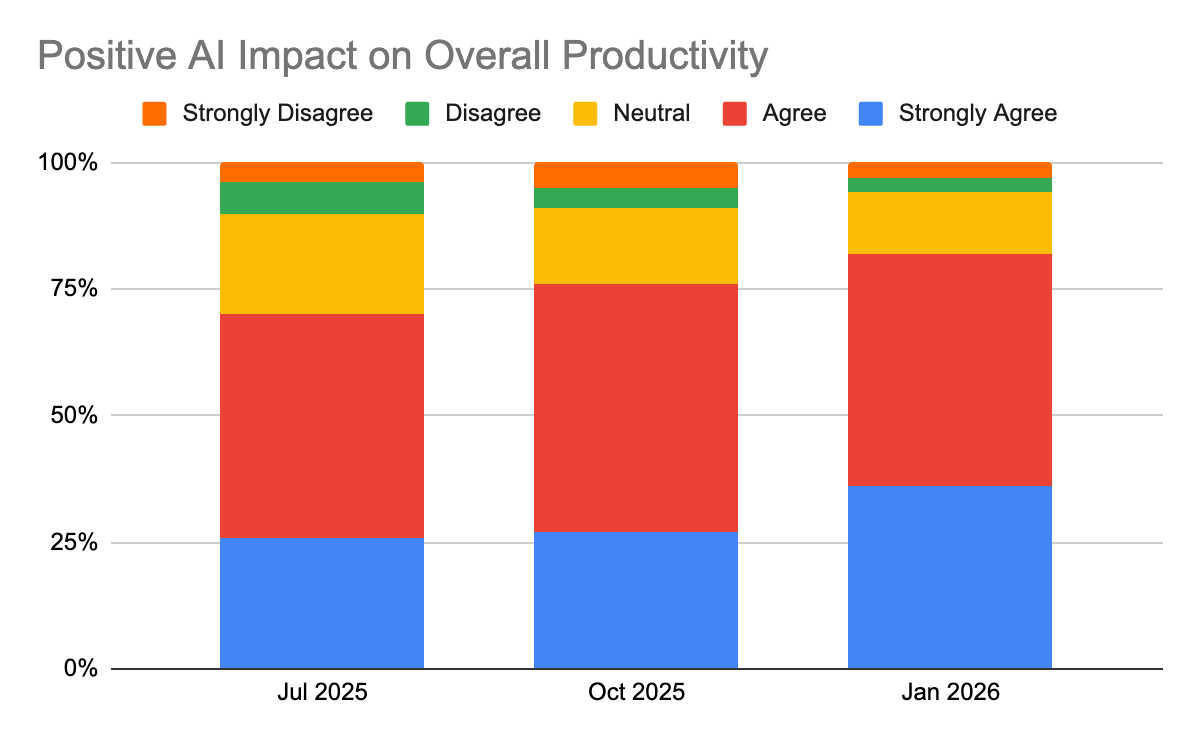
A graph showing the impact of AI on developer productivity has grown more positive over time, according to surveys of Dropboxer engineers.

Most importantly, developers feel less friction using AI to accelerate their work because we’ve made it easier to adopt tooling according to what they feel works best for their team.

The executive roundtable

The heart of the evening was a roundtable discussion designed to cross-pollinate ideas across different industries. To facilitate this, we divided attendees into three cohorts, rotating the groups for each question so that every leader could learn from three different peer groups.

The discussion centered around three core pillars:

  1. Measuring impact. What are the top three ways attendees are measuring AI-driven engineering productivity gains and what are the top three ways of measuring the resulting business impact?
  2. Leadership alignment. Describe three ways of aligning with company leadership on the progress and pace of AI deployment and use for productivity.
  3. The human element. What are the top three ways attendees are recruiting, evaluating, and growing their workforce for AI competency and productivity? What lessons can be applied to make non-developers more productive?

Following the structured session, the conversation continued over a cocktail hour, where leaders shared further insights into the commitment to craft required to lead in the age of AI.

What we learned, and what’s next

The overarching themes that emerged from the roundtable discussions centered around the following:

  1. Balance. Productivity gains must be carefully balanced against potential trade-offs in quality and long-term maintenance costs.
  2. The role of leadership. Management, particularly technical leadership, is pivotal in establishing and enforcing effective AI usage norms.
  3. Formalization. Formalizing AI competency within career frameworks signals a long-term commitment to its strategic importance.

Still, there are a number of open questions, such as: If AI is giving us more capacity, where is that capacity actually going? For Dropbox, this capacity is currently being channeled into areas like addressing tech debt, executing migrations, and improving reliability. 
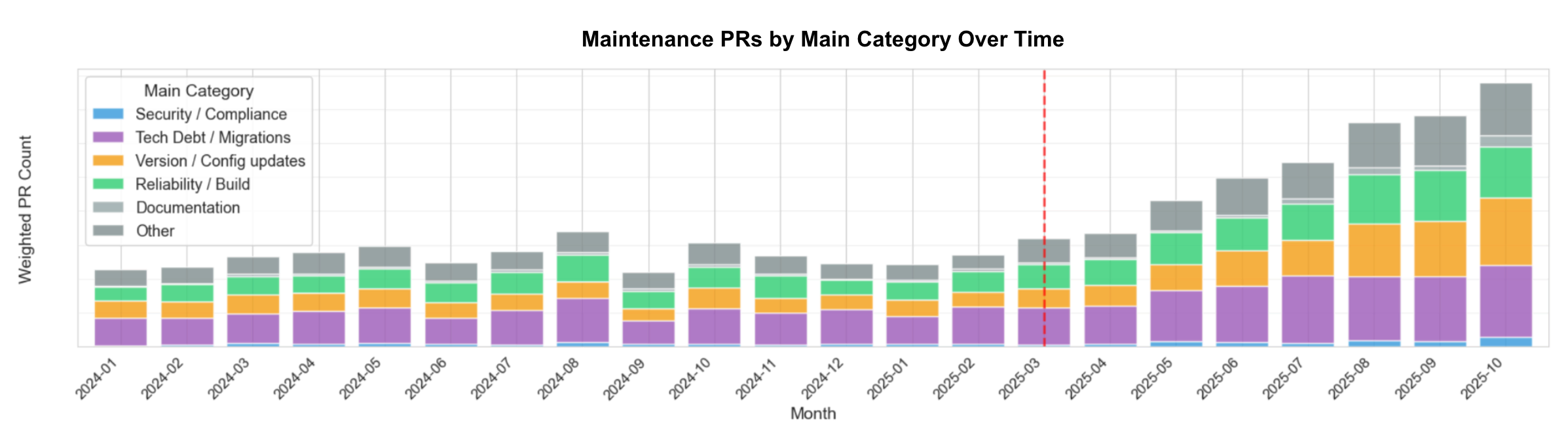
A graph showing the different categories in which PR throughput has increased since we introduced AI tools for developers.

However, a key challenge remains in effectively connecting these productivity gains to tangible business outcomes—a challenge also voiced by many attendees during the roundtable. Therefore, the focus for 2026 will be on mapping productivity directly to specific outcomes, extending operational rigor beyond engineering teams, and ultimately driving end-to-end product velocity.

A huge thank you to everyone who made the trip to our San Francisco studio and contributed to such a memorable event. If you missed out this time, keep an eye on our events page for future opportunities to connect!

~ ~ ~ 

If building innovative products, experiences, and infrastructure excites you, come build the future with us! Visit jobs.dropbox.com to see our open roles.


  • Link copied