



惯性聚合 高效追踪和阅读你感兴趣的博客、新闻、科技资讯
阅读原文 在惯性聚合中打开

推荐订阅源

K
KPMG report finds enterprise disconnect between AI and its ROI | CIO
H
Help Net Security
博客园_首页
P
Privacy International News Feed
钛媒体:引领未来商业与生活新知
钛媒体:引领未来商业与生活新知
T
Tenable Blog
Latest news
Latest news
D
Darknet – Hacking Tools, Hacker News & Cyber Security
爱范儿
爱范儿
Cyberwarzone
Cyberwarzone
P
Palo Alto Networks Blog
月光博客
月光博客
有赞技术团队
有赞技术团队
Know Your Adversary
Know Your Adversary
博客园 - 叶小钗
P
Proofpoint News Feed
让小产品的独立变现更简单 - ezindie.com
S
Schneier on Security
A
About on SuperTechFans
F
Full Disclosure
The Cloudflare Blog
T
The Exploit Database - CXSecurity.com
S
SegmentFault 最新的问题
Apple Machine Learning Research
Microsoft Security Blog
cs.AI updates on arXiv.org
N
News and Events Feed by Topic
www.infosecurity-magazine.com
cs.CL updates on arXiv.org
Webroot Blog
Webroot Blog
量子位
大猫的无限游戏
大猫的无限游戏
小众软件
小众软件
WordPress大学
WordPress大学
Last Week in AI
Last Week in AI
美团技术团队
Help Net Security
Help Net Security
Microsoft Azure Blog
GbyAI
GbyAI
云风的 BLOG
云风的 BLOG
Y
Y Combinator Blog
博客园 - 司徒正美
N
Netflix TechBlog - Medium
S
Security @ Cisco Blogs
B
Blog
P
Privacy & Cybersecurity Law Blog
Security Archives - TechRepublic
Hacker News - Newest:
Hacker News - Newest: "LLM"
V
Visual Studio Blog
NISL@THU
NISL@THU

Nautilus

Can the Sugar Molecules That Coat Our Cells Predict Our Health? These Ancient Baby Predators Challenge Our Understanding of Evolution This “Roasted Exoplanet” Has a Wild Orbit Today Was the Day Galileo Caved See the Southern Lights from Space in New ISS Video Qatari Sand Cats Caught on Camera for the First Time How to Protect Earth Against Violent Space Weather In the Midst of Tornado Season, a Surprisingly Short History of Predicting Twisters Can “Dante’s Inferno” Tell Us Something About Space Rocks? The Inventor of the Thinking Machine Didn’t Worry. Neither Should You Science Is Political—and Spiritual Take a Gander at an Ancient Supernova in the Heart of the Milky Way The Model for Botticelli’s Venus Died at 23 The Birth-Control Pill May Encourage Binge Eating This Shark Can Walk on Land Aliens Probably Have Consciousness If You’re Counting on Calcium and Vitamin D Supplements to Prevent Fractures, Think Again Saving a Tiny Endangered Porpoise One Pixel at a Time This Cosmonaut Was the First Woman in Space Does This Protein Hold the Key to Differences in Aging Between Males and Females? The Nautilus Reading List of Books on Evolution Does Cooperation Beat Cheating After All? Is This the King of GLP-1s? What Is a Trillion, Really? Bad Third-Grade Behavior Could be a Preview of Educational Failure These Ancient Millipedes Paved the Way for Terrestrial Life ISS Astronaut Shares Incredible Photos of Volcanoes Taken From Space Goblin Sharks Caught on Camera in Their Natural Habitat for the First Time The Ancient Roots of Modern Winemaking How to Feel at Home in the Modern World The Surprising Things You Find Digging Through Frozen Prehistoric Squirrel Poop What Makes Sloths So Slow? Why Robots Still Can’t Do Science Hidden Fungal Networks Could Stretch from the Earth to the Sun a Billion Times Over Turning the Psychedelic Experience into a Math Problem These Overlooked Pollutants Cause About 15 Percent of Global Warming The Venus Flytrap Mystery That Vexed Darwin, Solved Inside the Largest Whale Graveyard on Earth How to Stop a Killer Asteroid 274 Years Ago Today, Benjamin Franklin Flew a Kite Listen to the Sound of the Most Massive Organism on Earth Looking for Signs of Intelligence in Chatbots The Healing Power of Dreaming Under Anesthesia Hawaii’s False Killer Whales Are Wasting Away How These Supergiant Sea Creatures Survive More Than 5 Years Without Eating Mysterious Web-Footed “Ghost Dog” Caught on Camera How to Heal People with Science Fiction Here’s Why Our Walking Gets Slower as We Age See the First-Ever Photos of Cozumel’s Mysterious Dwarf Fox Koalas Were in Trouble Before Humans Arrived in Australia Dogs Could Be Humanity’s Best Friend in the Fight Against This Invasive Species Vast Hidden Structure Discovered Beneath Antarctica Human Ancestors Were Using Fire Earlier Than Previously Thought Check Out the Newest Fluorescent Amphibian Your Saliva Knows How Sleepy You Are Lessons in Chemistry, 19th-Century Style Newly Discovered Four-Winged Dinosaur Didn’t Need to Fly to Hunt Birds Ice Age CSI: Mammoth Cold Case Files Check Out This New Colorful Sea Slug the Size of a Sesame Seed The Soul of Numbers Hell Heron: An Illustrated Story This Towering Fir Is the Tallest Tree in East Asia Why Doesn’t Coffee Taste Like Caffeine? Screwworms Are Back. Here’s How We Eliminated Them the First Time Who Was Nancy Grace Roman? Bumblebees Have Chimp-Like Problem-Solving Abilities Despite Tiny Brains Solving Feynman’s Formula for Eating Well, Parking Your Car, and Finding a Mate Newly Discovered Active Fault Line Could Threaten New Zealand’s Biggest City The Cold War’s Accidental Whale Observatory Watch How “Trashy” City Bowerbirds Attract Their Mates Stupid in the Land of Oz Food Noise Goes Quiet with GLP-1s The Iceman’s Microbiome Ancient DNA Illuminates the Uniqueness of the Extinct Cave Lion Rare Meteorite Hints at Ancient Planetary Collision in Our Solar System How Animals Pick and Choose the Sex of Their Offspring This Non-Movie-Star Shark Is Feeding Close to Shore Beavers Don’t Just Build Dams, They Build Nations Tadpoles Use a World War I Naval Strategy to Dazzle Predators See the Gravity Waves from a Super Typhoon 9 Books We’re Excited About This June Did a Roman Legionnaire Wear Eyeliner? See Saturn Like You’ve Never Seen it Before How the “Perfectionism Pandemic” Is Crushing Young People What Happened When the First Animals Started to Move After the Black Death, Italy’s Oak Trees Came Back Editing the Pesky Bones Out of a Popular Farmed Fish This Blood-Sucking Fly Drastically Transforms When It Finds Its Prey These Stars Swallowed Their Earth-like Planets Nightmarish Heron-like Dinosaur Unearthed in Patagonia How a Tiny Bird Might Tell the Tale of Island Giants How Right-Wing Politics Make You Physically Ill The Cephalopods Are Coming The Moon Bases of Yesteryear This Is What Gives Pigeons Their Excellent Sense of Direction The Genetic Secrets of a Shark That Lives for 500 Years The Many Ways to Build a Black Hole Wearing DEET Might Be Like Ringing the Mosquito Dinner Bell This “Feathered Dragon” Shook Its Tail Feathers in the Time of Dinosaurs The Supernova That Sparked the Original Scientific Revolution
How to Dodge a Mountain Lion
Kristen French · 2026-06-19 · via Nautilus

I recently hiked through the Laguna Mountain range in California at dusk. At the trailhead, svelte mountain lions and shiny rattlesnakes greeted us from warning posters. We were hiking with my boyfriend’s 11-year-old son, so we rehearsed what we’d do on the very off-chance that a large cat emerged from the brush ready to pounce. We waved our hands in the air—though the effect was more goofy than intimidating. We shouted to each other in booming voices. We reminded each other that we could throw rocks if necessary, but definitely not crouch or run.

Statistically, you’re more likely to be struck by lightning than to be attacked by a mountain lion on a hike, so we weren’t particularly worried. But after the sun set and the dark crept in, we took a wrong turn, and I caught myself startling at the slightest crackle in the bushes. Big cats mostly hunt at night. I picked up a rock and a stick. A couple of incidents from earlier this year caught in the gears of my mind.

CALL OF THE WILD: This cougar, known as Monkey, was caught on camera taking a stroll and chirping. The camera was placed by the Olympic Cougar Project in Washington state. Credit: Panthera

In March, two brothers out on a hike in the Sierra Nevada foothills of California were attacked by a mountain lion. One died, and the other suffered traumatic injuries to his face. It was the first fatal attack by a cougar in California in 20 years. On New Year’s Day, an ultramarathoner on a solo hike in Colorado was mauled and killed by a mountain lion. I couldn’t recall if these attacks happened during the daytime or at night. I wondered if the hikers did what they were supposed to do or if they ran. I wondered if I’d be able to stand my ground in the face of a snarling lion.

We quickly found our way back to the trail and returned to our campsite safely. In fact, I forgot all about mountain lions, until I read about a new paper on human-puma encounters in the journal Current Biology. A team of researchers looked at mountain lion and human activity in the Santa Cruz Mountains, which is both prime habitat for these cats and also draws millions of tourists every year. The assumption has long been that the more habituated mountain lions become to people, the more likely they are to attack, and this has led wildlife agencies to kill any carnivore they think has gotten too cozy with humans. But the researchers found that conflict near trails was likely better explained by how many humans were in a particular area than by whether a mountain lion had become more accustomed to people. And killing tolerant lions, the researchers argued, could just open the territory to younger and less predictable cats.

Read more: “When We Were Lunch

That’s great news for people, and mountain lions, also known as pumas, who rely on wilderness lands often used for hiking and camping, and who are crucial for keeping these ecosystems healthy. Pumas prey on deer, often leaving behind carcasses that not only provide food for scavengers but add nutrients to the soil. Pumas could potentially even reduce the spread of ticks with lyme disease by keeping deer populations in check and changing the movement and feeding patterns of smaller prey, like mice.

The scientists first analyzed six years of data from 36 wild pumas that had been tagged with GPS tracking collars at various locations in the Santa Cruz Mountains and compared their routes against data from a fitness tracking app called Strava, which is popular with hikers, runners, and mountain bikers. What they found is that most pumas actively avoided heavily trafficked trails, especially areas within about 100 feet of trail sections with the highest average hourly usage.
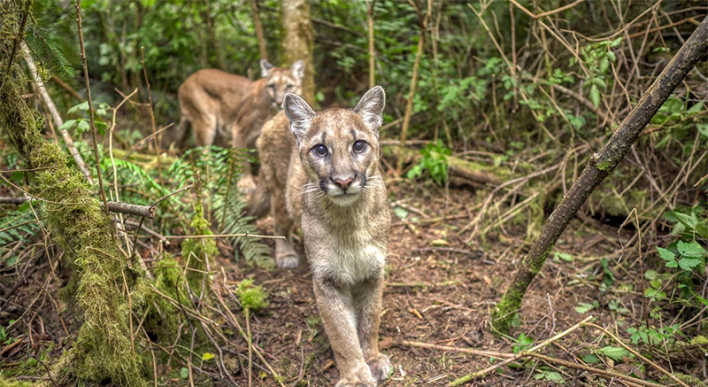
CURIOSITY WON'T KILL THIS CAT: A cougar known as Genevieve and her kitten, both monitored through the Olympic Cougar Project, inspect a camera trap in Washington state. Photo by Matt Mahen

While some pumas seemed to habituate to human activity, becoming more comfortable in areas frequently used by people, others did not. But at the population level, most pumas, regardless of how well habituated they were to humans, avoided areas where conflict had occurred, including attacks on pets or livestock, aggressive or unusual behavior, or rare attacks on humans. The team mapped the locations of 678 human-puma conflict events reported in the Santa Cruz Mountains between 2018 and 2023 and then simulated how likely pumas with different levels of human tolerance would be to use any of those areas, versus how likely humans were to use them.

Basically, mountain lions learn over time where humans tend to show up. The authors of the study suggest this means people can help limit dangerous puma encounters, not just by making themselves look big or using a booming voice. They can design trail policies that ensure predictable patterns of human presence. That means limiting backcountry access—and closing trails at night.

Part of the appeal of camping and hiking in the mountains is ditching the confines of the built human world for a wilder experience. But what is wilder than co-existing harmoniously with America’s largest terrestrial predator? Next time, I might skip the night hike.

Enjoying Nautilus? Subscribe to our free newsletter.

Lead photo by Mark Elbroch