


惯性聚合 高效追踪和阅读你感兴趣的博客、新闻、科技资讯
阅读原文 在惯性聚合中打开

推荐订阅源

Recorded Future
Recorded Future
Stack Overflow Blog
Stack Overflow Blog
Cisco Talos Blog
Cisco Talos Blog
Jina AI
Jina AI
S
Schneier on Security
Engineering at Meta
Engineering at Meta
M
MIT News - Artificial intelligence
腾讯CDC
NISL@THU
NISL@THU
Hacker News: Ask HN
Hacker News: Ask HN
Google DeepMind News
cs.CL updates on arXiv.org
D
Darknet – Hacking Tools, Hacker News & Cyber Security
S
Secure Thoughts
Recent Announcements
博客园_首页
GbyAI
GbyAI
IT之家
IT之家
Security Archives - TechRepublic
V2EX - 技术
V2EX - 技术
美团技术团队
PCI Perspectives
PCI Perspectives
Blog — PlanetScale
Blog — PlanetScale
W
WeLiveSecurity
Application and Cybersecurity Blog
P
Privacy International News Feed
Know Your Adversary
Know Your Adversary
人人都是产品经理
人人都是产品经理
C
Cisco Blogs
V
Visual Studio Blog
Martin Fowler
Martin Fowler
博客园 - 叶小钗
让小产品的独立变现更简单 - ezindie.com
H
Help Net Security
Google DeepMind News
Y
Y Combinator Blog
T
Troy Hunt's Blog
Hugging Face - Blog
Hugging Face - Blog
S
Securelist
宝玉的分享
宝玉的分享
N
News | PayPal Newsroom
云风的 BLOG
云风的 BLOG
Security Latest
Security Latest
Project Zero
Project Zero
I
InfoQ
G
GRAHAM CLULEY
博客园 - 司徒正美
C
Check Point Blog
O
OpenAI News
cs.CV updates on arXiv.org

Vercel News

Vercel Open Source Program: Winter 2026 cohort How Notion Workers run untrusted code at scale with Vercel Sandbox How we run Vercel's CDN in front of Discourse From idea to secure checkout in minutes with Stripe Building Slack agents can be easy Scaling redirects to infinity on Vercel Gamma builds design-first agents with Vercel How Avalara turns pipe dreams into patent-pending with v0 Keeping community human while scaling with agents How OpenEvidence built a healthcare AI that physicians actually trust Security boundaries in agentic architectures Skills Night: 69,000+ ways agents are getting smarter Video Generation with AI Gateway We Ralph Wiggumed WebStreams to make them 10x faster How Stably ships AI testing agents in hours, not weeks How we built AEO tracking for coding agents Anyone can build agents, but it takes a platform to run them Introducing Geist Pixel The Vercel AI Accelerator is back with $6m in credits Making agent-friendly pages with content negotiation The Vercel OSS Bug Bounty program is now available Introducing the new v0 Run untrusted code with Vercel Sandbox, now generally available How Stripe built a game-changing app in a single flight with v0 How Sensay went from zero to product in six weeks AGENTS.md outperforms skills in our agent evals Agent skills explained: An FAQ Testing if "bash is all you need" AWS databases are now live on the Vercel Marketplace and v0 Use Perplexity Web Search with Vercel AI Gateway Introducing: React Best Practices Nick Bogaty joins Vercel as Chief Revenue Officer How Mux shipped durable video workflows with their @mux/ai SDK How to build agents with filesystems and bash How we made v0 an effective coding agent Stopping the slow death of internal tools Building AI-Generated Pixel Trading Cards with Vercel AI Gateway We removed 80% of our agent’s tools AI SDK 6 Our $1 million hacker challenge for React2Shell Cline now runs on Vercel AI Gateway How to prompt v0 Build smarter workflows with Notion and v0 Vercel launches partner certification Inside Workflow DevKit: How framework integrations work React2Shell Security Bulletin | Vercel Knowledge Base Billions of requests: Black Friday-Cyber Monday 2025 Investing in the Python ecosystem AWS Databases coming to the Vercel Marketplace How we built the v0 iOS app Workflow Builder: Build your own workflow automation platform Vercel Open Source Program: Fall 2025 cohort Self-driving infrastructure Vercel collaborates with Google for Gemini 3 Pro Preview launch Vercel: The anti-vendor-lock-in cloud How Nous Research used BotID to block automated abuse at scale How AI Gateway runs on Fluid compute What we learned building agents at Vercel Build and deploy data applications on Snowflake with v0 BotID Deep Analysis catches a sophisticated bot network in real-time Vercel achieves TISAX AL2 compliance to serve automotive partners Bun runtime on Vercel Functions David Totten Joins Vercel to Lead Global Field Engineering Vercel Ship AI 2025 recap You can just ship agents AI agents and services on the Vercel Marketplace Built-in durability: Introducing Workflow Development Kit Zero-config backends on Vercel AI Cloud Introducing Vercel Agent: Your new Vercel teammate Update regarding Vercel service disruption on October 20, 2025 Agents at work, a partnership with Salesforce and Slack Running Next.js in ChatGPT: How to Build ChatGPT Apps Talha Tariq joins Vercel as CTO of Security Just another (Black) Friday Server rendering benchmarks: Fluid Compute and Cloudflare Workers Towards the AI Cloud: Our Series F Collaborating with Anthropic on Claude Sonnet 4.5 to power intelligent coding agents Preventing the stampede: Request collapsing in the Vercel CDN BotID uncovers hidden SEO poisoning How we made global routing faster with Bloom filters What you need to know about vibe coding Scale to one: How Fluid solves cold starts Addressing security & quality issues with MCP tools - Vercel AI agents at scale: Rox’s Vercel-powered revenue operating system Helly Hansen migrated to Vercel and drove 80% Black Friday growth Agentic Infrastructure Zero Data Retention on AI Gateway Optimizing Vercel Sandbox snapshots How Waldium made a blog platform work for humans and AI alike How FLORA shipped a creative agent on Vercel's AI stack Agent responsibly Making Turborepo 96% faster with agents, sandboxes, and humans Unified reporting for all AI Gateway usage new.website joins forces with v0 SERHANT.'s playbook for rapid AI iteration Two startups at global scale without DevOps Chat SDK brings agents to your users 360 billion tokens, 3 million customers, 6 engineers Meet the 2026 Vercel AI Accelerator Cohort Build knowledge agents without embeddings
Advancing Python typing
Yury SelivanovDirector of EngineeringMichael J. SullivanSoftware · 2026-03-02 · via Vercel News

We’re excited to share a year-long research effort aimed at making Python’s type system more expressive and composable, something closer in spirit to the programmable types in TypeScript, but carefully crafted for Python’s runtime model. The result is PEP 827: Type Manipulation.

Python’s runtime is incredibly powerful: classes, methods, and even whole APIs can be generated on the fly from a few lines of code. Concepts like metaprogramming can transform class declarations, decorators can give functions and methods additional behaviors, and those are just a few examples.

But Python's static typing often can’t “follow along” without typechecker plugins or boilerplate code. PEP 827 proposes a set of standard, type-level building blocks for introspecting existing types and constructing new ones, designed to help both type checkers and runtime tooling.

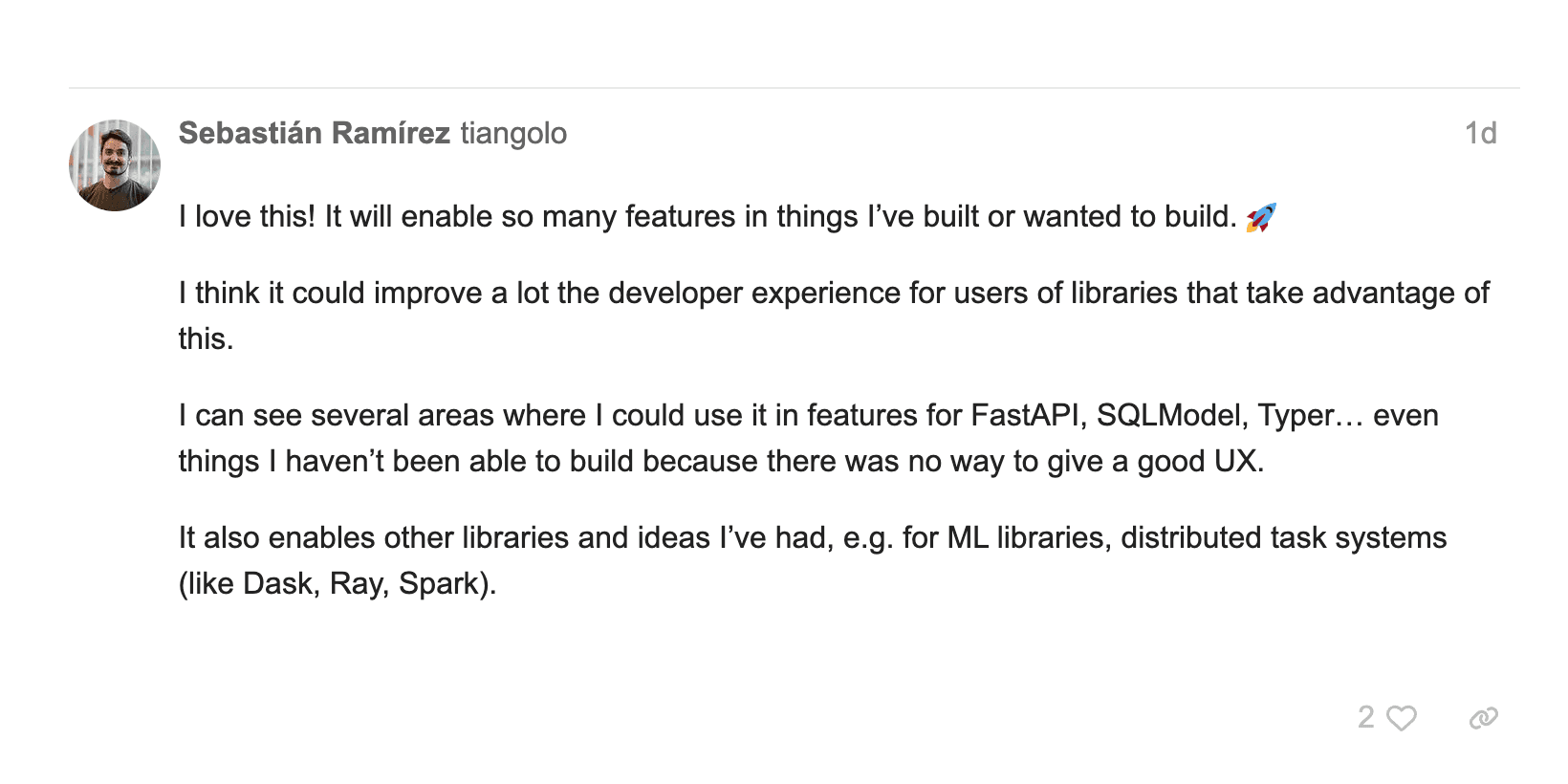
FastAPI creator Sebastián Ramírez summed up the potential impact well on our post in the Python Discourse:
Link to headingQuick taste

One concrete example is the familiar TypeScript utility types, like Pick and Omit. Here's Pick implemented in TypeScript and Python side by side:

We can immediately see that the TypeScript dedicated typing syntax is short and to the point, albeit quite different from the rest of the language. Python, on the other hand, relies on the standard Python imperative syntax combined with type-level APIs.

Now let's look at how Omit can be implemented:

Interestingly enough, Python's version is more in line with the Pick implementation, the only difference is inverting the condition. TypeScript, on the other hand, composes quite differently, and requires a deeper rewrite.

This illustrates that the big idea isn't "make Python look like TypeScript." It’s to give Python typing a programmable core that matches Python’s semantics and stays introspectable at runtime, so frameworks like Pydantic can benefit too.

Link to headingWhat's next

PEPs are debated, revised, and sometimes rejected. We’re excited to be part of that process, and we invested in this research because we build across TypeScript and Python and want both ecosystems to thrive.

One might ask: in an age where agents are writing an increasing share of source code, should we even care about programming language syntax, tooling, or type system capabilities?

We argue the answer is, more than ever, "yes". We want type checkers to be more thorough and frameworks to be more expressive, so that we can safely ship more reviewable, succinct code. The less boilerplate we have to maintain, the better, and we don’t see that changing anytime soon.

So yes, agents will care. And so will we.