惯性聚合 高效追踪和阅读你感兴趣的博客、新闻、科技资讯
阅读原文 在惯性聚合中打开

推荐订阅源

Help Net Security
Help Net Security
G
Google Developers Blog
雷峰网
雷峰网
WordPress大学
WordPress大学
Threat Intelligence Blog | Flashpoint
Engineering at Meta
Engineering at Meta
Security Latest
Security Latest
T
Threat Research - Cisco Blogs
AWS News Blog
AWS News Blog
F
Full Disclosure
C
Cybersecurity and Infrastructure Security Agency CISA
T
The Exploit Database - CXSecurity.com
J
Java Code Geeks
U
Unit 42
C
Cyber Attacks, Cyber Crime and Cyber Security
V
V2EX
C
Cisco Blogs
博客园 - 司徒正美
Project Zero
Project Zero
L
LINUX DO - 热门话题
阮一峰的网络日志
阮一峰的网络日志
Blog — PlanetScale
Blog — PlanetScale
Scott Helme
Scott Helme
A
About on SuperTechFans
Hugging Face - Blog
Hugging Face - Blog
S
Securelist
小众软件
小众软件
aimingoo的专栏
aimingoo的专栏
S
Schneier on Security
G
GRAHAM CLULEY
酷 壳 – CoolShell
酷 壳 – CoolShell
Cyberwarzone
Cyberwarzone
MongoDB | Blog
MongoDB | Blog
钛媒体:引领未来商业与生活新知
钛媒体:引领未来商业与生活新知
博客园 - 叶小钗
T
Threatpost
Recorded Future
Recorded Future
C
CXSECURITY Database RSS Feed - CXSecurity.com
宝玉的分享
宝玉的分享
N
News and Events Feed by Topic
人人都是产品经理
人人都是产品经理
The Register - Security
S
Security Archives - TechRepublic
博客园 - Franky
N
News | PayPal Newsroom
Simon Willison's Weblog
S
SegmentFault 最新的问题
W
WeLiveSecurity
A
Arctic Wolf
B
Blog

Crazyrouter Blog (English)

Ideogram AI Guide 2026: Product Mockups, Text Rendering, and API Automation Akool AI Voice Generator Review 2026: API Alternatives for Developers GLM 4.6 API Guide 2026: Build Chinese-English Agents with Tool Calling Google Veo3 API Guide 2026: Batch Video Generation, QA, and Fallbacks Claude Opus 4.8 vs Opus 4.7: Real API Benchmark Results for Developers Opus 4.8 vs Opus 4.7 Coding Test: What Changed for Developers? Opus 4.8 vs Opus 4.7 for Agents: JSON, Tool Use, and Structured Output Gemini 2.5 Flash-Lite for RAG, Agent Routing, and Cost per Successful Task Gemini 2.5 Flash-Lite for Support Automation and Ticket Triage Gemini 2.5 Flash-Lite Use Cases: The Practical Automation Tier for Developers Claude Jupiter v1-p vs GPT-5.5 Benchmark: Real API Test on Reasoning and Coding Claude Jupiter v1-p vs Claude Opus 4.7 vs Sonnet 4.6: Live API Test Claude Jupiter v1-p vs Claude Opus 4.7 vs Sonnet 4.6: Live API Test Claude Code Pricing 2026: Pro vs Max vs Team vs API Costs Claude Opus 4.7 vs DeepSeek V4 Pro: Real API Compatibility and Coding Benchmark Gemini CLI Complete Guide 2026: Repo Automation, CI Agents, and Multi-Model Routing Ideogram AI Guide 2026: Brand Design Automation, API Workflows, and Alternatives GLM 4.6 API Guide 2026: Agents, RAG, Tool Calling, and Bilingual Apps WAN 2.2 Animate Tutorial 2026: Character Consistency, Shot Control, and API Workflows Google Veo3 API Guide 2026: Production Video Pipelines, Prompts, Pricing, and Fallbacks AI API Pricing Comparison 2026: Text, Image, Video, Caching, and Router Costs Codex CLI Installation Guide 2026: Windows, macOS, Linux, Proxies, and CI Setup How to Get a Claude API Key in 2026: Secure Setup for Teams, CI, and Alternatives Gemini Advanced Review 2026: Is It Worth It for Coding, Research, and API Teams? Claude Code Pricing Guide 2026: Team Agent Budgets, API Fallbacks, and Cost Control Seedance 2.0 Pricing: Convert 46 CNY per Million Tokens to Cost per Second Qwen2.5-Omni Guide 2026: Real-Time Voice, Vision, and Multimodal Agents Kimi K2 Thinking Guide 2026: Reasoning Workflows, Evals, and Cost Control Google Veo3 API Guide 2026: Batch Video Pipelines, Pricing, and Fallbacks Codex CLI Installation Guide 2026: macOS, Linux, WSL, Proxies, and Dev Containers How to Get a Claude API Key in 2026: Safe Production Setup and Alternatives AI API Pricing Comparison 2026: GPT, Claude, Gemini, Video, and Agent Workloads Gemini Advanced Review 2026: Is It Worth It for Developer Teams? Claude Code Pricing Guide 2026: API Fallbacks, Team Seats, and Budget Control Seedream 4.0 API Tutorial 2026: Batch Image Generation, Product Creative, and Pricing Qwen2.5-Omni Guide 2026: Real-Time Voice, Vision, Text Agents, and API Integration Kimi K2 Thinking Guide 2026: Reasoning Agents, Evaluation Workflows, and API Cost Control WAN 2.2 Animate Tutorial 2026: Character Motion, Shot Control, API Pipelines, and Pricing Google Veo3 API Guide 2026: Production Video Workflows, Prompts, Pricing, and Fallbacks AI API Pricing Comparison 2026: OpenAI, Claude, Gemini, DeepSeek, and Router Costs How to Get a Claude API Key in 2026: Setup, Security, Rotation, and Alternatives Codex CLI Installation Guide 2026: macOS, Linux, WSL, Proxies, and Devcontainers Gemini Advanced Review 2026: Is It Worth It for Developers and API Builders? Claude Code Pricing Guide 2026: CI Agents, Team Seats, and API Budget Planning AI API Gateway for Singapore and Malaysia Developers: One Endpoint for GPT, Claude and Gemini AI API Gateway for Thai Developers: Use GPT, Claude and Gemini with One Key One API Key for GPT, Claude and Gemini: A Practical Setup for Central Asia Developers Gemini 3.5 Flash vs Claude Response-Tier Models: Which One Should Developers Use? Gemini 3.5 Flash vs Gemini 3 Flash vs Gemini 2.5 Flash: Real API Benchmark "How to Test Multiple AI Image Models with One API Key" Codex CLI Installation Guide: Setup on macOS, Linux, Windows WSL and CI/CD Seedream 4.0 API Tutorial: ByteDance Image Generation for Production Pipelines Kimi K2 Thinking Model: Complete Developer Guide for Reasoning Workflows Luma Ray 2 Review: AI Video Generation Quality, Speed, and API Guide Pika 2.2 New Features Review: Scene Director, Sound Design, and API Updates Google Veo 3 API Guide: Video Generation with Audio for Developers AI Lip Sync Tools Comparison 2026: Best APIs for Talking Avatars and Video Dubbing Gemini Advanced Review May 2026: Is It Worth $20/Month for AI Power Users? Claude Code Pricing in May 2026: Max Plan, Opus 4, and Real Cost Breakdown Hermes Agent + Crazyrouter: One-Click Setup for 627+ AI Models Text-Embedding-3-Small: Complete Guide to OpenAI's Most Popular Embedding Model (2026) AI Meme Generator & Coloring Book Creator with GPT-image-2 — Fun Projects That Actually Make Money AI Future Baby Prediction with GPT-image-2 — See What Your Child Might Look Like Ghibli Style Photo Transformation with GPT-image-2 — Turn Any Photo Into Anime Art AI Action Figure Generator with GPT-image-2 — Turn Anyone Into a Boxed Toy AI Face Reading & Personal Color Analysis with GPT-image-2 — Two Viral Use Cases in One Guide AI Palm Reading with GPT-image-2 — Generate Professional Palmistry Analysis from a Single Photo Gemini 2.5 Flash-Lite Pricing Explained — The Cheapest Gemini Model for High-Volume Workloads Claude Sonnet 4.6 Pricing Explained — Caching, Tiers, and How to Save 45% with Crazyrouter Gemini Free vs Gemini Advanced: Pricing, Limits, Features, and Is It Worth Paying For? AI Context Window Comparison (2026): GPT, Claude, Gemini Token Limits by Model Claude Sonnet 4.5 Pricing Explained — Caching, Batch API, and How to Save 45% with Crazyrouter Claude Opus 4.7 Pricing Explained — New Tokenizer, Caching, and How to Save 45% with Crazyrouter Claude Opus 4.6 Pricing Explained — Caching, Tiers, and How to Save 45% with Crazyrouter Best AI Models for RAG Applications 2026: Embeddings, Retrieval, and Generation Seedance 2.0 vs Kling 2.1 vs Runway Gen 4 Turbo: Video AI API Comparison 2026 AI Video Generation API Pricing May 2026: Veo3 vs Kling vs Runway vs Sora How to Get Claude API Key in China 2026: Complete Setup Guide AI Coding Tools ROI Calculator: Claude Code vs Codex CLI vs Gemini CLI Cost Analysis 2026 AI API Pricing Comparison May 2026 - Complete Developer Guide Grok 4 API Pricing Complete Guide 2026 DeepSeek R2: The 32B Reasoning Model That Runs on a Single GPU — Complete Guide for Developers "GPT-5.1 Codex Max Pricing Explained — The Code-Specialized Model and How to Save with Crazyrouter" GPT-4o Pricing Explained — The Legacy Flagship That's Still Worth Using GLM-5 Pricing Explained — Zhipu AI's Flagship Model and How to Access via Crazyrouter Gemini 3 Flash Pricing Explained — Balanced Speed and Cost with Crazyrouter Savings "Gemini 3.1 Pro Pricing Explained — Context Tiers, Caching, and How to Save with Crazyrouter" GPT-5.5 Pricing Explained — OpenAI's Latest Flagship, Reasoning Tokens, and How to Save with Crazyrouter AI Model Pricing Guide 2026: What Every Model Costs on Crazyrouter (and How Much You Save) MiniMax M2 Pricing Explained — China's Competitive AI Model and How to Access via Crazyrouter Grok 4.1 Thinking Pricing Explained — Reasoning Tokens, Caching, and How to Save with Crazyrouter Grok 4.1 Pricing Explained — 2M Context, Caching, Tool Costs, and How to Save with Crazyrouter GPT-5 Pricing Explained — Reasoning Tokens, Caching, Batch API, and How to Save with Crazyrouter GPT-5-nano Pricing Explained — The Cheapest GPT Model for High-Throughput Workloads GPT-5-mini Pricing Explained — Ultra-Low Cost AI with Caching and Batch Discounts GPT-5.4 Pricing Explained — Cached Input, Context Tiers, Batch API, and How to Save with Crazyrouter GPT-5.2 Pricing Explained — Caching, Batch API, and How to Save with Crazyrouter OpenRouter vs Crazyrouter (2026): Pricing, Models, and Which API Gateway Fits Developers Better Suno v4 vs v5 vs v4.5: Which Version Sounds Better and Is Worth Using in 2026? How to Use Claude Code with Crazyrouter: Base URL Setup, Model Routing, and Cost Savings
Can Claude Code Build a World Cup 2026 Match Predictor? A Real Crazyrouter API Test
Crazyrouter Team · 2026-06-13 · via Crazyrouter Blog (English)

Can Claude Code Build a World Cup 2026 Match Predictor? A Real Crazyrouter API Test#

Claude Code is most interesting when it builds a working project, not when it only generates snippets. For this experiment, I used a Claude Code-style workflow to build a small World Cup 2026 match predictor: fixture data, a transparent Elo/Poisson prediction model, charts, and real LLM-generated match previews through Crazyrouter.

This is an analytics and developer workflow demo. It is not betting advice.

The live API layer was tested through:
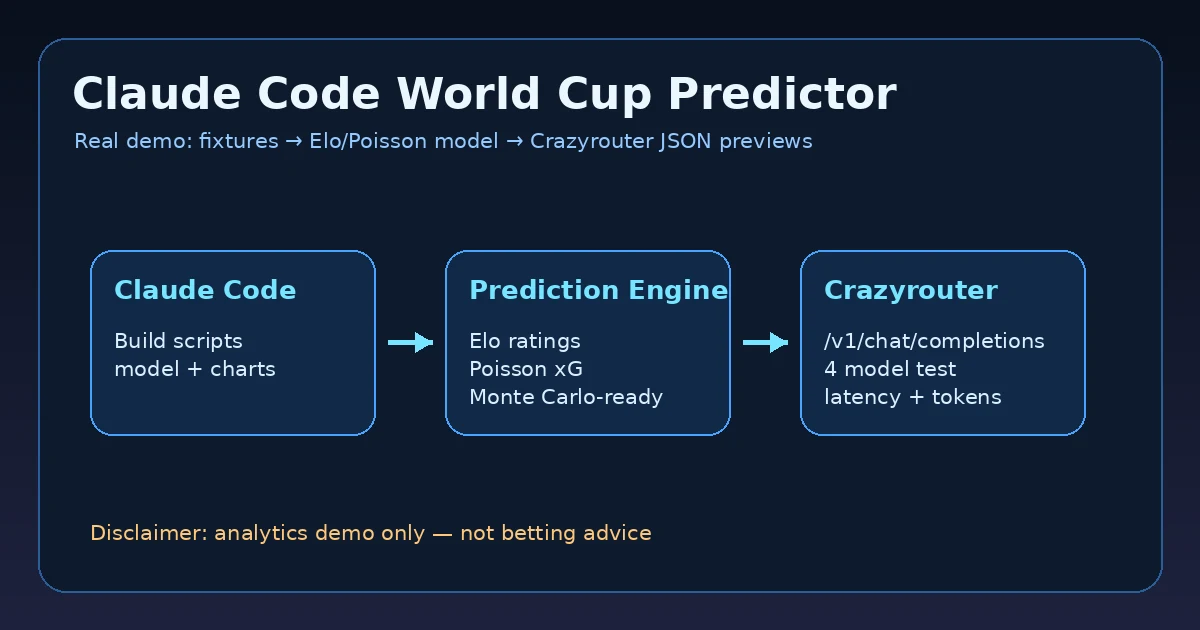
Claude Code World Cup predictor architecture with Crazyrouter API

Why this is a good Claude Code project#

A sports prediction dashboard is a useful coding-agent demo because it forces the agent to do more than write UI code:

  1. collect and normalize messy event data;
  2. define a transparent model;
  3. generate reproducible outputs;
  4. create charts;
  5. call an LLM API for structured explanations;
  6. handle model failure modes like malformed JSON.

That makes it a better article than a generic “Claude Code project ideas” list. The project produces real files, real numbers and real API traces.

Public data signals used#

For this demo, I used public fixture information available on World Cup schedule pages and focused on early tournament matches around June 11-18, 2026. The fetched pages confirmed the tournament format: 48 teams, 104 matches, 16 stadiums, group-stage fixtures, and early fixtures such as Mexico vs South Africa, South Korea vs Czechia, USA vs Paraguay and Brazil vs Morocco.

The local demo data is intentionally small and reproducible:

  • fixtures.json — nine early fixtures;
  • team_ratings_seed.json — seed Elo-style ratings for demo purposes;
  • predictions.json — model output for each match;
  • crazyrouter_test_results.json — raw LLM API test summary.

The model is deliberately simple. A production system should replace the seed ratings with live Elo/FIFA ranking data, injury data, lineups, odds, travel, rest days and result updates.

Prediction method: transparent beats mystical#

The predictor combines three simple ideas:

  • Elo-style rating difference for relative team strength;
  • host boost for host-nation matches in relevant venues;
  • Poisson expected goals for scoreline probabilities.

The core idea looks like this:

Then the script enumerates likely scorelines, estimates home/draw/away probabilities, and saves a prediction object for each fixture.

Sample predictions#

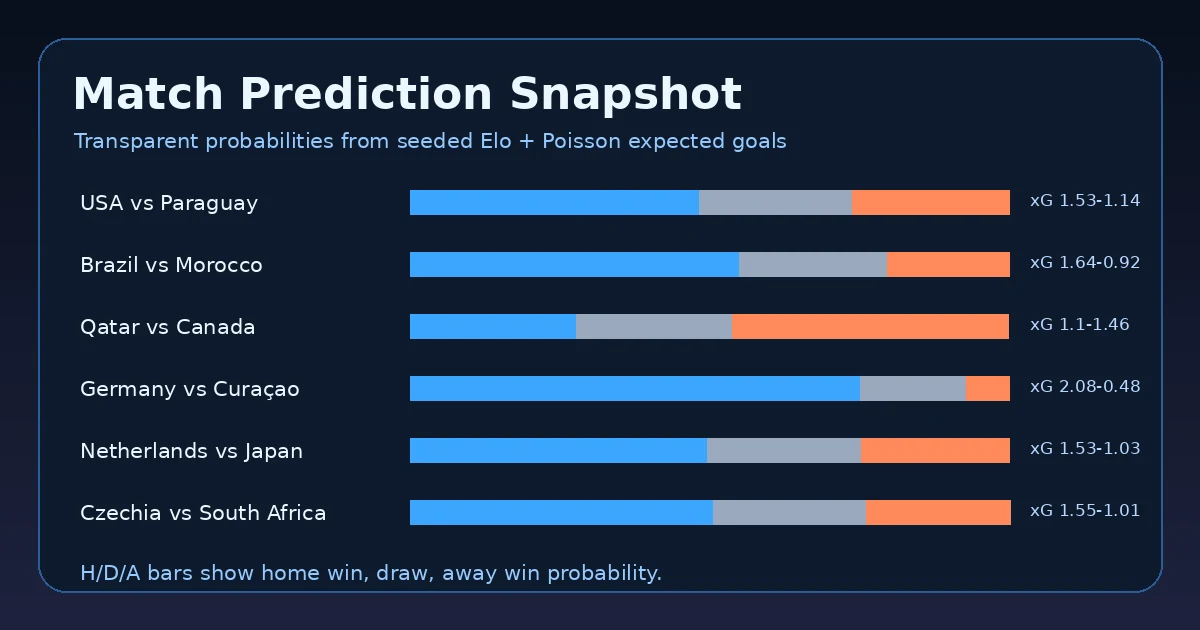
Here are the first seven predictions from the demo run:

DateMatchGroupxGHome / Draw / AwayPick
2026-06-11Mexico vs South AfricaA1.68-0.9855.8% / 24.2% / 19.9%Mexico
2026-06-11South Korea vs CzechiaA1.35-1.2140.1% / 26.6% / 33.3%South Korea
2026-06-12USA vs ParaguayD1.53-1.1448.2% / 25.5% / 26.3%USA
2026-06-13Brazil vs MoroccoC1.64-0.9254.9% / 24.7% / 20.4%Brazil
2026-06-13Qatar vs CanadaB1.1-1.4627.8% / 26.1% / 46.1%Canada
2026-06-14Germany vs CuraçaoE2.08-0.4875.1% / 17.7% / 7.2%Germany
2026-06-14Netherlands vs JapanF1.53-1.0349.5% / 25.7% / 24.8%Netherlands

World Cup 2026 match prediction probability snapshot

Notice the USA vs Paraguay example: the model gives the USA a slight edge, but not a dominant one. The home win probability is 48.2%, while draw plus Paraguay win is 51.8%. That is exactly the kind of uncertainty a good demo should preserve.

Crazyrouter real API test#

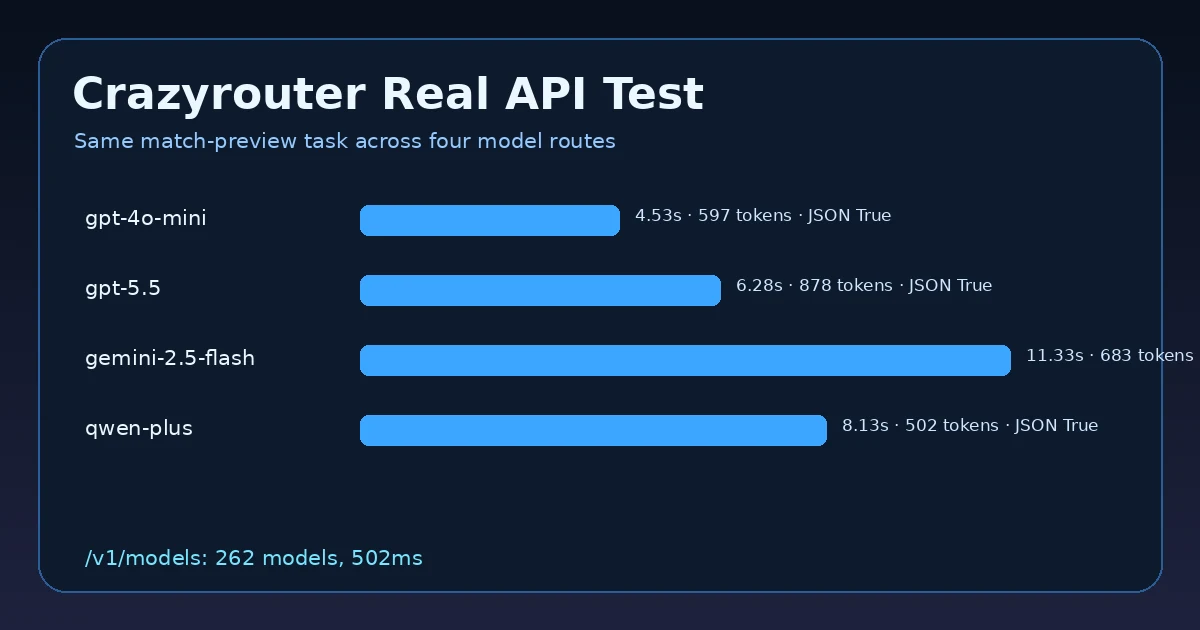
After generating model probabilities, the script asked four model routes to turn the USA vs Paraguay model output into a structured JSON match preview.

Task:

The Crazyrouter model-list endpoint also worked:

The chat-completion test results:

ModelHTTPLatencyPrompt tokensCompletion tokensTotal tokensValid JSON
gpt-4o-mini2004.53s305292597True
gpt-5.52006.28s600278878True
gemini-2.5-flash20011.33s327356683False
qwen-plus2008.13s325177502True

Crazyrouter API test latency and token usage for World Cup predictor

What the model outputs showed#

Three routes returned valid JSON:

  • gpt-4o-mini
  • gpt-5.5
  • qwen-plus

One route returned HTTP 200 but failed JSON validation:

  • gemini-2.5-flash

That failure is not a problem for the article; it is the article. In production AI workflows, HTTP 200 is not enough. A coding agent should build validators, retries and fallback routes.

A valid output example from gpt-4o-mini:

What Claude Code should build around the LLM call#

A robust Claude Code workflow should not simply call an LLM and trust the text. It should build an execution pipeline:

  1. read fixture and rating data;
  2. calculate deterministic probabilities;
  3. send compact model output to Crazyrouter;
  4. require JSON schema;
  5. validate JSON;
  6. retry or fallback when invalid;
  7. save raw responses for audit;
  8. render dashboard and article assets.

This is the practical reason to use an AI API gateway. You can route the same task through multiple models while keeping one API base URL and one client shape.

Minimal reproduction structure#

The demo folder contains:

The key API client configuration is standard OpenAI-compatible code:

Do not add UTM parameters to API base URLs. UTM belongs on human-facing links only.

Engineering lessons#

1. Claude Code is good at project scaffolding#

This is a strong Claude Code project because the deliverable is not one function. It is a pipeline with data files, modeling code, API calls, raw logs and visual assets.

2. Simple models are better for explainability#

For an article/demo, a transparent Elo/Poisson model is better than a black-box “AI says Brazil wins” answer. The LLM should explain the model, not replace the model.

3. JSON validation is mandatory#

The Gemini route returned HTTP 200 but invalid JSON in this constrained test. That is a real production lesson: validate the output and fallback automatically.

4. A gateway makes experiments easier#

The same request shape worked across GPT, Gemini and Qwen-style routes. That makes model comparison and fallback easier than wiring every provider directly.

Limitations#

This demo intentionally keeps the model small. It does not include:

  • live injury reports;
  • confirmed lineups;
  • rest days and travel fatigue;
  • bookmaker odds;
  • live xG;
  • player-level form;
  • calibrated historical backtesting.

So the predictions should be read as a coding and data workflow demonstration, not as betting recommendations.

Next improvements#

A stronger version could add:

  1. automatic fixture updates from a World Cup API;
  2. real Elo/FIFA ranking ingestion;
  3. Monte Carlo group-stage simulation;
  4. odds movement monitoring;
  5. automatic fallback when JSON validation fails;
  6. a static web dashboard;
  7. daily World Cup prediction articles generated from the same pipeline.

Final verdict#

Yes: Claude Code can build a credible World Cup 2026 match predictor demo, as long as the project is framed correctly.

The right architecture is:

In this run, Crazyrouter returned 262 models from /v1/models, and three of four tested model routes produced valid JSON match previews. The failed JSON route is useful evidence too: real AI projects need validation and fallback, not just prompts.

If you want to build Claude Code projects that compare multiple AI models through one API layer, start with Crazyrouter.