








If you are searching for the best OpenRouter alternative in 2026, you are usually not just looking for a list of vendors. You are trying to answer a production question:
Can I access GPT, Claude, Gemini, Qwen, DeepSeek, image models and other AI routes through one stable API layer without rewriting my app every time a provider changes?
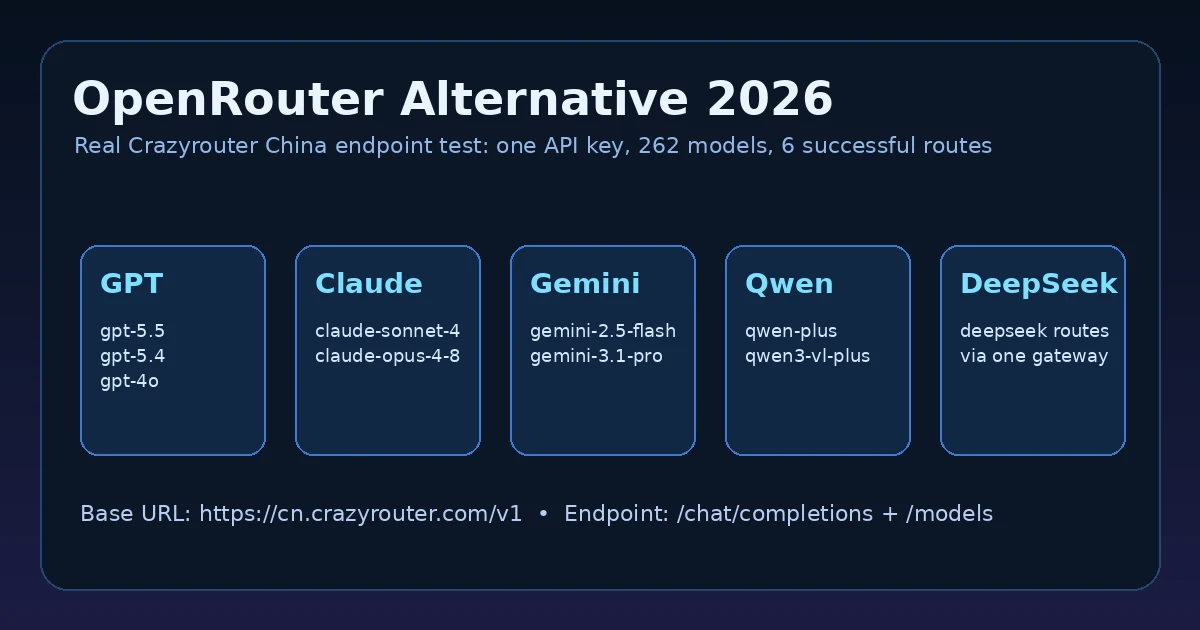
To make this article useful instead of theoretical, I tested Crazyrouter through its China endpoint:
The short result: https://cn.crazyrouter.com/v1/models returned 262 models in 492 ms, and six representative chat-completion routes returned successful HTTP 200 responses through the same OpenAI-compatible API shape.
Before writing this, I checked current search results for queries like:
best OpenRouter alternative AI API gateway unified API 2026OpenRouter alternative unified LLM API gateway GPT Claude Gemini DeepSeekThe ranking pages mostly focus on three angles:
The missing piece in many results is practical API evidence. So this article focuses on what developers can verify immediately: model list visibility, request compatibility, latency, usage fields and migration shape.
/v1/models#The first test was simple:
Result summary:
Sample model IDs returned by the endpoint included:
qwen3-vl-plus, gemini-2.5-pro, qwq-32b-preview, claude-sonnet-4, claude-opus-4-8, doubao-1.5-pro-32k, qwen2.5-coder-14b-instruct, glm-5v-turbo, doubao-seedance-1-0-lite-t2v, text-embedding-3-small, doubao-seedream-5-0, qwen2-vl-72b-instruct, wan2.2-t2v-plus, grok-4, gpt-4o-mini, claude-opus-4-6, gemini-2.5-flash-lite, chat-latest, qwen3-coder-480b-a35b-instruct, gpt-image-2, llama-3.2-11b-vision-instruct, doubao-seedream-4-0, glm-4-flash, doubao-seed-1-8-251228-thinking, glm-4.1v-thinking-flash, glm-5-turbo, gemini-2.5-flash, qwen3-vl-30b-a3b-instruct
This matters because an AI gateway is only useful if model discovery is available and if model IDs are visible enough for application routing.
For the second test, I sent the same OpenAI-compatible chat-completion request through the same endpoint and changed only the model field.
The test prompt asked each model to return compact JSON explaining why developers use a unified AI API gateway instead of separate provider APIs.
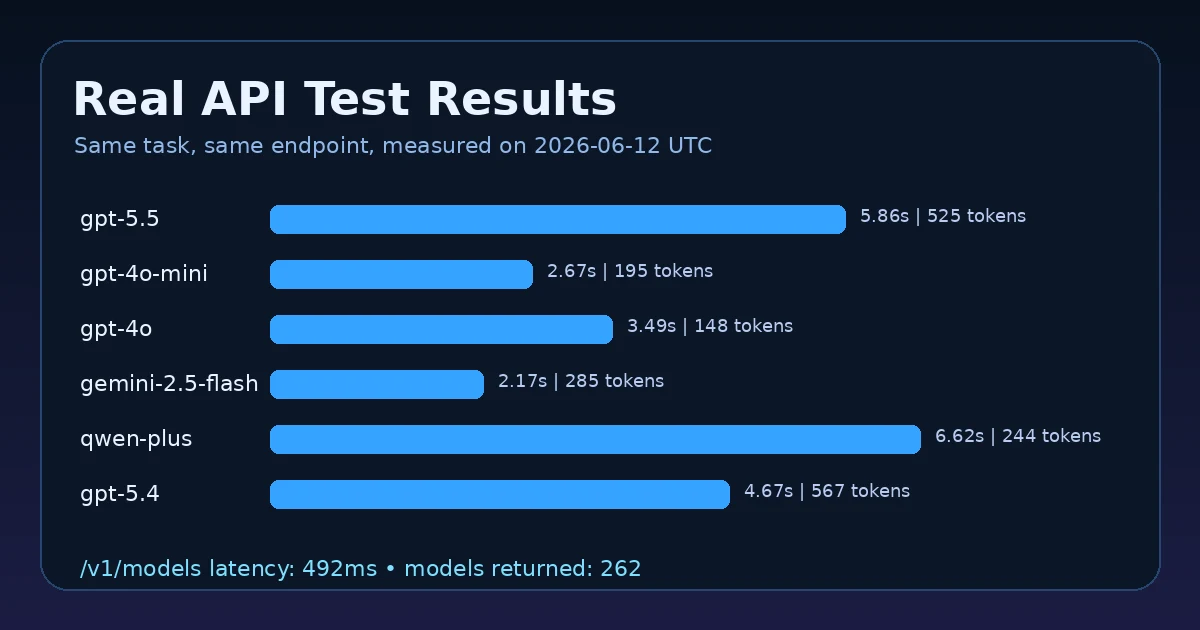
Here is the measured result:
| Model | HTTP | Latency | Prompt tokens | Completion tokens | Total tokens |
|---|---|---|---|---|---|
gpt-5.5 | 200 | 5.86s | 368 | 157 | 525 |
gpt-4o-mini | 200 | 2.67s | 73 | 122 | 195 |
gpt-4o | 200 | 3.49s | 73 | 75 | 148 |
gemini-2.5-flash | 200 | 2.17s | 69 | 216 | 285 |
qwen-plus | 200 | 6.62s | 138 | 106 | 244 |
gpt-5.4 | 200 | 4.67s | 368 | 199 | 567 |
A few practical observations from the raw responses:
gpt-5.5 and gpt-5.4 returned resp_... style response IDs and included reasoning-token details.gpt-4o-mini returned detailed latency checkpoint fields, useful for debugging time-to-first-token and total duration.gpt-4o returned a compact OpenAI-compatible response with standard usage fields.gemini-2.5-flash returned HTTP 200, but this specific low-token JSON test produced a truncated fenced JSON start, showing why production systems should validate content, not only HTTP status.qwen-plus returned clean JSON and standard token usage fields.This is exactly why a real API gateway article should include actual request data. A model can be listed, callable and still have task-specific formatting behavior that your app should validate.
OpenRouter popularized multi-model access. But many teams now want alternatives for one or more of these reasons:
Crazyrouter's main SEO-relevant value proposition is straightforward:
For developers, that means the migration is usually configuration-first rather than architecture-first.
If your current code already uses the OpenAI SDK, the migration pattern is simple.
The API endpoint in code should stay clean. Do not add UTM parameters to API base URLs. UTM belongs on human-facing links, not API endpoints.
The real benefit of a gateway is not only calling one model. It is routing by task.
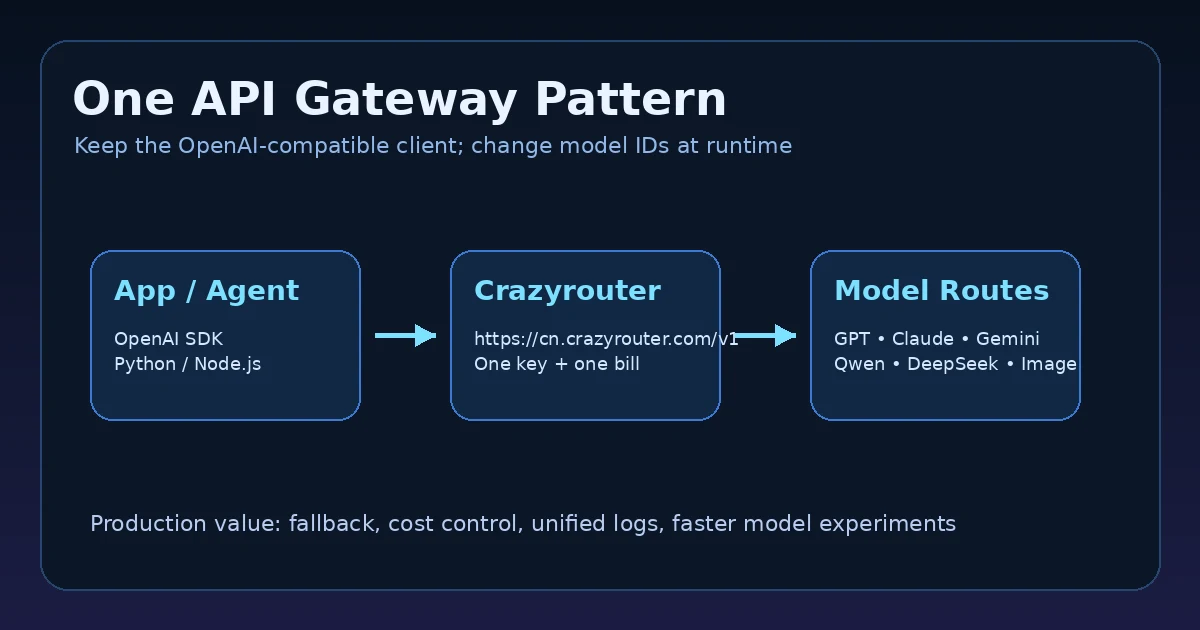
A practical route map could look like this:
| Task type | First route | Escalation route | Why |
|---|---|---|---|
| Simple summarization | gpt-4o-mini or fast Gemini/Qwen route | stronger GPT/Claude route | optimize latency and cost |
| Strict JSON extraction | route with best formatting score | retry with validator cleanup | HTTP 200 is not enough |
| Coding assistant | GPT/Claude/Qwen coding-capable route | strongest reasoning model | code quality varies by task |
| Agent planning | stronger reasoning route | fallback if timeout | agent steps compound errors |
| Multimodal app | image/video route through same platform | text model for prompt rewrite | one product can share billing and logs |
When evaluating any OpenRouter alternative, do not stop at the homepage checklist. Measure your workload.
Minimum checklist:
/v1/models return the models you need?finish_reason, empty content and malformed JSON?For this test, Crazyrouter passed the basic gateway checks: model listing worked, six chat routes returned HTTP 200, and usage data was present. The Gemini output also reminded us to validate content shape before treating a response as successful.
Direct provider APIs are still the right choice when you only need one vendor and want the deepest provider-specific features. A gateway becomes more attractive when you need model choice as a runtime decision.
| Requirement | Direct provider APIs | Crazyrouter unified API |
|---|---|---|
| One vendor only | Good | Works, but may be more than needed |
| Many model families | More integrations | One API layer |
| One key and billing flow | No | Yes |
| Runtime model switching | More code | Change model field |
| Fallback between providers | Build yourself | Easier at gateway layer |
| Fast model experiments | Slower | Faster |
For developers who want an OpenAI-compatible unified API with broad model access, Crazyrouter is a strong OpenRouter alternative to test. In this run, https://cn.crazyrouter.com/v1/models returned 262 models and multiple GPT/Gemini/Qwen routes worked through the same /chat/completions API format.
Yes, the gateway pattern is designed for that. You use one API key and one base URL, then switch model IDs based on the task. Always verify the exact model IDs you need with /v1/models.
Yes for the tested Chat Completions flow. The examples above use the OpenAI SDK with base_url="https://cn.crazyrouter.com/v1".
No. You should validate content, JSON shape, finish reason and retry behavior. In this test, one Gemini route returned HTTP 200 but produced a truncated JSON-shaped response for a constrained low-token prompt, which is useful production evidence.
Not always. Use a gateway when you need multiple providers, fallback, unified billing, faster experiments or model routing. Use direct provider APIs when you need a provider-specific feature that is not exposed through the gateway.
If your SEO question is “what is the best OpenRouter alternative,” the practical answer should not be based on brand claims alone.
The useful test is:
In this test, Crazyrouter through https://cn.crazyrouter.com/v1 returned 262 models, completed six representative chat routes, and exposed enough usage/latency data to support a real migration article.
For developers building multi-model apps, coding agents, RAG systems, SEO automation, image/video products or internal AI tools, Crazyrouter is worth testing as a unified API gateway and OpenRouter alternative.
Start here: Crazyrouter
此内容由惯性聚合(RSS阅读器)自动聚合整理,仅供阅读参考。 原文来自 — 版权归原作者所有。