



惯性聚合 高效追踪和阅读你感兴趣的博客、新闻、科技资讯
阅读原文 在惯性聚合中打开

推荐订阅源

T
Threatpost
aimingoo的专栏
aimingoo的专栏
OSCHINA 社区最新新闻
OSCHINA 社区最新新闻
T
Tailwind CSS Blog
J
Java Code Geeks
博客园_首页
Google Online Security Blog
Hugging Face - Blog
Hugging Face - Blog
C
CXSECURITY Database RSS Feed - CXSecurity.com
I
Intezer
P
Palo Alto Networks Blog
V
Vulnerabilities – Threatpost
雷峰网
雷峰网
O
OpenAI News
SecWiki News
SecWiki News
小众软件
小众软件
酷 壳 – CoolShell
酷 壳 – CoolShell
美团技术团队
N
News | PayPal Newsroom
Project Zero
Project Zero
Forbes - Security
Forbes - Security
IT之家
IT之家
A
Arctic Wolf
WordPress大学
WordPress大学
Jina AI
Jina AI
T
Tor Project blog
博客园 - 三生石上(FineUI控件)
S
Secure Thoughts
Google DeepMind News
Attack and Defense Labs
博客园 - 聂微东
Exploit-DB.com RSS Feed
P
Privacy International News Feed
Cloudbric
Cloudbric
G
GRAHAM CLULEY
博客园 - 叶小钗
H
Hacker News: Front Page
腾讯CDC
量子位
Help Net Security
Help Net Security
人人都是产品经理
人人都是产品经理
C
Cyber Attacks, Cyber Crime and Cyber Security
月光博客
月光博客
奇客Solidot–传递最新科技情报
奇客Solidot–传递最新科技情报
宝玉的分享
宝玉的分享
爱范儿
爱范儿
L
Lohrmann on Cybersecurity
Hacker News - Newest:
Hacker News - Newest: "LLM"
Recorded Future
Recorded Future
C
CERT Recently Published Vulnerability Notes

News and Events Feed by Topic

NIST Receives New Patent for Microbe-Killing Water Heater Spotlight: How NIST Helps Make Sure the Fish You Catch Are Safe to Eat NIST Expands Its Library of ‘Chemical Fingerprints’ to Identify Unknown Substances SRM Story: SRM 1947a Great Lakes Fish Tissue SRM Story: SRMs 3672a and 3673a Organic Contaminants in Smokers’ and Nonsmokers’ Urine Space: The Final Frontier for Standards Securing Smart Speakers for Home Health Care: NIST Offers New Guidelines NIST’s ‘Living Reference Material’ Could Accelerate R&D of Lifesaving Biological Drugs NIST Awards Over $1.8 Million to Small Businesses Advancing AI, Semiconductors, Additive Manufacturing and More SRM Story: SRM 965c Glucose in Frozen Human Serum Second Seminar on Building an In-Space Circular Economy New NIST Reference Material to Strengthen Quality Control for Biological Drugs NIST Releases Trove of Genetic Data to Spur Cancer Research New NIST Research Grade Test Material to support mRNA therapeutics NIST Shares Preliminary Findings From Hurricane Maria Investigation New NIST Standard Helps Deliver the Right Dosage of Cancer-Fighting Drugs Second Series of Workshops on Measurements and Standards for Advanced Therapy NIST Researcher Addresses London Healthcare Innovation Forum NIST Releases Reference Material to Aid Gut Microbiome Research NIST Researchers Develop Material for Measuring Arsenic in Shellfish 2025 NIST Workshop on Rapid Microbial Testing Methods An SRM for Accuracy in Electrolyte Panel Clinical Tests Study Highlights Need for Standardized Measurement Methods in Gene Therapy NIST Develops Genetic Material for Validating H5N1 Bird Flu Diagnostic Tests PFAS Found in Firefighter Gloves, Hoods and Wildland Gear AI and Flow Cytometry Workshop Genome Editing Consortium Workshop Social Spotlight: Engineered Cells as a Shoebox NIST Scientists Use DNA Origami on a Chip to Detect Biomolecules NIST Awards Up to $1.5 Million to Support Development of Regenerative Medicine Standards Curricula NIST Research Leader Featured in Medical IoT Discussions Spotlight: Game-Changing Microscopy Technique for Identifying Cancerous Cells Spotlight: Cassie Stoffer Helps Run Calibration and Measurement Services Related to Magnetic Resonance NIST Researchers to Test New Approach for Detecting Cannabis in Breath Spotlight: SURF Student Zainab Altamimi Spends Her Summer Researching the Capsules and Tablets in 3D Drug Printing From Pandemics to Pedicures: NIST Rebuilds World-Class UV Calibration System NIST Partners With the Gates Foundation to Develop Breathalyzers for Malaria and Tuberculosis Research Finds Dolphins With Elevated Mercury Levels in Florida and Georgia NIST Awards Over $1.2 Million to Small Businesses to Advance Cybersecurity, Biopharmaceuticals, Semiconductors and More Spotlight: Shape-Shifting Probes Will Help Improve MRI Imaging NIST Researchers Use Cellphone Compass to Measure Tiny Concentrations of Compounds Important for Human Health CHIPS R&D National Advanced Packaging Manufacturing Program (NAPMP) Advanced Packaging Summit 2024 NIST Rapid Microbial Testing Methods Consortium Workshop
NIST-Led Working Group Developing Standards for Organ-on-a-Chip Research
Jennifer Lauren Lee · 2024-02-22 · via News and Events Feed by Topic

When testing a new medicine, researchers must do more than assess how well that drug works. They also have to determine whether the medicine has some negative, unintended consequences.

To do that now, scientists have a couple of choices in pre-clinical studies: They test the drugs in vitro – that is, with laboratory equipment outside the body – and in vivo – that is, in animal models.

But a growing number of researchers are experimenting with a third way, something that’s sort of in between the two. It’s called organ-on-a-chip, and it involves growing real tissue from a human organ on a small structure that mimics what that organ tissue would experience inside a body. 
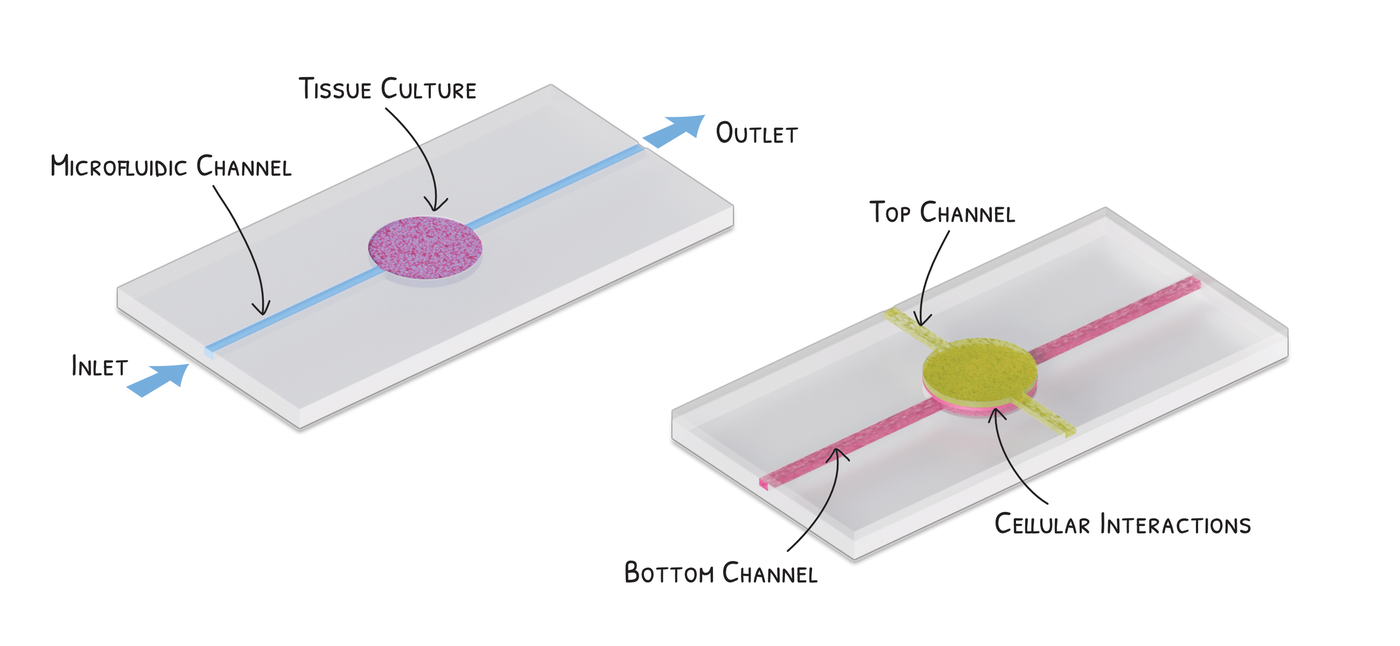
Organ-on-a-chip device illustration

Organ-on-a-chip devices use tiny structures called microfluidic channels to bring small, controlled amounts of fluid into contact with tissue cultures. These devices can be used to study how cells react to certain molecular compounds such as medications, or to observe how different types of cells interact with each other. Left: This device features a single channel with a stationary cell culture in the middle. Right: This device features two channels that overlap at a central intersection, with cells flowing through them.

Credit: Sean Kelley/NIST

These structures are not computer chips but microfluidic devices – tiny instruments that provide the moist environment that body tissue needs to thrive, complete with a fluid that brings nutrients to mimic, to some extent, what the blood does in the body when flowing past cells. In recent years, more sophisticated microfluidic devices have also been made that expand and contract tissue to simulate, for example, conditions within the lungs.

By mimicking the organ’s microenvironment, researchers hope to get a better idea of how the medications might affect these tissues in a person without relying on an animal model. 

Though many groups around the world are developing this technology, each has its own protocols, styles of measurements, and even terminology. As a result, the studies can’t be easily intercompared, which some researchers feel is slowing progress in the field.

To address this need for standardization, NIST is leading a working group to develop a set of guidelines and standards for organ-on-a-chip systems. The group includes researchers from industry, academia, and other government agencies, from around the world.

In a paper published this week in the journal Lab on a Chip the working group laid out their case for why these standards will help the field grow. 
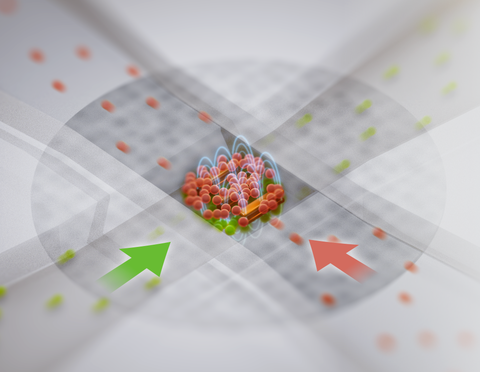
Artist’s rendering of an organ-on-a-chip device

Artist’s rendering of an organ-on-a-chip device used to study cancer cells (red) and endothelial cells (green), a type of tissue that lines the interior surface of blood vessels. This close-up shows two overlapping channels with a thin semi-permeable membrane between them. Electrodes are used to trap cells in each channel, allowing researchers to observe cell-to-cell interactions between the two types of cells on the chip.

Credit: Sean Kelley/NIST

“This is step one: to publish a summary of guidelines so that people will start to get interested in standardization,” said NIST’s Darwin R. Reyes, chairperson of the working group. “But the ultimate goal is to get fully developed standards.”

The working group also held a workshop at Michigan State University (MSU) in April 2023. Participants included representatives from industry, academia, and government, including NIST, the U.S. Food and Drug Administration (FDA), and the European Commission, the executive branch of the European Union. NIST co-sponsored the workshop alongside the co-chair of the group, Nureddin Ashammakhi from MSU.

Right now, the group is gathering input from the various organ-on-a-chip stakeholders, people who are researching or funding organ-on-a-chip projects. This involves asking stakeholders what they need, and what recommendations they have for standardizing their own technology. Though there are many organs represented in organ-on-a-chip research, the group has chosen three – the heart, kidney, and liver – as models to begin their data collection.

“The members of the working group want to focus on issues that have to do with the engineering of these systems,” Reyes said. “For example, how would flow actually affect the cells that are in the systems? How do you maintain a number of cells that is in accordance with the ratio of cells that are in real organs? And what volume of fluid in these systems will be comparable to the number of cells we’re putting in to make it similar to real organs?”

One challenge the group faces is that many commercial organ-on-chip devices contain proprietary information, meaning companies making their own devices can’t divulge what’s inside. Any standards the working group develops would focus on the input and the output of the devices, Reyes said, without specifying how the company achieves that result.

NIST is a logical leader for a project like this, Reyes said, because it’s a neutral entity, an institute that doesn’t compete with anyone else. 

“Being at NIST allowed me to gather people together from all over the world to tackle this issue of standardizing organ-on-a-chip research,” Reyes said. “They wouldn’t have come in if it wasn’t NIST talking about standards.

“That’s part of our mission, to help industry,” Reyes said. “This is one of the ways we can do that.”

--Reported and written by Jennifer Lauren Lee


Paper: D.R. Reyes, M. Esch, L. Ewart, R. Nasiri, A. Herland, K. Sung, M. Piergiovanni, C. Lucchesi, J.T. Shoemaker, J. Vukasinovic, H. Nakae, J. Hickman, K. Pant, A. Taylor, N. Heinz, N. Ashammakhi. From animal testing to in vitro systems: advancing standardization in microphysiological systems. Lab on a Chip. Published online February 15, 2024. DOI: 10.1039/D3LC00994G