








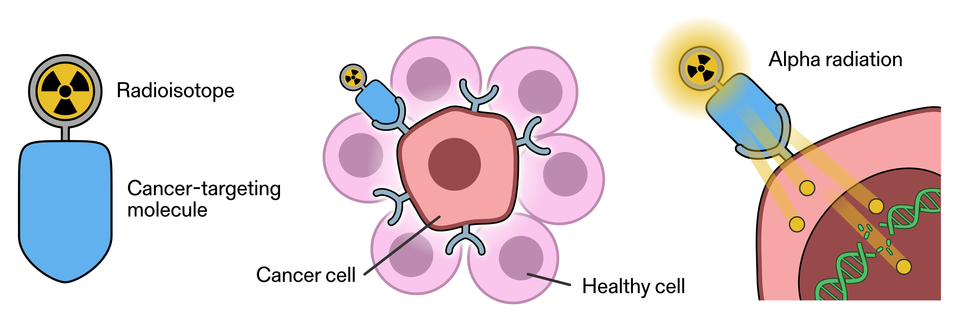
Actinium-225 and some other radioactive elements that emit alpha rays can be transformed into cancer-fighting missiles if they are attached to molecules that seek out and attach to tumor cells. Because alpha rays dump most of their energy within extremely short distances in the human body, this radiation can be harnessed to kill cancer cells while sparing surrounding healthy tissue.
Credit: S. Kelley/NIST
Scientists at the National Institute of Standards and Technology (NIST) have developed the first U.S. standard for measuring the radioactivity of actinium-225, a radioactive isotope that drug companies are using to develop a new class of anticancer drugs.
The new standard, which is tied to the International System of Units (SI), has enabled NIST to open a calibration service for drug companies and research institutions studying the cancer-fighting potential of actinium-225. By comparing NIST’s measurement of a sample of actinium-225 to their own measurements, the companies can ensure that human volunteers injected with actinium-225 receive the exact amount of radioactivity required for it to be effective.
“Health care providers don’t want to overdose patients. Then they risk doing more harm than good,” said NIST chemist Denis Bergeron. “But they also don’t want to underdose patients. In a way, that’s even worse because a patient is exposed to potentially harmful radiation without effectively treating their cancer. This is a case where you have to get it precisely right. That’s our job at NIST. For actinium-225, that means accurately measuring the injected radioactivity.”
As the national measurement institute for the U.S., NIST provides a wide range of calibration services to industry and other organizations to help ensure that their equipment is providing accurate readings. This latest calibration service could facilitate FDA review of anticancer drugs based on actinium-225, potentially speeding their deployment to cancer patients. More than 15 clinical trials in the U.S. have revealed that drugs based on actinium-225 show promise for fighting several cancers, including prostate cancer, neuroendocrine tumors and acute myeloid leukemia.
Actinium-225 is one of several radioisotopes — radioactive versions of stable elements — that dump a massive amount of energy, in the form of alpha particles, within an extremely short distance in the human body. Alpha particles, composed of two protons and two neutrons, are relatively bulky and dense, so they don’t travel far before depositing all their energy.
Taking advantage of this short-range blast of energy, clinicians have devised drugs that act like anticancer missiles, binding actinium-225 or another alpha-emitting radioisotope to molecules that seek out and attach to cancer cells specifically. Once the radioactive source arrives at a tumor, alpha particles destroy the DNA of the cancer cells while leaving healthy cells unscathed.
To deliver the right dose to the tumor, clinicians must know how many alpha particles are being emitted at the tumor site. But counting radioactive decays is not as simple as it may seem.
When it decays, actinium-225 successively transforms into a series of smaller atoms that are also unstable and emit their own alpha particles, along with gamma rays (a form of high-energy electromagnetic radiation) and beta particles (electrons). To measure radioactivity, researchers must account for all the decay products.

Credit: S. Kelley/NIST
To create the new standard, Bergeron and his NIST colleagues relied on an established method of measuring radioactivity known as the triple-to-double coincidence ratio (TDCR). They placed a small amount of actinium-225 in a vial filled with a liquid that emits flashes of light when struck by radioactive particles. They then converted the flashes into electrical signals.
This allowed the researchers to accurately measure the number of decays per second of actinium-225, a unit of measure known as the becquerel that is defined by using fundamental constants of nature. Other measurement techniques confirmed the accuracy of the new standard, the team reported online in the journal Applied Radiation and Isotopes.
Once the NIST team established the new standard with TDCR, pharmaceutical companies began sending NIST samples of actinium-225 that they had measured in their own laboratories. The NIST scientists measured the radioactivity of the samples using the NIST standard. By comparing NIST’s measurement to its own, each pharmaceutical company was able to calibrate its equipment to the NIST standard.
“When you inject a radioactive drug into a patient, you want to make sure that the strength is exactly right for treating a tumor; a lower amount could harm the patient without any benefit,” said Elisa Napoli, a nuclear physicist at the pharmaceutical company ARTBIO in Cambridge, Massachusetts, which specializes in developing radioactive anticancer drugs. “If you have different dial settings or different instruments that measure radioactivity [in different parts of the world] and they are not calibrated with the same standard, then it’s a mess,” she added. “You don’t know how much radioactivity you’re injecting into a patient in Japan or how much you’re injecting into another patient in Italy.”
The service is in high demand: Since November, five pharmaceutical companies have sent samples of actinium-225 to NIST for radioactivity measurements, and several other companies are on a waiting list. Instructions for using the service are available on the NIST website.
“Our goal in developing, improving and disseminating radioactivity standards is to give pharmaceutical companies and research facilities the resources they need to accurately monitor the activity of radionuclides on their own,” Bergeron said.
Pharmaceutical companies measured the radioactivity of actinium-225 by using a simpler, easier-to-use method than NIST’s. They placed the radioactive element in a gas-filled device known as an ionization chamber. Gamma rays released by the sample of actinium-225 ionized the gas, stripping atoms in the gas of electrons and creating an electric current proportional to the intensity of the radiation.
When they received a company’s sample, the NIST scientists measured the radioactivity of the sample also using an ionization chamber — but with one important difference. The radioactivity recorded by the chamber at NIST had been calibrated according to the NIST standard.
“We let the calibrated ionization chamber serve as the repository, or memory, for our primary standard,” Bergeron said.
Paper: Bergeron, D.E.; Hamad, G.; Broder, B.A.; Cesna, J.T.; Pearce, A.J.; LaRosa, J.; Pibida, L.; Salter, R.; Saxena, N.S.; and Zimmerman, B.E. Activity measurements and calibrations for 225Ac in radioactive equilibrium with its progeny. Applied Radiation and Isotopes. Published online Dec. 9, 2024. DOI: 10.1016/j.apradiso.2024.111630
此内容由惯性聚合(RSS阅读器)自动聚合整理,仅供阅读参考。 原文来自 — 版权归原作者所有。