








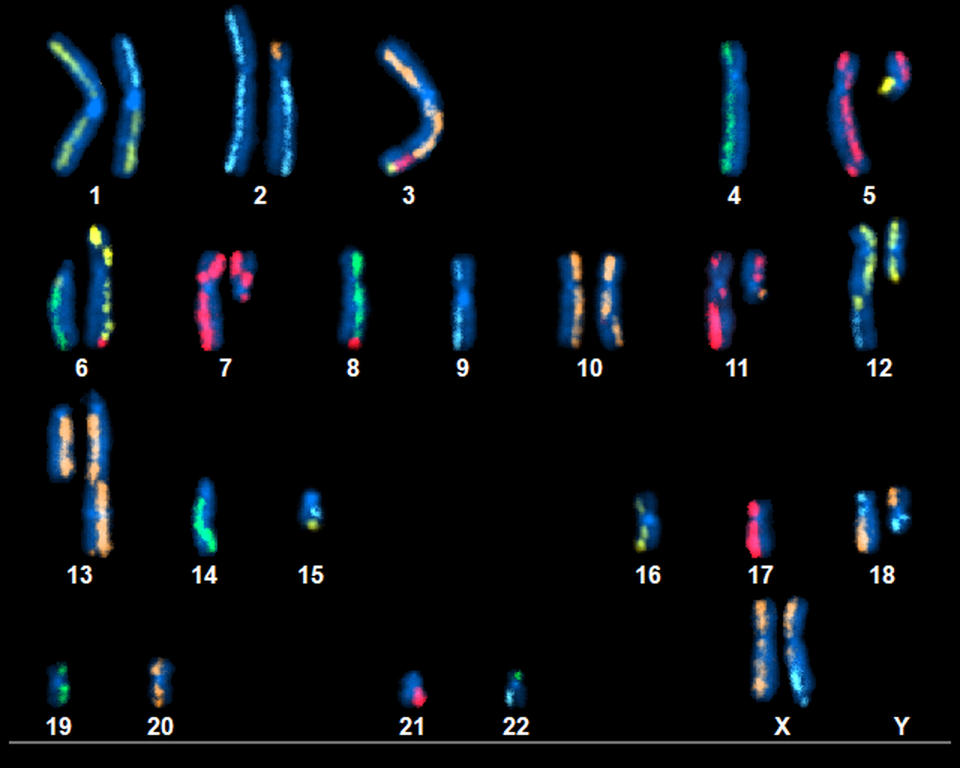
This image shows chromosomes in the pancreatic cancer cell line, where mixed colors indicate chromosomal rearrangements. For example, the first copy of chromosome 1 in the top left of the image is normal because both the top and bottom are yellow, but the top part of the second copy of chromosome 1 is replaced by the top part of chromosome 2 (blue) due to a rearrangement of chromosomes in the tumor. Image was created using the Kromatid KROMASURE Screen platform.
Credit: NIST
In an effort to foster progress in cancer research, the National Institute of Standards and Technology (NIST) is releasing detailed and comprehensive data about the entire genetic content of a pancreatic cancer cell. Scientists can use it to research tumors, improve cancer diagnostic tests, and develop new cancer treatments.
The NIST data on this cancer genome — that is, the full set of genetic instructions from the cell, including the mutations that caused the disease — is several terabytes in size. The genome came from a 61-year-old pancreatic cancer patient who explicitly consented to making the genetic code of her cancer cells publicly available for research and clinical use.
Previous cancer cell lines had been released without the explicit consent of the donors, creating potential legal and ethical impediments to their use in research and drug development.
For example, in 1951, doctors harvested cervical cancer cells from Baltimore resident Henrietta Lacks without her consent. She died shortly thereafter and was buried in an unmarked grave. But her cells played a major role in the development of the polio vaccine, genetic research and even COVID-19 vaccines. The Immortal Life of Henrietta Lacks became a best-selling book and HBO movie starring Oprah Winfrey.
“In the past, there have been controversies about using genetic data for research due to the lack of consent by patients,” said NIST biomedical engineer Justin Zook. “This is the first cancer cell line developed from an individual who explicitly consented to making her genomic data freely available to the public.”
The researchers describe the cell line and genomic data in the journal Scientific Data. In addition, the complete genomic data was released by the NIST Genome in a Bottle Consortium, a 12-year-old public-private-academic collaboration to develop reference standards and protocols for genetic analysis and sequencing in research and clinical practice. In 2022, NIST started the Cancer Genome in a Bottle program as part of the consortium to focus on cancer.
“In the past, there have been controversies about using genetic data for research due to the lack of consent by patients. This is the first cancer cell line developed from an individual who explicitly consented to making her genomic data freely available to the public.” —Justin Zook, NIST biomedical engineer
To analyze the genome of pancreatic cancer cells, NIST researchers used 13 distinct state-of-the-art whole genome measurement technologies, some of which were only recently developed.
Each method identifies the sequence of DNA nucleotides — adenine (A), cytosine (C), guanine (G) and thymine (T) — in an individual’s genome. However, the methods produce slightly varying results and have different strengths and weaknesses.
NIST’s dataset contains separate results for each of the 13 techniques used to sequence the cancer genome. Scientists performing their analysis can compare their data with NIST’s. If there are discrepancies, they can then determine whether their equipment is working properly and remedy the problem if not.
Researchers can also use the genomic data from this cell line to train artificial intelligence models to detect cancer-causing mutations and determine which drugs might work best for treating those cancers.
Health care practitioners send cancer patients’ cells to labs for gene sequencing. The results help them better understand the patient’s illness and identify appropriate treatments.
“Labs can use NIST’s database to perform quality control on their equipment,” said Zook. “As a result, the public can have more confidence in the results produced by clinical laboratories that analyze cancer tumors.”
Scientists can also use NIST’s data to advance cancer research. They can scour the nucleotide sequences for genetic mutations that may offer new insights into how cancer develops and progresses in humans.
Though certain features of NIST’s analysis pertain only to pancreatic cancer — and only pancreatic cancer in this individual — the genomes of all cancers contain sufficiently similar types of mutations that it will be useful for researching other cancers as well, Zook said.
Finally, manufacturers can analyze NIST’s results to identify the strengths and weaknesses of various gene sequencing technologies currently on the market. Zook said this may lead to improvements in existing methods and the development of new sequencing platforms.
Having sequenced the genome of this pancreatic cell line, Zook and his colleagues will turn their attention to other types of cancer and plan to release data on those genomes as well.
The pancreatic cancer patient who donated her cancer cells also donated her noncancerous ones. Zook’s team has published data from these healthy cells as well, so they can be compared with her tumor cells.
“Long term, we would love to see our research lead to new and better cancer diagnostics and treatments,” Zook said.
The genomic data from this cell line is freely available on NIST’s Cancer Genome in a Bottle website.
Paper: Jennifer H. McDaniel, et al. Development and extensive sequencing of a broadly-consented Genome in a Bottle matched tumor-normal pair. Scientific Data. Published online July 16, 2025. DOI: 10.1038/s41597-025-05438-2
此内容由惯性聚合(RSS阅读器)自动聚合整理,仅供阅读参考。 原文来自 — 版权归原作者所有。