

惯性聚合 高效追踪和阅读你感兴趣的博客、新闻、科技资讯
阅读原文 在惯性聚合中打开

推荐订阅源

T
Threatpost
OSCHINA 社区最新新闻
OSCHINA 社区最新新闻
Engineering at Meta
Engineering at Meta
T
The Blog of Author Tim Ferriss
Recent Announcements
G
Google Developers Blog
Google DeepMind News
The Register - Security
MongoDB | Blog
MongoDB | Blog
U
Unit 42
B
Blog
H
Hackread – Cybersecurity News, Data Breaches, AI and More
L
LangChain Blog
Stack Overflow Blog
Stack Overflow Blog
P
Privacy International News Feed
L
LINUX DO - 最新话题
博客园_首页
博客园 - Franky
大猫的无限游戏
大猫的无限游戏
小众软件
小众软件
Threat Intelligence Blog | Flashpoint
T
Tor Project blog
V
Visual Studio Blog
让小产品的独立变现更简单 - ezindie.com
P
Privacy & Cybersecurity Law Blog
C
Cyber Attacks, Cyber Crime and Cyber Security
K
Kaspersky official blog
C
Cisco Blogs
博客园 - 【当耐特】
阮一峰的网络日志
阮一峰的网络日志
I
Intezer
罗磊的独立博客
MyScale Blog
MyScale Blog
Last Week in AI
Last Week in AI
A
About on SuperTechFans
G
GRAHAM CLULEY
Y
Y Combinator Blog
Microsoft Security Blog
GbyAI
GbyAI
T
Threat Research - Cisco Blogs
P
Proofpoint News Feed
D
DataBreaches.Net
The Hacker News
The Hacker News
Spread Privacy
Spread Privacy
AWS News Blog
AWS News Blog
I
InfoQ
T
The Exploit Database - CXSecurity.com
Simon Willison's Weblog
博客园 - 叶小钗
Project Zero
Project Zero

News and Events Feed by Topic

NIST Receives New Patent for Microbe-Killing Water Heater Spotlight: How NIST Helps Make Sure the Fish You Catch Are Safe to Eat NIST Expands Its Library of ‘Chemical Fingerprints’ to Identify Unknown Substances SRM Story: SRM 1947a Great Lakes Fish Tissue SRM Story: SRMs 3672a and 3673a Organic Contaminants in Smokers’ and Nonsmokers’ Urine Space: The Final Frontier for Standards Securing Smart Speakers for Home Health Care: NIST Offers New Guidelines NIST’s ‘Living Reference Material’ Could Accelerate R&D of Lifesaving Biological Drugs NIST Awards Over $1.8 Million to Small Businesses Advancing AI, Semiconductors, Additive Manufacturing and More SRM Story: SRM 965c Glucose in Frozen Human Serum Second Seminar on Building an In-Space Circular Economy New NIST Reference Material to Strengthen Quality Control for Biological Drugs NIST Releases Trove of Genetic Data to Spur Cancer Research New NIST Research Grade Test Material to support mRNA therapeutics NIST Shares Preliminary Findings From Hurricane Maria Investigation New NIST Standard Helps Deliver the Right Dosage of Cancer-Fighting Drugs Second Series of Workshops on Measurements and Standards for Advanced Therapy NIST Researcher Addresses London Healthcare Innovation Forum NIST Releases Reference Material to Aid Gut Microbiome Research 2025 NIST Workshop on Rapid Microbial Testing Methods An SRM for Accuracy in Electrolyte Panel Clinical Tests Study Highlights Need for Standardized Measurement Methods in Gene Therapy NIST Develops Genetic Material for Validating H5N1 Bird Flu Diagnostic Tests PFAS Found in Firefighter Gloves, Hoods and Wildland Gear AI and Flow Cytometry Workshop Genome Editing Consortium Workshop Social Spotlight: Engineered Cells as a Shoebox NIST Scientists Use DNA Origami on a Chip to Detect Biomolecules NIST Awards Up to $1.5 Million to Support Development of Regenerative Medicine Standards Curricula NIST Research Leader Featured in Medical IoT Discussions Spotlight: Game-Changing Microscopy Technique for Identifying Cancerous Cells Spotlight: Cassie Stoffer Helps Run Calibration and Measurement Services Related to Magnetic Resonance NIST Researchers to Test New Approach for Detecting Cannabis in Breath Spotlight: SURF Student Zainab Altamimi Spends Her Summer Researching the Capsules and Tablets in 3D Drug Printing From Pandemics to Pedicures: NIST Rebuilds World-Class UV Calibration System NIST Partners With the Gates Foundation to Develop Breathalyzers for Malaria and Tuberculosis Research Finds Dolphins With Elevated Mercury Levels in Florida and Georgia NIST Awards Over $1.2 Million to Small Businesses to Advance Cybersecurity, Biopharmaceuticals, Semiconductors and More Spotlight: Shape-Shifting Probes Will Help Improve MRI Imaging NIST Researchers Use Cellphone Compass to Measure Tiny Concentrations of Compounds Important for Human Health CHIPS R&D National Advanced Packaging Manufacturing Program (NAPMP) Advanced Packaging Summit NIST-Led Working Group Developing Standards for Organ-on-a-Chip Research 2024 NIST Rapid Microbial Testing Methods Consortium Workshop
NIST Researchers Develop Material for Measuring Arsenic in Shellfish
Alex Boss · 2025-03-13 · via News and Events Feed by Topic
  • Geoduck clams are an important U.S. food export and are critical to local economies on the Washington state and Alaskan coasts.
  • To ensure that these clams and other shellfish are safe to eat, they must be tested for toxic elements and compounds, including inorganic arsenic.
  • NIST researchers have developed a standard reference material that will support more accurate measurements of inorganic arsenic in geoduck clams and other shellfish.
A scientist wearing protective equipment places a tray of diced geoduck clam tissue into large open machinery.

NIST researchers developed the geoduck clam reference material by shucking, cleaning and dicing geoduck clams and then freezing them in liquid nitrogen. The material was ground into a fine powder, and researchers then used an analytical laboratory technique to measure precise amounts of arsenic.

Credit: NIST

Even if you are a big fan of scallops, oysters and other shellfish, you may not have heard of the geoduck clam. But these outsized mollusks are an important food export to Asia and vital to coastal economies in Washington state and Alaska. Divers from these states harvested more than $60 million worth of them in 2023, according to the National Oceanic and Atmospheric Administration (NOAA).

To promote confidence in their food products, these states must test geoduck clams and other shellfish for toxic elements and compounds, including inorganic arsenic, a known carcinogen.

To help ensure accurate measurements, researchers at the National Institute of Standards and Technology (NIST) have developed a standard reference material (SRM) made of geoduck tissue containing very carefully measured amounts of inorganic arsenic. This material will help states monitor inorganic arsenic levels in their geoduck exports. It will also help ensure the food safety of geoduck clams and other shellfish sold in the U.S.

“Many marine organisms absorb arsenic because it is naturally present in the ocean environment,” said NIST biologist Colleen Bryan Sallee, who led the development of the material. “This material will help ensure that inorganic arsenic is accurately measured in shellfish for determining food safety.” 

Previously, geoduck clams were tested for total arsenic, which includes the element in both its organic and inorganic forms. But the inorganic form is considered more toxic, and the new SRM will help labs accurately measure that form specifically.
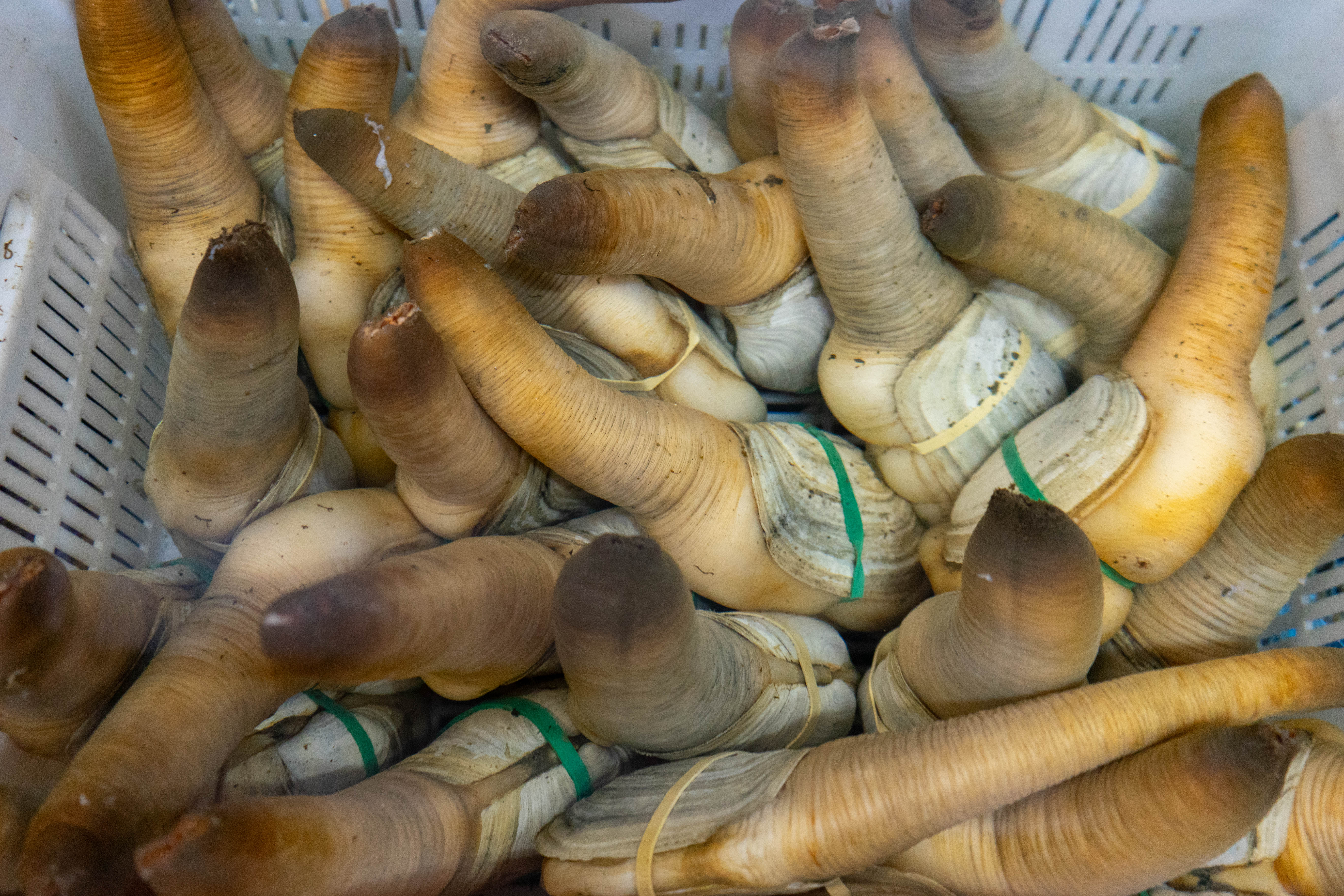
A white plastic bin filled with freshly caught geoduck clams.

Geoduck clams are found along the west coast of the United States, from Alaska all the way down to Baja California. They are an important food export and are critical to local economies on the Washington and Alaskan coasts.

Credit: Megan Ewald/NOAA Fisheries

SRM 2983: Inorganics in Geoduck Clam Tissue (Panopea generosa) consists of one jar of frozen geoduck clam tissue, along with a document listing the measured amounts of organic and inorganic arsenic, with uncertainty values for each.

Seafood testing laboratories and research organizations can ensure the accuracy of their measurements by running a small sample of the SRM through their instruments. If their results match the certified values from NIST to within a specified uncertainty, then they can have confidence in their measurement methods. If not, they’ll know they need to adjust their methods. 

To create this new material, researchers shucked, cleaned and diced geoduck clams, froze them in liquid nitrogen, and ground the frozen tissue into a fine powder. They used an analytical technique called inductively coupled plasma mass spectrometry to measure the arsenic amounts in the material.

NIST produces more than a thousand SRMs that promote public health and safety and support U.S industry. These materials help ensure accurate measurements in industries ranging from food (peanut butter and infant formula) to health care (cholesterol in blood serum) to manufacturing (carbon steel) and many more.

NIST researchers collaborated on this project with the NOAA Fisheries Seafood Inspection Program, the Washington State Department of Health, and the Southeast Alaska Regional Dive Fisheries Association.

SRM 2983: Inorganics in Geoduck Clam Tissue (Panopea generosa) is available for purchase at the NIST Store