




惯性聚合 高效追踪和阅读你感兴趣的博客、新闻、科技资讯
阅读原文 在惯性聚合中打开

推荐订阅源

Microsoft Azure Blog
量子位
小众软件
小众软件
C
Cybersecurity and Infrastructure Security Agency CISA
Threat Intelligence Blog | Flashpoint
T
Tenable Blog
V
Vulnerabilities – Threatpost
Know Your Adversary
Know Your Adversary
T
Threat Research - Cisco Blogs
Latest news
Latest news
Spread Privacy
Spread Privacy
C
Cyber Attacks, Cyber Crime and Cyber Security
NISL@THU
NISL@THU
T
Tor Project blog
Hacker News: Ask HN
Hacker News: Ask HN
V2EX - 技术
V2EX - 技术
T
The Exploit Database - CXSecurity.com
博客园 - 三生石上(FineUI控件)
K
Kaspersky official blog
Cyberwarzone
Cyberwarzone
博客园 - 叶小钗
博客园 - 聂微东
Last Week in AI
Last Week in AI
爱范儿
爱范儿
腾讯CDC
博客园 - Franky
美团技术团队
J
Java Code Geeks
O
OpenAI News
L
Lohrmann on Cybersecurity
Simon Willison's Weblog
有赞技术团队
有赞技术团队
T
Threatpost
G
GRAHAM CLULEY
Hugging Face - Blog
Hugging Face - Blog
博客园 - 【当耐特】
宝玉的分享
宝玉的分享
I
Intezer
N
News and Events Feed by Topic
钛媒体:引领未来商业与生活新知
钛媒体:引领未来商业与生活新知
CTFtime.org: upcoming CTF events
OSCHINA 社区最新新闻
OSCHINA 社区最新新闻
T
The Blog of Author Tim Ferriss
S
Security @ Cisco Blogs
Forbes - Security
Forbes - Security
N
News | PayPal Newsroom
Stack Overflow Blog
Stack Overflow Blog
Scott Helme
Scott Helme
H
Hacker News: Front Page
Cloudbric
Cloudbric

News and Events Feed by Topic

NIST Receives New Patent for Microbe-Killing Water Heater Spotlight: How NIST Helps Make Sure the Fish You Catch Are Safe to Eat NIST Expands Its Library of ‘Chemical Fingerprints’ to Identify Unknown Substances SRM Story: SRM 1947a Great Lakes Fish Tissue SRM Story: SRMs 3672a and 3673a Organic Contaminants in Smokers’ and Nonsmokers’ Urine Space: The Final Frontier for Standards Securing Smart Speakers for Home Health Care: NIST Offers New Guidelines NIST’s ‘Living Reference Material’ Could Accelerate R&D of Lifesaving Biological Drugs NIST Awards Over $1.8 Million to Small Businesses Advancing AI, Semiconductors, Additive Manufacturing and More SRM Story: SRM 965c Glucose in Frozen Human Serum Second Seminar on Building an In-Space Circular Economy New NIST Reference Material to Strengthen Quality Control for Biological Drugs NIST Releases Trove of Genetic Data to Spur Cancer Research New NIST Research Grade Test Material to support mRNA therapeutics NIST Shares Preliminary Findings From Hurricane Maria Investigation New NIST Standard Helps Deliver the Right Dosage of Cancer-Fighting Drugs Second Series of Workshops on Measurements and Standards for Advanced Therapy NIST Researcher Addresses London Healthcare Innovation Forum NIST Releases Reference Material to Aid Gut Microbiome Research NIST Researchers Develop Material for Measuring Arsenic in Shellfish 2025 NIST Workshop on Rapid Microbial Testing Methods An SRM for Accuracy in Electrolyte Panel Clinical Tests Study Highlights Need for Standardized Measurement Methods in Gene Therapy NIST Develops Genetic Material for Validating H5N1 Bird Flu Diagnostic Tests PFAS Found in Firefighter Gloves, Hoods and Wildland Gear AI and Flow Cytometry Workshop Genome Editing Consortium Workshop Social Spotlight: Engineered Cells as a Shoebox NIST Scientists Use DNA Origami on a Chip to Detect Biomolecules NIST Awards Up to $1.5 Million to Support Development of Regenerative Medicine Standards Curricula NIST Research Leader Featured in Medical IoT Discussions Spotlight: Game-Changing Microscopy Technique for Identifying Cancerous Cells NIST Researchers to Test New Approach for Detecting Cannabis in Breath Spotlight: SURF Student Zainab Altamimi Spends Her Summer Researching the Capsules and Tablets in 3D Drug Printing From Pandemics to Pedicures: NIST Rebuilds World-Class UV Calibration System NIST Partners With the Gates Foundation to Develop Breathalyzers for Malaria and Tuberculosis Research Finds Dolphins With Elevated Mercury Levels in Florida and Georgia NIST Awards Over $1.2 Million to Small Businesses to Advance Cybersecurity, Biopharmaceuticals, Semiconductors and More Spotlight: Shape-Shifting Probes Will Help Improve MRI Imaging NIST Researchers Use Cellphone Compass to Measure Tiny Concentrations of Compounds Important for Human Health CHIPS R&D National Advanced Packaging Manufacturing Program (NAPMP) Advanced Packaging Summit NIST-Led Working Group Developing Standards for Organ-on-a-Chip Research 2024 NIST Rapid Microbial Testing Methods Consortium Workshop
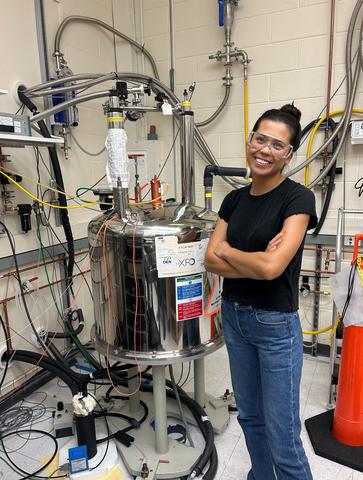
Spotlight: Cassie Stoffer Helps Run Calibration and Measurement Services Related to Magnetic Resonance
2024-08-27 · via News and Events Feed by Topic
Cassie Stoffer smiles while wearing safety glasses and standing next to a large metal tank with many pipes and wires attached to it.

Credit: NIST

If you ask NIST physicist Cassie Stoffer what she finds most exciting about science, it’s seeing what she learned in a textbook have real-world applications.

Cassie helps run calibration and measurement services related to magnetic resonance imaging (MRI) at NIST. Part of her work relates to phantoms — but not the ghost kind. These are standard reference objects used by the biomedical research community to make sure their systems and methods for imaging the human body are operating correctly.

These objects are scientific devices that serve as stand-ins for human tissue. They contain materials like salt solutions or gels that mimic the responses of human tissue under specific conditions. Cassie characterizes these materials by measuring certain parameters with a well-defined, low uncertainty.  

The parameters she measures are used in MRI as biomarkers, or numerical values that indicate biological processes in the human body. These biomarkers can tell a doctor what type of tumor a patient has or evaluate the body’s response to a specific treatment, for example.  

Cassie’s measurements provide reference values that are used to ensure that an MRI system accurately measures biomarkers.

MRI is conventionally a qualitative and nonnumerical tool; it produces images that radiologists study to make a diagnosis. Cassie and her group work in the field of quantitative MRI, where images contain numerical information that offer more precise details on what the images show.  

Cassie’s work aims to bring lower uncertainties to quantitative MRI measurements in phantoms and ultimately the human body.  

As an early career professional in this field, Cassie enjoys working with experts in this area and seeing how the work she does at NIST, a small piece of the bigger picture, has implications in the real world.