惯性聚合 高效追踪和阅读你感兴趣的博客、新闻、科技资讯
阅读原文 在惯性聚合中打开

推荐订阅源

Apple Machine Learning Research
Recent Announcements
IT之家
IT之家
人人都是产品经理
人人都是产品经理
G
Google Developers Blog
Microsoft Azure Blog
博客园_首页
大猫的无限游戏
大猫的无限游戏
U
Unit 42
罗磊的独立博客
博客园 - Franky
WordPress大学
WordPress大学
CTFtime.org: upcoming CTF events
M
MIT News - Artificial intelligence
SecWiki News
SecWiki News
V
Vulnerabilities – Threatpost
P
Privacy International News Feed
P
Palo Alto Networks Blog
F
Fortinet All Blogs
P
Proofpoint News Feed
博客园 - 叶小钗
C
CERT Recently Published Vulnerability Notes
T
Tor Project blog
Spread Privacy
Spread Privacy
S
Securelist
C
Cisco Blogs
I
Intezer
D
Darknet – Hacking Tools, Hacker News & Cyber Security
Cyberwarzone
Cyberwarzone
钛媒体:引领未来商业与生活新知
钛媒体:引领未来商业与生活新知
P
Privacy & Cybersecurity Law Blog
宝玉的分享
宝玉的分享
OSCHINA 社区最新新闻
OSCHINA 社区最新新闻
Engineering at Meta
Engineering at Meta
S
Schneier on Security
C
CXSECURITY Database RSS Feed - CXSecurity.com
GbyAI
GbyAI
T
Troy Hunt's Blog
T
Threatpost
博客园 - 司徒正美
Y
Y Combinator Blog
Hugging Face - Blog
Hugging Face - Blog
AWS News Blog
AWS News Blog
T
The Blog of Author Tim Ferriss
G
GRAHAM CLULEY
N
Netflix TechBlog - Medium
酷 壳 – CoolShell
酷 壳 – CoolShell
Google DeepMind News
Know Your Adversary
Know Your Adversary
S
SegmentFault 最新的问题

RealCat

📝笔记:图像匹配挑战赛回顾(CVPR 2023) | RealCat 📝笔记:Stable Diffusion QR-Code | RealCat 📝笔记:Python zip() | RealCat 📝笔记:图像匹配挑战赛回顾(CVPR 2022) | RealCat 📝笔记:5秒钟训练NeRF,NVIDIA Instant NeRF 测试 | RealCat 📝笔记:Visualization Localization Revisited(under construction...) | RealCat 📝笔记:使用vlfeat的Matlab接口简单实现BOW以及VLAD | RealCat 📝笔记:一些关于KD-Tree的知识点 | RealCat 📝笔记:简明矩阵求导术之分子布局与分母布局 | RealCat 📝笔记:使用Clockwise/Spiral Rule技巧轻松读懂变量/函数声明 | RealCat 🔨工具:优雅地下载Youtube视频 | RealCat 🔨工具:每日自动获取arXiv论文摘要 | RealCat 🎃资料: 从Eigen向量化谈内存对齐 | RealCat 📝笔记:图像匹配挑战赛总结 (SuperPoint + SuperGlue 缝缝补补还能再战一年) | RealCat 📝笔记:ICCV 2021最佳学生论文 | COLMAP 优化建图组件 Pixel-Perfect SFM | RealCat 📝笔记:CVPR 2021 | PixLoc: 端到端场景无关视觉定位算法(SuperGlue一作出品) | RealCat 📝笔记:港大MARS实验室 R3LIVE (R2LIVE升级) 鲁棒实时RGB雷达视觉惯导紧耦合状态估计 | RealCat 🔨工具:bash常用命令 | RealCat 📝笔记:VSLAM基础知识导图 | RealCat 📝笔记:Patch-NetVLAD论文阅读 | RealCat 📝笔记:光场相机能否用于SLAM? | RealCat 📝笔记:读写文本常用操作 | RealCat 📝笔记:CVPR 2020 视觉定位挑战赛冠军方案 | RealCat 📝笔记:三维重建系列 COLMAP: Structure-from-Motion Revisited | RealCat 🐈芒果驾到 | RealCat 📝笔记:GMS一种基于运动统计的快速鲁棒特征匹配过滤算法 | RealCat 🌡️秋天到了,还是很热 | RealCat 📝笔记:AdaLAM: Revisiting Handcrafted Outlier Detection 超强外点滤除算法 | RealCat 🔨工具:使用vercel加速Hexo静态博客访问 | RealCat 📝笔记:ORB-SLAM3论文阅读 | RealCat 🔨工具:解决Github挂图及龟速访问 | RealCat 📝笔记:图解卡尔曼滤波 | RealCat 🔨工具:国内加速访问arxiv | RealCat 📝笔记:CVPR2020图像匹配挑战赛,新数据集+新评测方法,SOTA正瑟瑟发抖! | RealCat 📝笔记:SuperGlue:Learning Feature Matching with Graph Neural Networks论文阅读 | RealCat 📝笔记:SLAM常见问题(四):求解ICP,利用SVD分解得到旋转矩阵 | RealCat 📝笔记:SLAM常见问题(五):Singular Value Decomposition(SVD)分解 | RealCat 📝笔记:SLAM常见问题(三):PNP | RealCat 📝笔记:SLAM常见问题(二):重定位Relocalisation | RealCat 📝笔记:SLAM常见问题(一):SearchByBoW | RealCat 📝笔记:2019年浙大CADCG暑假SLAM培训部分课件 | RealCat 🔨工具:Filebrowser:一款轻量级个人网盘 | RealCat 📝笔记:SuperPoint: Self-Supervised Interest Point Detection and Description 自监督深度学习特征点 | RealCat Black Hole | RealCat 🔥Awesome CV Works | RealCat 🔨工具:开启SSR模式 | RealCat 虚实:「未麻的部屋」 | RealCat 笔记:李群与李代数求导 | RealCat 资料:ORB SLAM2 阅读报告 | RealCat 资料:SLAM草稿 | RealCat 资料:Line Segments Detection | RealCat 资料:Eigen与Matlab语句之对应关系 | RealCat 笔记:清华-谷歌人工智能研讨会(Tsinghua-Google AI Symposium) | RealCat Think Different | RealCat Light Field Depth Estimation | RealCat CV Related References | RealCat 立体视觉综述:Stereo Vision Overview | RealCat Lytro的光场AR之路:从巅峰到死亡 | RealCat Stephen Hawking | RealCat 常用的生产力工具 | RealCat 深度学习在深度(视差)估计中的应用(2) | RealCat 深度学习在深度(视差)估计中的应用(1) | RealCat Matlab Deep Learning学习笔记 | RealCat 理解LSTM网络【译】 | RealCat 降维之PCA主成分分析原理 | RealCat 📝笔记:SIFT和SURF特性提取总结 | RealCat 统计学习方法总结 | RealCat Ubuntu上使用Git以及GitHub | RealCat 机器学习修炼手册 | RealCat 初试HCI光场数据集 | RealCat 实习季到了,大家又浮躁了起来 | RealCat 日本与美国之行 | RealCat Light Field 光场以及MATLAB光场工具包(LightField ToolBox)的使用说明 | RealCat MATLAB:多个不同维度的箱线图画在一起 | RealCat AR形势与应用 | RealCat Hexo+Github+jsDelivr+Vercel建站备忘录 | RealCat Markdown 学习 | RealCat 复试那些事儿 | RealCat
CNN框架(CNN Architectures) | RealCat
2017-11-06 · via RealCat

本文来自于CS231N(2017 Spring),将介绍几种较为常见的CNN结构。以下网络均是ImageNet比赛的冠军之作,我们将从网络结构,参数规模,运算量等来描述各个网络的特点。

  • AlexNet
  • VGG
  • GoogLeNet
  • ResNet

后续将补充以下几种网络:

  • NiN(Network in Network)
  • wide ResNet
  • ResNeXT
  • stochastic Depth
  • DenseNet
  • FractalNet
  • SqueezeNet

以下是正文。

AlexNet

网络结构

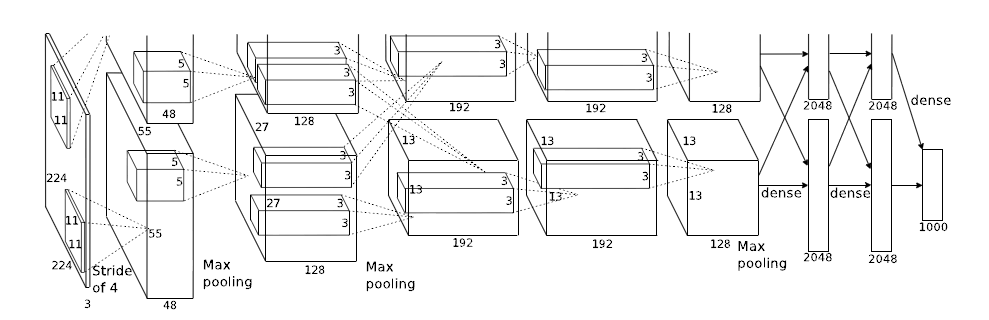
AlexNet 网络的输入大小为:227*227*3,每一层的结构以及参数设置如下:

Layer Type

#Filters

Stride

Pading

OUTPUT SIZE

Parameters

CONV1

#96 @11*11

4

0

55*55*96

11*11*3*96

MAXPOOL1

3*3

2

0

27*27*96

0

NORM1

27*27*96

55*55*96

CONV1

#256 @5*5

1

2

27*27*256

55*55*96

MAXPOOL2

3*3

2

0

13*13*256

55*55*96

NORM2

13*13*256

55*55*96

CONV3

#384 @3*3

1

1

13*13*384

55*55*96

CONV4

#384 @3*3

1

1

13*13*384

55*55*96

CONV5

#256 @3*3

1

1

13*13*256

55*55*96

MAXPOOL3

3*3

2

0

6*6*256

55*55*96

FC6

4096

55*55*96

FC7

4096

55*55*96

FC8

1000

55*55*96

The size of output image is
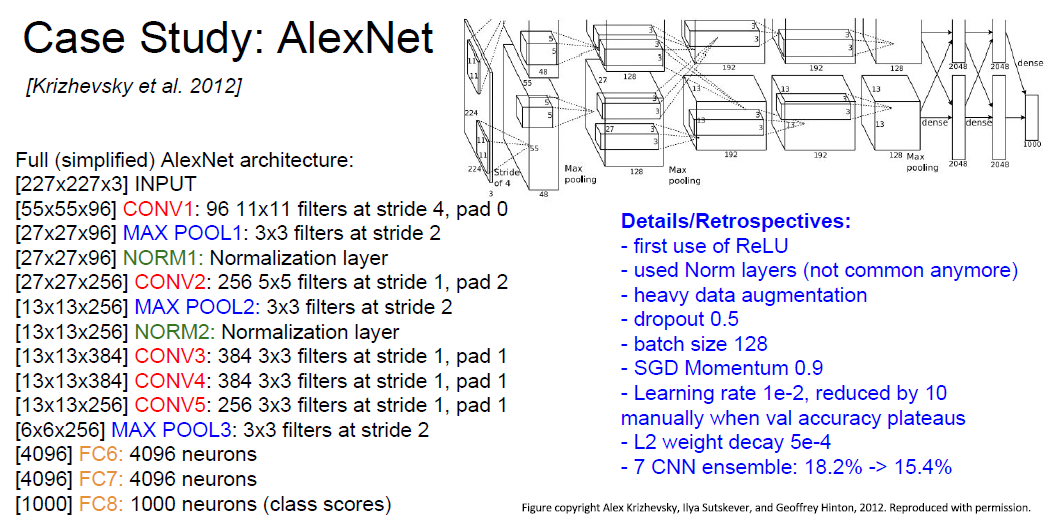
AlexNet-details

AlexNet-details

后续将使用Matlab DL 工具包补充Alexnet实验…

VGGNet

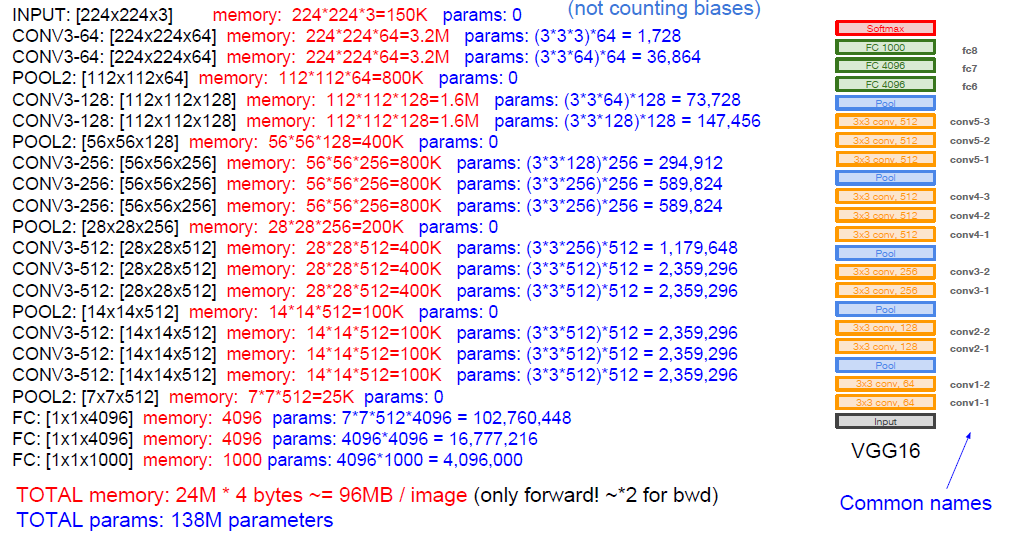
The winner of ImageNet Large Scale Visual Recognition Challenge (ILSVRC) 2014. ### 网络结构 small filters, deeper networks。 将原来8层的AlexNet扩展到了16&19层。卷积层的大小仅仅有3*3,stride=1,pad=1;池化层仅仅有stride=2的2*2的MAXPOOL。以下是其与AlexNet的结构对比图。 VGG
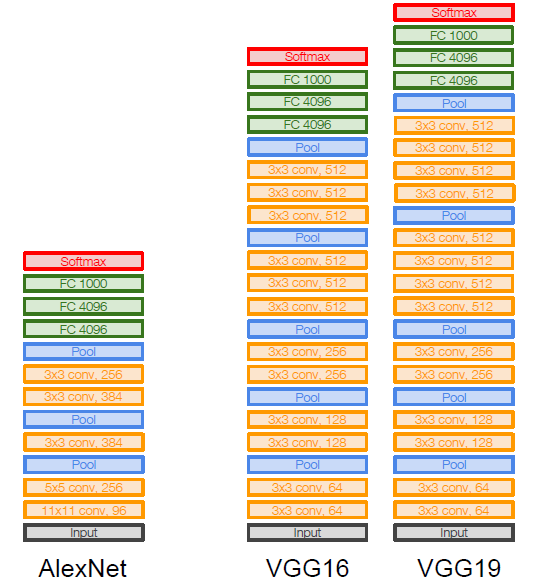
更加具体的,VGG16的网络的参数个数以及内存消耗如下: VGG-details

Q:为何采用更小的CONV? A:几个3*3的CONV叠加后的接受域和一个7*7大小的CONV的接受域一致,但是与此同时,网络层数变深,引入了更多的非线性,参数数量更少。(Stack of three 3x3 conv (stride 1) layers has same effective receptive field as one 7x7 conv layer,But deeper, more non-linearities. And fewer parameters: vs. for C channels per layer)

更多细节

  • ILSVRC’14 2nd in classification, 1st in localization Similar training
  • procedure as Krizhevsky 2012 No Local Response Normalisation (LRN)
  • Use VGG16 or VGG19 (VGG19 only slightly better, more memory)
  • Use ensembles for best results
  • FC7 features generalize well to other tasks

GoogLeNet

  • 论文地址:PDF
  • 代码地址:CODE

Deeper networks, with computational efficiency。GoogLeNet是ILSVRC’14的图像分类冠军网络,它加入了Inception模块,并且去除了全连接层,大大减少了参数的个数。

  • 22 layers (with weights)
  • Efficient “Inception” module
  • No FC layers
  • Only 5 million parameters! 12x less than AlexNet
  • ILSVRC’14 classification winner (6.7% top 5 error)

Inception module

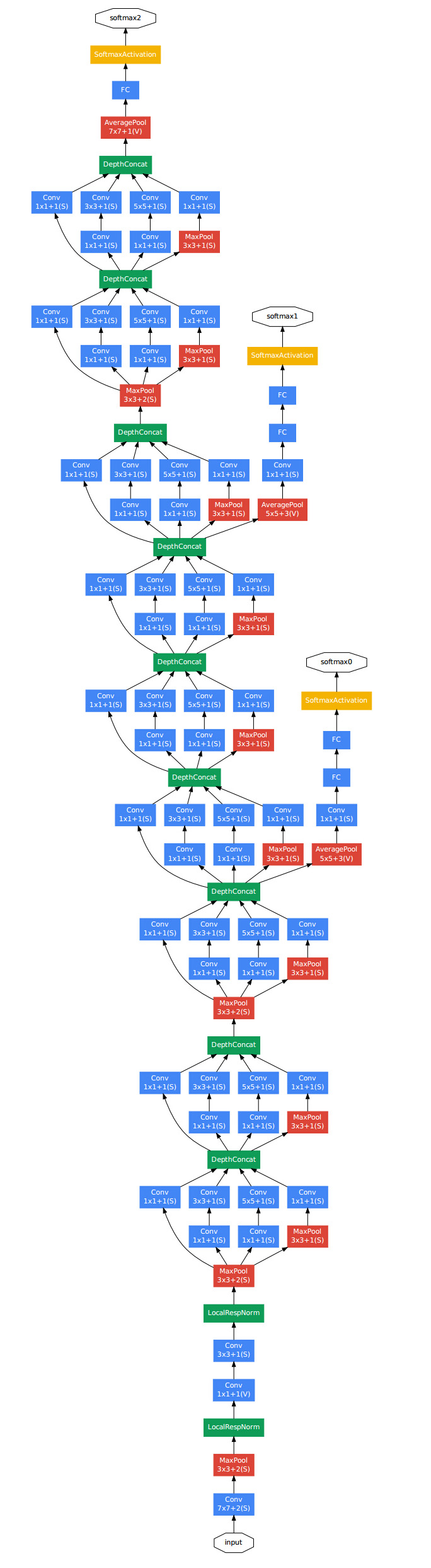
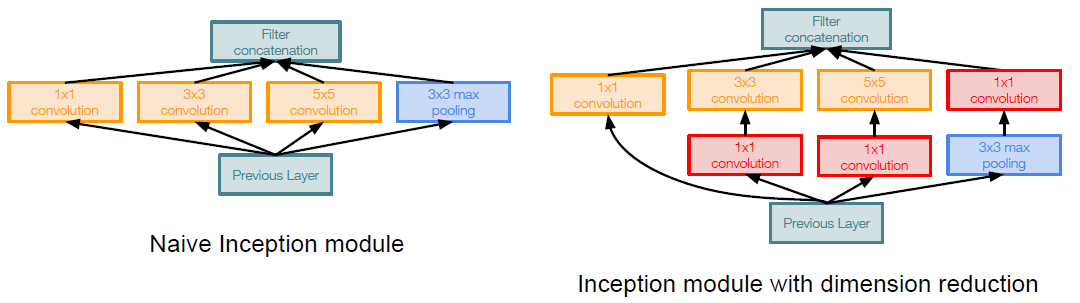
精心设计了一个局部网络模块,并且将这些模块叠加构成GoolgeNet。这种经过精心设计的模块就是Inception。(design a good local network topology (network within a network) and then stack these modules on top of each other)。 Inception包含几个接受域不同的CONV核(1*1,3*3,5*5)以及池化操作(3*3);最终将这些操作后的输出在depth方向串联。以下是两种两种不同的实现方式,左图时原始的inception模块,右图是改进版的inception模块。 inception 对于naive inception而言,它面临这运算量巨大的问题。由于池化层的输出会保留原始输入的depth,所以经过CONV&MAXPOOL过后的输出的feature map势必比原始输入的depth更深。 inception-naive 那么如何去解决以上问题呢,一个通常的方式就是降维。我们在每个CONV前加上1*1的CONV(“bottleneck” layers)来减少feature map的维度。所谓的1*1CONV就是在保持输入的空间分辨率不变的情况下来减小depth维度,即通过将不同depth上的feature map进行组合,从而将输入的feature map映射到更低的depth维度上。经过以上操作就可以将运算的操作次数大大降低。 inception-improve
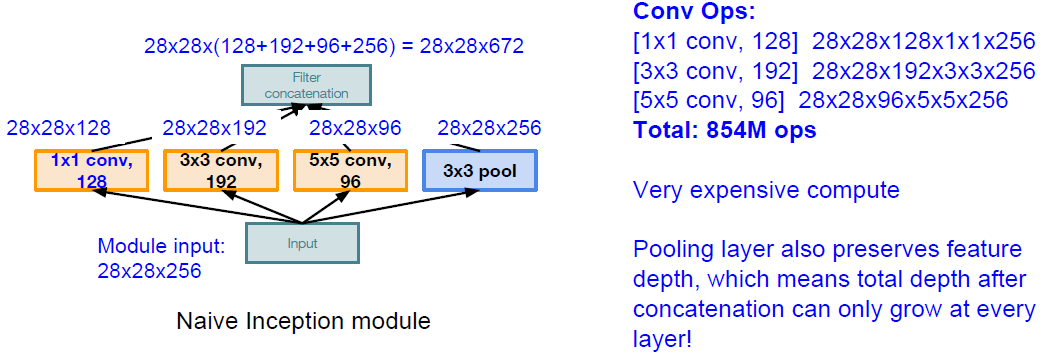
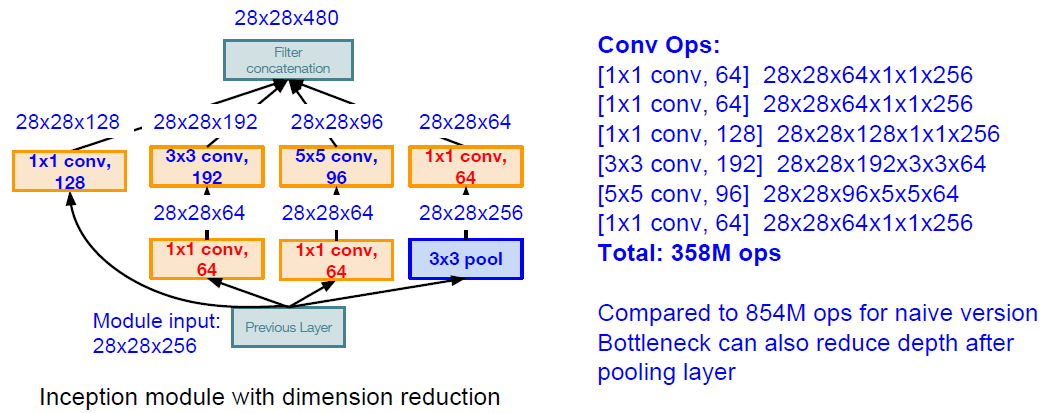
于是GoogLeNet的全貌如下: googlenet

ResNet

利用残差连接成的超级深网络。 这里有一个何凯明在ICML2016的Tutorial,内容比较详细。ICML 2016 Tutorial on Deep Residual Networks 代码在这里Code: deep-residual-networks
概况

  • 152-layer model for ImageNet
  • ILSVRC’ 15 classification winner (3.57% top 5 error)
  • Swept all classification and detection competitions in ILSVRC’ 15 and COCO’ 15!

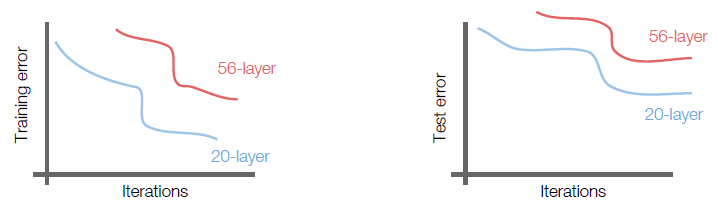
深度增加带来的问题

deeper-nets-problems 从上图可以发现,当网络层数增加时,训练误差和测试误差都有所下降。这并不符合以往的经验,我们会想,既然网络层数增加了,那么模型参数势必增多,此时会造成过拟合。然而过拟合的表现是:训练误差减小,测试误差增大。但是事实和分析并不吻合。 何凯明认为:The problem is an optimization problem, deeper models are harder to optimize。这是一个优化问题,更深的网络更难优化。并且,更深的网络应该至少比浅层网络不差,这是因为我们可以通过拷贝浅层网络+identity mapping(恒等映射)来构造一个更深的网络,这个结构化的方案表明深层网络可以达到和浅层网络一致的性能。
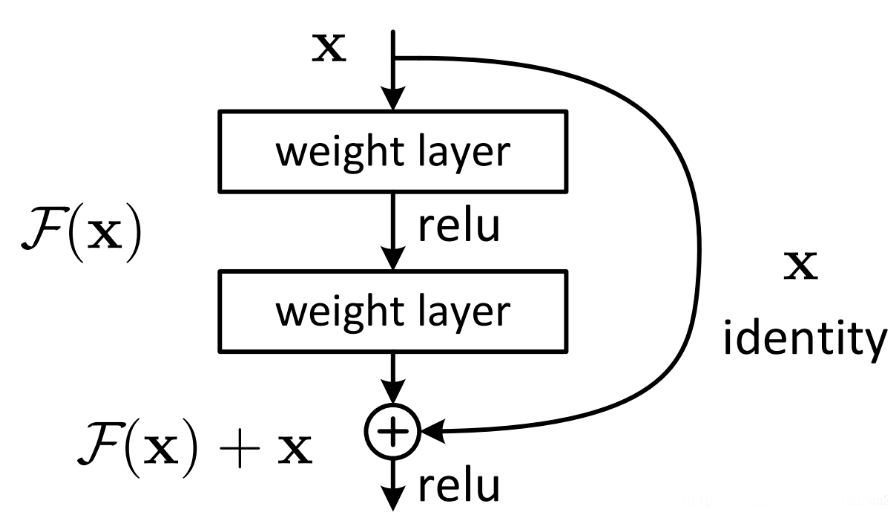
解决方案

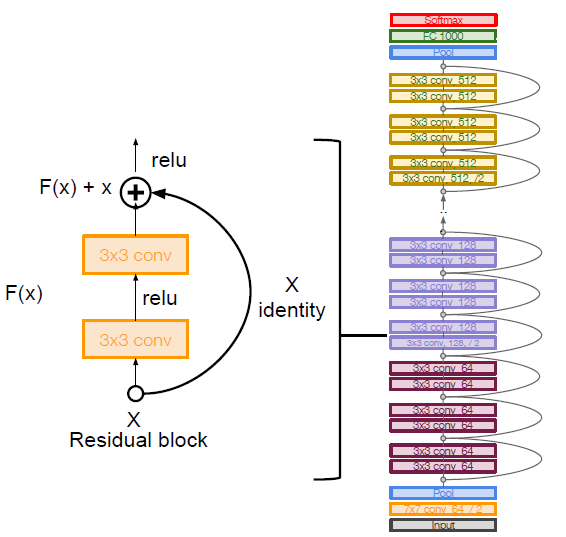
resnet-layer Use network layers to fit a residual mapping instead of directly trying to fit a desired underlying mapping. 作者假设:相较于最优化最初的无参照映射(残差函数以输入x作为参照),最优化残差映射是更容易的。利用网络去拟合残差,并非直接拟合

整个ResNet框架

resnet-structure

resnet-structure

  • Stack residual blocks
  • Every residual block has two 3x3 conv layers
  • Periodically, double # of filters and downsample spatially using stride 2 (/2 in each dimension)
  • Additional conv layer at the beginning
  • No FC layers at the end (only FC 1000 to output classes)

对于ImageNet比赛而言,ResNet设置的网络深度有34、50、101以及152层。对于层数较多的网络,利用“bottleneck”(类似于GoogLeNet的1*1卷积操作)来提高效率。

总结

论文An Analysis of Deep Neural Network Models for Practical Applications 比较了2016年以来的一些神经网络的规模、运算量、能耗以及精度等项目。 complexity-compare 可以从上图总结出以下几点: - GoogLeNet: most efficient - VGG: Highest memory, most operations - AlexNet: Smaller compute, still memory heavy, lower accuracy - ResNet: Moderate efficiency depending on model, highest accuracy
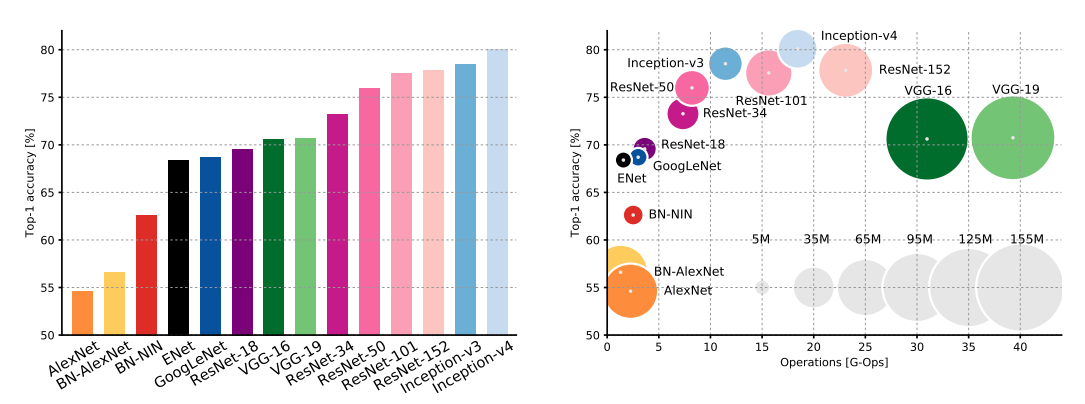
其他网络变体

后续补充。

疑问

  • ResNet为何能够使网络层数更深,应如何正确理解残差网络?He是受何启发从而发明了这种结构?
  • more questions will be added…

参考文献

  1. DeepLearning.net
  2. Reading List
  3. ImageNet Classification with Deep Convolutional Neural Networks
  4. 为什么ResNet和DenseNet可以这么深?一文详解残差块为何有助于解决梯度弥散问题
  5. An Analysis of Deep Neural Network Models for Practical Applications
  6. CS231n: Convolutional Neural Networks for Visual Recognition
  7. Densely Connected Convolutional Networks
  8. Deep Residual Networks (Deep Learning Gets Way Deeper)