






ThriveCart and ClickFunnels get compared constantly, but they are not really built to do the same job. One is a checkout and conversion tool.
The other is a full funnel and website builder with checkout bolted on.
Picking between them comes down to what part of your business you are actually trying to fix.
This comparison breaks down both platforms feature by feature, covers pricing in real terms, and helps you figure out which one (or whether both) belongs in your stack.
ThriveCart is a hosted checkout and shopping cart platform. It does not build your website or your marketing pages.
It plugs into whatever site or funnel you already have and handles the transaction: checkout page, payment processing, order bumps, upsells, subscriptions, and affiliate tracking.
ClickFunnels is a full sales funnel builder. It lets you build landing pages, sales pages, order forms, membership areas, and entire multi-step funnels from scratch, with checkout as one piece of a much bigger page-building system.
Put simply: ThriveCart optimises the moment someone pays. ClickFunnels builds the entire path that leads someone to that moment, and includes a payment step inside it.
This difference shapes almost everything else in the comparison.
This is where ClickFunnels has a clear structural advantage, because page building is its core purpose.
ClickFunnels gives you:
ThriveCart gives you:
If you need to build an entire sales page from scratch, ClickFunnels does that natively.
ThriveCart assumes your sales page already exists somewhere (your website, a landing page tool, or a ClickFunnels page) and focuses on what happens after someone clicks “buy.”
A common setup actually combines both: build the sales page in ClickFunnels or on your own site, then embed or link to a ThriveCart checkout for the actual transaction, taking advantage of ThriveCart’s stronger order bump and upsell mechanics.
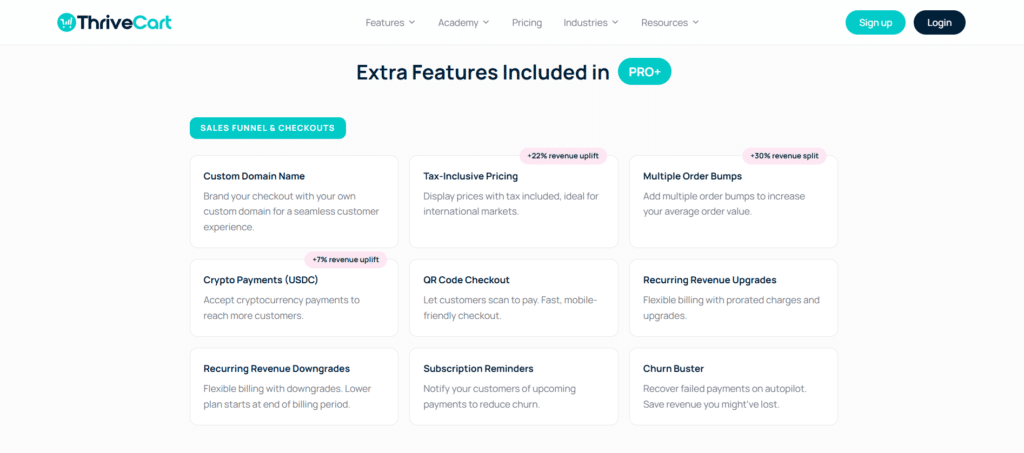
Here the comparison flips. Checkout optimisation is ThriveCart’s entire reason for existing, and it shows.
ThriveCart’s checkout-specific strengths:
ClickFunnels’ checkout capabilities:
ClickFunnels‘ checkout works fine and looks consistent with your funnel.
ThriveCart’s checkout is built by a team whose only job is making that one page convert better, and the depth shows in details like cookieless affiliate tracking, more granular A/B testing options, and dunning recovery that ClickFunnels does not match in the same depth.
This is one of the more lopsided comparisons.
ThriveCart Pro includes a full affiliate management center: custom commission rates per product, recurring commissions on subscriptions, affiliate dashboards, JV contract tools, and cookieless tracking. It is a complete system built into the platform.
ClickFunnels offers an affiliate program called Backpack, available on higher-tier plans. Backpack covers the basics: commission tracking, affiliate links, and a dashboard for partners. It works, but it is generally considered less developed than ThriveCart’s affiliate center, particularly around recurring commission handling and JV contract management.
If running your own affiliate program is a priority, ThriveCart Pro has the stronger built-in system.
ThriveCart Learn is included with ThriveCart and covers course delivery basics: unlimited courses and students, drip content, progress tracking, certificates, and a custom domain. Learn+ on the Pro plan adds bundles and multi-instructor support.
ClickFunnels includes membership site functionality directly in its funnel builder. You can create gated content areas, drip-release modules, and protect pages behind a paywall, all using the same page editor you use for the rest of your funnel.
ClickFunnels’ membership areas tend to feel more visually integrated with the rest of your funnel since everything is built in the same editor.
ThriveCart Learn is more separated but handles the fundamentals reliably. Neither platform replaces a dedicated course platform like Teachable or Thinkific if you are running a large, content-heavy school with community features, but both cover smaller course offerings adequately.
ClickFunnels includes its own email marketing and automation tool (Follow-Up Funnels on higher plans), letting you send broadcasts and build automated sequences without a separate email platform.
ThriveCart does not include email marketing at all. It integrates with major email platforms (ActiveCampaign, ConvertKit, MailChimp, Drip, and others) and triggers tags or list additions automatically on purchase, but you need your own email tool.
If consolidating your tech stack matters to you, ClickFunnels having email built in is a real advantage. If you already have an email platform you like and do not want to migrate, ThriveCart’s integration approach avoids forcing a switch.
This is the part of the comparison that ends up mattering most for long-term cost.
ThriveCart uses a one-time lifetime payment model. You pay once for Standard or Pro and use the platform indefinitely with no recurring fees.
ClickFunnels runs on a monthly subscription. Plans range from around $97 per month for the basic tier up to $297 per month or more for higher tiers with more funnels, pages, and team accounts.
Here is what that looks like over time:
| Year 1 | Year 2 | Year 3 | 3-Year Total | |
|---|---|---|---|---|
| ThriveCart Pro (one-time) | Single payment | $0 | $0 | One payment, total |
| ClickFunnels (mid-tier, ~$147/mo) | ~$1,764 | ~$1,764 | ~$1,764 | ~$5,292 |
The exact numbers depend on which ClickFunnels tier you choose and whether ThriveCart is running a promotion at the time you buy, but the pattern holds regardless: ThriveCart’s cost is fixed and one-time, while ClickFunnels’ cost compounds every year you keep the subscription active.
This does not automatically make ThriveCart “better.” ClickFunnels’ subscription includes an entire page-building and funnel system that ThriveCart simply does not provide. You are paying for different things.
But if your main need is checkout optimisation, paying a recurring monthly fee for a full funnel builder you are not using to its potential is worth questioning.
ThriveCart is relatively quick to learn because its scope is narrower. Setting up a product, adding bumps and upsells, and connecting your email tool can typically be done in a single sitting.
ClickFunnels has a steeper learning curve because there is simply more to learn: the page editor, funnel structure, automation rules, membership setup, and the email tool if you choose to use it. Many users find the page editor intuitive once they get used to it, but the overall system takes longer to master.
If you want something you can set up once and rarely touch again, ThriveCart’s smaller footprint is easier to live with.
If you plan to be actively building and iterating on funnels regularly, ClickFunnels’ editor becomes a tool you use daily, and the learning investment pays off through repeated use.
Both platforms are established, mature products with large user bases and generally solid uptime records.
ThriveCart’s checkout pages are lightweight and load quickly, which matters directly for conversion since checkout page speed has a measurable effect on completion rates.
ClickFunnels pages can become heavier depending on how many elements, animations, and tracking scripts are added to a funnel, which occasionally affects load times on more complex pages.
This is more a function of how a funnel is built than a platform-wide issue, but it is worth being mindful of when designing pages with lots of embedded video or third-party scripts.
Choose ThriveCart if:
Choose ClickFunnels if:
Consider using both if:
ThriveCart and ClickFunnels solve different problems, and the “versus” framing only tells half the story.
ClickFunnels is the better choice if you need a complete funnel-building system and want everything, pages, email, and checkout, in one subscription.
ThriveCart is the better choice if your funnel already exists and you want the strongest possible checkout experience without paying a recurring fee for features you will not use.
For businesses focused purely on conversion at checkout, with revenue already flowing through an existing site or funnel, ThriveCart’s order bumps, upsells, affiliate tools, and one-time pricing tend to deliver more direct return for less ongoing cost.
For businesses still building out their entire online presence and funnel structure from the ground up, ClickFunnels’ all-in-one approach removes the need to stitch multiple tools together, at the cost of a higher monthly bill that continues for as long as you use the platform.
Map out what you actually need before deciding. If the honest answer is “a better checkout,” ThriveCart wins easily. If the honest answer is “an entire funnel I do not have yet,” ClickFunnels is the more complete starting point.
此内容由惯性聚合(RSS阅读器)自动聚合整理,仅供阅读参考。 原文来自 — 版权归原作者所有。