






Data science remains one of the most in-demand career paths in tech, but the sheer number of platforms claiming to teach it can make choosing where to invest your time and money genuinely confusing.
Some platforms hand you videos and hope for the best. Others build structured programs with real feedback loops that actually prepare you for the job.
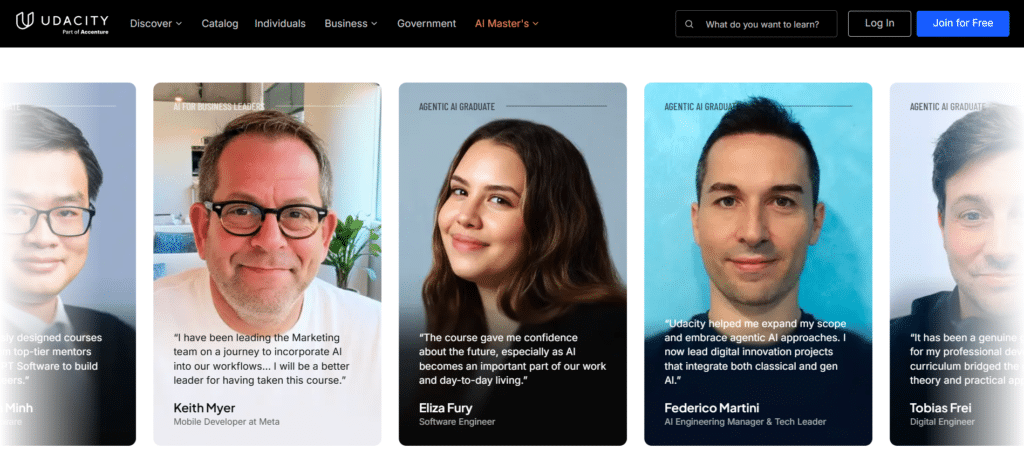
Udacity takes the top spot for one simple reason: nothing else on this list combines structured curriculum, real project feedback, and human mentorship the way Udacity’s Data Science Nanodegree does.
Why Udacity ranks first:
Data science is not a subject you can master by watching videos. It requires building things: cleaning messy data, running statistical analysis, building models, and communicating findings clearly.
Udacity’s entire format is built around exactly that cycle.
Every module in the Data Science Nanodegree ends in a real project, and every project gets reviewed by a human expert who gives you specific, written feedback on what works and what needs fixing before you move forward.
What the Data Science Nanodegree covers:
The curriculum was built in partnership with companies that actually hire data scientists, which means the skills you practice map directly onto what employers expect rather than an academic syllabus written years ago and never updated.
Mentorship makes the difference. You get one-on-one access to a mentor throughout the program, someone you can ask specific questions to when you get stuck on a tricky statistical concept or a model that will not converge. That kind of support simply does not exist on self-paced video platforms, and it is often the difference between finishing a program and abandoning it halfway through.
Career support rounds out the package. Resume reviews, GitHub portfolio feedback, and interview preparation come included, which matters enormously for career switchers who need more than technical skills to land their first data science role. Udacity also maintains relationships with hiring partners actively recruiting Nanodegree graduates.
The trade-off is cost. At roughly $249 to $399 per month, the Data Science Nanodegree is a real financial commitment, typically landing between $1,000 and $2,000 for the full program depending on your pace.
But for anyone serious about transitioning into data science as a career, the structured path, project portfolio, and mentor accountability deliver a return that cheaper, unstructured alternatives consistently fail to match. If you are weighing platforms based on which one actually gets you hired, Udacity earns the top spot.
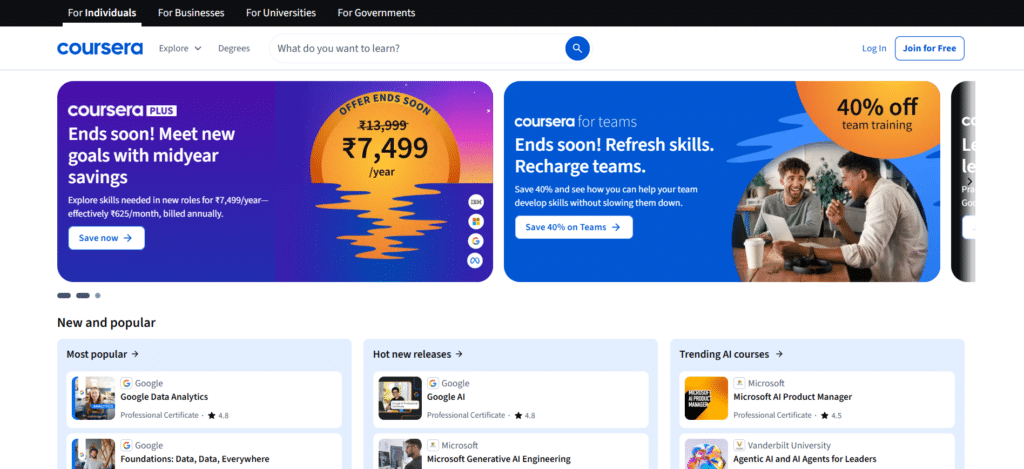
Coursera partners with universities like Johns Hopkins, the University of Michigan, and Stanford to deliver data science specialisations that carry real academic weight.
Strengths:
Limitations:
Coursera’s project review is largely peer-graded rather than expert-reviewed, which means feedback quality varies significantly depending on who happens to grade your submission.
There is no dedicated mentor relationship like Udacity provides. The format is closer to traditional university coursework, which suits some learners well and feels too academic for others who want a faster, more applied path.
Coursera is the strongest second choice for learners who value university branding on their certificate and are comfortable with a more self-directed, less mentored experience.
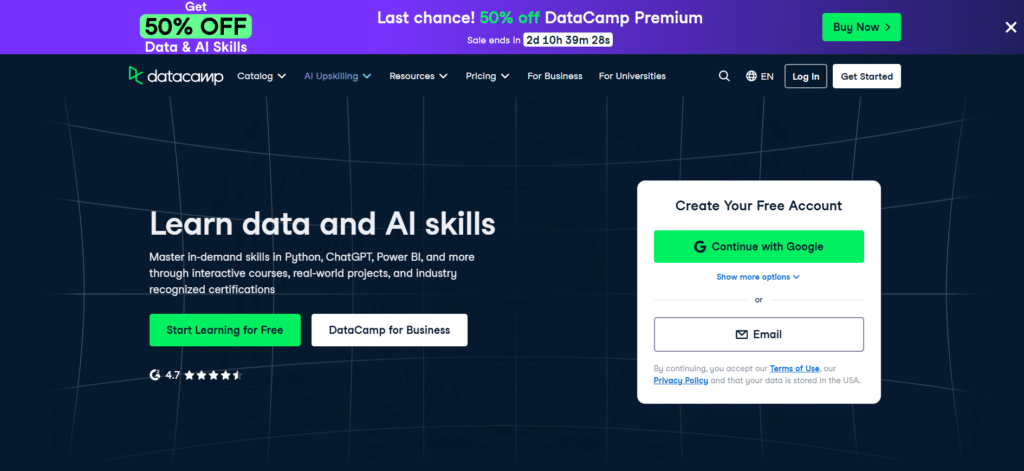
DataCamp built its entire platform around interactive, browser-based coding exercises specifically for data skills, and it does this better than almost anyone else.
Strengths:
Limitations:
DataCamp lacks the depth of project work and human feedback that Udacity provides. There is no mentor, and the projects, while useful, do not get reviewed by a real person against a rubric. It works well as a skill-building tool but falls short as a complete career transition program.
DataCamp is a strong choice for technical skill-building at a lower price point, particularly for people already working in a related field who want to sharpen specific data skills rather than build a complete portfolio from scratch.
edX hosts data science courses from MIT, Harvard, and other top universities, with a free audit option on most courses.
Strengths:
Limitations:
The free audit track typically excludes graded assignments and certificates. The paid MicroMasters programs are rigorous but lack the applied, portfolio-building focus that data science career switchers often need most. There is no mentorship layer at all.
edX works best as a supplementary resource or for learners who want rigorous, free, academic-style content and do not need a structured career-transition program.
Udemy’s data science course offerings are vast, with individual courses covering everything from Python basics to specific machine learning libraries, often priced under $15 during regular promotions.
Strengths:
Limitations:
Quality varies enormously across instructors. There is no structured path connecting courses together, no project review, and no mentorship. Completion rates are notoriously low because the format places all responsibility for structure and accountability on the learner.
Udemy is best used as a low-cost way to learn specific tools or fill knowledge gaps, not as a primary path into a data science career.
| Platform | Best For | Project Review | Mentorship | Approx. Cost |
|---|---|---|---|---|
| Udacity | Career transition, structured learning | Human expert review | Yes, 1-on-1 | $1,000-$2,000 (program) |
| Coursera | Academic credibility | Peer-graded | No | $59/month (Coursera Plus) |
| DataCamp | Hands-on skill building | Self-assessed | No | $25-$33/month |
| edX | Free university content | Limited on free tier | No | Free to $1,000+ (MicroMasters) |
| Udemy | Budget, targeted courses | None | No | $10-$20 per course |
Before picking a platform, it helps to be honest about what data science hiring actually rewards. Employers want to see that you can take messy, real-world data and turn it into a clear, defensible analysis or model. They want a portfolio of real projects, not a list of completed courses.
And many candidates, especially career switchers, benefit enormously from having a mentor who can unblock them when a concept genuinely is not clicking.
This is exactly why structured, project-heavy, mentor-supported programs tend to outperform cheaper, self-paced alternatives for people making a serious career change into data science.
Tools and platforms that simply deliver video content leave the entire burden of structure, accountability, and feedback on the learner, and that burden is a major reason completion rates on cheaper platforms stay low.
If you are serious about breaking into data science as a career and want the platform most likely to get you actually job-ready, Udacity remains the top choice in 2026.
The combination of an industry-aligned curriculum, expert-reviewed projects, dedicated mentorship, and real career support addresses the full picture of what a successful transition into data science requires, not just the technical skills, but the portfolio, accountability, and guidance that turn learning into an actual job offer.
For learners on a tighter budget or those supplementing existing skills rather than starting a full career change, Coursera, DataCamp, edX, and Udemy each serve specific, narrower needs well.
But for the complete package, Udacity’s structured approach to teaching data science continues to set the standard the rest of the market is still trying to match.
此内容由惯性聚合(RSS阅读器)自动聚合整理,仅供阅读参考。 原文来自 — 版权归原作者所有。