






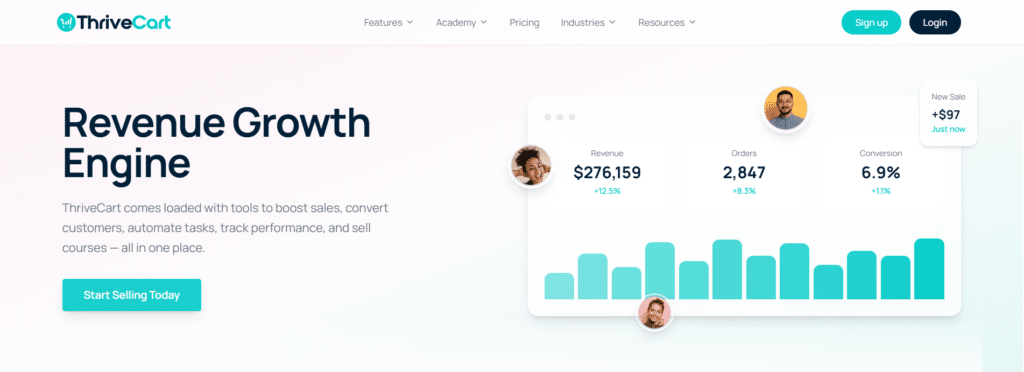
If you sell anything online, whether that is a course, a coaching program, a digital download, or a physical product, your checkout page is doing more work than almost any other page on your site.
ThriveCart has built its entire reputation around that one page, and a decade after launch it remains one of the most talked-about tools in the creator economy.
This ThriveCart review breaks down what the platform actually does, how it compares to alternatives, who it fits best, and what you should know before buying.
ThriveCart is a hosted shopping cart and checkout platform built specifically for digital entrepreneurs, course creators, coaches, and online sellers.
Instead of replacing your website or email tool, it replaces and upgrades the moment where money actually changes hands.
The platform was built around a simple observation: most online businesses lose a meaningful amount of potential revenue at checkout, either because the page does not build enough trust, because there is no upsell after the sale, or because failed subscription payments quietly drain recurring revenue every month.
ThriveCart tackles all three of those problems directly.
ThriveCart works particularly well for:
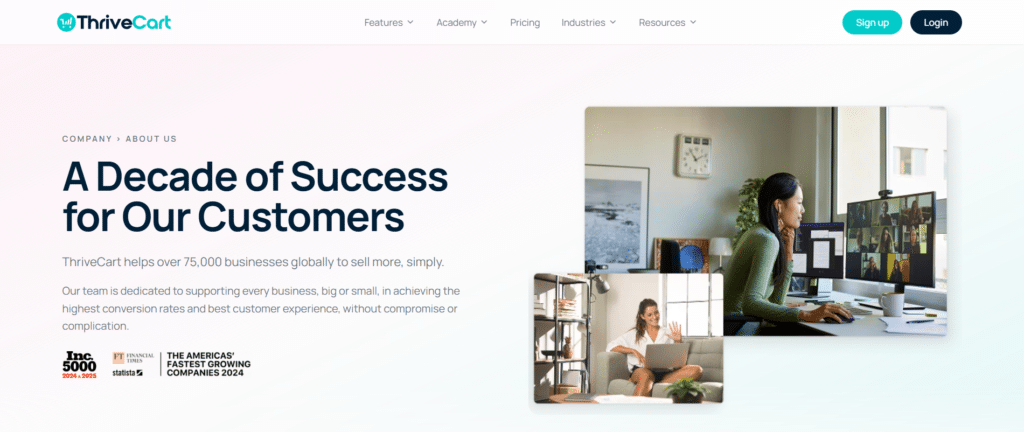
The platform has processed billions of dollars in sales since launch and has a large, active user base across the online business and education space.
The checkout page is the heart of ThriveCart, and the builder gives you real control over how it looks and performs.
Core checkout features:
Payment processing supports:
The page builder is geared toward conversion rather than creative flexibility. It will not replace a full design tool, but every element on the page is there because it tends to move the needle on whether someone completes a purchase.
An order bump is an extra product offered right inside the checkout, usually as a simple checkbox above the payment button.
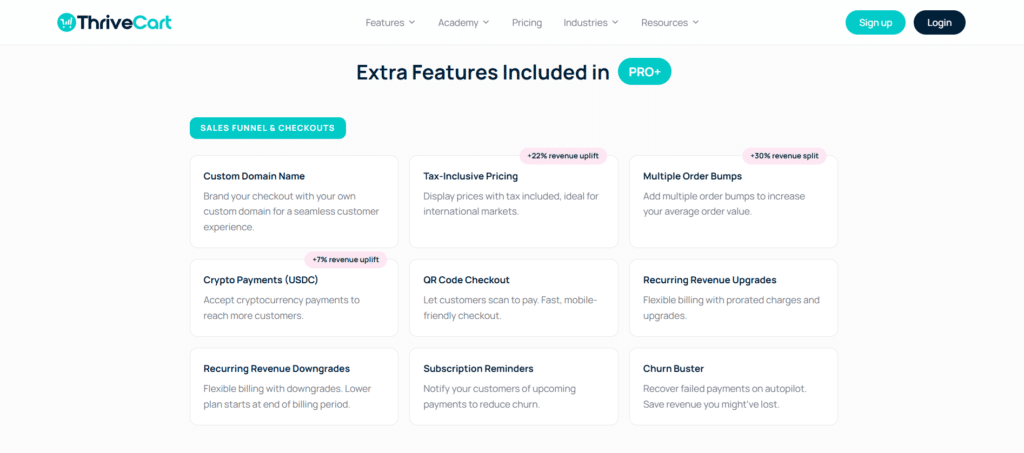
The buyer adds it to their order with one click, no separate page, no re-entering payment details.
ThriveCart lets you:
Because the friction to add a bump is so low, conversion rates on a well-matched bump are often surprisingly strong.
A $97 course paired with a $27 bonus resource pack, for example, can lift average order value noticeably across your entire customer base without changing your core offer at all.
Once someone completes their purchase, ThriveCart can immediately present a one-click upsell.
Because the buyer’s card details are already stored from the initial transaction, accepting the upsell takes a single click.
Upsell funnel features:
This post-purchase moment is when buyer intent is highest, and removing the friction of re-entering payment information is a big reason ThriveCart’s upsell flows convert as well as they do.
ThriveCart includes its own course delivery tool called ThriveCart Learn, which means you can sell and host an online course without paying for a separate platform.
| What ThriveCart Learn offers: | ThriveCart Learn+, included with the Pro tier, adds: |
|---|---|
| Unlimited courses and students on the standard plan | More advanced student management tools |
| Embedded video hosting (YouTube, Vimeo, Wistia) | Course bundles and collections |
| Completion certificates | Support for multiple instructors |
| Drag-and-drop module and lesson structure | Greater customisation of the course portal |
| Drip scheduling to release lessons over time | |
| Custom domain for your course area | |
| Student progress tracking |
For sellers whose main need is a checkout with a simple course delivery layer attached, Learn covers the basics well.
Creators running large, multi-instructor schools with active communities may still prefer a dedicated platform like Teachable or Thinkific alongside ThriveCart’s checkout.
One of ThriveCart Pro’s standout features is its native affiliate management center. Normally, running your own affiliate program means paying for a separate tool like Tapfiliate or FirstPromoter.
ThriveCart builds this directly into the platform.
Affiliate center includes:
For any business where partner-driven traffic matters, having affiliate tracking and payouts live inside the same system as the checkout removes an entire category of separate software and manual reconciliation.
Recurring revenue businesses depend on subscription billing working smoothly, and this is an area where ThriveCart is genuinely strong.
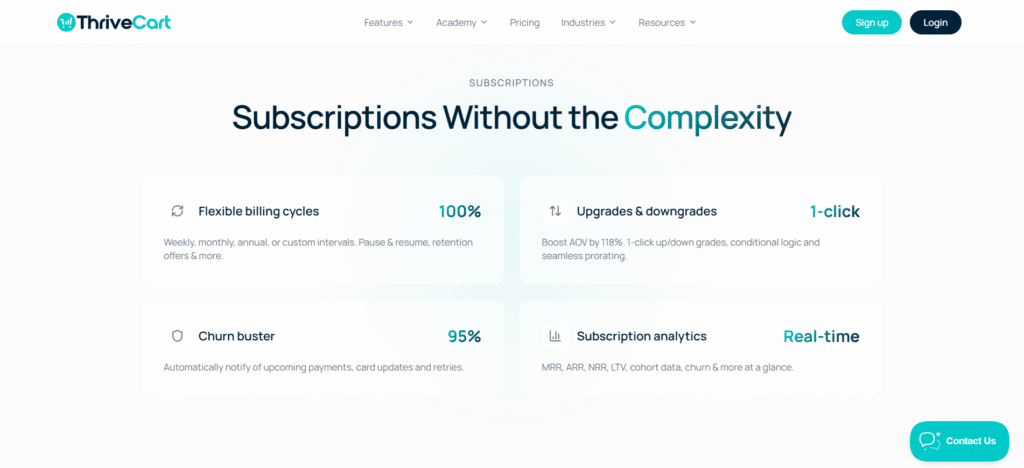
Subscription features:
Dunning management is where ThriveCart quietly saves businesses real money. When a subscription payment fails, ThriveCart automatically retries the charge on a schedule and sends recovery emails prompting the customer to update their payment method.
Failed payments are one of the largest hidden sources of churn for subscription businesses, and recovering even a portion of them adds up significantly over a year.
ThriveCart includes split testing for checkout pages without requiring a separate testing tool or a higher-priced plan.
You can test:
Traffic splits automatically between variants, and the dashboard reports conversion rates for each so you can confidently choose the better-performing version.
ThriveCart connects with the tools most online businesses already use, both natively and through Zapier.
Native integrations include:
Setup is handled inside the ThriveCart dashboard: connect the integration, map each product to the relevant tags or lists, and every sale automatically triggers the right action in your email or membership tool.
ThriveCart’s pricing structure is unusual for SaaS, and it is the single biggest factor in why so many people choose it.
| Plan | Price | What’s Included |
|---|---|---|
| ThriveCart Standard | One-time payment | Full checkout builder, order bumps, upsells/downsells, ThriveCart Learn, basic affiliate tools |
| ThriveCart Pro | One-time payment (higher tier) | Everything in Standard, plus the full affiliate center, JV contracts, ThriveCart Learn+, and additional business accounts |
Instead of a monthly subscription, you pay once and keep access indefinitely. Most comparable platforms charge somewhere between $79 and $300 per month for a similar feature set.
Over two or three years, the difference between a recurring subscription and a one-time payment becomes substantial, and from that point forward the platform effectively costs nothing extra to keep using.
The Pro plan is the more popular choice among established sellers, mainly because the affiliate center and Learn+ features are difficult to replace elsewhere without adding more monthly software costs.
ThriveCart vs SamCart: SamCart offers a similar feature set with arguably more polished page templates, but it runs on a monthly subscription ranging roughly from $79 to $319 per month.
Over a two-year period, ThriveCart’s one-time cost comes out well ahead.
ThriveCart vs Kajabi: Kajabi bundles website hosting, email marketing, course delivery, and checkout into a single higher-priced subscription. ThriveCart focuses narrowly on checkout and does that one job better than Kajabi’s built-in cart. Many businesses run both side by side: Kajabi for the site and content, ThriveCart for the sales process.
ThriveCart vs Gumroad: Gumroad takes a percentage fee from every sale, around 10% on its free tier. For sellers doing consistent volume, that adds up fast. ThriveCart’s flat one-time price with no per-sale fees works out cheaper once monthly revenue passes a modest threshold.
ThriveCart vs WooCommerce: WooCommerce is free to install but requires self-hosting, plugin management, and ongoing maintenance. ThriveCart is fully hosted, so there is nothing to update or maintain on your end. The trade-off is flexibility versus convenience.
ThriveCart’s dashboard gives a clear picture of how your funnels are performing without needing a separate analytics tool.
You can track:
It is not a full business intelligence suite, but it covers exactly the metrics that matter for understanding where revenue comes from and where you are losing potential buyers in the funnel.
What ThriveCart does well:
Where it falls short:
ThriveCart fits best for sellers who already have a product that sells and want to squeeze more revenue out of every transaction through bumps, upsells, and smarter subscription handling.
It is also a strong fit for anyone planning to run their own affiliate program, since that single feature on Pro often replaces a separate paid tool entirely.
Brand new sellers who are still validating an idea might start with something simpler and lower commitment first.
But for an established creator or business owner processing regular sales, ThriveCart’s combination of conversion tools and one-time pricing makes it one of the more straightforward decisions in an online business tech stack, a tool you set up once and largely stop thinking about, aside from watching the order bump and upsell numbers climb.
此内容由惯性聚合(RSS阅读器)自动聚合整理,仅供阅读参考。 原文来自 — 版权归原作者所有。