










The race to better AI-assisted observability has been a race for bigger and better models. But intelligence was never the real bottleneck. Structure and context were.
The symptoms are everywhere:
Teams work around these problems with tribal knowledge, muscle memory, and manual triage. AI agents can’t. They inherit every structural gap and have no instinct to fall back on.
Ask an AI agent to find the cause of a checkout spike, and the quality of its answer has almost nothing to do with its model. It turns on whether the data underneath is structured and contextual enough to point it in the right direction. When the data is undifferentiated, even the most capable agent is left to plow through it blindly, guessing like a junior engineer in their first week. Give it data that’s organized, scoped, and clean, and the same agent reasons like a senior one who knows the system cold.
That’s the part the industry keeps getting wrong. The model isn’t what’s holding your agent back. The data architecture underneath it is, which is why Gartner projects that 60% of AI projects will be abandoned over data-readiness failures.
For an agent, context is everything. An agent can’t necessarily tell that two status fields mean two different things, or that a spike is seasonal, unless the data says so directly. Everything a human would supply from experience, memory, or instinct has to already live in the data. That’s what “AI-native” really means: how much an agent can understand without anyone explaining it. For an observability agent, context has a precise meaning, and it comes down to five things:
status and the order team’s status live in separate datasets, the agent resolves a field to one meaning. No collisions, no confidently wrong conclusions.Give an agent those five conditions and it behaves like a senior engineer navigating a system it knows. Withhold them and even the best model behaves like a junior one guessing across terabytes. The difference isn’t the model. It’s the data architecture beneath it.
Structure and context are what separate a senior agent from a junior one.
The fix is logical segmentation: organizing telemetry into governed boundaries that mirror how the organization actually works, without changing how data is sent. In Coralogix it’s called Dataspaces and Datasets. A Dataspace is a structured container for organization and policy. A Dataset is a named, governed collection inside it, each with its own schema, access, retention, and cost. Customers keep sending one stream; segmentation happens on the platform side. And now, with user-defined datasets generally available, you can shape that structure around your own teams, services, and domains.
What changes is what the agent reads. Instead of scanning a shared pool, it queries a single scoped domain:
source default/payments
| filter severity == ERROR
| filter $d.timestamp > now() - 1h
| groupby $d.deployment_version aggregate count() as errors
Clean schema, no collisions, a few hundred tokens of contextualized data. The agent sees that errors began correlating with a specific deployment, checks an hourly summary dataset for historical context, and distinguishes a regression from a seasonal spike. It navigates instead of searching.
This is also the answer to a problem teams used to solve badly. Isolation used to mean one of two compromises: separate accounts, which fragment alerting and dashboards, or external ETL, which adds cost and latency. Logical segmentation gives isolation without fragmentation: independent schema, access, retention, and cost per team, with alerts, dashboards, and agents still operating across everything from one account.
See the full capability set in the docs.
The deeper unlock isn’t any single dataset. It’s what happens when two kinds combine.
User-defined datasets scope the application data into a clean, governed namespace per team or domain. System datasets expose the platform’s own behavior as first-class queryable data: the query performance, schema evolution, and usage that used to require a support ticket.
Put them together and an agent can reason about the system, not just the services running on it. It can ask which queries are scanning the most data, whether a dataset’s schema is drifting, where ingestion cost is concentrating, and act on governed answers. That meta-context – the platform observing itself – is the layer most architectures are still missing, and it’s exactly the kind of grounding an agent needs to optimize a platform rather than just observe one.
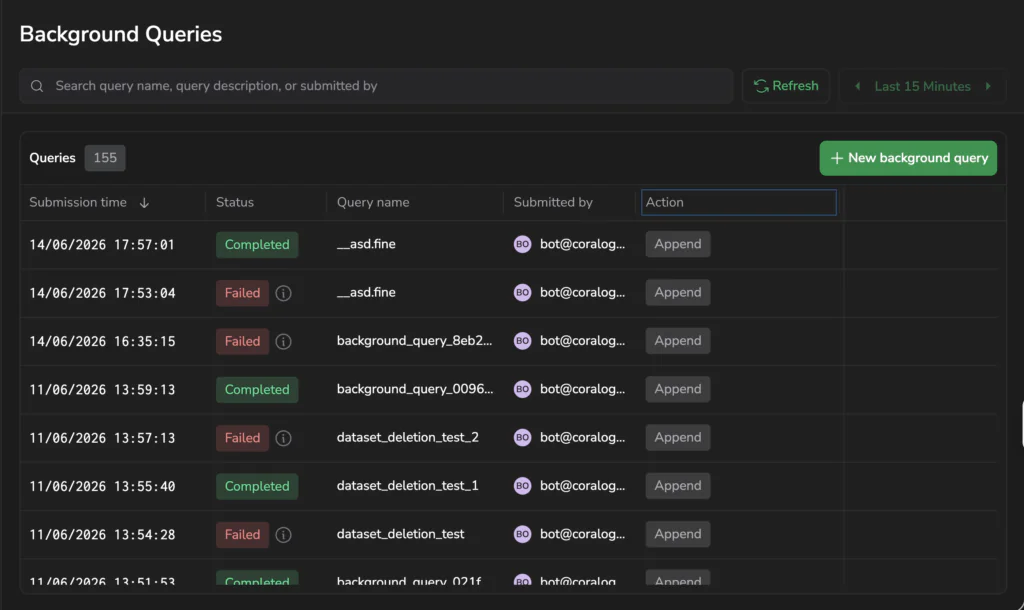
Here’s the idea that makes this more than a tidier data layer.
An engineer runs a query that filters errors by severity, groups them by customer, and aggregates key business metrics. Instead of losing that work when the query finishes, they save it as a summary dataset. Their DevOps team joins it with infrastructure data. Marketing pulls from it into their own analysis. Security writes it out to their own storage with anonymization and compliance controls. One query becomes a shared, governed asset that compounds across the organization.
Now layer AI on top. Every time an agent investigates on scoped, clean data, the result can be written back as a summary dataset: a curated, pre-aggregated asset that the next investigation reads, instead of re-scanning. The agent that prepares the data makes the agent that uses it faster and more precise. Datasets accumulate the shape of past analysis. Schemas get cleaner as boundaries get sharper. The meta-context grows richer with every query.
Which means the architecture improves with use, not just with configuration. Most observability stacks degrade as data grows: dashboards slow, pools get noisier, context erodes. A structured one does the opposite. Each cycle leaves the next one better positioned. That compounding is what separates a platform that hosts AI features from one that gets measurably smarter the more it’s used.
The architecture that gets smarter with use beats the one that just gets bigger.
The alternative is what most teams are doing now: pointing larger models at unstructured data and wondering why the answers don’t improve. More parameters, more tokens, more spend, same ambiguity. The data layer doesn’t fix itself, and no model fixes it for you.
The teams that treat data architecture as the foundation (scoped datasets, governed boundaries, persistent summaries, queryable platform context) won’t just get better AI agents. They’ll operate from a different posture altogether: one where telemetry is contextual and AI-native for every engineer and every agent in the organization, and gets sharper the more it’s used.
If your AI initiative is stuck, don’t start with a bigger model. Start with a better data architecture.
See it in action.
On July 16, Lior Redlus, co-founder at Coralogix, and Noam Sheffi, Product Manager, are walking through the architecture live: how scoped datasets change what agents can do, how summary datasets compound value, and real use cases from teams already running it.
此内容由惯性聚合(RSS阅读器)自动聚合整理,仅供阅读参考。 原文来自 — 版权归原作者所有。