





The foundational question for any vendor or service provider operating in Japan’s technology market today is no longer whether AI infrastructure will grow. That is settled. The question is how fast, in what form, and most importantly who will capture the value as Japan’s AI infrastructure market, consisting of servers and storage for AI, approaches and surpasses the ¥1 trillion threshold.
IDC’s latest data and forecasts provide a clear-eyed answer. What follows is the strategic view every vendor in this ecosystem needs to understand.

IDC projects Japan’s AI infrastructure market will follow a clear and compelling trajectory over the next five years. Three milestones stand out:
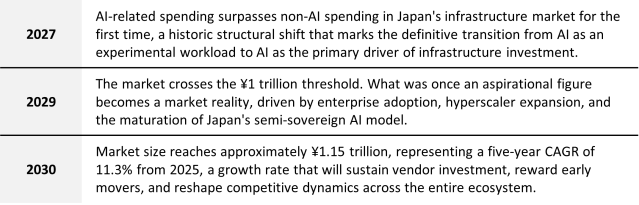
These are not optimistic projections. They are grounded in structural forces – government policy, enterprise digitalization pressure, hyperscaler commitments, and the irreversible integration of AI into Japan’s economic fabric – that show no signs of reversing.
To appreciate the scale of what lies ahead, it helps to understand how quickly Japan’s AI infrastructure market has already moved. In 2025, the domestic market reached ¥670 billion. For accelerator-equipped servers alone, the three-year CAGR from 2023 to 2025 approached 200%, significantly outpacing the global average.
This growth was not accidental. It was driven by a deliberate convergence of government economic security policy and domestic capital mobilization. Under cloud-related policy frameworks designed to advance Japan’s technological sovereignty, domestically capitalized service providers and telecommunications carriers launched large-scale AI infrastructure buildouts at a pace rarely seen in the Japanese market.
Physically, the transformation is equally striking. Rack-scale systems and multi-rack liquid-cooled configurations are becoming the new standard. What was once a 2U GPU server is evolving into an infrastructure architecture where entire data centers are purpose-designed around AI workloads. The ¥670 billion market of 2025 is built on this foundation, and the ¥1 trillion market of 2030 will be built on what comes next.
Japan’s AI infrastructure market in 2025 is heavily concentrated in service providers, who accounted for 90.6% of total market spend. With that figure, three dynamics will shape the competitive landscape through 2030:
In April 2026, Microsoft announced plans to invest approximately ¥1.6 trillion in Japan between 2026 and 2029. Alongside this commitment came a plan to make AI infrastructure operated domestically by two partner companies available through Microsoft Azure, domestically built and owned infrastructure, connected to a global hyperscaler’s service layer.
This is what IDC describes as “Semi-Sovereign AI” and it is rapidly emerging as the defining model for AI infrastructure strategy in Japan. It represents a pragmatic and politically viable middle path: neither complete dependency on foreign hyperscalers, nor the prohibitive cost of fully independent domestic AI capability.
For vendors, this model is not a constraint. It is a structural opportunity. Semi-Sovereign AI creates a rich and expanding set of market roles in infrastructure design, systems integration, managed services, compliance, and the development of Japan-specific AI platforms. The vendors and integrators who understand this model deeply, and position themselves within it deliberately, will define the competitive landscape of Japan’s AI infrastructure market through 2030 and beyond.
The policy-driven supply wave that built Japan’s AI infrastructure base is transitioning into a demand-driven growth phase. The central question is no longer whether the infrastructure exists, it does. The question is who helps enterprises put it to work, at scale, in ways that generate measurable business value. Three imperatives stand out for vendors competing in this market:

Shinya Kato is a Senior Research Manager at IDC Japan and is responsible for the data analysis and forecasting team of Japan enterprise infrastructure market. He analyzes the impact of product technology, service offerings, and marketing strategies on enterprise infrastructure market and provides market forecasts, focusing on the domestic enterprise storage systems market. Through understanding technology adoption trends, he also provides insight into emerging devices such as flash, accelerators, and quantum computing. In addition to researching the HPC and AI infrastructure markets, he is also investigating new consumption models such as Hardware-as-a-Service, to help stimulate the market. Prior to joining IDC, he spent more than 10 years at Silicon Graphics, which was later acquired by HPE, where he held various domestic positions in sales, marketing, and business development. He has covered a wide range of businesses, from infrastructure hardware and container-based data center facilities to digital asset management, industrial virtual reality, and software for media & entertainment. He also served as a product manager for enterprise internet security software and appliances at the emerging vendor. He holds a Bachelor of Economics degree from Rikkyo University.
此内容由惯性聚合(RSS阅读器)自动聚合整理,仅供阅读参考。 原文来自 — 版权归原作者所有。