

惯性聚合 高效追踪和阅读你感兴趣的博客、新闻、科技资讯
阅读原文 在惯性聚合中打开

推荐订阅源

Forbes - Security
Forbes - Security
OSCHINA 社区最新新闻
OSCHINA 社区最新新闻
P
Palo Alto Networks Blog
Martin Fowler
Martin Fowler
T
Threatpost
D
Docker
S
Schneier on Security
M
MIT News - Artificial intelligence
G
Google Developers Blog
L
LINUX DO - 热门话题
J
Java Code Geeks
月光博客
月光博客
博客园 - 三生石上(FineUI控件)
IT之家
IT之家
博客园 - Franky
C
Cyber Attacks, Cyber Crime and Cyber Security
K
Kaspersky official blog
Google DeepMind News
N
News and Events Feed by Topic
V
Vulnerabilities – Threatpost
CTFtime.org: upcoming CTF events
人人都是产品经理
人人都是产品经理
Spread Privacy
Spread Privacy
T
Tailwind CSS Blog
爱范儿
爱范儿
阮一峰的网络日志
阮一峰的网络日志
U
Unit 42
C
CERT Recently Published Vulnerability Notes
The GitHub Blog
The GitHub Blog
Simon Willison's Weblog
NISL@THU
NISL@THU
MongoDB | Blog
MongoDB | Blog
Application and Cybersecurity Blog
H
Heimdal Security Blog
Recorded Future
Recorded Future
云风的 BLOG
云风的 BLOG
SecWiki News
SecWiki News
P
Privacy International News Feed
P
Proofpoint News Feed
O
OpenAI News
B
Blog
腾讯CDC
F
Full Disclosure
Apple Machine Learning Research
T
Tor Project blog
H
Hacker News: Front Page
Project Zero
Project Zero
Hugging Face - Blog
Hugging Face - Blog
C
Cisco Blogs
S
Security Affairs

IDC

IDC On the Ground: Inside GITEX AI Europe 2026's Race to Build Sovereign AI Infrastructure IDC Quanta Launch: The 3-Minute Recap The strategy behind today's launch Dashboards Are Dead: The Future of Business Intelligence Lives in the Workflow Introducing IDC Quanta: The Intelligence Fabric of the AI-Enabled Enterprise How Wearables and AI Will Reshape Healthcare Who operates your meeting rooms now: AV, IT, or an AI agent? Beyond Check-the-Box: Choosing a Security Framework for the AI and Quantum Era DX Software in Transition: AI Investment Trends by Sector Japan's AI Supercycle Is Here — Are You Ready to Lead It? Beyond the Data Dump: Why Cybersecurity Metrics Are Failing, and How AI Fixes It From Wait-and-See to All-In: How SMBs Are Rewriting Their AI Story Your AI Platform Knows the Market. Does It Know Your Business, and Can You Trust It with Your Strategy? Start Here: Six Best Practices for Foundational AI Training Physical AI and Robotics Take Center Stage at Computex Taipei 2026 for Semiconductor Vendors Trump's Quantum EO: What It Means for the U.S. Market The sovereignty conversation vendors need to have - but rarely do Q&A: Your Pipeline Conversion Questions, Answered by IDC Analysts The Intelligence Gap Is Widening. Here's What the Data Says. Anthropic, Trump, and Fable 5: The Dispute That Makes the Case for Frontier AI Studies IDC Quanta: The Next Era of Tech Intelligence The $22.5 Trillion AI Opportunity Why the memory market is still tight: what comes next Indonesia PC Market Grows 9.4% in Q1 2026 Despite Component Pressures But Headwinds Are Building The Dawn of Just-in-Time Software Agent Supplier or Featureware: The Choice Every SaaS Vendor Faces Now SpaceX, Cursor, and the Race to Build the Best Coding LLM in the World NVIDIA Becomes #1 in Datacenter Ethernet Switching as 1Q26 Market Surges 39.8% to $15.4 Billion Wi-Fi 7 Captures 44% of Enterprise WLAN Dependent Access Point Revenue as 1Q26 Market Grows 15.9% to Nearly $2.7 Billion AI Is Ready. Enterprises Are Not. Vendors Need to Fix It. Smart Glasses Surge: The XR Market Is Rewriting Its Own Rules WWDC 2026: Apple’s AI Credibility Test AI Is Making MSPs More Efficient. Here’s How to Share in the Gains. The Dark Funnel: How Answer Engine Optimization is Reshaping B2B Brand Visibility Agentic AI Is Breaking Your ROI Model. Here’s How to Fix It When the Question Can’t Wait: How Kyndryl Delivers Enterprise Intelligence at Speed Why the Grey Market Won’t Disappear in the Middle East and Africa: The Case of Notebooks Print, AI, and the expanded buying committee: highlights from IDC’s Print Executive Dinner in London AI in telecommunications: Why it is becoming an infrastructure priority Do AI Markets Face a Circular Financing Problem? Enterprise Applications Will Determine the Answer. From AI pilots to business value: what EMEA digital leaders are doing differently in 2026 Why India’s PC Market Surged 31.1% in Q1 2026 and What Comes Next PC Market Enters Volatile Territory as Memory Shortage Persists Through 2027 Agentic AI Ecosystems: Navigating the Megatrend That’s Reshaping Enterprise Technology Markets Leaning into disruption: How Perficient delivers real outcomes in an AI-first world Google’s Fitbit Air and Google Health: The Software Platform Play That Matters More Than the Hardware Why Fast and Trustworthy Aren’t Mutually Exclusive in AI Research The Middle East Conflict Just Rewrote the Rules of Business Continuity Ecosystem strategy in 2026: turning AI disruption into partner-led growth The AI Supercycle Has Started. Where Does Asia/Pacific Stand? Devices at Google I/O 2026: Android XR Glasses, Googlebooks, and Gemini Intelligence Why Research Alone Isn’t Enough: The Delivery Problem No One Is Talking About Digital Accessibility in the Workplace: From Compliance to Competitive Advantage When Pinocchio Became a Real Boy: Security Platforms Have Grown Up Plotting a Future-Proof Course: How The Resorts Companies Turned a Decade of IDC Partnership into a Competitive Edge European CISO priorities in 2026: AI agents, platformization, and sovereignty Why IDC Directions Is Coming to Hangzhou — and Why You Should Be There Telcos’ Next AI Revenue Play: Monetizing Orchestrated Digital Infrastructure The Workforce Skills Gap That AI Can’t Solve for Itself The Agent Takeover: What Happens When AI Becomes the Primary User of Enterprise Software The AI Answer Gap: Why Fast Answers and Defensible Ones Are No Longer the Same Thing The Market Every Western Executive Should Be Watching. IDC’s CEO Already Is. Ecosystem Strategy in 2026: Why AI Is Rewriting Partner-Led Growth Anthropic, SpaceXAI, and the New Compute Race in AI Navigating a Market Where the Wrong Bet Has Real Consequences Renuka Drummond Named Top 10 Corporate Counsel Worldwide by OnCon Icon Awards From Labor Arbitrage to Platform-Led Outcomes: How Agentic AI Is Rewriting the IT Services Playbook EMEA IT Market 2026 – Q2 Updates: 5 Key Takeaways on AI, IT Spending and Market Trends Japan’s AI Infrastructure Market Is Heading for ¥1 Trillion and Here Is What Comes Next Asia Pacific IT Spending Outlook 2026: How the Middle East War Is Reshaping IT Budgets From Digital Access to Accessibility with AI Enablement From Cost Optimization to Continuity: What IT Buyers Need Now and How Suppliers Must Respond AI as an Organizational Stress Test: What Will Break First in Your Operating Model? Japan’s ¥2.1 Trillion IT Modernization Wave: The Race Has Already Begun Semiconductor Market to Surge Past the Trillion-Dollar Threshold: AI Infrastructure Drives Market Growth Most AI Investments Don’t Deliver Value – Here’s What EMEA Leaders Are Missing Hannover Messe 2026: 7 Insights and 3 Pieces of Advice on Industrial AI, Manufacturing, and the Future of the Factory IDC Directions 2026: The AI Conversation Has Shifted. Here’s How to Catch Up. Coding by Prompt Is Coming to Your Business Units: What CIOs Should Do Next FutureScape 2026: Building Trust, Resilience, and Prosperity in the Agentic Future FutureScape 2026: Charting the Path to Enterprise-Wide Orchestration From Task Execution to Value Creation: What the 2026 Humanoid Robot Half Marathon Reveals About Industry Progress Europe’s AI Story Has a New Problem: It’s Actually Working AI Infrastructure Spending Caps Historic Year at ~$90 Billion in Q4 2025; 2029 Spending to Eclipse $1 Trillion Digital Sovereignty: Why “Sovereign” Is No Longer Enough FutureScape 2026: Navigating the Crosscurrents of Disruption Huawei and Apple Support China Smartphone Market Resilience as Shipments Decline 3.3% in Q1 2026 The Dirty Secret of AI in ITSM: Why Bad Data Wins Every Time Wholesale telecommunications: How platform models are reshaping the market Beyond LLMs: Why AI Strategy Now Requires Multi-Model, Multimodal, and Multi-Agent Architectures It’s a Data Thing: Retail and Restaurant AI Investments Will Miss the Mark if Not Led by Data Modernization Inference to Overtake Training by 2027 – Why Japanese First Movers Are Betting on Sovereign AI Infrastructure The productivity plateau: Why efficiency gains no longer differentiate Why I’m Excited about IDC Directions 2026 GTC 2026: Workstations enter the sidetop era Dispelling the myth of a silver bullet in sovereign AI MacBook Neo: Apple’s strategic play to disrupt the PC market AI sovereignty risk: A five-step agenda for CIOs Data pricing for AI is being negotiated without a stable model From cyber risk to business risk: How CISOs should engage the board in 2026
Worldwide Smartphone Market to Decline 13.9% in 2026 as Memory Crisis and US-Iran War Constrain Growth
Nabila Popal, Francisco Jeronimo · 2026-05-27 · via IDC

The smartphone market is headed into its worst year on record.

According to IDC’s Worldwide Quarterly Mobile Phone Tracker, worldwide smartphone shipments are forecast to decline 13.9% year-on-year in 2026 to 1.09 billion units. That is a further downward revision from IDC’s February forecast of a 12.9% decline, and it would mark the steepest annual contraction in smartphone history. A second consecutive decline of 1.1% is now expected in 2027, with a 5.5% rebound forecast in 2028 as memory supply normalises.
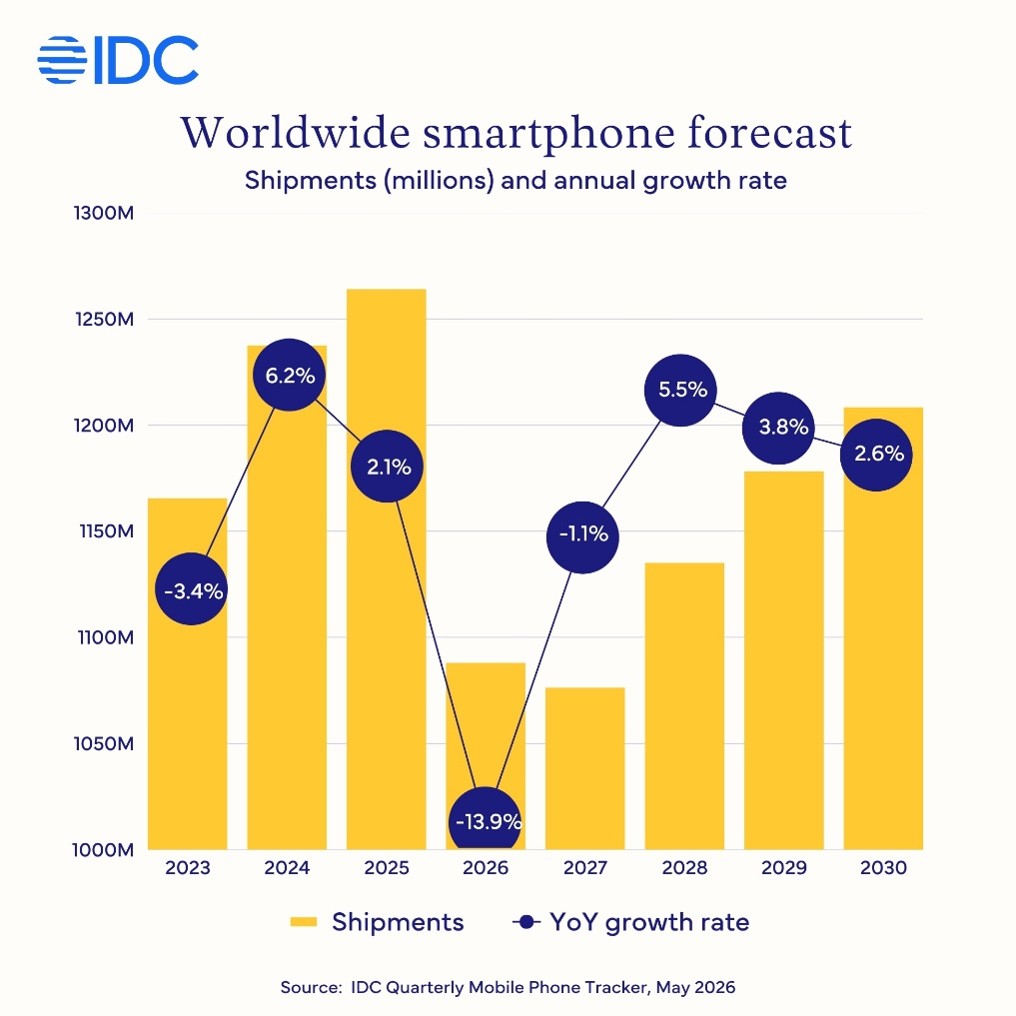
So what is behind the numbers, and what do they mean for vendors, regions, and operating systems trying to navigate this moment?

Why will the smartphone market see a record decline in 2026?

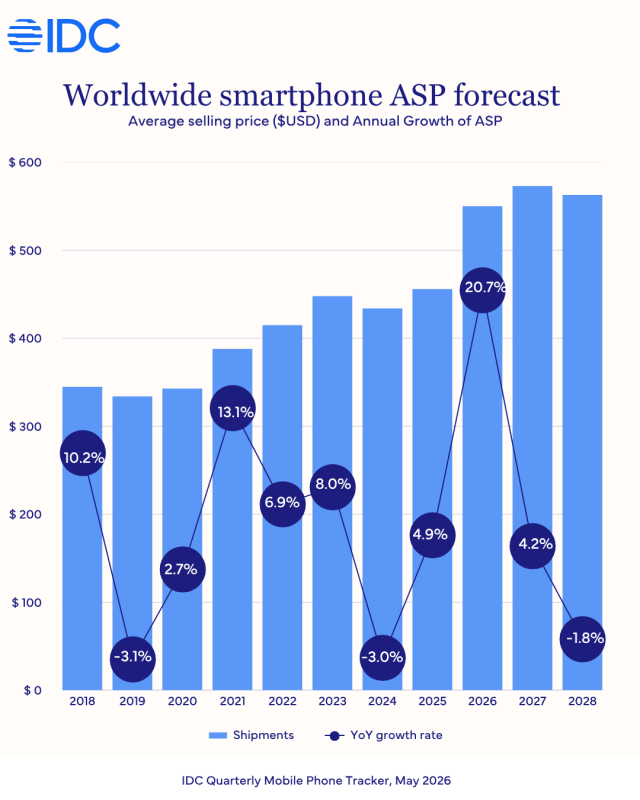
“The deepening memory shortage crisis remains the dominant force behind the record 14% drop this year, but it is no longer the only one,” said Nabila Popal, Senior Research Director with IDC’s Worldwide Quarterly Mobile Phone Tracker. “The US-Iran war has added a fresh layer of cost pressure for smartphone OEMs, driven by rising oil prices and transportation costs. Combined, these pressures are compelling vendors to reduce shipments, raise prices and concentrate on higher price tiers — elevating smartphone ASP to a record $550, up $100 from last year. 2026 will be a defining year for the industry as new reality of structurally higher costs take hold. For consumers, it means the era of ultra cheap smartphones is over. For vendors, it means only those that can adapt their strategies to this new cost environment and sustain demand at elevated price points will survive.”
How will different regions perform in 2026?

The decline is not distributed evenly. It is concentrated at the bottom of the market, and that means emerging markets will absorb the most pain.

The sub-$200 segment, where margins are already thin and consumers are most price-sensitive, will shrink the most. Regions with the highest concentration of sub-$200 devices are facing the sharpest declines: Middle East and Africa (MEA) is forecast to drop 23%, Central and Eastern Europe 19%, and Asia Pacific excluding Japan and China (APeJC) 14%.

North America holds up comparatively well, with only a 6.3% decline. The region is dominated by the premium segment, with 60% of shipments in 2026 Q1 above $800, and Apple and Samsung have proven resilient to the crisis at that tier. China is also forecast to decline double digits at 13%, as low-end Android players struggle to compete in the new cost environment.

How will performance differ across vendors and operating systems?

Android as a whole is forecast to see a 20% year-on-year drop, but that number masks two very different stories playing out within it.

Samsung is expected to grow market share in 2026, defying the broader Android decline by expanding in the premium segment and taking share in the mid-range. A combination of secured memory supply, a stronger Galaxy S26 line-up, and aggressive mid-range positioning is allowing Samsung to capture demand that smaller Android vendors simply cannot serve as memory costs squeeze their bill of materials.

iOS tells a different story. Apple’s forecast improved from an 8.1% decline to just 5.2% in 2026, a meaningful divergence at a time when the rest of the market is heading sharply downward. Apple secured the memory supply it needed early and is seeing exceptionally strong demand for the iPhone 17 series across developed markets and especially in China.

“2026 will be a defining year for Apple,” said Francisco Jeronimo, Vice President for Worldwide Client Devices at IDC. “In a year when the broader smartphone market will record its steepest decline in history, iOS will deliver its highest annual share ever, at 22%. Apple has done three things that few of its competitors have managed: it secured memory supply early, it built a portfolio strong enough to drive a remarkable turnaround in China, and it positioned the iPhone 17 to capture demand exactly when consumers in developed markets are extending replacement cycles and trading up. The shift in market share that follows from this crisis will benefit Apple more than any other vendor.”

HarmonyOS is the other bright spot. Huawei’s operating system is forecast to reach 62 million units in 2026, up sharply from the 42 million previously forecasted. Huawei has expanded HarmonyOS into the entry-level segment, sustained or reduced pricing on new models, and continued promotional support for older devices. The strategy has worked particularly well in China’s lower-tier cities, where the affordability gap created by rising Android ASPs has created space for a domestic alternative.

Will foldable smartphones grow in 2026?

Yes, and it is one of the few unambiguously good news stories in this forecast.

For the second consecutive year, foldables are defying the broader downturn. The category is forecast to grow 20% year-on-year in 2026, supported by new models from existing players and, more importantly, Apple’s long-anticipated entry into the segment in the second half of the year. Foldables remain a small share of total smartphone volumes, but they are now the only segment where vendors can credibly defend premium pricing and grow units at the same time.

What does this mean for vendors and the industry?

The forecast draws a clear dividing line. Vendors with scale, supply leverage, and pricing power, namely Apple, Samsung, and Huawei within China, will gain share. Smaller Android brands concentrated in entry-level price bands and emerging markets will face the sharpest contractions and, in some cases, exit the market.

ASPs are unlikely to return to 2025 levels within the forecast horizon. The sub-$100 segment, which accounted for over 170 million devices in 2025, becomes economically unviable as memory and NAND costs settle at a permanently higher level, even after the memory shortage stabilises in 2028.

The next 18 months will determine who emerges from this reset with a sustainable position and who does not.

Nabila Popal

Nabila Popal - Senior Director, Data & Analytics

Nabila Popal is Senor Director with IDC's Data & Analytics team, specializing in Mobile Phones, PC Monitors and other consumer devices.  Ms. Popal is responsible for the global research and quality and timely delivery for her respective technologies, coordinating with regional…

Francisco Jeronimo

Francisco Jeronimo - VP, Data and Analytics, Devices, IDC EMEA

Francisco Jeronimo is VP for Data and Analytics at IDC EMEA. Based in London, he leads the research that covers mobile devices, personal computing devices, emerging technologies and the circular economy trends across EMEA. His team delivers data on personal…