


惯性聚合 高效追踪和阅读你感兴趣的博客、新闻、科技资讯
阅读原文 在惯性聚合中打开

推荐订阅源

Martin Fowler
Martin Fowler
T
The Blog of Author Tim Ferriss
J
Java Code Geeks
M
MIT News - Artificial intelligence
F
Fortinet All Blogs
Cyber Security Advisories - MS-ISAC
B
Blog
Microsoft Azure Blog
I
InfoQ
Microsoft Security Blog
N
Netflix TechBlog - Medium
G
Google Developers Blog
L
LangChain Blog
腾讯CDC
大猫的无限游戏
大猫的无限游戏
U
Unit 42
Google DeepMind News
人人都是产品经理
人人都是产品经理
罗磊的独立博客
钛媒体:引领未来商业与生活新知
钛媒体:引领未来商业与生活新知
小众软件
小众软件
The GitHub Blog
The GitHub Blog
博客园_首页
GbyAI
GbyAI

IDC

IDC On the Ground: Inside GITEX AI Europe 2026's Race to Build Sovereign AI Infrastructure IDC Quanta Launch: The 3-Minute Recap The strategy behind today's launch Dashboards Are Dead: The Future of Business Intelligence Lives in the Workflow Introducing IDC Quanta: The Intelligence Fabric of the AI-Enabled Enterprise How Wearables and AI Will Reshape Healthcare Who operates your meeting rooms now: AV, IT, or an AI agent? Beyond Check-the-Box: Choosing a Security Framework for the AI and Quantum Era DX Software in Transition: AI Investment Trends by Sector Japan's AI Supercycle Is Here — Are You Ready to Lead It? Beyond the Data Dump: Why Cybersecurity Metrics Are Failing, and How AI Fixes It From Wait-and-See to All-In: How SMBs Are Rewriting Their AI Story Your AI Platform Knows the Market. Does It Know Your Business, and Can You Trust It with Your Strategy? Start Here: Six Best Practices for Foundational AI Training Physical AI and Robotics Take Center Stage at Computex Taipei 2026 for Semiconductor Vendors Trump's Quantum EO: What It Means for the U.S. Market The sovereignty conversation vendors need to have - but rarely do Q&A: Your Pipeline Conversion Questions, Answered by IDC Analysts The Intelligence Gap Is Widening. Here's What the Data Says. Anthropic, Trump, and Fable 5: The Dispute That Makes the Case for Frontier AI Studies IDC Quanta: The Next Era of Tech Intelligence The $22.5 Trillion AI Opportunity Why the memory market is still tight: what comes next Indonesia PC Market Grows 9.4% in Q1 2026 Despite Component Pressures But Headwinds Are Building The Dawn of Just-in-Time Software Agent Supplier or Featureware: The Choice Every SaaS Vendor Faces Now SpaceX, Cursor, and the Race to Build the Best Coding LLM in the World NVIDIA Becomes #1 in Datacenter Ethernet Switching as 1Q26 Market Surges 39.8% to $15.4 Billion Wi-Fi 7 Captures 44% of Enterprise WLAN Dependent Access Point Revenue as 1Q26 Market Grows 15.9% to Nearly $2.7 Billion AI Is Ready. Enterprises Are Not. Vendors Need to Fix It.
Beyond LLMs: Why AI Strategy Now Requires Multi-Model, Mu...
Tim Law, Zhenshan Zhong · 2026-04-14 · via IDC

For the past few years, large language models (LLMs) have dominated the AI conversation, and for good reason. They have transformed how we interact with software, accelerated content creation, and unlocked new forms of productivity.

But here is the reality enterprises need to internalize in 2026: the future of AI is no longer about a single model architecture.

A new AI model ecosystem is rapidly taking shape, one that is more diverse, more specialized, and far more powerful when orchestrated correctly.

The shift is subtle, but its implications are massive.

What is replacing LLM-only AI strategies? The shift to “any-to-any” models

LLMs, largely built on transformer architectures, still play a central role. But they are no longer sufficient on their own. Across industries, we are seeing a more diverse model landscape emerge that includes:
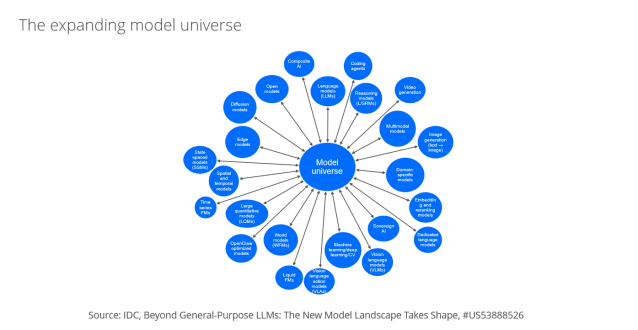
  • Deep reasoning models with adaptive thinking
  • Multimodal models (text, image, video, audio)
  • Small, efficient models for edge and latency- or cost-sensitive use cases
  • Domain-specific models tailored to industries like healthcare, finance, and manufacturing
  • Dedicated language models that excel in underrepresented languages
  • Quantitative and physics-based models for scientific and simulation-heavy workloads and real-world problems, ultimately enabling physical AI
  • Models with novel architectures beyond transformers, such as structured state space models (SSMs), mixture of experts (MoE), liquid neural networks (LLNs), and world models that solve problems differently, including time series and spatial tasks
  • Vision-language models built on novel architectures
  • Vision-action and world models that interact with real environments
  • Autonomous AI agents that interact with the real world, search the web, manage knowledge work, and use tools

This expansion is happening because real-world problems are not purely linguistic, and many business requirements are not easily solved by transformer-based models. Enterprises are discovering that while LLMs “think in language,” many business problems require reasoning in numbers, space, time, and physics.

To truly accomplish work and enable action-oriented outcomes, models need different skill sets and must be trained on a more diverse corpus of data. Solving a business problem may require a combination of models optimized for both reasoning and execution.

Why multi-model AI matters for enterprise strategy

This is not just a technical evolution. It is a strategic one. Organizations that continue to treat AI as a single-model problem will quickly hit limitations in:

Meanwhile, those adopting a multi-model, multimodal, and multi-agent approach will unlock entirely new capabilities, including action-oriented AI.

How to build a multi-model AI strategy: Three actions to take now

1. Treat model selection as a core capability
Most enterprises still underinvest in model selection. That is a mistake. Choosing the right model is no longer a one-time decision. It is an ongoing enterprise capability involving:

  • Matching model types to use cases
  • Evaluating trade-offs (cost versus performance versus latency)
  • Routing tasks dynamically across models

Action: Build internal processes or platforms for continuous model evaluation and benchmarking. Think of this like cloud cost optimization, but for AI.

2. Design for a “model portfolio,” not a single stack
Your future AI architecture will look less like a stack and more like a portfolio, with different models playing distinct roles. This includes general-purpose LLMs, models for large quantitative tasks, and vision-language models for generating video and other content. The possibilities are extensive.

This “constellation of models” is becoming the new normal.

Action: Start mapping your top 10 AI use cases and identify where different model types could outperform a single LLM approach.

3. Invest in AI-ready data infrastructure
As models diversify, data becomes the unifying layer. Without the right data foundation, even the best models will underperform. The shift toward a multi-model world is driving a major evolution in data platforms, including:

  • Converged data architectures
  • Vector and multimodal databases

Action: Prioritize data readiness, including governance, pipelines, and accessibility across model types.

Final thought: AI success will depend on model orchestration

The organizations that win will be those that:

  • Build flexible AI architectures that can quickly incorporate new model types and innovations
  • Invest in AI-ready data architecture and orchestration

Because in the new AI landscape, it is not about having the best model. It is about having the right combination of models.

Learn more

Tim Law - Research Director, AI & Automation - IDC

Timothy Law is a Research Director for AI & Automation, responsible for the generative AI lifecycle tools and technologies research practice. Mr. Law’s core research coverage includes the evolution of generative AI infrastructure and platforms, foundation models, developer tools, observability solutions, agentic systems, and generative AI services. This research analyzes the trends and developments in the AI software markets, including the costs, benefits, and impact of generative AI technologies.

Zhenshan Zhong - Vice President, Emerging Technology Research - IDC

Zhenshan Zhong is the vice president of Emerging Technology Research, leading the research teams focusing on emerging technologies (the four pillars and innovation accelerators). Zhenshan and his team are responsible for the overall success of these research domains, including participation and program management of key client engagements and the daily management of research team members.