


惯性聚合 高效追踪和阅读你感兴趣的博客、新闻、科技资讯
阅读原文 在惯性聚合中打开

推荐订阅源

Cisco Talos Blog
Cisco Talos Blog
K
Kaspersky official blog
T
The Exploit Database - CXSecurity.com
NISL@THU
NISL@THU
AWS News Blog
AWS News Blog
V2EX - 技术
V2EX - 技术
Google DeepMind News
OSCHINA 社区最新新闻
OSCHINA 社区最新新闻
S
Security @ Cisco Blogs
让小产品的独立变现更简单 - ezindie.com
Recent Commits to openclaw:main
J
Java Code Geeks
Microsoft Azure Blog
Attack and Defense Labs
Jina AI
Jina AI
The Last Watchdog
The Last Watchdog
W
WeLiveSecurity
H
Help Net Security
V
Visual Studio Blog
宝玉的分享
宝玉的分享
C
Cybersecurity and Infrastructure Security Agency CISA
T
Threat Research - Cisco Blogs
IT之家
IT之家
Hugging Face - Blog
Hugging Face - Blog
Latest news
Latest news
T
Tor Project blog
I
Intezer
美团技术团队
GbyAI
GbyAI
T
Tailwind CSS Blog
Last Week in AI
Last Week in AI
博客园 - 三生石上(FineUI控件)
Google DeepMind News
Scott Helme
Scott Helme
Y
Y Combinator Blog
博客园 - 司徒正美
T
Tenable Blog
O
OpenAI News
N
News and Events Feed by Topic
cs.CL updates on arXiv.org
V
Vulnerabilities – Threatpost
P
Palo Alto Networks Blog
博客园 - 聂微东
酷 壳 – CoolShell
酷 壳 – CoolShell
D
Darknet – Hacking Tools, Hacker News & Cyber Security
T
Threatpost
Google Online Security Blog
Apple Machine Learning Research
云风的 BLOG
云风的 BLOG
Help Net Security
Help Net Security

IDC

IDC On the Ground: Inside GITEX AI Europe 2026's Race to Build Sovereign AI Infrastructure IDC Quanta Launch: The 3-Minute Recap The strategy behind today's launch Dashboards Are Dead: The Future of Business Intelligence Lives in the Workflow Introducing IDC Quanta: The Intelligence Fabric of the AI-Enabled Enterprise How Wearables and AI Will Reshape Healthcare Who operates your meeting rooms now: AV, IT, or an AI agent? Beyond Check-the-Box: Choosing a Security Framework for the AI and Quantum Era DX Software in Transition: AI Investment Trends by Sector Japan's AI Supercycle Is Here — Are You Ready to Lead It? Beyond the Data Dump: Why Cybersecurity Metrics Are Failing, and How AI Fixes It From Wait-and-See to All-In: How SMBs Are Rewriting Their AI Story Your AI Platform Knows the Market. Does It Know Your Business, and Can You Trust It with Your Strategy? Physical AI and Robotics Take Center Stage at Computex Taipei 2026 for Semiconductor Vendors Trump's Quantum EO: What It Means for the U.S. Market The sovereignty conversation vendors need to have - but rarely do Q&A: Your Pipeline Conversion Questions, Answered by IDC Analysts The Intelligence Gap Is Widening. Here's What the Data Says. Anthropic, Trump, and Fable 5: The Dispute That Makes the Case for Frontier AI Studies IDC Quanta: The Next Era of Tech Intelligence The $22.5 Trillion AI Opportunity Why the memory market is still tight: what comes next Indonesia PC Market Grows 9.4% in Q1 2026 Despite Component Pressures But Headwinds Are Building The Dawn of Just-in-Time Software Agent Supplier or Featureware: The Choice Every SaaS Vendor Faces Now SpaceX, Cursor, and the Race to Build the Best Coding LLM in the World NVIDIA Becomes #1 in Datacenter Ethernet Switching as 1Q26 Market Surges 39.8% to $15.4 Billion Wi-Fi 7 Captures 44% of Enterprise WLAN Dependent Access Point Revenue as 1Q26 Market Grows 15.9% to Nearly $2.7 Billion AI Is Ready. Enterprises Are Not. Vendors Need to Fix It. Smart Glasses Surge: The XR Market Is Rewriting Its Own Rules WWDC 2026: Apple’s AI Credibility Test AI Is Making MSPs More Efficient. Here’s How to Share in the Gains. The Dark Funnel: How Answer Engine Optimization is Reshaping B2B Brand Visibility Agentic AI Is Breaking Your ROI Model. Here’s How to Fix It When the Question Can’t Wait: How Kyndryl Delivers Enterprise Intelligence at Speed Why the Grey Market Won’t Disappear in the Middle East and Africa: The Case of Notebooks Print, AI, and the expanded buying committee: highlights from IDC’s Print Executive Dinner in London AI in telecommunications: Why it is becoming an infrastructure priority Do AI Markets Face a Circular Financing Problem? Enterprise Applications Will Determine the Answer. From AI pilots to business value: what EMEA digital leaders are doing differently in 2026 Why India’s PC Market Surged 31.1% in Q1 2026 and What Comes Next PC Market Enters Volatile Territory as Memory Shortage Persists Through 2027 Agentic AI Ecosystems: Navigating the Megatrend That’s Reshaping Enterprise Technology Markets Leaning into disruption: How Perficient delivers real outcomes in an AI-first world Google’s Fitbit Air and Google Health: The Software Platform Play That Matters More Than the Hardware Why Fast and Trustworthy Aren’t Mutually Exclusive in AI Research The Middle East Conflict Just Rewrote the Rules of Business Continuity Ecosystem strategy in 2026: turning AI disruption into partner-led growth Worldwide Smartphone Market to Decline 13.9% in 2026 as Memory Crisis and US-Iran War Constrain Growth The AI Supercycle Has Started. Where Does Asia/Pacific Stand? Devices at Google I/O 2026: Android XR Glasses, Googlebooks, and Gemini Intelligence Why Research Alone Isn’t Enough: The Delivery Problem No One Is Talking About Digital Accessibility in the Workplace: From Compliance to Competitive Advantage When Pinocchio Became a Real Boy: Security Platforms Have Grown Up Plotting a Future-Proof Course: How The Resorts Companies Turned a Decade of IDC Partnership into a Competitive Edge European CISO priorities in 2026: AI agents, platformization, and sovereignty Why IDC Directions Is Coming to Hangzhou — and Why You Should Be There Telcos’ Next AI Revenue Play: Monetizing Orchestrated Digital Infrastructure The Workforce Skills Gap That AI Can’t Solve for Itself The Agent Takeover: What Happens When AI Becomes the Primary User of Enterprise Software The AI Answer Gap: Why Fast Answers and Defensible Ones Are No Longer the Same Thing The Market Every Western Executive Should Be Watching. IDC’s CEO Already Is. Ecosystem Strategy in 2026: Why AI Is Rewriting Partner-Led Growth Anthropic, SpaceXAI, and the New Compute Race in AI Navigating a Market Where the Wrong Bet Has Real Consequences Renuka Drummond Named Top 10 Corporate Counsel Worldwide by OnCon Icon Awards From Labor Arbitrage to Platform-Led Outcomes: How Agentic AI Is Rewriting the IT Services Playbook EMEA IT Market 2026 – Q2 Updates: 5 Key Takeaways on AI, IT Spending and Market Trends Japan’s AI Infrastructure Market Is Heading for ¥1 Trillion and Here Is What Comes Next Asia Pacific IT Spending Outlook 2026: How the Middle East War Is Reshaping IT Budgets From Digital Access to Accessibility with AI Enablement From Cost Optimization to Continuity: What IT Buyers Need Now and How Suppliers Must Respond AI as an Organizational Stress Test: What Will Break First in Your Operating Model? Japan’s ¥2.1 Trillion IT Modernization Wave: The Race Has Already Begun Semiconductor Market to Surge Past the Trillion-Dollar Threshold: AI Infrastructure Drives Market Growth Most AI Investments Don’t Deliver Value – Here’s What EMEA Leaders Are Missing Hannover Messe 2026: 7 Insights and 3 Pieces of Advice on Industrial AI, Manufacturing, and the Future of the Factory IDC Directions 2026: The AI Conversation Has Shifted. Here’s How to Catch Up. Coding by Prompt Is Coming to Your Business Units: What CIOs Should Do Next FutureScape 2026: Building Trust, Resilience, and Prosperity in the Agentic Future FutureScape 2026: Charting the Path to Enterprise-Wide Orchestration From Task Execution to Value Creation: What the 2026 Humanoid Robot Half Marathon Reveals About Industry Progress Europe’s AI Story Has a New Problem: It’s Actually Working AI Infrastructure Spending Caps Historic Year at ~$90 Billion in Q4 2025; 2029 Spending to Eclipse $1 Trillion Digital Sovereignty: Why “Sovereign” Is No Longer Enough FutureScape 2026: Navigating the Crosscurrents of Disruption Huawei and Apple Support China Smartphone Market Resilience as Shipments Decline 3.3% in Q1 2026 The Dirty Secret of AI in ITSM: Why Bad Data Wins Every Time Wholesale telecommunications: How platform models are reshaping the market Beyond LLMs: Why AI Strategy Now Requires Multi-Model, Multimodal, and Multi-Agent Architectures It’s a Data Thing: Retail and Restaurant AI Investments Will Miss the Mark if Not Led by Data Modernization Inference to Overtake Training by 2027 – Why Japanese First Movers Are Betting on Sovereign AI Infrastructure The productivity plateau: Why efficiency gains no longer differentiate Why I’m Excited about IDC Directions 2026 GTC 2026: Workstations enter the sidetop era Dispelling the myth of a silver bullet in sovereign AI MacBook Neo: Apple’s strategic play to disrupt the PC market AI sovereignty risk: A five-step agenda for CIOs Data pricing for AI is being negotiated without a stable model From cyber risk to business risk: How CISOs should engage the board in 2026
Start Here: Six Best Practices for Foundational AI Training
Gina Smith, PhD · 2026-06-30 · via IDC

As AI adoption accelerates across enterprises, organizations are learning a hard lesson: bolt-on training tied to individual use cases just won’t cut it. To win, organizations must treat AI literacy as a strategic enterprise-wide capability.

That means embedding AI training in culture, governance structures, onboarding and performance expectations. It also means moving beyond the pilot mindset and building systematic programs with sustained executive backing, role-based curricula and real change management discipline.

IDC research reveals the gap.

According to the IDC 2026 Global IT Skills Survey, just a third of global IT and business leaders say they’re fully ready to incorporate AI into daily work. Some 93% of IT leaders rank AI as the most important enterprise skill, yet many organizations have yet to embark on organization-wide AI training.

Meanwhile, companies charge on with their AI plans. That leaves a lot of employees improvising on the very tools their companies are betting on. Good intentions can’t substitute for real, organization-wide knowledge about what AI can and can’t do, and how to make the best use of it.

As the recent IDC study on Foundation AI literacy, the baseline competencies every employee needs to use AI responsibly and effectively, makes clear: AI training must be for everyone, not just technical teams. Scaling means moving past pilot- and use-case-specific training to a tiered curriculum that reaches the whole workforce. Start with the basics for all employees: what AI is and is not, responsible-use guidelines and the key risks, including bias, hallucinations, privacy and data leakage. Then show the upside, the opportunities for augmentation and productivity. Most employees arrive without a structured academic grounding in AI, so accessible, role-aware pathways matter.

Here are six practices that distinguish successful AI initiatives at global organizations.
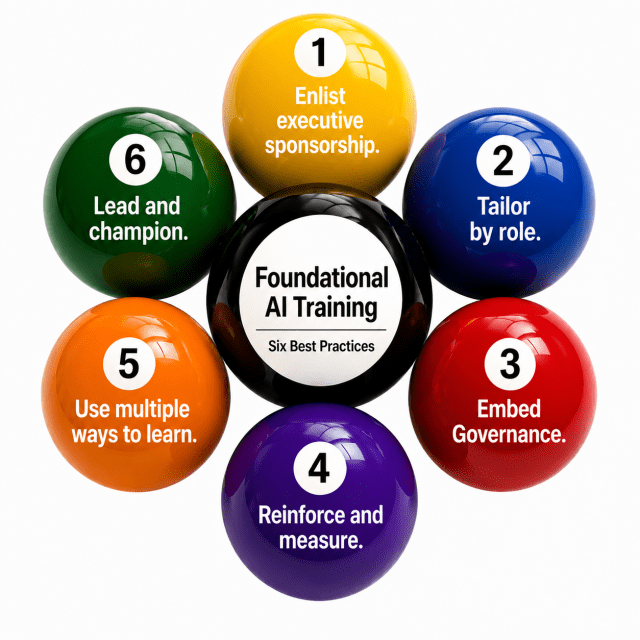
Successful programs begin with visible, sustained support from senior leadership. When a CEO or COO clearly signals that responsible AI use is a business priority, adoption accelerates. Position AI literacy as a strategic workforce capability, aligned directly with organizational objectives, risk frameworks and governance priorities. It should sit alongside AI governance and compliance efforts, not in a silo operating separately from them.

2. Tailor by role

Once the foundation is set, layer in role-based modules. Business leaders need strategic decision-making, oversight and risk awareness. Technical teams need implementation, validation and monitoring. Add scenario-based learning on top: realistic, sector-relevant case studies and high-impact use cases drawn from your own environment, in simulated settings where possible. The closer the training sits to the work, the better it sticks.

3. Embed governance

Responsible AI principles, fairness, transparency, accountability and privacy, shouldn’t be a standalone module. Weave them through the entire curriculum. Training should reinforce internal AI usage policies, data classification standards, escalation and oversight procedures and documentation expectations. Use real-world examples from your sector. Concrete evidence of real consequences — good and bad — is what makes governance stick.

4. Reinforce and measure

One-time training fails because AI capabilities, risks, and policies change continuously. Build periodic refreshers, knowledge checks, feedback loops and ongoing updates into the program, and embed reinforcement directly into daily workflows to lift retention. Then measure more than completion rates. Track behavioral change and impact. Adoption of approved AI tools, fewer policy violations, better documentation and productivity or quality gains can and should be tied to responsible AI use. Those metrics give you confidence that the program is actually working — and the evidence you need to sustain investment in it.

5. Use multiple ways to learn

Different formats reinforce different behaviors, and mature programs don’t rely on a single mode. They layer self-paced e-learning, live workshops, microlearning, hands-on labs and in-app guidance. Meeting people where they work, in the flow of the job, beats stacking one-off events.

6. Lead and champion

None of this scales without visible, sustained sponsorship from the top. When a CEO or COO signals that responsible AI use is a business priority, adoption accelerates, so position AI literacy as a strategic workforce capability aligned with organizational objectives, risk frameworks and governance priorities, not parked in a training silo. Treat it as a core, required competency for all staff, the way you treat cybersecurity awareness or data privacy training. Clear communication helps: emphasize AI as augmentation, the organization’s commitment to responsible use and how literacy supports mission, stewardship and risk management. Good change management reduces uncertainty. It also discourages shadow AI, people reaching for unapproved tools because no one showed them the approved path.

The takeaway is simple. Organizations that treat AI literacy as a strategic capability across the organization will be better positioned to close the gap between AI investment and AI output. Those that skip the discipline will see the gap between ambition and readiness widen. IDC’s Foundation AI Literacy study is a practical starting point. Read it to see how leading organizations are building the capability today.

Gina Smith, PhD

Gina Smith, PhD - Research Director – IT Skills for Digital Business

As a Research Director at IDC, Gina Smith produces research in the IT education and skills sector. Her responsibilities include primary research, analysis, and the production of market insights worldwide. The New York Times bestselling author of Apple cofounder Steve Wozniak’s memoir, iWoz:…