

惯性聚合 高效追踪和阅读你感兴趣的博客、新闻、科技资讯
阅读原文 在惯性聚合中打开

推荐订阅源

P
Proofpoint News Feed
Vercel News
Vercel News
T
Tailwind CSS Blog
freeCodeCamp Programming Tutorials: Python, JavaScript, Git & More
博客园 - 聂微东
Hugging Face - Blog
Hugging Face - Blog
WordPress大学
WordPress大学
S
SegmentFault 最新的问题
小众软件
小众软件
让小产品的独立变现更简单 - ezindie.com
Apple Machine Learning Research
奇客Solidot–传递最新科技情报
奇客Solidot–传递最新科技情报
OSCHINA 社区最新新闻
OSCHINA 社区最新新闻
人人都是产品经理
人人都是产品经理
Google DeepMind News
Engineering at Meta
Engineering at Meta
B
Blog RSS Feed
U
Unit 42
Y
Y Combinator Blog
www.infosecurity-magazine.com
The Register - Security
量子位
C
CXSECURITY Database RSS Feed - CXSecurity.com
P
Privacy & Cybersecurity Law Blog
Scott Helme
Scott Helme
GbyAI
GbyAI
Know Your Adversary
Know Your Adversary
月光博客
月光博客
Threat Intelligence Blog | Flashpoint
Stack Overflow Blog
Stack Overflow Blog
S
Secure Thoughts
L
Lohrmann on Cybersecurity
腾讯CDC
P
Palo Alto Networks Blog
MongoDB | Blog
MongoDB | Blog
T
Tor Project blog
博客园_首页
W
WeLiveSecurity
G
Google Developers Blog
K
Kaspersky official blog
爱范儿
爱范儿
V
Visual Studio Blog
T
Threat Research - Cisco Blogs
Simon Willison's Weblog
F
Fortinet All Blogs
T
The Exploit Database - CXSecurity.com
N
News and Events Feed by Topic
Last Week in AI
Last Week in AI
aimingoo的专栏
aimingoo的专栏
A
About on SuperTechFans

IDC

IDC On the Ground: Inside GITEX AI Europe 2026's Race to Build Sovereign AI Infrastructure IDC Quanta Launch: The 3-Minute Recap The strategy behind today's launch Dashboards Are Dead: The Future of Business Intelligence Lives in the Workflow Introducing IDC Quanta: The Intelligence Fabric of the AI-Enabled Enterprise How Wearables and AI Will Reshape Healthcare Who operates your meeting rooms now: AV, IT, or an AI agent? Beyond Check-the-Box: Choosing a Security Framework for the AI and Quantum Era DX Software in Transition: AI Investment Trends by Sector Japan's AI Supercycle Is Here — Are You Ready to Lead It? Beyond the Data Dump: Why Cybersecurity Metrics Are Failing, and How AI Fixes It From Wait-and-See to All-In: How SMBs Are Rewriting Their AI Story Your AI Platform Knows the Market. Does It Know Your Business, and Can You Trust It with Your Strategy? Start Here: Six Best Practices for Foundational AI Training Physical AI and Robotics Take Center Stage at Computex Taipei 2026 for Semiconductor Vendors Trump's Quantum EO: What It Means for the U.S. Market The sovereignty conversation vendors need to have - but rarely do Q&A: Your Pipeline Conversion Questions, Answered by IDC Analysts The Intelligence Gap Is Widening. Here's What the Data Says. Anthropic, Trump, and Fable 5: The Dispute That Makes the Case for Frontier AI Studies IDC Quanta: The Next Era of Tech Intelligence The $22.5 Trillion AI Opportunity Why the memory market is still tight: what comes next Indonesia PC Market Grows 9.4% in Q1 2026 Despite Component Pressures But Headwinds Are Building The Dawn of Just-in-Time Software Agent Supplier or Featureware: The Choice Every SaaS Vendor Faces Now SpaceX, Cursor, and the Race to Build the Best Coding LLM in the World NVIDIA Becomes #1 in Datacenter Ethernet Switching as 1Q26 Market Surges 39.8% to $15.4 Billion Wi-Fi 7 Captures 44% of Enterprise WLAN Dependent Access Point Revenue as 1Q26 Market Grows 15.9% to Nearly $2.7 Billion AI Is Ready. Enterprises Are Not. Vendors Need to Fix It. Smart Glasses Surge: The XR Market Is Rewriting Its Own Rules WWDC 2026: Apple’s AI Credibility Test AI Is Making MSPs More Efficient. Here’s How to Share in the Gains. The Dark Funnel: How Answer Engine Optimization is Reshaping B2B Brand Visibility Agentic AI Is Breaking Your ROI Model. Here’s How to Fix It When the Question Can’t Wait: How Kyndryl Delivers Enterprise Intelligence at Speed Why the Grey Market Won’t Disappear in the Middle East and Africa: The Case of Notebooks Print, AI, and the expanded buying committee: highlights from IDC’s Print Executive Dinner in London AI in telecommunications: Why it is becoming an infrastructure priority Do AI Markets Face a Circular Financing Problem? Enterprise Applications Will Determine the Answer. From AI pilots to business value: what EMEA digital leaders are doing differently in 2026 Why India’s PC Market Surged 31.1% in Q1 2026 and What Comes Next PC Market Enters Volatile Territory as Memory Shortage Persists Through 2027 Agentic AI Ecosystems: Navigating the Megatrend That’s Reshaping Enterprise Technology Markets Leaning into disruption: How Perficient delivers real outcomes in an AI-first world Google’s Fitbit Air and Google Health: The Software Platform Play That Matters More Than the Hardware Why Fast and Trustworthy Aren’t Mutually Exclusive in AI Research The Middle East Conflict Just Rewrote the Rules of Business Continuity Ecosystem strategy in 2026: turning AI disruption into partner-led growth Worldwide Smartphone Market to Decline 13.9% in 2026 as Memory Crisis and US-Iran War Constrain Growth The AI Supercycle Has Started. Where Does Asia/Pacific Stand? Devices at Google I/O 2026: Android XR Glasses, Googlebooks, and Gemini Intelligence Why Research Alone Isn’t Enough: The Delivery Problem No One Is Talking About Digital Accessibility in the Workplace: From Compliance to Competitive Advantage When Pinocchio Became a Real Boy: Security Platforms Have Grown Up Plotting a Future-Proof Course: How The Resorts Companies Turned a Decade of IDC Partnership into a Competitive Edge European CISO priorities in 2026: AI agents, platformization, and sovereignty Why IDC Directions Is Coming to Hangzhou — and Why You Should Be There Telcos’ Next AI Revenue Play: Monetizing Orchestrated Digital Infrastructure The Workforce Skills Gap That AI Can’t Solve for Itself The Agent Takeover: What Happens When AI Becomes the Primary User of Enterprise Software The AI Answer Gap: Why Fast Answers and Defensible Ones Are No Longer the Same Thing The Market Every Western Executive Should Be Watching. IDC’s CEO Already Is. Ecosystem Strategy in 2026: Why AI Is Rewriting Partner-Led Growth Anthropic, SpaceXAI, and the New Compute Race in AI Navigating a Market Where the Wrong Bet Has Real Consequences Renuka Drummond Named Top 10 Corporate Counsel Worldwide by OnCon Icon Awards From Labor Arbitrage to Platform-Led Outcomes: How Agentic AI Is Rewriting the IT Services Playbook EMEA IT Market 2026 – Q2 Updates: 5 Key Takeaways on AI, IT Spending and Market Trends Japan’s AI Infrastructure Market Is Heading for ¥1 Trillion and Here Is What Comes Next From Digital Access to Accessibility with AI Enablement From Cost Optimization to Continuity: What IT Buyers Need Now and How Suppliers Must Respond AI as an Organizational Stress Test: What Will Break First in Your Operating Model? Japan’s ¥2.1 Trillion IT Modernization Wave: The Race Has Already Begun Semiconductor Market to Surge Past the Trillion-Dollar Threshold: AI Infrastructure Drives Market Growth Most AI Investments Don’t Deliver Value – Here’s What EMEA Leaders Are Missing Hannover Messe 2026: 7 Insights and 3 Pieces of Advice on Industrial AI, Manufacturing, and the Future of the Factory IDC Directions 2026: The AI Conversation Has Shifted. Here’s How to Catch Up. Coding by Prompt Is Coming to Your Business Units: What CIOs Should Do Next FutureScape 2026: Building Trust, Resilience, and Prosperity in the Agentic Future FutureScape 2026: Charting the Path to Enterprise-Wide Orchestration From Task Execution to Value Creation: What the 2026 Humanoid Robot Half Marathon Reveals About Industry Progress Europe’s AI Story Has a New Problem: It’s Actually Working AI Infrastructure Spending Caps Historic Year at ~$90 Billion in Q4 2025; 2029 Spending to Eclipse $1 Trillion Digital Sovereignty: Why “Sovereign” Is No Longer Enough FutureScape 2026: Navigating the Crosscurrents of Disruption Huawei and Apple Support China Smartphone Market Resilience as Shipments Decline 3.3% in Q1 2026 The Dirty Secret of AI in ITSM: Why Bad Data Wins Every Time Wholesale telecommunications: How platform models are reshaping the market Beyond LLMs: Why AI Strategy Now Requires Multi-Model, Multimodal, and Multi-Agent Architectures It’s a Data Thing: Retail and Restaurant AI Investments Will Miss the Mark if Not Led by Data Modernization Inference to Overtake Training by 2027 – Why Japanese First Movers Are Betting on Sovereign AI Infrastructure The productivity plateau: Why efficiency gains no longer differentiate Why I’m Excited about IDC Directions 2026 GTC 2026: Workstations enter the sidetop era Dispelling the myth of a silver bullet in sovereign AI MacBook Neo: Apple’s strategic play to disrupt the PC market AI sovereignty risk: A five-step agenda for CIOs Data pricing for AI is being negotiated without a stable model From cyber risk to business risk: How CISOs should engage the board in 2026
Asia Pacific IT Spending Outlook 2026: How the Middle East War Is Reshaping IT Budgets
Stephen Mint · 2026-05-05 · via IDC

The Middle East War is no longer just a regional risk for technology leaders. It is becoming a global economic stress test — affecting energy prices, supply chains, inflation, business confidence, and IT budget decisions across Asia Pacific.

For CIOs, CFOs, and technology suppliers, the question is not simply whether IT spending will continue to grow in 2026. The sharper question is: which investments will still earn approval when volatility hits the budget?

That is the central signal from IDC’s latest webinar, Asia Pacific IT Spending Outlook 2026: Where to Win Amid Market Volatility. The market is not freezing. It is filtering.

The Middle East War is the shock

In Asia Pacific, those pressures are showing up in practical ways. Higher oil and electricity costs can raise operating expenses. Supply chain disruption can increase hardware costs and delay availability. Currency and pricing pressure can make approvals harder. As uncertainty rises, organizations move faster into contingency planning.

The first effect is not always a budget cut. More often, it is hesitation. Organizations start asking which projects are necessary, which can be phased, and which need to prove value faster.

As I noted during the webinar: “IT spending is likely to remain more resilient than in previous downturns because AI investment continues to support both the IT industry and broader economic growth.”

Resilience matters. It keeps the outlook from becoming a slowdown story. But resilience does not remove risk. The longer energy prices and supply chain disruption remain elevated, the more likely selective delays become targeted cuts.

Budget rotation is the signal

The most important shift is not how much organizations spend, but what they are willing to defend.

In a more volatile environment, buyers are becoming more risk-averse. ROI thresholds are rising. Procurement cycles involve more stakeholders. Vendors are seeing longer deal cycles, greater pricing pressure, and less predictable pipelines.
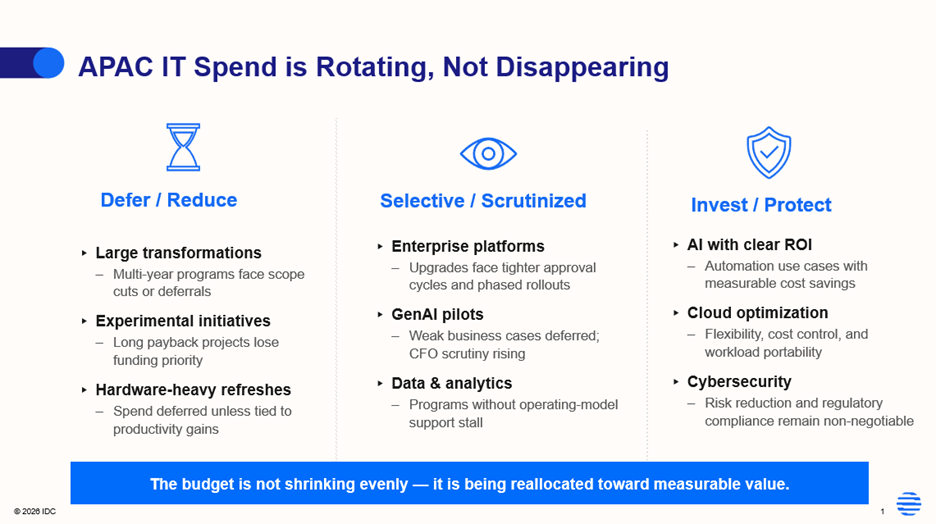
The visual above captures the core market signal: APAC IT spend is rotating, not disappearing.

Large transformations, experimental initiatives, and hardware-heavy refreshes are more likely to be deferred or reduced unless they are directly tied to productivity gains. Enterprise platform upgrades, GenAI pilots, and data and analytics programs are still in play, but they face tighter scrutiny and phased rollouts.

What remains protected? Investments tied to measurable outcomes. AI with clear ROI. Cloud optimization that supports flexibility and cost control. Cybersecurity that reduces risk and supports regulatory compliance. Infrastructure resiliency that helps organizations absorb disruption.

My colleague Vinayaka Venkatesh, summarized the shift directly: “The deals are not disappearing, but they are taking longer and require more effort to close.”

For technology suppliers, that line is the market cue. In 2026, vendors will not win by selling transformation in broad terms. They will win by helping buyers make the case for action now.

AI remains resilient, but proof matters more

But resilience does not mean every AI project gets a free pass.

One of the more important nuances from the webinar is the gap between AI infrastructure investment and enterprise AI execution. Hyperscalers and service providers continue to invest aggressively in AI infrastructure. At the same time, some enterprise AI initiatives are being de-scoped, delayed, or challenged on measurable outcomes.

This is where the “year of reckoning” for AI becomes real. AI use cases tied to cost savings, automation, customer experience, risk reduction, and operational efficiency will be easier to defend. Weak GenAI pilots, unclear operating models, or projects without a credible path to production will face more scrutiny from CFOs and cross-functional decision-makers.

AI for AI’s sake will not win the next budget cycle. AI with measurable business impact will.

What to remember for H2 2026 planning

As technology leaders plan for the second half of 2026, three takeaways matter most:

1. APAC IT spending is being disrupted, not derailed
The Middle East War is creating real pressure through energy costs, inflation, supply chain disruption, and weaker business visibility. But priority investments continue to support the market, especially AI infrastructure, cybersecurity, resiliency, and cloud optimization.

2. Budgets are rotating toward measurable value
Lower-priority initiatives, long-payback projects, and unclear business cases are facing delays. Investments that reduce risk, improve efficiency, support compliance, or deliver near-term ROI are better positioned for approval.

3. AI remains resilient, but the proof bar is rising
AI investment remains strong, but enterprise projects need clearer outcomes, stronger business cases, and a faster path from pilot to production.

The path forward is not about spending more for the sake of momentum. It is about knowing where to spend, what to protect, and what to pause.

Register for the on-demand webinar

The Middle East War is the shock. Budget rotation is the signal. Measurable value is the next move.

Stephen Minton - Group Vice President, Data & Analytics - IDC

Stephen Minton is a group vice president with the IDC Data & Analytics group, focusing on ICT spending and macroeconomics. Mr. Minton is responsible for Worldwide ICT Spending programs, including the Worldwide Black Book, Worldwide 3rd Platform Spending Guides, and Worldwide Telecom Services Tracker. Mr. Minton's research expertise includes global ICT and economic analysis, and he tracks market data across hardware, software, services, telecom and emerging technologies. He is the author of papers that focus on the economic impact of IT, and is a regular speaker on the subject of IT spending. In 2002 he addressed the United Nations in New York, speaking to UN ambassadors on the subject of the Information Society. Mr. Minton previously worked with Digital Equipment Corporation (DEC), before joining IDC in 1998. Originally from Hartlepool in the North of England, he graduated from the University of Salford in 1995. He has also worked in the field of consumer market research with Millward Brown International.

Vinayaka Venkatesh

Vinayaka Venkatesh - Senior Market Analyst

Vinayaka Venkatesh is a senior market analyst for the IDC Asia/Pacific IT Spending Team based in Bangalore, India. He currently works as a vertical analyst, covering multiple spending guides for Asia/Pacific (excluding Japan and China) (APEJC). He joined IDC in…