





惯性聚合 高效追踪和阅读你感兴趣的博客、新闻、科技资讯
阅读原文 在惯性聚合中打开

推荐订阅源

V
Vulnerabilities – Threatpost
D
Docker
C
Check Point Blog
P
Proofpoint News Feed
H
Help Net Security
A
About on SuperTechFans
GbyAI
GbyAI
MyScale Blog
MyScale Blog
F
Fortinet All Blogs
U
Unit 42
Y
Y Combinator Blog
The GitHub Blog
The GitHub Blog
云风的 BLOG
云风的 BLOG
I
InfoQ
Recent Announcements
Stack Overflow Blog
Stack Overflow Blog
博客园 - 三生石上(FineUI控件)
Google DeepMind News
Apple Machine Learning Research
Simon Willison's Weblog
WordPress大学
WordPress大学
Attack and Defense Labs
D
DataBreaches.Net
C
CXSECURITY Database RSS Feed - CXSecurity.com
人人都是产品经理
人人都是产品经理
J
Java Code Geeks
Help Net Security
Help Net Security
P
Proofpoint News Feed
Latest news
Latest news
L
LINUX DO - 最新话题
K
Kaspersky official blog
B
Blog
C
Cybersecurity and Infrastructure Security Agency CISA
S
SegmentFault 最新的问题
C
Cyber Attacks, Cyber Crime and Cyber Security
Project Zero
Project Zero
Exploit-DB.com RSS Feed
H
Heimdal Security Blog
阮一峰的网络日志
阮一峰的网络日志
小众软件
小众软件
Jina AI
Jina AI
Vercel News
Vercel News
AWS News Blog
AWS News Blog
L
Lohrmann on Cybersecurity
aimingoo的专栏
aimingoo的专栏
H
Hackread – Cybersecurity News, Data Breaches, AI and More
博客园 - 【当耐特】
Hacker News - Newest:
Hacker News - Newest: "LLM"
W
WeLiveSecurity
Martin Fowler
Martin Fowler

Fastly Blog

Fastly Fastly Fastly Fastly Fastly Fastly Fastly Fastly Fastly Fastly Fastly Fastly Fastly Fastly Fastly Fastly Fastly Fastly Six Common Live Streaming Mistakes (And How to Avoid Them) How Fastly and Skyfire Enable Trusted Agentic Commerce at the Edge Bot Defense is Table Stakes. Machine Traffic Requires a Business Strategy AI Traffic Grew 6.5x Faster Than Human Traffic This Year Python SDK Beta: How the Language of AI Runs Faster and Safer with Fastly Give AI Agents the Markdown They Actually Want How to Configure Local Logging for an On-Prem Next-Gen WAF Agent Accountability Without Control Is Breaking Security Leadership Fastly Joins the Agentic AI Foundation (AAIF) to Guide Edge AI Interoperability The E-commerce Industry in the AI Era: Has the Agentic Flood Hit? No Margin for Error: What the FIFA World Cup Teaches Us About Performance at the Edge Why iGaming Infrastructure is Breaking and What Comes Next The Publishing Industry in the AI Era: Why Bot Strategy is Now a Business Strategy Bad Performance Kills SaaS/PaaS Growth — Why Your CDN Matters Why your code is safe from Copy Fail on Fastly Compute Myth or Marvel: Claude Mythos and What it Means for Security Introducing Compliance Audit Reports Supporting Google Private AI Compute with Privacy-Preserving Edge Infrastructure Fastly Nearly Half the Web Isn’t Human: Inside Fastly’s Threat Insight Report Media over QUIC: Can Streaming Finally Have Both Scale and Low Latency? Introducing Fastly’s Redesigned Homepage: Your Central Hub for Actionable Insights The False Choice of Indiscriminate Blocking: Why Technical Precision is the New Standard for an Open Internet What is CVE-2026-23869? React Server Components Security Alert Fastly enables first-party tagging for Google Advertisers Shrink Your Bill With Efficient Software Your AI coding agent just got better at Fastly Fastly Ranked as a Leader in the 2026 Forrester Wave™ for Edge Development Platforms Fastly at RSAC 2026: New Advances in AppSec, Bot Management, and Deception Mastering the Edge: What Golf Can Teach Us About Speed, Precision, and Performance Real-Time CDN Monitoring for Live Events with Bronto Imperva Alternatives Fastly + Scalepost: Extending the Fastly platform to manage AI Crawlers Best content delivery networks for bot management Vibe Shift? Senior Developers Ship nearly 2.5x more AI Code than Junior Counterparts Maximizing Compute Performance with Log Explorer & Insights Fastly CDN Expands Scaling Fastly Network: Balancing Requests | Fastly Best Practices for Multi-CDN Implementations | Fastly Compute@Edge: Serverless Insights by Company | Fastly Fastly can teach you about the Wasm future in just 6 talks Fastly's Observability Unleashed: New Updates and Insights Optimizing your multi-CDN infrastructure to improve performance Stay ahead of attackers by pushing your security perimeter to the edge Are APIs the Key to Digital Innovation or a Trojan Horse? Fastly Academy: on-demand learning at your fingertips. | Fastly 30 Years of Web: Building for Tomorrow 4 Ways Legacy WAF Fails to Protect Your Apps Adobe boosts performance and MTTR with Epsagon and Fastly logs | Fastly Beta" A New Serverless Compute Environment Early TLS at Fastly Technical trainings & the future of edge delivery at Altitude 2016: a year in review Innovation Capacity Defined: Tech Stack Values | Fastly Deep Log Visibility Offered by Logentries | Fastly Caching the Uncacheable: CSRF Security Increase Your Hit Ratio With This Simple Tip
Fastly
Rebecca McCrory, Michael Cangelose, Dan Smith · 2026-07-17 · via Fastly Blog

Every four years, the world stops for a month. Streets empty, offices grow suspiciously quiet, and collective breaths are held as the FIFA World Cup takes center stage. But here at Fastly, we don’t just experience the tournament by watching the pitches in Dallas, Miami, or Los Angeles. We watch the map.

As a platform that powers the moments that matter worldwide, we have a unique, real-time vantage point on human behavior. And when the World Cup schedule unfolds right here in our own time zones, the traffic flowing through our platform tells a fascinating story. 

We’ve covered broad game viewership trends in other posts, but the World Cup is more than a story of bandwidth and bitrates. It’s a story of passion, loyalty, and the incredible mix of different cultures that defines the U.S. In this post, we share some of the most interesting things we discovered by analyzing World Cup traffic across the Fastly platform in the U.S.

Fastly’s Platform as a Microcosm of the World's Attention

Network traffic is, in a way, a proxy for human interest. When we look at how data shifts across our U.S. nodes during the group stages, we can literally map the country's diverse heartbeat.

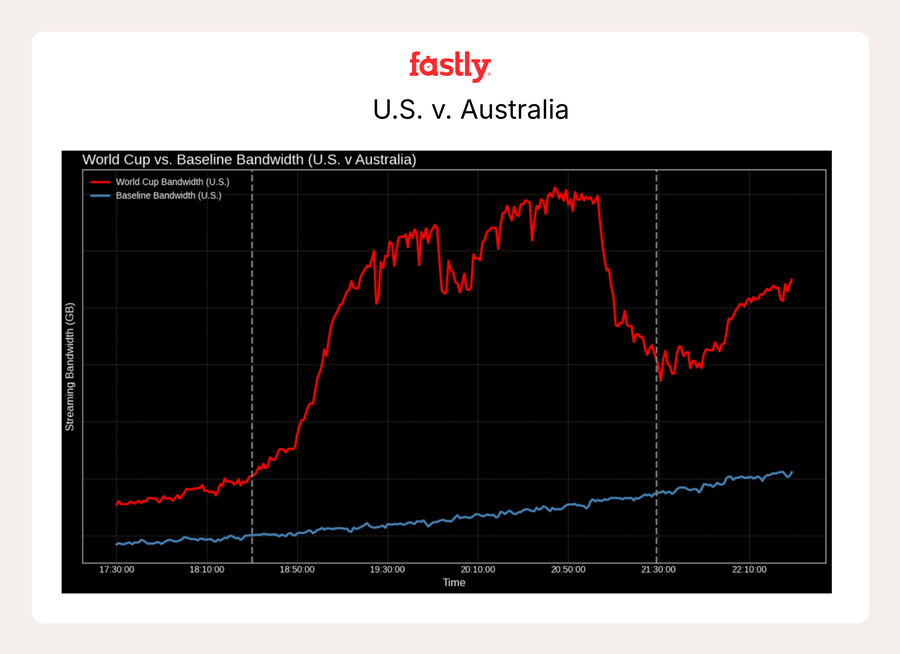
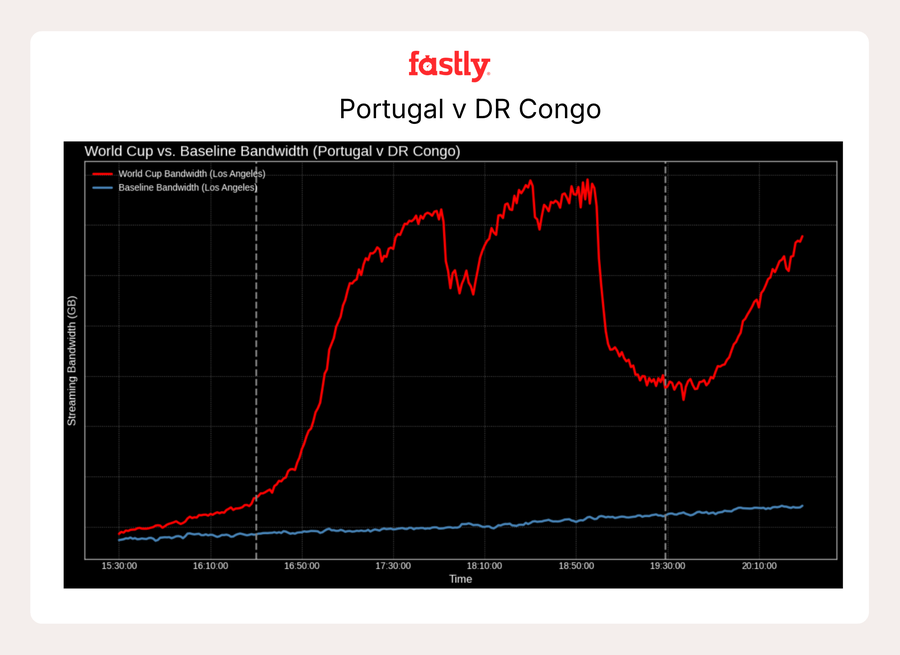
For each game, we analyzed minute-by-minute bandwidth consumption by PoP (Points of Presence) and compared that traffic to the same timeframe for the same weekday from June 3 through June 9 to provide a baseline comparison. For example, the US/Australia match took place on June 19 from 18:30 UTC to 21:29 UTC and we compared it to the same timeframe on June 5. We summed up bandwidth across the length of the game to provide aggregate increases versus baseline. All figures stated below use this methodology.

Here is what the data showed us as the tournament unfolded:

  • Australia: when the US Men's National Team took the pitch against Australia on a Friday, we saw a nationwide wave. Across the board, streaming traffic surged by 93% compared to the same time during our June 3–9 pre-World Cup baseline week. Interestingly, the biggest localized spikes weren't just in expected hubs, but in cities like Palo Alto and Vancouver, which saw bandwidth consumption jump by up to 3x during the game compared to the reference timeframe.
  • Portugal: During Portugal’s thrilling match against the Democratic Republic of Congo, traffic through our Miami and Los Angeles PoPs increased by a staggering 4.81x and 3.26x, respectively, dwarfing the national baseline for that time slot.
  • Sweden: When Sweden played Tunisia, we saw our servers in Columbus reach 3.1x greater than their baseline. Minneapolis lit up, peaking at 1.71x of their traffic levels over the reference period. Later, when Sweden faced the Netherlands, Minneapolis traffic levels reached 1.26x compared to pre-World Cup levels.

  • Cabo Verde: One of the most unexpected results to come out of the World Cup was Cabo Verde, one of the smallest countries to ever qualify. When Cabo Verde played Saudi Arabia, social media bandwidth jumped to 1.4x baseline, with particular spikes of 3.85x in Phoenix and 3.27x in Dallas. iGaming (betting) also saw traffic increase during all three Cabo Verde matches in our dataset, ranging from 1.6x to 2.2x the normal amount. 

Delivering the Passion

These large, dynamic shifts are exactly what keep Fastly focused, and what get our engineering teams fired up. When millions of dispersed fans suddenly demand high-definition, ultra-low-latency video at the exact same second, our infrastructure delivers.

At the end of the day, bytes are just bytes, and servers are just metal. But the data they process during a World Cup represents something much bigger. It represents fans honoring their home cultures while watching on a smartphone in a break room. It represents a neighborhood gathering around a screen to celebrate the teams they grew up watching.

At Fastly, we don't just deliver data. We deliver those moments. And as the final whistle approaches, we'll be here, so the fans can keep cheering.

Learn more about how Fastly's platform can support your critical event streaming at scale.