






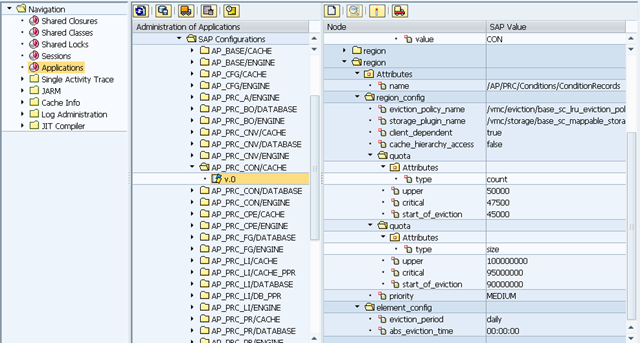
When we try to recommend the proper start_of_eviction/upper/critical parameters in VMC for the condition records, it’s always not so easy to give a number simply by a Note or something else. So far there is no fixed rules for such a estimation. And I want to open this discussion via this blog. Any comments after you reading through the following parts are welcome. :-)
It’s more like a blog to review the pricing procedure determination for transactions. To know how many condition records we are about to use in the current system, we should trace back from where condtion records are fetched in the pricing determination steps.
The CRM pricing procedure could be simply summarized like this:
(1) Sales Area + Doc. Pricing Procedure (PP) + Cust. PP. => Pricing procedure (1 Tran. : 1 PP)
(2) Pricing procedure => Condition Types (1:N)
(3) Condition Types => Access Sequence (this is a one-one mapping)
(4) Access sequences => Accesses (in the definition of AS, normaly 1:N)
(5) Accesses => Condition Tables (1:N)
(6) Condition Tables => Condition records (1:1)
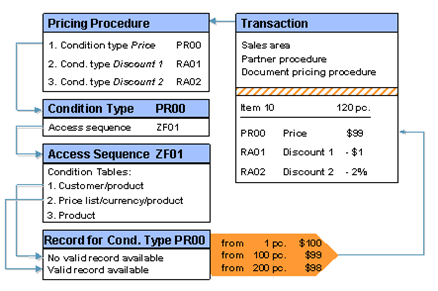
Although only one result for each condtion type is required, we still should consider all the potential calculations. that means we need to consider all the 1:N relationships above instead of not only the 1:N between pricing procedure and the conditon types.
After all the ideas is confirmed, it is quite clear how we should estimate the total number of condition records are estimated in the system.
Let’s assume that all the 1-N relationships were maintained in a simple table and let’s naming it just after the step number (from 1 – 6) like T1, T2, T3, T4, T5, T6.
Then the number result could be roughly estimated in such a calculation:
Loop T1, get all the possible pricing processdures, set it as DATASET1.
For all entries in DATASET1, loop T2, get all the combination of PP and CT, set it as DATASET2, here we need to delete the duplicated entries for the first time.
For all entries in DATASET2, loop T3, get all the access sequences, and delete the dupliated entries again. Set it as DATASET3.
For all entries in DATASET3, loop each Access Sequence and get the total dataset of the accesses (T4) and condition tables therefore with the mapping in T5. Here we get a DATASET4 containing all the condition tables which is supposed to be active.
Then for each condition table, I think we could fetch either 1 or all the number of condition records in that condition table.
This should work out anyway an estimated number. Although there are still a lot of other factors to be considered.
I will do some research and continue explorering the series of tables!!!
Raymond Zhang
If you want to discuss with me about any idea, please contact me at raymond.zhang@sap.com
此内容由惯性聚合(RSS阅读器)自动聚合整理,仅供阅读参考。 原文来自 — 版权归原作者所有。