



惯性聚合 高效追踪和阅读你感兴趣的博客、新闻、科技资讯
阅读原文 在惯性聚合中打开

推荐订阅源

WordPress大学
WordPress大学
O
OpenAI News
钛媒体:引领未来商业与生活新知
钛媒体:引领未来商业与生活新知
博客园 - 三生石上(FineUI控件)
Webroot Blog
Webroot Blog
GbyAI
GbyAI
S
SegmentFault 最新的问题
Cyberwarzone
Cyberwarzone
Exploit-DB.com RSS Feed
J
Java Code Geeks
Google DeepMind News
cs.CV updates on arXiv.org
博客园 - 【当耐特】
S
Secure Thoughts
酷 壳 – CoolShell
酷 壳 – CoolShell
AWS News Blog
AWS News Blog
Engineering at Meta
Engineering at Meta
S
Security Affairs
H
Help Net Security
Microsoft Security Blog
D
DataBreaches.Net
云风的 BLOG
云风的 BLOG
Hugging Face - Blog
Hugging Face - Blog
Google DeepMind News
Spread Privacy
Spread Privacy
T
Threatpost
Forbes - Security
Forbes - Security
C
Cisco Blogs
Scott Helme
Scott Helme
Attack and Defense Labs
Simon Willison's Weblog
腾讯CDC
The Last Watchdog
The Last Watchdog
Cloudbric
Cloudbric
Last Week in AI
Last Week in AI
Recorded Future
Recorded Future
小众软件
小众软件
V
Vulnerabilities – Threatpost
美团技术团队
人人都是产品经理
人人都是产品经理
有赞技术团队
有赞技术团队
Apple Machine Learning Research
Hacker News - Newest:
Hacker News - Newest: "LLM"
I
Intezer
月光博客
月光博客
C
Cyber Attacks, Cyber Crime and Cyber Security
博客园 - 司徒正美
C
Cybersecurity and Infrastructure Security Agency CISA
Martin Fowler
Martin Fowler
博客园 - 聂微东

Citrix Blogs

Celebrating the Partners powering Citrix forward – Citrix Blogs What’s left for humans? – Citrix Blogs Why this moment feels different – Citrix Blogs Introducing Citrix Platform for Public Sector – Citrix Blogs how our partnership with Google has matured secure access for the browser era – Citrix Blogs When session recording stops scaling – Citrix Blogs A conversation with Cletis Earle – Citrix Blogs Imprivata Ready Certification validates Citrix Unicon: A practical guide for healthcare IT – Citrix Blogs Skills are all you need – Citrix Blogs UHMC customers now have expanded Citrix Secure Private Access entitlement – Citrix Blogs How CIOs turn post‑merger disorder into a synergy engine – Citrix Blogs why your AI strategy is focused on the wrong layer – Citrix Blogs Securing high privileged admin access doesn’t have to be complicated – Citrix Blogs What will knowledge work be in 18 months? Look at what AI is doing to coding right now. – Citrix Blogs Untangling spaghetti – Citrix Blogs Workers’ “second brains” break every assumption about how we secure knowledge work – Citrix Blogs Taming integration chaos (the core of M&A failure) – Citrix Blogs OpenClaw and Moltbook preview the changes needed with corporate AI governance – Citrix Blogs Three years. Five Use Cases. A Leader: Citrix – Citrix Blogs The hard truths about hospital consolidation: An M&A guide for IT leaders – Citrix Blogs Why Citrix is the most complete EUC platform – Citrix Blogs Sign in once, get more done: Why continuous identity is a strategic advantage – Citrix Blogs Everyone’s worried about the wrong AI security risk – Citrix Blogs Security by design, proven by action with Citrix NetScaler – Citrix Blogs The invisible 80%—what corporate-led AI transformations can’t see – Citrix Blogs Workers don’t want to build automations. They want to delegate. – Citrix Blogs speed vs. security – Citrix Blogs AI will be THE interface to knowledge work. Here’s how we’ll get there. – Citrix Blogs Why I joined Citrix — and what it means for healthcare leaders – Citrix Blogs How the most successful CIOs are building successful merger and acquisition approaches – Citrix Blogs IT admits workers control AI. Workers admit they use it to leave at 5. – Citrix Blogs One identity. Every app. Now inside Citrix sessions. – Citrix Blogs Built-in AI intelligence that keeps IT focused – Citrix Blogs Everyone wants to provide your AI. Nobody wants to help you manage it. – Citrix Blogs Certificate lifetimes are shrinking—your business continuity doesn’t have to: Automating SSL/TLS at scale with NetScaler – Citrix Blogs Advancing Zero Trust at the browser – Citrix Blogs Citrix is headed to Microsoft Ignite 2025 as a Partner of the Year Finalist, top sponsor, and more! – Citrix Blogs Three trends reshaping how work happens – Citrix Blogs Our vision for secure access in a browser-first world – Citrix Blogs Will AI need to operate your legacy desktop apps or is direct file manipulation enough? – Citrix Blogs an executive blueprint for streamlined app delivery – Citrix Blogs AI just created 10,000 accidental citizen developers in your company. Welcome to the post-application era! – Citrix Blogs Why healthcare IT leaders are embracing Unicon + Imprivata – Citrix Blogs Windows 10 & IGEL OS 11 end-of-life: How Unicon OS turns deadlines into competitive advantage – Citrix Blogs The bitter lesson of workplace AI: Stop engineering, start enabling – Citrix Blogs If AI is normal technology, boring infrastructure is your best strategy – Citrix Blogs Innovation, efficiency, and the future of licensing – Citrix Blogs Worker-led AI isn’t shadow IT. It’s shadow strategy. – Citrix Blogs Everyone’s wrong about why enterprise AI is failing – Citrix Blogs Citrix Virtual Apps and Desktops 2507 Long Term Service Release is now available: Get current, stay ahead – Citrix Blogs If AI progress stopped today, we can still transform the enterprise with what we have – Citrix Blogs AI agents are the new insider threat. Secure them like human workers. – Citrix Blogs How NetScaler helps prevent a silent data breach decades in the making – Citrix Blogs What happens when AI agents score 100% in computing using benchmarks? – Citrix Blogs Citrix DaaS for Amazon WorkSpaces Core Managed Instances – Citrix Blogs Why AI agents will use the same desktops and apps as human workers – Citrix Blogs Modern applications need modern networking — Here’s what that means for your business – Citrix Blogs Powering your present, readying your future, and now available for all workloads – Citrix Blogs To understand AI’s future impact, check out this playbook from 150 years ago – Citrix Blogs The 7-stage roadmap for human-AI collaboration in the workplace (2025 edition) – Citrix Blogs Secure your business with Citrix and Google Chrome Enterprise Premium – Citrix Blogs AI agents need a secure place to work. The Citrix workspace is ready. – Citrix Blogs What’s New and Next with Citrix: Q&A from our May 2025 webinar – Citrix Blogs What if your CEO never sends the AI-first memo? – Citrix Blogs Your CEO just sent a company-wide “AI-First” memo. Now what? – Citrix Blogs Citrix and Nutanix team up to simplify virtual desktop management – Citrix Blogs eLux + Imprivata coming soon for healthcare and beyond – Citrix Blogs Rising costs. Aging hardware. One smart solution. – Citrix Blogs Citrix Virtual Apps and Desktops 2503 is now generally available – Citrix Blogs What does “AI” mean at Citrix? – Citrix Blogs Making sense of AI in the workplace: A starting point for leaders – Citrix Blogs Control the endpoint, control the experience – Citrix Blogs Why I joined Citrix and what I’m excited about – Citrix Blogs Citrix’s approach to Secure by Design – Citrix Blogs Citrix and NVIDIA partner to deliver AI Virtual Workstations – Citrix Blogs Welcoming Google Chrome Enterprise Premium into the Citrix platform – Citrix Blogs Apple M4 chip delivers another significant performance boost to Citrix VDA for macOS! – Citrix Blogs Updated STIG guidance for highly secure environments – Citrix Blogs It’s time to upgrade your hypervisor to XenServer 8! – Citrix Blogs Furthering our investment in the Citrix platform with the strategic acquisition of Unicon – Citrix Blogs Faster logins, more productivity – Citrix Blogs New optimization for Microsoft Teams in Citrix environments – Citrix Blogs Password spraying attacks on NetScaler/NetScaler Gateway – December 2024 – Citrix Blogs Citrix Secure Private Access delivers ZTNA in hybrid mode – Citrix Blogs Citrix strengthens zero trust security posture with strategic acquisitions of deviceTRUST and Strong Network – Citrix Blogs Ease your virtual machine device management with MCS & Intune – Citrix Blogs Free uberAgent training is now available on Pluralsight – Citrix Blogs Improved security, admin interfaces, and user experiences across the Citrix solution portfolio – Citrix Blogs Citrix ranked highest for all 4 Use Cases in the Gartner® Critical Capabilities for Desktop as a Service Report – Citrix Blogs Join us at Microsoft Ignite – Citrix innovations for the modern workplace – Citrix Blogs Improve user experiences and reliability with new expanded uberAgent entitlements – Citrix Blogs Citrix Secure Private Access now supports multi-session VDI – Citrix Blogs The new Citrix platform experience – Citrix Blogs Citrix Secure Private Access for ZTNA now supports Linux – Citrix Blogs Citrix Workspace app – いつの間に?Citrixへの入口がこんなに進化しました – Citrix Blogs Launch right into your Citrix environment with Desktop Lock – Citrix Blogs Making Policy Management Smarter and Simpler with Citrix Policy Sets – Citrix Blogs Image and Power Management Support for Azure Sovereign Air-gap – Citrix Blogs Think you have what it takes to be a CTP or CTA? Apply today! – Citrix Blogs How Citrix supports financial contact centers 24/7 – Citrix Blogs
The desktop has dissolved. Now where does work live in 2025? – Citrix Blogs
Brian Madden · 2025-05-01 · via Citrix Blogs

For decades, the desktop was the center of work. A worker sat down at a physical machine—typically running Windows—and everything they needed was right there: apps, files, security, and access. Their work lived in a single, managed workspace, tightly coupled to a device controlled by IT.

Today, that world is long gone. The old metaphor of “the desktop is the workspace” has melted, as the components that made up the workspace now float freely and recombine dynamically when needed. Today’s workspace isn’t tied to a specific operating system or machine, rather it’s more abstract, portable, and accessible. The modern workspace is no longer a place where work happens. It’s the control plane for work itself.

We meant to do this, right?

In many ways, we’re living our dream.

I remember “futuristic” videos from decades ago showing a worker moving their apps and context from a desktop, to a (yet-to-be-invented) palm-sized device, to a (yet-to-be-invented) wall-sized home display. Wild!

Even wilder is, over the next few decades, we humans actually went out and built those things!

  • We pulled the Windows workspace out of the desktop computer and centralized it so it can be accessed from anywhere via VDI and DaaS.
  • We invented new kinds of apps that run inside browsers, accessible from anywhere.
  • We stopped buying and installing software and started consuming it as a service, accessible from anywhere.
  • We built always-connected portable devices for accessing all of this from anywhere.
  • We reached the point where everything—apps, files, data, and communications—follows us, available anywhere, anytime, and from any device.

We’re living the dream we spent decades building. Huzzah!

But what did we lose?

Congratulations aside, standing here in 2025 and looking at this new world we built, a bunch of hard questions come up:

  • How do we secure something that doesn’t really live anywhere anymore?
  • How do we manage it when it’s everywhere and nowhere at the same time?
  • How do we control access if everything is now a service instead of a thing?

In the early days of this evolution, we treated the new world just like a fancier version of the existing world. The desktop was still a “desktop”—it just lived somewhere else. We could domain-join it, install security agents, and manage it just like before.

Then mobile happened. We initially tried managing phones the same as desktops. While we couldn’t domain-join them (not for lack of trying), we figured out how to push policies, secure them, and manage them as if they were portable mini-desktops.

As apps moved to the web, we rejoiced because they were so much “easier” to manage than traditional desktop apps. After all, managing a single local app (the browser) provided access to dozens of different corporate apps. A life hack!

As we were figuring this all out, technological progress continued. The workspace kept reducing down into smaller and smaller chunks. (“Wait, I need to manage browser plug-ins now?”) Modern apps, data, and usage patterns slipped through our existing nets. The model was evolving faster than our management tools could keep up.

Eventually we realized that we couldn’t keep wrapping the outside tighter. We had to flip the model to start thinking from the inside out.

What a workspace really is now

We’ve established that in today’s world, the workspace isn’t a device. It’s not an OS, and it’s not a browser.

The modern workspace is a fungible abstraction. It comes to life in a VDI desktop, on a MacBook with Chrome, in a mobile app, or via a browser tab. It’s in any and all and none of these at the same time. But those tangible representations of a workspace are just that—instantiated instances of the workspace—not the workspace itself.

So what is a workspace?

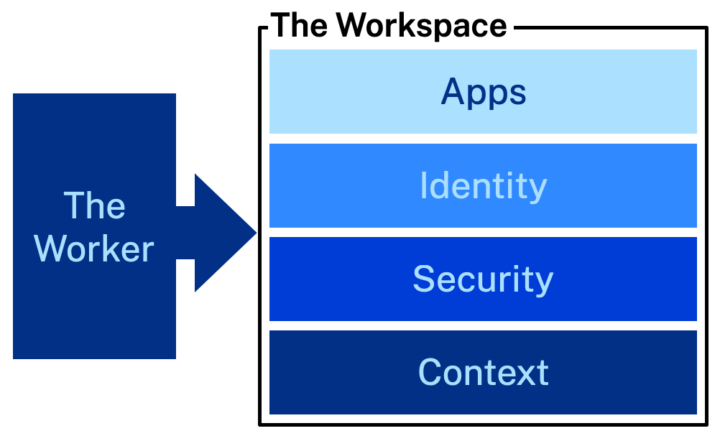
To me, a workspace is the sum of its components:

  • Apps
  • Identity
  • Security
  • Context

Wherever and whenever these converge—that’s the workspace.

Workspace + Worker = Work

While you could be excused for thinking this is just a philosophical exercise, in 2025 and beyond it will be important to understand what the workspace really is, and where it lives, if you want to secure and manage it.

I don’t just mean managing all the various devices where the worker and workspace come together—I mean managing the workspace itself. The way to do that is to think of the workspace as a dynamic control plane—a layer that’s always available to a worker, regardless of where they are or what device they’re using.

This isn’t about controlling devices anymore. It’s about controlling the context.

When all the components—the apps, identity, security, and some context—come together, they create the workspace. The moment a worker connects—bringing their knowledge, intent, and agency—is when the workspace becomes real. (It’s alive!)
Why does this matter?

Devices, browsers, apps, and identities still matter, but just as ingredients. The missing piece is the workspace itself, created in the moment when apps, identity, security and context converge around a worker. In 2025, if you don’t manage that context, you leave openings that attackers, shadow IT, and auditors will find.

Treating the workspace as a dynamic control plane lets you:

  1. Unify policy at the source. A worker’s identity and risk posture automatically govern every workspace session, wherever it spins up.
  2. Adapt in real time. Add or retract privileges as context shifts (time, location, device posture), rather than only at log-in.
  3. Deliver seamless experiences. Let your workers jump between devices and tools without losing context.

In 2025, work no longer lives in a fixed location—it emerges dynamically, wherever a worker connects to a workspace. By treating the workspace as a dynamic control plane, you can unify policy enforcement at its source, adapt security in real-time, and deliver seamless worker experiences across devices and locations. Ultimately, managing the modern workspace means managing the moment when work truly happens—securing not just the tools, but the work itself.

Join the conversation and discuss this post on LinkedIn or Bluesky. You can find all my posts on my author page on the Citrix blog (or via RSS).