





Microsoft Ignite just wrapped and Citrix was there in a big way. From our product announcements to our breakout sessions to our massive booth, we brought conversations about the future of work to life over the four days.
One of the fun ways we engaged attendees was by asking four simple questions about AI at work. We got over 1,500 responses and streamed the live results via the huge LED display tower in the middle of our booth.
I initially didn’t give much credence to the results, as this was a simple survey designed for lighthearted engagement rather than scientific rigor. But as I flipped through my photos on the flight home, I realized our “throwaway” questions reveal some interesting insights about both IT pros and workers.
The first question we asked: Who controls AI at work?
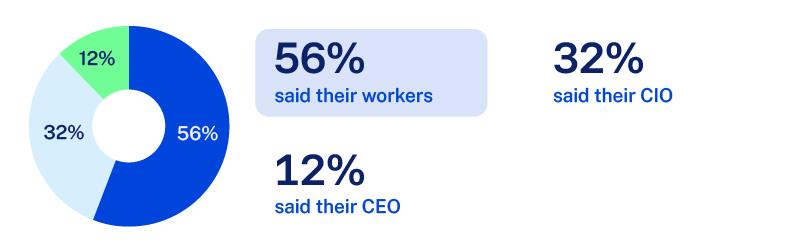
While we had QR codes for our survey in our ads at San Francisco airport and in the Lyft app, the vast majority of our respondents accessed the survey via links at Ignite. Therefore I assume most of our respondents were IT professionals, not end users.
So this question asking who controls AI at work is interesting not because the majority of respondents said the workers do, but because this is IT professionals saying the workers do. (e.g. The very people whose job it is to govern technology are telling us they don’t govern this!)
I’ve been writing for months about how worker-led AI adoption is outpacing enterprise strategy and how companies pour millions into top-down AI initiatives while their workers get more usable results with $20 ChatGPT subscriptions. But I wasn’t expecting IT to just … confirm it.
The CIO/CEO split (32%/12%) is interesting too. Even among the minority who think leadership is in control, it’s the CIO rather than the CEO. All those “AI-first” memos from executive suites apparently aren’t translating to perceived control. The CEO might light the fire, but workers decide where it spreads.
To be clear, this isn’t a failure of IT or a lack of executive vision, it’s just reality. Workers discovered that AI makes their jobs easier, and they’re not waiting for permission to use it. (They never do! We saw the same pattern with smartphones, cloud apps, and every other wave of technology that actually worked.)
We asked: Where would your AI badge in at work?

Nearly half the respondents rejected the premise entirely. The “office vs. cloud” framing is already obsolete. AI isn’t a thing that lives in a place—it’s a capability that shows up wherever work happens.
This maps directly to my exploration of what a workspace actually is in 2025. It’s not a device, OS, or location; rather, the workspace is the dynamic convergence of apps, identity, security, and context around a worker.
If AI needs to “badge in everywhere,” you can’t govern it at the device layer or the application layer. You need governance at the workspace layer—the control plane that follows the work regardless of where it happens or who (or what) is doing it.
The IT pros who responded get this intuitively. AI goes where work goes. The governance & security model has to match.
We asked: What’s your biggest infrastructure challenge for scaling AI on virtual desktops or Cloud PCs?

This question had a bit more of a “desktop” spin, (which could be computer using agents doing real work, not just local models on laptops with NPUs), so I truly didn’t know how the results would shake out. Funny that good old-fashioned economics strikes again. (You could even make the argument that limited GPU/NPU is also a form of economic limitation, which taken together reach 61%.)
This is the “AI as normal technology” thesis playing out in real time. People aren’t waiting for better models, and they’re not blocked by GPU shortages. We’re all stuck with the unglamorous work of making the economics pencil out.
A few months ago, I wrote that even if all AI development stopped today, we’d still have years of transformation ahead just integrating what already exists. These responses confirm that. People aren’t struggling because the technology isn’t ready—they’re struggling because operationalizing it is hard. Infrastructure, cost management, and compatibility—the unsexy boring infrastructure bubbles to the top again.
We asked: How would you spend the hour AI saves you daily?

This was supposed to be the throwaway question which turned out to be the most revealing.
The standard enterprise AI narrative assumes workers want to be more productive for the company. AI saves time, productivity gains flow to the organization, and everyone wins. But that’s not what these responses say. When AI saves workers an hour, they don’t want to spend it on more work output, they want it for themselves.
They’re not dreaming of higher OKRs. They want to leave at 5.
This reframes why worker-led AI adoption is outpacing top-down initiatives. The motivation isn’t corporate, it’s personal. The CEO wants transformation, but the worker wants breathing room. Those aren’t the same thing, and workers are the ones holding the tools.
I’ve written about how AI is recalibrating what we value, as things that were valuable because they required human effort don’t have the same value when AI makes them easy. This is the worker’s version of that recalibration. If AI can do in minutes what used to take an hour, why should that hour still belong to the company?
Companies expecting to capture the full productivity dividend should probably revisit that assumption.
By the way, props to the 3% who answered “social media”. At lease we know our respondents are answering honestly.
These four findings paint a picture of AI adoption that’s messier and more human than the AI consultant strategy decks suggest.
Workers are in control, and IT knows it. AI needs to be everywhere, which means governance has to be everywhere too. The real challenges are economic and operational rather than technical. And when AI saves workers time, they’re keeping it.
None of this is a crisis, but it confirms reality and why you’ve got to start thinking about the workspace as the control plane. Remember, it’s not about locking things down or blocking the AI tools workers have already adopted, but securing the environment where work actually happens, regardless of who or what is doing it, or where.
Meet workers where they are, provide the guardrails, and get out of the way. That’s what we’ve been helping Citrix customers do for decades, and the model extends naturally as AI enters the workspace.
Read more & connect
Join the conversation and discuss this post on LinkedIn. You can find all my posts on my author page (or via RSS).
Photo: Matt Lee, Graphics: Ryan Flowers
此内容由惯性聚合(RSS阅读器)自动聚合整理,仅供阅读参考。 原文来自 — 版权归原作者所有。