





惯性聚合 高效追踪和阅读你感兴趣的博客、新闻、科技资讯
阅读原文 在惯性聚合中打开

推荐订阅源

爱范儿
爱范儿
P
Palo Alto Networks Blog
月光博客
月光博客
H
Hackread – Cybersecurity News, Data Breaches, AI and More
I
InfoQ
aimingoo的专栏
aimingoo的专栏
腾讯CDC
T
Threatpost
D
DataBreaches.Net
Vercel News
Vercel News
F
Fortinet All Blogs
Engineering at Meta
Engineering at Meta
C
Cybersecurity and Infrastructure Security Agency CISA
Forbes - Security
Forbes - Security
U
Unit 42
C
Check Point Blog
Blog — PlanetScale
Blog — PlanetScale
O
OpenAI News
量子位
TaoSecurity Blog
TaoSecurity Blog
Microsoft Azure Blog
cs.AI updates on arXiv.org
V
Visual Studio Blog
Recorded Future
Recorded Future
云风的 BLOG
云风的 BLOG
Security Archives - TechRepublic
The Last Watchdog
The Last Watchdog
S
Security Affairs
Attack and Defense Labs
罗磊的独立博客
Stack Overflow Blog
Stack Overflow Blog
Microsoft Security Blog
让小产品的独立变现更简单 - ezindie.com
V
V2EX
小众软件
小众软件
S
SegmentFault 最新的问题
www.infosecurity-magazine.com
W
WeLiveSecurity
AI
AI
Threat Intelligence Blog | Flashpoint
博客园 - 聂微东
I
Intezer
Know Your Adversary
Know Your Adversary
Exploit-DB.com RSS Feed
P
Proofpoint News Feed
freeCodeCamp Programming Tutorials: Python, JavaScript, Git & More
The Cloudflare Blog
博客园_首页
NISL@THU
NISL@THU
K
KPMG report finds enterprise disconnect between AI and its ROI | CIO

Cisco Blogs

Cisco Live 2026: Bringing the Future of Customer Experience to Las Vegas Edge opportunity for service providers: Turn infrastructure into new services MRC and SRv6: How Foundational Networking Innovations Are Enabling the Next Generation of AI Supercomputers The SMB Marketing Reset: Winning Customer Trust in a Digital-First Economy Inside the SOC: AI-powered DNS defense against ransomware Our Path Forward Securing the Federal Digital Experience with Cisco ThousandEyes for Government Cisco at ONUG Dallas 2026: Securing the AI Data Center in the Agentic Era Cisco and Red Hat are powering intelligent core to edge: Red Hat Summit insights Building the Capabilities That Win: How Cisco Partners Can Lead in the SMB & Mid-Market Era How Two Hours Felt Bigger Than My To-Do List Announcing Foundry Security Spec Ace the CCIE Collaboration Lab: Success Tips from a TAC Engineer Turned CCIE Protecting Agents with Cisco AI Defense and Google Agent Development Kit Powering an Inclusive Future: Your guide to the Purpose Pavilion at Cisco Live Las Vegas The Infrastructure Behind the Mission: SOF Week 2026 Cisco Networking App Marketplace Partners at Cisco Live 2026 Beyond the Pilot: Building the Clinical Data Fabric for the Agentic Era Benchmarking scale-out AI fabrics with Cisco N9000 + AMD Pensando™ Pollara 400 NICs Month of Developer Productivity: Build and Forget The race to autonomous transport networks: A new study Lean IT, future-ready: How to save time and simplify wireless management with AI Reading Between the Pixels: Failure Modes in Vision Language Models Biochar’s triple win: Healthier soils, improved crops, and decarbonization Designing a Proactive Customer Journey Modernize your data center operations with Cisco Nexus Dashboard Why your automation stack needs Cisco Agentic Workflows Try Cisco AI Defense Explorer Edition in this hands-on lab From Bandwidth to Intelligence: How Cisco is Powering AI-Ready Networks Spotlight on digital transformation | FY25 Purpose Report Galaxy Mode is live: A limited-time look at what your Cisco AI Assistant and AgenticOps can already do Securing the Agentic Workforce: Cisco Announces Intent to Acquire Astrix Security Understanding CISA BOD 26-02: Mitigating Risk from End-of-Support Edge Devices Digging Deeper: The Future of Mining with Automation and Ultra-Reliable Wireless Voices from the field: Helping farmers build resilient local economies across rural America Built like a startup, scaled like Cisco: Transforming data center cooling for the AI era Defining Model Provenance: A Constitution for AI Supply Chain Safety and Security Introducing Model Provenance Kit: Know Where Your AI Models Come From Security Insights: A Threat-First View for the Platform That Enforces Access How I Turned My Curiosity into a Patent From Strategy to Architecture: How Cisco is Building a Quantum-Safe Future Maximizing Managed Security Services: A Strategic Guide to Optimizing Your Portfolio (Part 1 of 2) Simplify access control in five easy steps Trust: Why security is your next growth engine Cisco IQ is generally available. Here’s what that actually means. From Vision to Reality: Intelligence in Action with Cisco IQ How connectivity is shaping the future of surgical care The power of your network: Solving a physical security incident on Vision portal 5 signs your data center is holding your AI strategy back Stop Overthinking OT Security: The Total Cost of Ownership and Being Smart with Refreshes AI-Ready, Simpler, and More Secure WAN: Cisco SD-WAN Innovations Scaling the digital future: Why AI and skills investments matter for business and society Expanding our Product Organization Recap Scaling the Future: Reddit AMA on Network Automation at Scale Bringing Professional-Level Skills to Cisco Networking Academy Announcing Cisco Availability in Google Cloud Marketplace: A New Path to Scalable, Partner-Led Growth The Innovation Paradox: How We Reduced Incidents by 25% While Deploying Faster Funding the AI-ready data center: Why flexibility wins The switch that quantum networking has been waiting for From a Message I Couldn’t Believe to a Stage I’ll Never Forget The Hidden Bottleneck Slowing Down Manufacturing Transformation 30 Years as a CCIE: Why Certifications Matter in the AI Era Securing Enterprise AI: Cisco AI Defense Expands to Google Cloud How ThousandEyes Closed the Cloud Visibility Gap by Solving It Themselves First Energy Will Define the Scale of AI Introducing the AI Agent Security Scanner for IDEs: Verify Your Agents Stop Overthinking OT Security: People, Process and Technology Powering the Future of Research: Join Cisco at NLIT 2026 Building the Digital Foundation for a Smarter West Lincoln Memorial Hospital How Cisco built an AI-RRM that maximizes your wireless solution From Automation to Autonomy: Cisco and Rockwell Power a New Era for Manufacturing Unlocking the Future of Fan Engagement: The Power of VisionEDGE Find Yourself in the Future: AI Is the New Baseline—Here’s How to Build Your Skills One Day with Our Customers: Driving better outcomes through customer centricity What It Really Takes to Build an AI-First Workforce From Connectivity to Security: How E80 Future-proofed its AGV Operations with Cisco The Infrastructure of a Floating City: AIDA Cruises’ CX-Led Digital Transformation Scaling your network for AI without a forklift upgrade Why modern networks are moving DDoS defense to the edge Evolve IP Media to AI-Driven Media Fabrics: Future-Proof Broadcast with Cisco and NVIDIA Cisco and Generation are scaling AI-powered pathways to employment Reading Between the Pixels: Assessing Prompt Injection Attack Success in Images Lean IT, future-ready: Why Wi-Fi is your AI growth strategy Cisco Modeling Labs: Bringing the Network Digital Twin to Life Designing for What’s Next: Securing AI-Scale Infrastructure Without Compromise Scaling the Future: Join Our Reddit AMA on Network Automation at Scale 5 wireless trends retail IT teams can’t ignore in 2026 Can your infrastructure management tools do that? Sustainability 101: Let’s talk about energy efficiency From Chai Breaks to Checkpoints: A Day at Cisco Bengaluru Preparing for Post-Quantum Cryptography: The Secure Firewall Roadmap Non-Obvious Patterns in Building Enterprise AI Assistants Making AI Trustworthy and Observable in Real-Time: Cisco Announces Intent to Acquire Galileo A simpler path to unified, AI-ready network operations Cisco Celebrates The Smart Industry Industrial Transformation Award Winners Mobile World Congress 2026: AI-powered Network Security Powering MWC Barcelona – Building a Unified SOC and NOC with Splunk in Record Time How New Data Streams Transformed Cisco Store’s Decision-Making AI-powered Network Security at the Mobile World Congress 2026 SNOC Inside the Mobile World Congress 2026 SOC: Detecting Shadow Traffic with Firepower 6100
AI on the Factory Floor: Why Manufacturing Requires a New Architecture with Cisco Unified Edge
Carlos Rojas · 2026-04-15 · via Cisco Blogs

At Hannover Messe this year, innovation isn’t discussed in theory. It’s demonstrated in motion. 

Production lines, robotics, and control systems all point to the same shift: AI is moving directly into the operation of the factory itself. Not as dashboards. Not as delayed analysis. 

But as systems that make decisions in real time—adjusting processes, preventing defects, and keeping production running. 

That shift, from insight to action, is redefining what industrial infrastructure must deliver. 

From Industry 4.0 to Autonomous Industrial Operations 

For years, Industry 4.0 has been about digitizing the factory: connecting machines, collecting data, and improving visibility across operations. Now, that foundation is enabling something more advanced: software-defined automation and the emergence of autonomous industrial operations. 

In this new model: 

  • Sensors and cameras continuously monitor production 
  • Data is processed in real time 
  • AI models detect anomalies, predict issues, and recommend actions 
  • Systems respond automatically; adjusting processes, triggering maintenance, or stopping defects before they propagate 

This is closed-loop AI, where observation, inference, and action happen as part of a continuous system. And it’s happening directly on the factory floor. 

This is a fundamental shift in how manufacturing systems operate. As Blake Moret, Chairman and CEO of Rockwell Automation, explained in a recent conversation with Cisco, “In the past, a machine was most performant on the day it passed commissioning. With AI, machines can continue to learn and become more performant over time.” 

Where AI Actually Runs: The Reality of Factory Architecture  

Manufacturing environments are not flat networks. They are structured in layers—each with distinct responsibilities and constraints. To make this more concrete, it helps to visualize how these environments are structured and where different workloads operate across the factory. 
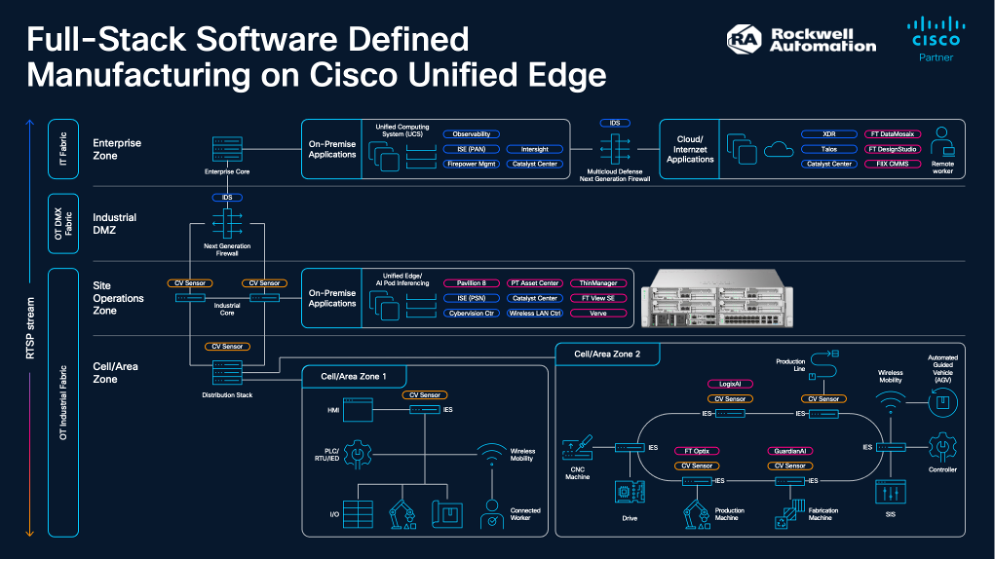
Figure: Example industrial architecture showing cell area, site operations, and edge compute placement across the factory floor.

From machine-level control in the cell area, to coordination in the site operations zone, to integration points across factory and enterprise systems, workloads are distributed intentionally.

The Factory Floor is Becoming a Compute Platform

As AI and software-defined control converge, the factory floor itself is evolving into a new kind of compute environment. Historically, industrial systems like programable logic controllers (PLC) or human machine interfaces (HMI) operated independently. That separation worked when workloads were fixed and predictable.

But AI changes that.

Modern manufacturing requires systems that can ingest data, analyze in real time, and act immediately. That’s driving a shift toward consolidated platforms where multiple workloads operate together within the same environment. Manufacturers are now bringing together:

  • Control logic (PLC/virtual PLC)
  • Visualization (HMI)
  • Monitoring with supervisory control and data acquisition (SCADA) systems
  • AI workloads (vision, prediction, optimization)

Advances in compute, including GPU acceleration, now make it possible to run these side by side without compromising performance or reliability. As Blake Moret noted, “Where you get the real benefit is when you combine and integrate these capabilities into a cohesive system.”

This is more than consolidation. It’s a shift toward a platform model, where the factory floor itself becomes the place where data is processed, decisions are made, and actions are executed in real time.

Real-World AI on the Line

These changes aren’t theoretical. They are already taking shape in real production environments.

In high-speed manufacturing lines, such as beverage production, AI systems can monitor fill levels, detect anomalies, and adjust processes instantly; ensuring consistency at scale without slowing throughput. In food production environments, AI can analyze visual and sensor data to maintain quality and consistency, adjusting variables like temperature or ingredient levels in real time.

Regardless of the specific use case, the pattern remains consistent: continuous data ingestion, immediate AI-driven inference, and automated, low-latency execution. Whether it’s identifying a microscopic defect or triggering a safety stop before equipment overheats, the value of AI is directly tied to the speed of the closed loop.

As Rajat Arora, Global Head of Networks at PepsiCo, noted in a recent conversation with us,  “The value really comes from being able to act on the data quickly.”

In addition to new levels of automation, GPUs at the edge can help workforces maximize uptime and production by applying self-service Generative AI Assist Tools to obtain answers to problems with machine set-up or equipment repair in seconds rather than minutes or hours.

This the human-in-the loop approach ensures that AI not only acts autonomously but also augments the people responsible for keeping production running. These patterns are already being adopted at scale across global manufacturing operations.

“It’s about bringing compute closer to where the data is generated so we can make faster decisions and operate more efficiently,” Arora added.

An Ecosystem Driving Industrial AI Forward

Industrial AI is not built in isolation. It is delivered through an ecosystem of automation leaders and software providers. This is already taking shape through close collaboration between Cisco and industrial automation leaders, where software, control systems, and AI workloads are being brought together on a shared edge platform.
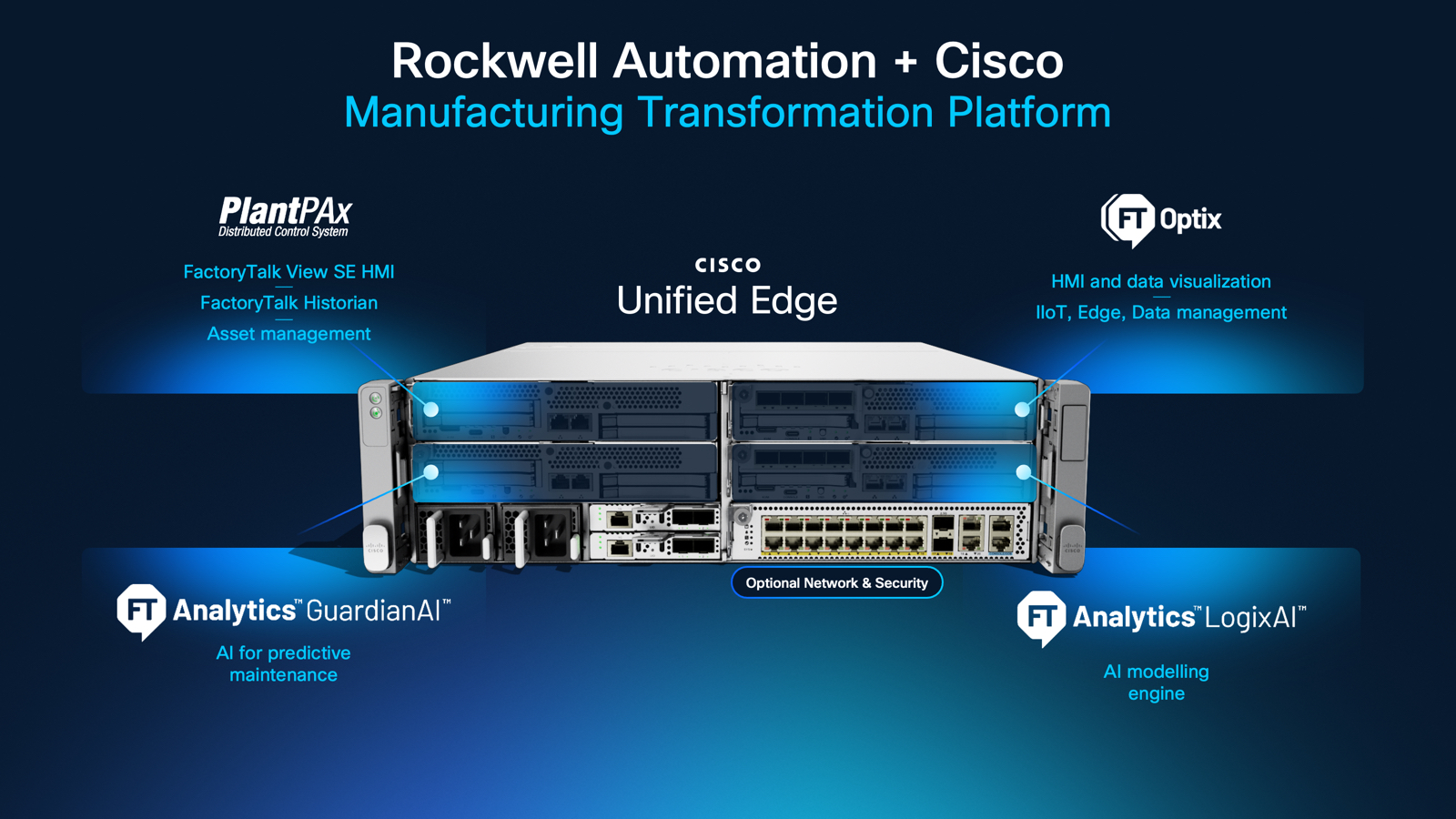
Figure: Example architecture showing how industrial control, visualization, and AI workloads are integrated on Cisco Unified Edge through partnerships with Rockwell Automation.

Companies like Rockwell Automation, Siemens, and Schneider Electric are developing the control systems, software platforms, and AI-driven applications that power modern factories. As these workloads evolve, they require infrastructure that can support them reliably within the constraints of industrial environments.

Platforms like Cisco Unified Edge are designed to provide that foundation; bringing together compute, acceleration, and secure operations in a form factor suited for the factory floor. We’re particularly excited to see this in action through our new strategic partnership with Rockwell Automation.

Why Architecture Matters Now

As manufacturing moves toward autonomous operations, infrastructure is no longer a background consideration. It is a determining factor.

AI workloads in industrial environments require:

  • Deterministic performance, not variable latency
  • Local execution, not dependency on external connectivity
  • Strong isolation, not shared-risk architectures
  • Scalable operations across multiple sites

This is about supporting a new model of operation where decisions are made continuously, and outcomes are shaped in real time.

The Path Forward

At Hannover Messe and beyond, the direction is clear. Manufacturing is moving toward a world where:

  • Control systems are software-defined
  • AI is embedded into operations
  • Decisions happen at the edge, not at a distance

The question is no longer whether AI can improve manufacturing outcomes. It’s whether infrastructure can operate at the speed, precision, and reliability the factory floor demands.

Increasingly, that means bringing intelligence directly to where work happens, and building architectures designed not just for insight, but for action.

If you’re attending Hannover Messe 2026, you can join us at the Rockwell Automation booth to see our our joint demonstration of FactoryTalk® Optix™ and GuardianAI™ running on Cisco Unified Edge, or you can learn more about the partnership in recent blog from Jeremy Foster.

To learn more about how Cisco Unified Edge is supporting the next generation of AI in manufacturing, connect with our team and explore our manufacturing solutions portfolio. We’ve also developed industry-specific at-a-glances (AAGs) that outline practical deployment models for manufacturing and other distributed environments.