



惯性聚合 高效追踪和阅读你感兴趣的博客、新闻、科技资讯
阅读原文 在惯性聚合中打开

推荐订阅源

U
Unit 42
罗磊的独立博客
博客园 - 聂微东
T
The Blog of Author Tim Ferriss
博客园 - 司徒正美
Stack Overflow Blog
Stack Overflow Blog
F
Fortinet All Blogs
A
About on SuperTechFans
腾讯CDC
Apple Machine Learning Research
B
Blog RSS Feed
IT之家
IT之家
V
Visual Studio Blog
freeCodeCamp Programming Tutorials: Python, JavaScript, Git & More
宝玉的分享
宝玉的分享
C
Check Point Blog
Cyber Security Advisories - MS-ISAC
Vercel News
Vercel News
爱范儿
爱范儿
Microsoft Security Blog
月光博客
月光博客
T
Tailwind CSS Blog
The Cloudflare Blog
Hugging Face - Blog
Hugging Face - Blog

Cisco Blogs

Edge opportunity for service providers: Turn infrastructure into new services MRC and SRv6: How Foundational Networking Innovations Are Enabling the Next Generation of AI Supercomputers The SMB Marketing Reset: Winning Customer Trust in a Digital-First Economy Inside the SOC: AI-powered DNS defense against ransomware Our Path Forward Securing the Federal Digital Experience with Cisco ThousandEyes for Government Cisco at ONUG Dallas 2026: Securing the AI Data Center in the Agentic Era Cisco and Red Hat are powering intelligent core to edge: Red Hat Summit insights Building the Capabilities That Win: How Cisco Partners Can Lead in the SMB & Mid-Market Era How Two Hours Felt Bigger Than My To-Do List Announcing Foundry Security Spec Ace the CCIE Collaboration Lab: Success Tips from a TAC Engineer Turned CCIE Protecting Agents with Cisco AI Defense and Google Agent Development Kit Powering an Inclusive Future: Your guide to the Purpose Pavilion at Cisco Live Las Vegas The Infrastructure Behind the Mission: SOF Week 2026 Cisco Networking App Marketplace Partners at Cisco Live 2026 Beyond the Pilot: Building the Clinical Data Fabric for the Agentic Era Benchmarking scale-out AI fabrics with Cisco N9000 + AMD Pensando™ Pollara 400 NICs Month of Developer Productivity: Build and Forget The race to autonomous transport networks: A new study Lean IT, future-ready: How to save time and simplify wireless management with AI Reading Between the Pixels: Failure Modes in Vision Language Models Biochar’s triple win: Healthier soils, improved crops, and decarbonization Designing a Proactive Customer Journey Modernize your data center operations with Cisco Nexus Dashboard Why your automation stack needs Cisco Agentic Workflows Try Cisco AI Defense Explorer Edition in this hands-on lab From Bandwidth to Intelligence: How Cisco is Powering AI-Ready Networks Spotlight on digital transformation | FY25 Purpose Report Galaxy Mode is live: A limited-time look at what your Cisco AI Assistant and AgenticOps can already do
Accelerating Enterprise-Scale AI Development & Experiment...
Navin Bilwar · 2026-05-23 · via Cisco Blogs

With special thanks to Arkaprabho Ghosh and David Reed. 

As AI continues to transform the enterprise landscape, the challenge for large organizations isn’t just adopting the technology—it’s scaling it effectively. At Cisco, we recognized that while our teams were eager to build Retrieval-Augmented Generation (RAG) applications, the process was often fragmented. Developers were spending months stitching together different components of a RAG pipeline—such as loaders, splitters, embedding models, and vector databases. Each component carried its own learning curve and operational overhead. The burden of evaluating an overwhelming number of open-source tools and endlessly experimenting with various configurations to find the right fit for specific use cases ultimately led to inconsistent standards, technical debt, and widespread “technology fatigue”.

To solve this, Cisco IT created DRIFT (Document Retrieval and Ingestion Framework Toolkit), a standardized, scalable platform that supports rapid development and experimentation in RAG workflows with the ability to scale to meet enterprise-standard workloads.

Simplifying the AI Journey

DRIFT was built with a simple premise: application teams should focus on building AI-first experiences and business logic, not on the heavy lifting of infrastructure. We are removing the barriers to entry by providing a platform that handles the complexity of data pipeline orchestration, allowing teams to fast-track their AI journey without the need for extensive ramp-up time on underlying, complex technologies.

Whether you are a hard-core developer requiring deep API-level control or a business user looking for an intuitive interface, DRIFT provides a true end-to-end development and experimentation environment.

The Cisco-on-Cisco Advantage: Built for Scale & Security

DRIFT is a powerful example of the Cisco-on-Cisco advantage—where Cisco software is built to run on Cisco’s own AI infrastructure. Built on a cloud-native microservices architecture and deployed on Kubernetes, DRIFT is engineered for agility, resilience, and enterprise-scale performance. Its asynchronous ingestion and file upload architecture is designed to handle large volumes of enterprise data efficiently, enabling high-throughput pipelines without sacrificing reliability.

At the heart of this foundation are Cisco AI PODs powered by Cisco UCS-C885A hardware. This gives DRIFT the high-performance compute backbone needed for demanding AI workloads such as inferencing, embeddings, and reranking. By running on-premise across multiple Cisco Data Centers, DRIFT combines scale, strong security, high availability, and operational control in a way that meets the needs of enterprise AI.

The result is more than just a modern AI platform—it is a clear demonstration of how Cisco AI software and Cisco AI infrastructure come together to deliver production-ready performance at scale. With DRIFT running on Cisco AI PODs built on UCS-C885A, Cisco is showcasing an end-to-end AI stack that is scalable, secure, and purpose-built for enterprise innovation.
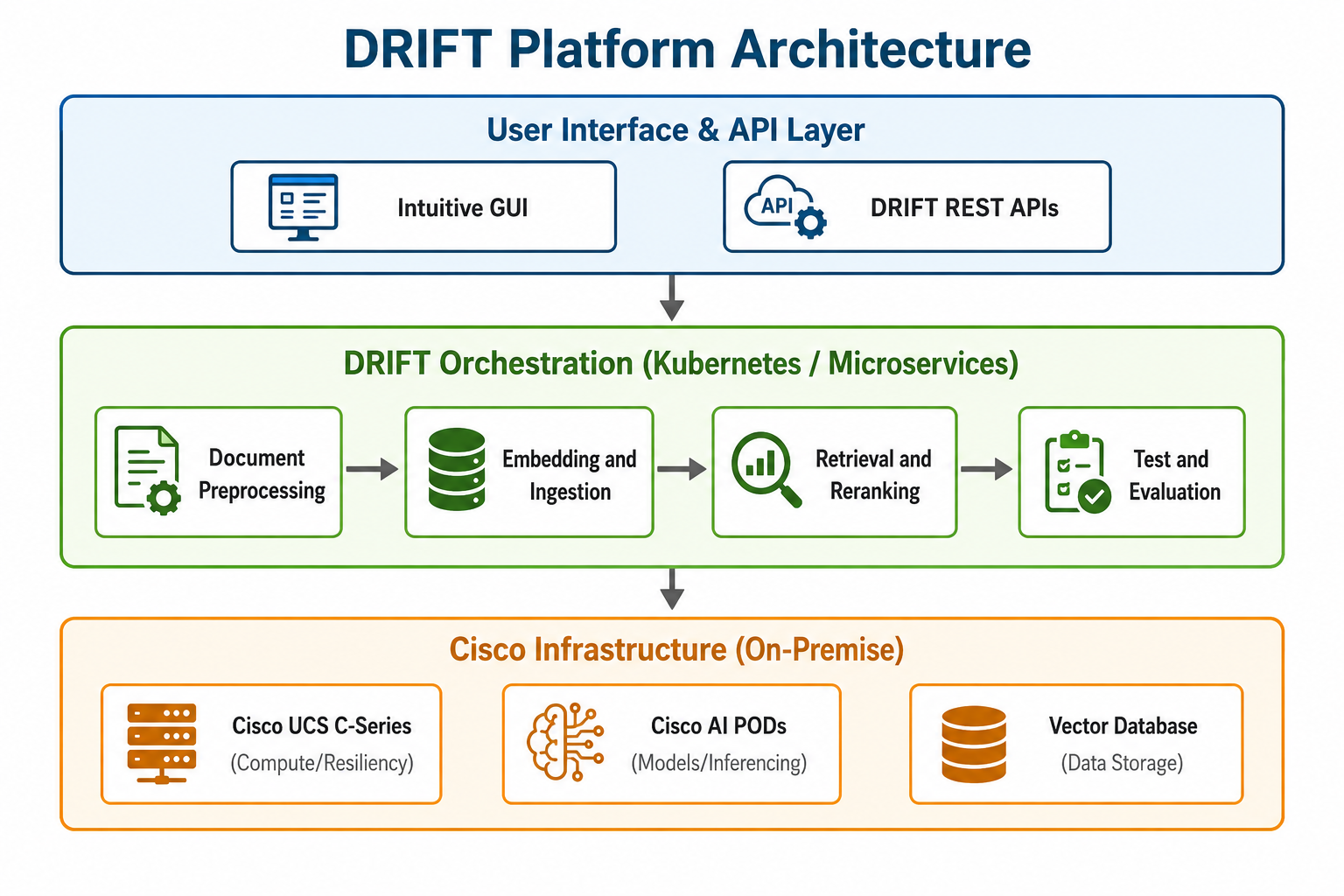
The DRIFT Methodology: Powering Secure RAG

DRIFT streamlines the path from raw document to intelligent assistant through a robust, modular pipeline architecture:

  • Document Preprocessing: We support diverse document sources and formats, standardizing diverse enterprise data into a consistent, model-ready format. We even leverage Vision Language Models (VLM) to convert images within documents into text representations.
  • Intelligent Splitting and Hybrid Processing: DRIFT supports a variety of splitting algorithms, including the ability to preserve a document’s structural formatting during the splitting process. For documents with mixed content, it also enables a hybrid approach that selectively processes images—serving as a highly effective cost optimization technique.
  • Embedding and Ingestion: Teams can choose from a suite of standard embedding models or bring their own. We offer seamless integration with both shared multi-tenant as well as dedicated Vector databases to suit a variety of business use cases. Our platform supports both keyword and semantic search algorithms, ensuring efficient ingestion and retrieval that meet enterprise SLAs.
  • Retrieval and Reranking: DRIFT allows for configurable hybrid search and metadata filtering, ensuring that retrieved data is precise. Our reranking capabilities further refine results based on relevance, significantly increasing accuracy.
  • Adaptive Architecture: Designed for the future, DRIFT supports evolving use cases, including Agentic RAG and Graph RAG, ensuring business applications can scale as AI architectures advance.
  • Built-in Testing and Evaluation: Developers can test retrievers against sample queries and interact with LLMs directly within the platform to validate generative summaries before deployment.

Why is DRIFT a Game-Changer:

  • API-First Architecture: DRIFT was built from the ground up with an API-first approach. We provide comprehensive, ready-to-use APIs for every step of the lifecycle—including document upload, ingestion, retrieval, and configuration—enabling seamless integration into existing enterprise applications and workflows.
  • Full Transparency and Experimentation: We have moved away from the “black-box” approach to a true end-to-end development and experimentation platform that empowers developers with full visibility. Teams have complete control over configuration choices for all components of their pipelines, allowing them to fine-tune, test, and optimize for maximum accuracy.
  • Curated, Responsible AI: We eliminate the guesswork of evaluating open-source libraries. DRIFT provides models that are already vetted and approved by Cisco’s Responsible AI (RAI) and governance teams.
  • Reduced Technology Fatigue: By providing a curated suite of industry-standard components, we save teams from “analysis paralysis.” We handle the integration so they can focus on innovation.
  • Flexibility and Scalability: While we provide standard, high-quality options, DRIFT remains fully flexible. Teams can integrate their own custom Vector Databases or fine-tuned models—such as those specialized for Cisco-specific financial or technical terminology.

Driving Real-World Impact

Since its MVP release in January 2025, the adoption of DRIFT has been extraordinary. Within the first 12 months, we have seen significant adoption with over 600 developers having built more than 1,500 pipelines across diverse business units, including Finance, Supply Chain, Engineering, Legal, IT Operations, and People and Communities.

By reducing the time required to build a data pipeline from months to minutes, DRIFT has become a critical engine for Cisco’s AI strategy, enabling teams to experiment rapidly and deliver high-accuracy, AI-first solutions at scale.

Looking Ahead

The success of DRIFT is a testament to the collaborative spirit at Cisco. By working across teams—from IT & Operations to our various business units—we have created a tool that not only powers internal AI assistants (like our company-wide HR assistant) but also provides a foundation for future product integrations.

As we continue to iterate, DRIFT remains committed to helping Cisco teams move faster, experiment more, and deliver the next generation of AI-powered solutions to our employees, customers and partners.