


惯性聚合 高效追踪和阅读你感兴趣的博客、新闻、科技资讯
阅读原文 在惯性聚合中打开

推荐订阅源

Forbes - Security
Forbes - Security
The Hacker News
The Hacker News
V
Vulnerabilities – Threatpost
C
CXSECURITY Database RSS Feed - CXSecurity.com
Spread Privacy
Spread Privacy
P
Proofpoint News Feed
AWS News Blog
AWS News Blog
S
Securelist
S
Security @ Cisco Blogs
Cloudbric
Cloudbric
T
Troy Hunt's Blog
SecWiki News
SecWiki News
cs.CL updates on arXiv.org
K
KPMG report finds enterprise disconnect between AI and its ROI | CIO
Security Latest
Security Latest
C
Cyber Attacks, Cyber Crime and Cyber Security
AI
AI
Threat Intelligence Blog | Flashpoint
Stack Overflow Blog
Stack Overflow Blog
I
Intezer
I
InfoQ
Attack and Defense Labs
H
Hackread – Cybersecurity News, Data Breaches, AI and More
Recent Commits to openclaw:main
T
The Exploit Database - CXSecurity.com
Cyber Security Advisories - MS-ISAC
N
News | PayPal Newsroom
云风的 BLOG
云风的 BLOG
S
Secure Thoughts
T
The Blog of Author Tim Ferriss
Martin Fowler
Martin Fowler
L
LINUX DO - 最新话题
Exploit-DB.com RSS Feed
D
Darknet – Hacking Tools, Hacker News & Cyber Security
A
About on SuperTechFans
Hacker News - Newest:
Hacker News - Newest: "LLM"
TaoSecurity Blog
TaoSecurity Blog
www.infosecurity-magazine.com
Webroot Blog
Webroot Blog
L
LangChain Blog
MyScale Blog
MyScale Blog
Recent Announcements
P
Privacy & Cybersecurity Law Blog
Vercel News
Vercel News
Engineering at Meta
Engineering at Meta
C
Cybersecurity and Infrastructure Security Agency CISA
Y
Y Combinator Blog
L
Lohrmann on Cybersecurity
B
Blog RSS Feed
The Last Watchdog
The Last Watchdog

Cisco Blogs

Cisco Live 2026: Bringing the Future of Customer Experience to Las Vegas Edge opportunity for service providers: Turn infrastructure into new services MRC and SRv6: How Foundational Networking Innovations Are Enabling the Next Generation of AI Supercomputers The SMB Marketing Reset: Winning Customer Trust in a Digital-First Economy Inside the SOC: AI-powered DNS defense against ransomware Our Path Forward Securing the Federal Digital Experience with Cisco ThousandEyes for Government Cisco at ONUG Dallas 2026: Securing the AI Data Center in the Agentic Era Cisco and Red Hat are powering intelligent core to edge: Red Hat Summit insights Building the Capabilities That Win: How Cisco Partners Can Lead in the SMB & Mid-Market Era How Two Hours Felt Bigger Than My To-Do List Announcing Foundry Security Spec Ace the CCIE Collaboration Lab: Success Tips from a TAC Engineer Turned CCIE Protecting Agents with Cisco AI Defense and Google Agent Development Kit Powering an Inclusive Future: Your guide to the Purpose Pavilion at Cisco Live Las Vegas The Infrastructure Behind the Mission: SOF Week 2026 Cisco Networking App Marketplace Partners at Cisco Live 2026 Beyond the Pilot: Building the Clinical Data Fabric for the Agentic Era Month of Developer Productivity: Build and Forget The race to autonomous transport networks: A new study Lean IT, future-ready: How to save time and simplify wireless management with AI Reading Between the Pixels: Failure Modes in Vision Language Models Biochar’s triple win: Healthier soils, improved crops, and decarbonization Designing a Proactive Customer Journey Modernize your data center operations with Cisco Nexus Dashboard Why your automation stack needs Cisco Agentic Workflows Try Cisco AI Defense Explorer Edition in this hands-on lab From Bandwidth to Intelligence: How Cisco is Powering AI-Ready Networks Spotlight on digital transformation | FY25 Purpose Report Galaxy Mode is live: A limited-time look at what your Cisco AI Assistant and AgenticOps can already do Securing the Agentic Workforce: Cisco Announces Intent to Acquire Astrix Security Understanding CISA BOD 26-02: Mitigating Risk from End-of-Support Edge Devices Digging Deeper: The Future of Mining with Automation and Ultra-Reliable Wireless Voices from the field: Helping farmers build resilient local economies across rural America Built like a startup, scaled like Cisco: Transforming data center cooling for the AI era Defining Model Provenance: A Constitution for AI Supply Chain Safety and Security Introducing Model Provenance Kit: Know Where Your AI Models Come From Security Insights: A Threat-First View for the Platform That Enforces Access How I Turned My Curiosity into a Patent From Strategy to Architecture: How Cisco is Building a Quantum-Safe Future Maximizing Managed Security Services: A Strategic Guide to Optimizing Your Portfolio (Part 1 of 2) Simplify access control in five easy steps Trust: Why security is your next growth engine Cisco IQ is generally available. Here’s what that actually means. From Vision to Reality: Intelligence in Action with Cisco IQ How connectivity is shaping the future of surgical care The power of your network: Solving a physical security incident on Vision portal 5 signs your data center is holding your AI strategy back Stop Overthinking OT Security: The Total Cost of Ownership and Being Smart with Refreshes AI-Ready, Simpler, and More Secure WAN: Cisco SD-WAN Innovations Scaling the digital future: Why AI and skills investments matter for business and society Expanding our Product Organization Recap Scaling the Future: Reddit AMA on Network Automation at Scale Bringing Professional-Level Skills to Cisco Networking Academy Announcing Cisco Availability in Google Cloud Marketplace: A New Path to Scalable, Partner-Led Growth The Innovation Paradox: How We Reduced Incidents by 25% While Deploying Faster Funding the AI-ready data center: Why flexibility wins The switch that quantum networking has been waiting for From a Message I Couldn’t Believe to a Stage I’ll Never Forget The Hidden Bottleneck Slowing Down Manufacturing Transformation 30 Years as a CCIE: Why Certifications Matter in the AI Era Securing Enterprise AI: Cisco AI Defense Expands to Google Cloud How ThousandEyes Closed the Cloud Visibility Gap by Solving It Themselves First Energy Will Define the Scale of AI Introducing the AI Agent Security Scanner for IDEs: Verify Your Agents Stop Overthinking OT Security: People, Process and Technology Powering the Future of Research: Join Cisco at NLIT 2026 Building the Digital Foundation for a Smarter West Lincoln Memorial Hospital How Cisco built an AI-RRM that maximizes your wireless solution From Automation to Autonomy: Cisco and Rockwell Power a New Era for Manufacturing Unlocking the Future of Fan Engagement: The Power of VisionEDGE Find Yourself in the Future: AI Is the New Baseline—Here’s How to Build Your Skills One Day with Our Customers: Driving better outcomes through customer centricity What It Really Takes to Build an AI-First Workforce From Connectivity to Security: How E80 Future-proofed its AGV Operations with Cisco The Infrastructure of a Floating City: AIDA Cruises’ CX-Led Digital Transformation Scaling your network for AI without a forklift upgrade Why modern networks are moving DDoS defense to the edge Evolve IP Media to AI-Driven Media Fabrics: Future-Proof Broadcast with Cisco and NVIDIA Cisco and Generation are scaling AI-powered pathways to employment Reading Between the Pixels: Assessing Prompt Injection Attack Success in Images Lean IT, future-ready: Why Wi-Fi is your AI growth strategy Cisco Modeling Labs: Bringing the Network Digital Twin to Life AI on the Factory Floor: Why Manufacturing Requires a New Architecture with Cisco Unified Edge Designing for What’s Next: Securing AI-Scale Infrastructure Without Compromise Scaling the Future: Join Our Reddit AMA on Network Automation at Scale 5 wireless trends retail IT teams can’t ignore in 2026 Can your infrastructure management tools do that? Sustainability 101: Let’s talk about energy efficiency From Chai Breaks to Checkpoints: A Day at Cisco Bengaluru Preparing for Post-Quantum Cryptography: The Secure Firewall Roadmap Non-Obvious Patterns in Building Enterprise AI Assistants Making AI Trustworthy and Observable in Real-Time: Cisco Announces Intent to Acquire Galileo A simpler path to unified, AI-ready network operations Cisco Celebrates The Smart Industry Industrial Transformation Award Winners Mobile World Congress 2026: AI-powered Network Security Powering MWC Barcelona – Building a Unified SOC and NOC with Splunk in Record Time How New Data Streams Transformed Cisco Store’s Decision-Making AI-powered Network Security at the Mobile World Congress 2026 SNOC Inside the Mobile World Congress 2026 SOC: Detecting Shadow Traffic with Firepower 6100
Benchmarking scale-out AI fabrics with Cisco N9000 + AMD Pensando™ Pollara 400 NICs
Rakesh Kumar · 2026-05-07 · via Cisco Blogs

The “AI paradox” is a growing hurdle for enterprise leaders: investing millions in powerful GPUs, only to watch them sit idle while waiting for data. As enterprises scale from pilot to production, the real bottleneck isn’t compute—it’s the hidden cost of an inefficient network. In scale-out architectures, the tens of thousands of GPUs must synchronize to complete a single training iteration. When the network can’t keep pace with the bursty demands of modern AI training, GPUs stall and job completion time (JCT) spikes. We’ve partnered with AMD to deliver a validated, end-to-end AI infrastructure that eliminates these bottlenecks and transforms the network into a high-performance engine for innovation.

Fabric as the foundation: The Cisco and AMD AI performance blueprint

As AI workloads expand across distributed clusters, the network must scale linearly to prevent packet loss and retransmissions. This performance is only verifiable through rigorous, real-world benchmarking. At Cisco, we prioritize systemic, deterministic performance that goes beyond individual component specs.

Our reference architecture features AMD Instinct™ MI300X GPUs, AMD Pensando™ Pollara 400 NICs, Cisco Silicon One G200-powered N9364E-SG2 switches, and Cisco 800G OSFP optics. Deploying is only half the challenge; operating at scale is the other. Cisco Nexus Dashboard provides the granular, real-time visibility needed for day-0 through day-N operations.
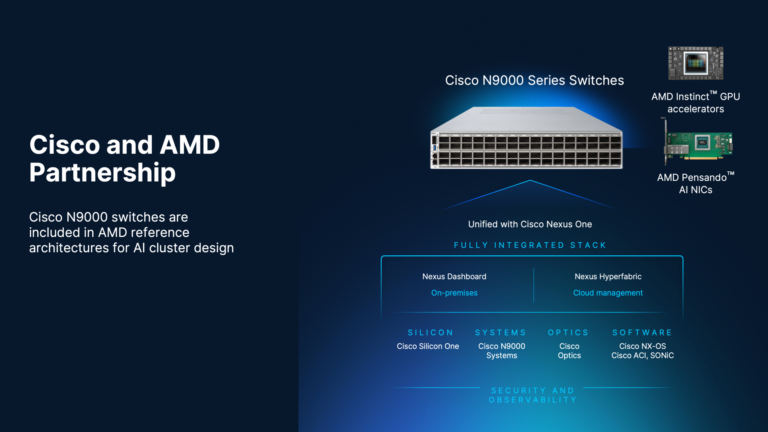
Cisco N9000 Series Switches, with AMD Instinct GPU accelerators and AMD Pensando AI NICs, unified with Cisco Nexus One in a fully integrated stack. N9000 Series switches are included in AMD reference architecture for AI cluster design.
Figure 1: Cisco N9000 Series Switches, with AMD Instinct™ GPU accelerators and AMD Pensando™ AI NICs

By combining these technologies, we minimize JCT and maximize GPU utilization, ensuring AI infrastructure remains secure, compliant, and continuously optimized.

Benchmarking the architecture

We benchmarked two Clos topologies (2×2 & 4×2) with Cisco N9364E-SG2 switches (each with 51.2 Tbps throughput and 64 ports of 800 GbE), 128 AMD Instinct™ MI300X Series GPUs (16 servers x 8 GPUs), 128 AMD Pensando™ Pollara 400 AI NICs (16 servers x 8 NICs), and the AMD ROCm™ 6.3/7.0.3 software ecosystem.

2×2 Clos topology

This design fully subscribes each leaf switch, forcing the switch into high-congestion states to test fabric resilience:
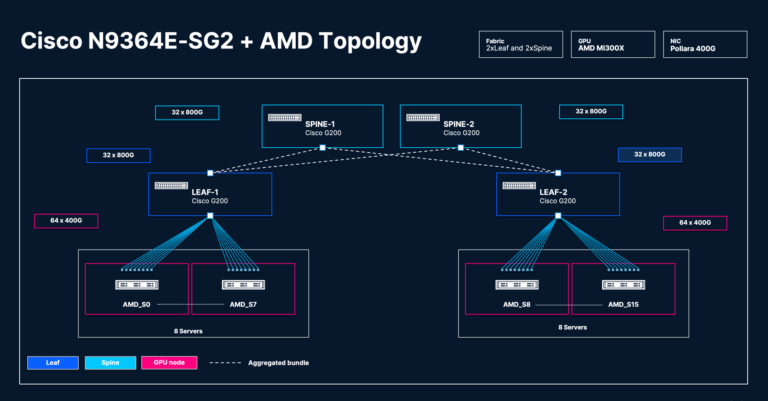
  • 2x leaf and 2x spine (4x Cisco N9364E-SG2) switches
  • 8 servers (8x AMD Instinct™ MI300X Series GPUs) connected to each leaf switch
  • 8x AMD Pensando™ Pollara 400G NICs per server
  • Switch side: Cisco OSFP 800G DR8 optics
2x2 CLOS topology with Cisco N9364E-SG2 + AMD Topology
Figure 2: 2×2 Clos topology

4×2 Clos topology

This design focuses on the efficacy of advanced load-balancing techniques for efficient load distribution during synchronous bursts in the GPU scale-out fabric:
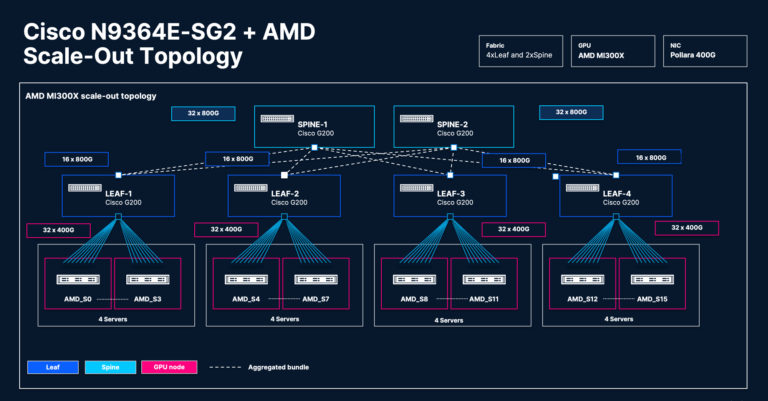
  • 4x leaf and 2x spine (6x Cisco N9364E-SG2) switches
  • 4 servers (8x AMD Instinct™ MI300X Series GPUs) connected to each leaf switch
  • 8x AMD Pensando™ Pollara 400G NICs per server
  • Switch side: Cisco OSFP 800G DR8 optics
4x2 CLOS topology with Cisco N9364E-SG2 + AMD Scale-out Topology
Figure 3: 4×2 Clos topology

Benchmarking tools

We measured scale-out fabric performance using a comprehensive toolset, including:

  • IBPerf measures RDMA performance over scale-out fabric in varying congestive scenarios. We used this tool to test performance between GPUs connected across a single leaf and across leaf-spine.
  • MLPerf is an industry-standard benchmark used to measure actual workload performance. The performance output translates to ROI on fully validated designs from Cisco and AMD.

Network fabric performance benchmarking results

We evaluated scale-out fabric performance using comprehensive testing and standard KPIs.

Single-hop IBPerf testing evaluates performance within a localized fabric domain, typically within a single leaf switch. This establishes a baseline for link utilization, buffer tuning effectiveness, and NIC-to-switch performance prior to introducing multi-hop variables.

These tests measure the Remote Direct Memory Access (RDMA) sessions’ throughput between two GPUs connected through a Cisco N9364E-SG2 leaf switch. The results capture P01 (1st percentile) and P99 (99th percentile) bandwidth, while all the sessions are active simultaneously. P01 bandwidth represents the throughput of the slowest session—a critical metric for synchronized AI/ML workload performance—while P99 represents the throughput of the fastest session. A minimal delta between P01 and P99 bandwidth and each bandwidth closer to the link bandwidth proves the efficacy of the GPU interconnect technology.

In the 2-leaf/2-spine (2×2) topology, each leaf switch handles 32 bi-directional sessions, effectively saturating the leaf switch. The 4-leaf/2-spine (4×2) topology handles 16 bi-directional sessions per leaf. Across both topologies and varying queue pair (QP) counts (4 QPs and 32 QPs), the P01 and P99 bandwidths in both topologies and both sets of queue pairs are closer to each other, with each one approaching the link bandwidth of 400 Gbps.
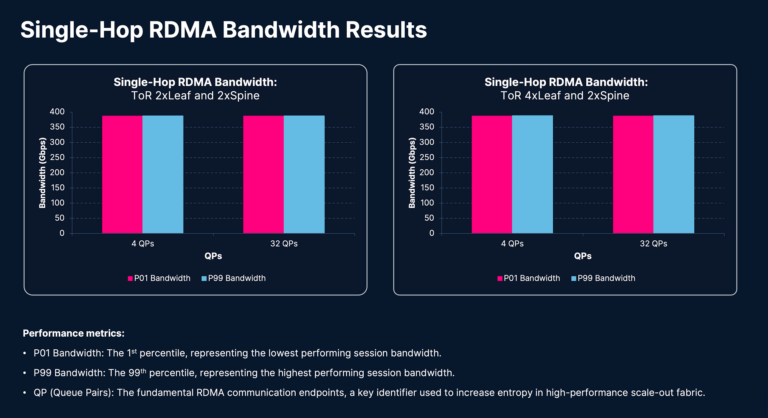
Figure 4: Single-hop RDMA bandwidth performance across varying leaf-spine topologies and queue pair counts

This performance shows that the AMD Pensando™ Pollara NIC and Cisco N9364E-SG2 switches deliver a highly efficient solution for demanding workloads. The tight delta between P01 and P99 metrics across different scale and configurations demonstrates that this architecture maintains deterministic performance, regardless of cluster size or queue pair density.

Bisectional IBPerf testing evaluates cross-fabric traffic traversing multiple tiers to measure bisection bandwidth, path symmetry, cross-spine load balancing, and congestion propagation.

These tests measure RDMA session throughput between two GPUs connected through leaf and spine Cisco N9364E-SG2 switches. The results show P01 and P99 bandwidth measurements with all sessions are simultaneously active. In the 2×2 topology, there are 32 bi-directional sessions per leaf, whereas the 4×2 topology has 16 bi-directional sessions per leaf. All these sessions go over spine. The traffic from each session traverses three hops (leaf-spine-leaf) to stress the entire fabric. This test validates the efficiency of the fabric’s load-balancing algorithm; any traffic polarization would lead to some links being underutilized, while other links become congested, ultimately degrading RDMA session performance. Tests were conducted using 4 and 32 QPs.
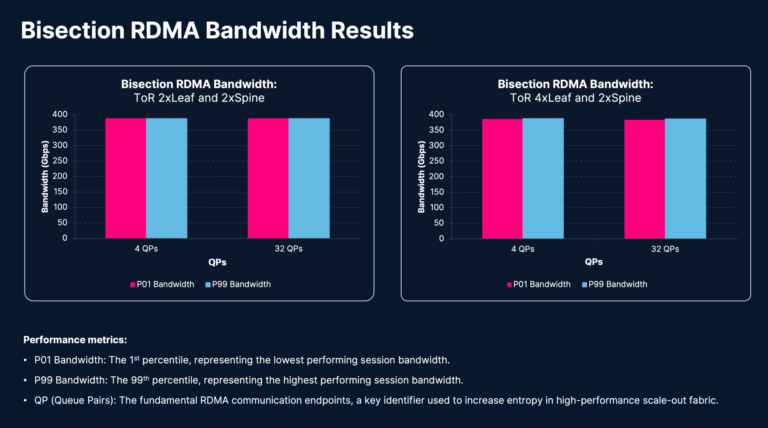
Figure 5: Bisection RDMA bandwidth stability comparison for 2-leaf/2-spine and 4-leaf/2-spine architectures across varying queue pair counts

The results demonstrate that P01 and P99 bandwidths are similar and each is closer to the link bandwidth of 400 Gbps, mirroring the performance observed in single-hop testing. This confirms that the Cisco N9364E-SG2 switches and AMD Pensando™ Pollara NIC provide a high-performance, resilient GPU interconnect technology capable of maintaining consistently deterministic performance under stress.

Congestive IBPerf testing creates high-contention scenarios using a 31:1 communication pattern, where 31 GPUs communicate with a single GPU. It evaluates queue buildup, Explicit Congestion Notification (ECN) effectiveness, Data Center Quantized Congestion Notification (DCQCN) reaction curves, tail latency, and fabric stability under worst-case AI communication patterns.

Incast conditions represent some of the most challenging scenarios for scale-out AI fabric. These tests measure P01 and P99 bandwidths under incast conditions, which manifest during collective communications such as all-to-all. If the scale-out fabric hardware, design, and tuning are not optimal, it leads to substantial degradation in JCT for training workloads. Because it is difficult to synchronize all sessions to start simultaneously, we use the Quantile Range Method to analyze the results. It analyzes bandwidth samples as a result of incast congestion instead of all bandwidth samples.
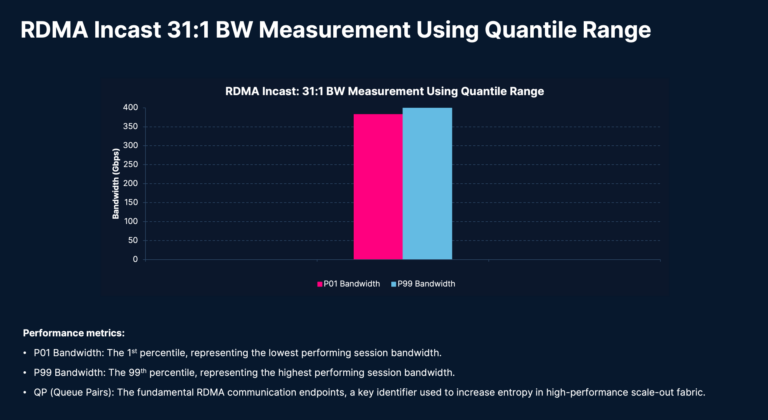
Figure 6: RDMA incast 31:1 congestion performance. Comparison of P01 and P99 bandwidth during high-contention 31:1 incast traffic

In this test, each of the 128 GPUs establishes 31 RDMA sessions to 31 other GPUs across the leaf-spine fabric, resulting in a total of 3,968 (31*128 = 3,968) simultaneously active sessions in the scale-out fabric. The delta between P01 and P99 bandwidth is very tight, and each bandwidth is close to the link bandwidth of 400 Gbps, which is a solid proof point of the Cisco N9364E-SG2 switches’ ability to handle extreme congestive conditions and a testament to the Cisco and AMD validated design.

MLPerf Training and Inference Benchmarking tests establish standardized metrics to evaluate the performance of training and inference workloads. By enforcing strict guidelines regarding models, datasets, and allowable optimizations, these benchmarks provide a level playing field for fair comparison among competing AI infrastructure solutions.

The MLPerf tests from MLCommons are designed to provide a common benchmarking methodology for measuring application-level KPIs, which are the primary indicators of performance for end users. For inference, the Llama 2 70B results demonstrate clear throughput scaling as the configuration expands from two to four nodes. The training benchmarks provide representative data for Llama 2 70B (on two nodes) and Llama 3.1 8B (on eight nodes).
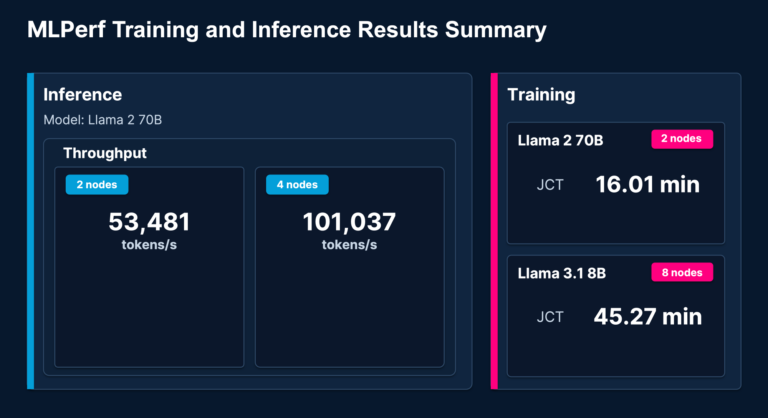
Figure 7: MLPerf training and inference key performance metrics for Llama 2 and Llama 3.1 models, detailing throughput and JCT across multi-node configurations

These findings provide the foundation for our core claim: the Cisco validated architecture is not just theoretically sound; benchmarking shows it can handle the most demanding AI inference and training workloads.

A real-world deployment of the Cisco and AMD AI solution architecture

The Cisco-AMD partnership delivers real-world impact, notably powering G42’s large-scale AI clusters. This end-to-end solution—integrating AMD GPUs, Cisco UCS servers, N9000 800G switches, and Nexus Dashboard—provides the secure, scalable performance required for cutting-edge AI workloads.

“As AI workloads scale, network performance becomes a critical enabler of cluster efficiency. The AMD Pensando™ Pollara 400 AI NIC, with its fully programmable, fault-resilient design, delivers consistent performance for GPU scale-out training. In collaboration with Cisco N9000 switching, we’re advancing Ethernet to the next level, helping maximize GPU utilization and accelerate job completion.”

—Yousuf Khan, Corporate Vice President, Networking Technology and Solutions Group, AMD

Operationalizing intelligence: A new standard for performance at scale

In the age of massive-scale AI, an organization’s infrastructure is either its greatest competitive advantage or its most significant bottleneck. When the stakes involve mission-critical training, fine-tuning, and inferencing, a unified, fully validated ecosystem is a must. Cisco and AMD are changing the equation, delivering a deterministic, high-performance fabric that turns your network into a catalyst for innovation.

Connect with a Cisco AI networking specialist today to design a deployment tailored to your specific workloads.

Start turning your AI potential into production-ready reality today

Additional resources: