


惯性聚合 高效追踪和阅读你感兴趣的博客、新闻、科技资讯
阅读原文 在惯性聚合中打开

推荐订阅源

I
InfoQ
Hugging Face - Blog
Hugging Face - Blog
月光博客
月光博客
量子位
freeCodeCamp Programming Tutorials: Python, JavaScript, Git & More
S
SegmentFault 最新的问题
罗磊的独立博客
Exploit-DB.com RSS Feed
L
LINUX DO - 最新话题
T
Threatpost
Cisco Talos Blog
Cisco Talos Blog
The GitHub Blog
The GitHub Blog
V
V2EX
SecWiki News
SecWiki News
P
Privacy & Cybersecurity Law Blog
Forbes - Security
Forbes - Security
T
Troy Hunt's Blog
S
Security @ Cisco Blogs
Martin Fowler
Martin Fowler
Attack and Defense Labs
A
Arctic Wolf
C
CXSECURITY Database RSS Feed - CXSecurity.com
The Register - Security
Blog — PlanetScale
Blog — PlanetScale
The Last Watchdog
The Last Watchdog
T
Tor Project blog
cs.CL updates on arXiv.org
C
Cisco Blogs
P
Proofpoint News Feed
O
OpenAI News
Hacker News - Newest:
Hacker News - Newest: "LLM"
小众软件
小众软件
雷峰网
雷峰网
H
Heimdal Security Blog
酷 壳 – CoolShell
酷 壳 – CoolShell
Stack Overflow Blog
Stack Overflow Blog
Engineering at Meta
Engineering at Meta
云风的 BLOG
云风的 BLOG
Last Week in AI
Last Week in AI
C
Cyber Attacks, Cyber Crime and Cyber Security
Webroot Blog
Webroot Blog
C
Check Point Blog
Threat Intelligence Blog | Flashpoint
W
WeLiveSecurity
T
Threat Research - Cisco Blogs
人人都是产品经理
人人都是产品经理
Hacker News: Ask HN
Hacker News: Ask HN
The Hacker News
The Hacker News
V
Vulnerabilities – Threatpost
Microsoft Security Blog

Cisco Blogs

Cisco Live 2026: Bringing the Future of Customer Experience to Las Vegas Edge opportunity for service providers: Turn infrastructure into new services MRC and SRv6: How Foundational Networking Innovations Are Enabling the Next Generation of AI Supercomputers The SMB Marketing Reset: Winning Customer Trust in a Digital-First Economy Inside the SOC: AI-powered DNS defense against ransomware Our Path Forward Securing the Federal Digital Experience with Cisco ThousandEyes for Government Cisco at ONUG Dallas 2026: Securing the AI Data Center in the Agentic Era Cisco and Red Hat are powering intelligent core to edge: Red Hat Summit insights Building the Capabilities That Win: How Cisco Partners Can Lead in the SMB & Mid-Market Era How Two Hours Felt Bigger Than My To-Do List Announcing Foundry Security Spec Ace the CCIE Collaboration Lab: Success Tips from a TAC Engineer Turned CCIE Protecting Agents with Cisco AI Defense and Google Agent Development Kit Powering an Inclusive Future: Your guide to the Purpose Pavilion at Cisco Live Las Vegas The Infrastructure Behind the Mission: SOF Week 2026 Cisco Networking App Marketplace Partners at Cisco Live 2026 Beyond the Pilot: Building the Clinical Data Fabric for the Agentic Era Benchmarking scale-out AI fabrics with Cisco N9000 + AMD Pensando™ Pollara 400 NICs Month of Developer Productivity: Build and Forget The race to autonomous transport networks: A new study Lean IT, future-ready: How to save time and simplify wireless management with AI Reading Between the Pixels: Failure Modes in Vision Language Models Biochar’s triple win: Healthier soils, improved crops, and decarbonization Designing a Proactive Customer Journey Modernize your data center operations with Cisco Nexus Dashboard Why your automation stack needs Cisco Agentic Workflows Try Cisco AI Defense Explorer Edition in this hands-on lab From Bandwidth to Intelligence: How Cisco is Powering AI-Ready Networks Spotlight on digital transformation | FY25 Purpose Report Galaxy Mode is live: A limited-time look at what your Cisco AI Assistant and AgenticOps can already do Securing the Agentic Workforce: Cisco Announces Intent to Acquire Astrix Security Understanding CISA BOD 26-02: Mitigating Risk from End-of-Support Edge Devices Digging Deeper: The Future of Mining with Automation and Ultra-Reliable Wireless Voices from the field: Helping farmers build resilient local economies across rural America Built like a startup, scaled like Cisco: Transforming data center cooling for the AI era Defining Model Provenance: A Constitution for AI Supply Chain Safety and Security Introducing Model Provenance Kit: Know Where Your AI Models Come From Security Insights: A Threat-First View for the Platform That Enforces Access How I Turned My Curiosity into a Patent From Strategy to Architecture: How Cisco is Building a Quantum-Safe Future Maximizing Managed Security Services: A Strategic Guide to Optimizing Your Portfolio (Part 1 of 2) Simplify access control in five easy steps Trust: Why security is your next growth engine Cisco IQ is generally available. Here’s what that actually means. From Vision to Reality: Intelligence in Action with Cisco IQ How connectivity is shaping the future of surgical care The power of your network: Solving a physical security incident on Vision portal 5 signs your data center is holding your AI strategy back Stop Overthinking OT Security: The Total Cost of Ownership and Being Smart with Refreshes AI-Ready, Simpler, and More Secure WAN: Cisco SD-WAN Innovations Scaling the digital future: Why AI and skills investments matter for business and society Expanding our Product Organization Recap Scaling the Future: Reddit AMA on Network Automation at Scale Bringing Professional-Level Skills to Cisco Networking Academy Announcing Cisco Availability in Google Cloud Marketplace: A New Path to Scalable, Partner-Led Growth The Innovation Paradox: How We Reduced Incidents by 25% While Deploying Faster Funding the AI-ready data center: Why flexibility wins The switch that quantum networking has been waiting for From a Message I Couldn’t Believe to a Stage I’ll Never Forget The Hidden Bottleneck Slowing Down Manufacturing Transformation 30 Years as a CCIE: Why Certifications Matter in the AI Era Securing Enterprise AI: Cisco AI Defense Expands to Google Cloud How ThousandEyes Closed the Cloud Visibility Gap by Solving It Themselves First Energy Will Define the Scale of AI Introducing the AI Agent Security Scanner for IDEs: Verify Your Agents Stop Overthinking OT Security: People, Process and Technology Powering the Future of Research: Join Cisco at NLIT 2026 Building the Digital Foundation for a Smarter West Lincoln Memorial Hospital How Cisco built an AI-RRM that maximizes your wireless solution From Automation to Autonomy: Cisco and Rockwell Power a New Era for Manufacturing Unlocking the Future of Fan Engagement: The Power of VisionEDGE Find Yourself in the Future: AI Is the New Baseline—Here’s How to Build Your Skills One Day with Our Customers: Driving better outcomes through customer centricity What It Really Takes to Build an AI-First Workforce From Connectivity to Security: How E80 Future-proofed its AGV Operations with Cisco The Infrastructure of a Floating City: AIDA Cruises’ CX-Led Digital Transformation Scaling your network for AI without a forklift upgrade Why modern networks are moving DDoS defense to the edge Cisco and Generation are scaling AI-powered pathways to employment Reading Between the Pixels: Assessing Prompt Injection Attack Success in Images Lean IT, future-ready: Why Wi-Fi is your AI growth strategy Cisco Modeling Labs: Bringing the Network Digital Twin to Life AI on the Factory Floor: Why Manufacturing Requires a New Architecture with Cisco Unified Edge Designing for What’s Next: Securing AI-Scale Infrastructure Without Compromise Scaling the Future: Join Our Reddit AMA on Network Automation at Scale 5 wireless trends retail IT teams can’t ignore in 2026 Can your infrastructure management tools do that? Sustainability 101: Let’s talk about energy efficiency From Chai Breaks to Checkpoints: A Day at Cisco Bengaluru Preparing for Post-Quantum Cryptography: The Secure Firewall Roadmap Non-Obvious Patterns in Building Enterprise AI Assistants Making AI Trustworthy and Observable in Real-Time: Cisco Announces Intent to Acquire Galileo A simpler path to unified, AI-ready network operations Cisco Celebrates The Smart Industry Industrial Transformation Award Winners Mobile World Congress 2026: AI-powered Network Security Powering MWC Barcelona – Building a Unified SOC and NOC with Splunk in Record Time How New Data Streams Transformed Cisco Store’s Decision-Making AI-powered Network Security at the Mobile World Congress 2026 SNOC Inside the Mobile World Congress 2026 SOC: Detecting Shadow Traffic with Firepower 6100
Evolve IP Media to AI-Driven Media Fabrics: Future-Proof Broadcast with Cisco and NVIDIA
Devanshi Kotak · 2026-04-16 · via Cisco Blogs

The media and entertainment industry is undergoing a seismic shift. Throughout the history of live media, the production control room (PCR) has been a hardware-centric, serial digital interface (SDI)–connected environment managing a single linear feed. Today, it has rapidly evolved into a hybrid, software-defined hub. Broadcasters face the daunting challenge of orchestrating hundreds of simultaneous media flows, spanning linear, FAST, and OTT feeds, social and multilingual variants, all while personalizing content to retain viewers.

In this high-pressure environment, the integration of AI and automation is no longer optional; it’s essential. AI-driven workflows promise to revolutionize live production, but they demand robust, high-performance infrastructure to ensure reliability, high quality, and seamless operation.

Cisco IP Fabric for Media: The Backbone of Reliability

Cisco IP Fabric for Media (IPFM) is designed for the rigorous demands of live production. With Cisco N9000 Series Switches managed on-premises through Nexus Dashboard as part of the Nexus One architecture, Cisco IPFM delivers:

  • Non-blocking, high-bandwidth architecture to handle uncompressed 4K, 8K, and up to 16K video flows.
  • Precision Time Protocol (PTP) for microsecond-level synchronization.
  • SMPTE ST 2022-7 support for redundant, air-gapped paths, guaranteeing uninterrupted media streams.

Cisco IPFM integrates end to end with top broadcast vendors including Imagine Communications, EVS, Lawo, Panasonic, and Nevion.

Cisco’s Leadership in Media Fabrics for AI

A key area of development in media is the integration of AI to enable capabilities such as automated captioning, real-time content analytics, AI-driven replay, and automated graphics. The emerging Media Exchange Layer (MXL) addresses the need for high-performance data exchange between media applications and AI processes. The Media Exchange Layer (MXL) is an open-source software framework designed to standardize how uncompressed video, audio, and timed metadata are shared across modern, cloud-native, or containerized media production environments.

Cisco’s media fabric, built on N9000 infrastructure, is an industry-leading platform that can now support MXL workloads. These include AI and containerized media workloads to coexist with traditional ST 2110 flows using Non-Blocking Multicast (NBM) within the same fabric. Cisco’s NAB 2026 announcements introduce the industry’s best single fabric with MXL for media workflows, which is a breakthrough compared to two or more fabrics. We can achieve this by allowing AI workloads or containerized media workloads across applications directly over Remote Direct Memory Access (RDMA).

This architecture reduces latency by enabling direct access to media flows for real-time inference, transforming the network from a transport layer into an active component of the content creation process.

“Software-driven broadcast production is the future, and real-time media exchange is a critical piece of this evolution. We are thrilled to collaborate with Cisco on our new project that leverages the Media Exchange Layer (MXL). Together, we are transforming how we handle live production workflows. Cisco provides the powerful network infrastructure we need, while France TV brings the media vision. This partnership enables us to build a fast, flexible workflow from major events like Roland Garros and the Olympic Games to our day-to-day production control rooms”

— Yannick Olivier, Technical Leader IP Media, France Télévisions

Here are the primary business outcomes you can achieve by implementing MXL:

  • Scale broadcast operations elastically: Handle peak broadcast traffic effortlessly by leveraging shared infrastructure including audio mixers, production switchers, audio consoles, and more across distributed data centers to scale up broadcast operations.
  • Streamline vendor-neutral workflows: Accelerate your production cycles by removing the need for custom, bespoke integrations. MXL seamlessly bridges traditional ST 2110 feeds with modern software applications. This connection guarantees real-time, vendor-neutral exchange of video, audio, and metadata across your entire production ecosystem.
  • Unlock real-time AI processing: Integrate AI into your live broadcasts without latency or costly data movement. Using RDMA, MXL provides a low-latency, shared-memory framework. This standard interoperable bridge allows multiple AI applications to simultaneously access and process live streams, empowering automated production and instant AI analysis.

Enhancing Media Workflows: Integrating Cisco IP Fabric for Media with NVIDIA Holoscan for Media

Cisco is making bold steps in strengthening its broadcast endpoints. This is why Cisco and NVIDIA are collaborating to develop a new schema for next-generation media infrastructure to define the future of media production.

To address the complexities of adopting AI in live production, Cisco has developed a Cisco Validated Design (CVD) for NVIDIA Holoscan for Media and Cisco IP Fabric for Media. This partnership combines Cisco’s industry-leading networking infrastructure with NVIDIA’s real-time AI platform and NIMs, creating a pre-tested, scalable schema for next-generation production environments. The result? Broadcasters can confidently deploy AI-enabled workflows and pipelines with the assurance of reliability and performance.

This solution brings together two purpose-built platforms—NVIDIA Holoscan for Media for real-time AI processing and Cisco IP Fabric for Media for the high-performance network foundation that makes it all possible at scale.

NVIDIA Holoscan for Media: AI at the Core of Live Production

NVIDIA Holoscan for Media is a software-defined, AI-enabled platform designed to run real-time video and audio pipelines on high-performance IT infrastructure. Leveraging containerization and Kubernetes, Holoscan for Media enables scalable AI applications such as live graphics, generative video, super resolution, and AI-powered captioning.

NVIDIA Holoscan for Media + Cisco IP Fabric for Media

By combining general-purpose computing with the immense parallel processing power of NVIDIA AI infrastructure, Holoscan for Media enables developers to build sophisticated, live media pipelines that integrate advanced AI capabilities directly into the broadcast workflow.

Deploying such high-performance, data-intensive compute layers requires a network foundation of equal sophistication and resilience. This is where Cisco IP Fabric for Media (IPFM) serves as the critical infrastructure backbone. While Holoscan for Media acts as the engine for next-generation rendering and AI inference, Cisco IPFM acts as the intelligent transport layer, leveraging Cisco Non-Blocking Multicast (NBM) to manage bandwidth and ensure that critical streams are delivered without congestion or packet loss.

“The future of media production lies at the intersection of AI innovation and robust networking infrastructure. With NVIDIA Holoscan for Media, we’re enabling broadcasters to harness real-time AI capabilities like multilingual audio, video, and graphics translation, transforming how content is created and delivered. Together with Cisco’s IP Fabric for Media with N9000 Series Switches with NVIDIA Spectrum-X Ethernet technology, we’re providing a seamless, scalable foundation that empowers our customers to push the boundaries of creativity while ensuring the reliability demanded by live production.”

— Richard Kerris, VP of Global Media & Entertainment, NVIDIA

Breaking Barriers: Real-Time Multilingual Broadcasting

One of the most compelling use cases of this integration is real-time caption translation with synchronized lip movements across multiple languages. Imagine a single live feed dynamically adapted to match translated audio tracks, delivering an authentic, native viewing experience for global audiences. This groundbreaking capability eliminates the need for traditional post-production dubbing, enabling broadcasters to:

  • Deliver multilingual feeds in real time.
  • Break down language barriers at scale for global reach.
  • Enhance viewer engagement with AI-driven personalization.

NVIDIA Holoscan for Media handles the AI-intensive processing, while Cisco IPFM built on Cisco N9000 Series Switches ensures reliable delivery of high-bandwidth traffic.

Together, NVIDIA Holoscan for Media and Cisco IP Fabric for Media deliver a future-ready, open-standards-based production environment that combines the limitless creativity of AI with the uncompromising reliability of enterprise-grade networking.
What’s New with Cisco IP Fabric for Media?

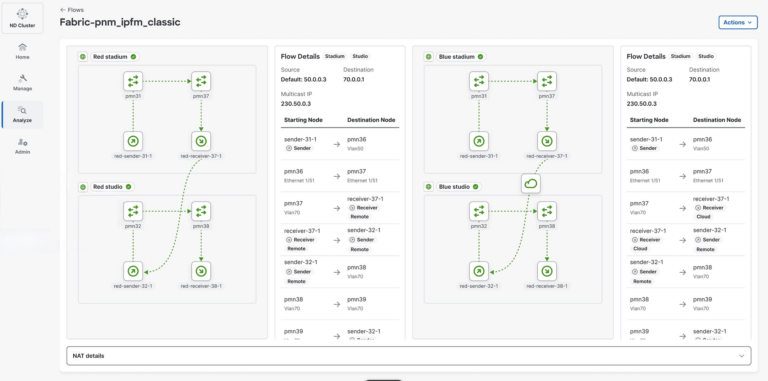
  • End-to-end flow visibility for multisite fabrics: To support the growing adoption of remote production sites, Cisco Nexus Dashboard now extends its flow visibility to include remote traffic. This capability ensures complete monitoring of remote senders and flows, significantly simplifying monitoring and troubleshooting processes.
Figure 1: Cisco Nexus Dashboard displaying multicast traffic flow analysis
  • Automation for PIM Flooding Mechanism – Source Discovery: Traditionally, Protocol Independent Multicast Sparse Mode (PIM-SM) relies on a Rendezvous Point (RP) and shared trees to establish multicast traffic paths. PIM Flooding Mechanism – Source Discovery (PFM–SD) simplifies this process by removing the need for RPs and shared trees, instead flooding multicast source information throughout the PIM domain using a generic PIM flooding mechanism. This enables routers to discover active sources without requiring initial data packets or a central RP, thereby reducing operational complexity and providing much faster convergence as well as optimal traffic forwarding. We will offer support for PFM–SD in both single and multisite scenarios. The automation for this feature capability will now be available using Nexus Dashboard.
  • Automate granular media flow priority with Cisco Nexus Dashboard: Ensure the seamless, high-quality delivery of time-sensitive media, such as live broadcasts, without delay or packet loss. To give administrators more precise control, this capability now features up to 16 distinct priority levels for managing a wide variety of media flows. Additionally, proactive bandwidth management automatically adjusts or preempts lower-priority traffic to safeguard your most critical content during network congestion.

Experience the Future of Media at NAB 2026

Join Cisco at the National Association of Broadcasters (NAB) Show 2026 in Las Vegas, April 18–22. Explore our latest innovations in media networking and AI-driven production at West Hall – Booth #W2633. Don’t miss our mini-theater sessions featuring:

  • AI Networks for Media on Apr 19 (Sunday) at 11:20am
  • How EVS and Cisco delivered a ST2110 solution at the Gillette Stadium, home of the New England Patriots on Apr 19 (Sunday) at 11:20am
  • Automating IP Fabrics for Media on Apr 20 (Monday) at 4:20pm and Apr 21 (Tuesday) at 9:40am
  • Orchestrating Media Networks using Cisco IPFM and Nevion VideoIPath on Apr 20 (Monday) at 11:20am
  • From SDI to IP: Building Scalable Media Networks with Cisco’s IPFM and Imagine’s Magellan Control System on Apr 20 (Monday) at 2:00pm
  • Content Localization at Scale on the Real-Time AI Platform for Live Media with Cisco IPFM and NVIDIA Holoscan for Media on Apr 21 (Tuesday) at 2:00pm

Discover how Cisco IP Fabric for Media delivers the uncompromising reliability your live broadcasts demand