



Modern data center operations are evolving rapidly. Growth in AI workloads, increasingly diverse architectures, and the need for consistent security and observability are driving organizations to rethink how they operate their data centers.
Cisco Nexus Dashboard 4.2 introduces meaningful innovation aligned to the business outcomes customers expect today. With focused advancements across five key areas—Nexus One, AI-driven operations, secure data center operations, platform flexibility, and customer outcomes—this release helps organizations operate with greater intelligence, agility, and confidence. Let’s explore a few highlights and how they move customers closer to their goals.
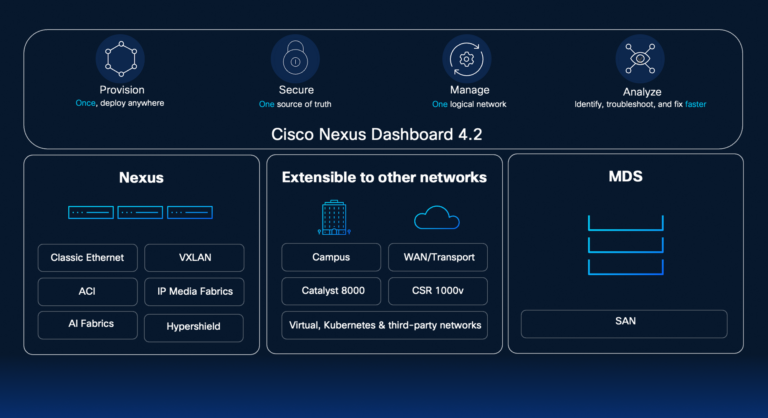
Organizations require a unified control point to seamlessly operate across diverse data center fabric architectures. Nexus One delivers a full-stack architecture that addresses these needs—providing consistent operations, enhanced visibility, and the flexibility to scale across evolving environments.
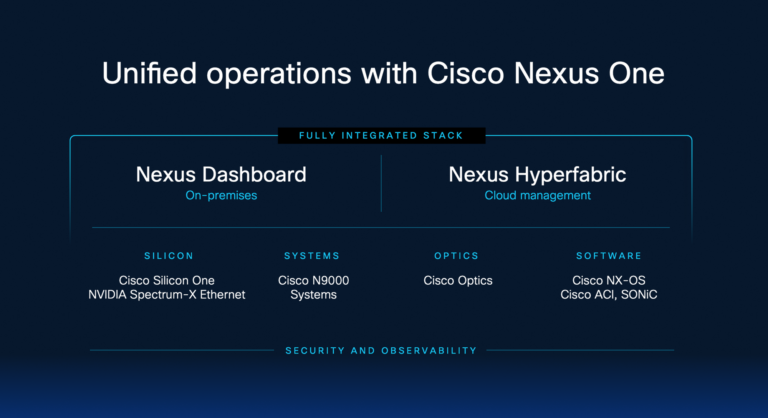
Cisco Nexus One simplifies and modernizes data center networking through:
You gain a consistent fabric experience whether you deploy on-premises, across colocation facilities, or within sovereign clouds.
AI and high-performance workloads introduce a new class of operational challenges, particularly around end-to-end visibility and workload correlation. In AI-driven fabrics, performance is critical—latency and congestion must be minimized to maintain efficiency at scale.
Nexus Dashboard 4.2 enhances support for these environments with targeted, purpose-built capabilities. A key addition is job monitoring and visibility powered by Slurm, the open-source workload manager. Operators can now:
To further optimize performance, Nexus Dashboard 4.2 introduces LLDP-based integration with NVIDIA NICs to enable adaptive routing. This allows networks to dynamically adjust traffic paths and avoid congestion hotspots. Combined with Dynamic Load Balancing (DLB) on Cisco Silicon One platforms, the network becomes a self-optimizing system capable of handling bursty, high-performance AI workloads.
By integrating workload-aware insights into network operations, Nexus Dashboard enables a more proactive, data-driven approach to managing AI infrastructure.
Security remains foundational for data center operations. This release launches Live Protect for Cisco NX-OS, enhancing the ability to maintain a strong security posture without impacting availability.
Live Protect delivers customers:
Live Protect delivers zero-downtime vulnerability protection for Nexus switches, enabling immediate threat mitigation without disruptive patching.
It leverages extended Berkeley Packet Filter (eBPF) technology to deploy kernel-level mitigations in real time. When a Common Vulnerabilities and Exposures (CVE) alert is published, Live Protect compiles compensating controls into policy-based shields that can be deployed instantly in monitor or enforce mode—without requiring a system reboot or causing network disruption.
This approach represents a significant advancement in how organizations protect their infrastructure while maintaining continuous availability.
As deployment models evolve, organizations require greater flexibility in how infrastructure is managed. Nexus One extends its operational model to support:
This enables consistent management across environments, allowing teams to standardize workflows, policies, and monitoring regardless of deployment model.
Nexus Dashboard 4.2 also expands deployment flexibility with support for virtual Nexus Dashboard on Nutanix and AWS—providing greater choice and control beyond traditional hypervisor environments.
For organizations where scale and efficiency are critical, this release introduces a new G5L “large” Nexus Dashboard appliance built on the Cisco UCS M8 platform. It supports up to 1,000 switches in a 3-node cluster while maintaining a compact 1RU per-node footprint—delivering exceptional scale without compromising efficiency.
To further enhance operational value, Nexus Dashboard 4.2 expands its integrations and visibility capabilities. This release introduces native Splunk support on Nexus Dashboard, enabling organizations to extend their Splunk data lake into the platform. This allows for:
Driven by strong customer feedback, Traffic Analytics now delivers even deeper insights with:
Together, these capabilities accelerate troubleshooting, improve performance optimization, and provide a more comprehensive view of data center traffic health.
Features only matter if they deliver real business value. Nexus Dashboard 4.2 helps organizations achieve measurable outcomes:
Want to see exactly how these capabilities work in real-world scenarios? Watch our new set of feature spotlight videos. Our engineering and product teams have put together step-by-step demonstrations showcasing how to leverage AI job monitoring, Live Protect, and Cisco ACI/NX-OS interoperability.
Simplify your data center and AI network operations
Additional resources
Explore the video series to see how you can start building your next-generation data center today.
此内容由惯性聚合(RSS阅读器)自动聚合整理,仅供阅读参考。 原文来自 — 版权归原作者所有。